This thread could easily go in several different areas but I figured C&V is where it's most relevant to most regular viewers.
As the title so states, I had a 1" threaded fork steerer fail during a ride. Snapped clean off at the base of threads. It's an aluminum fork with a steel steerer. No issues with the aluminum fork or any of the bonded joints. Here's a photo I took as soon as I came to a stop.
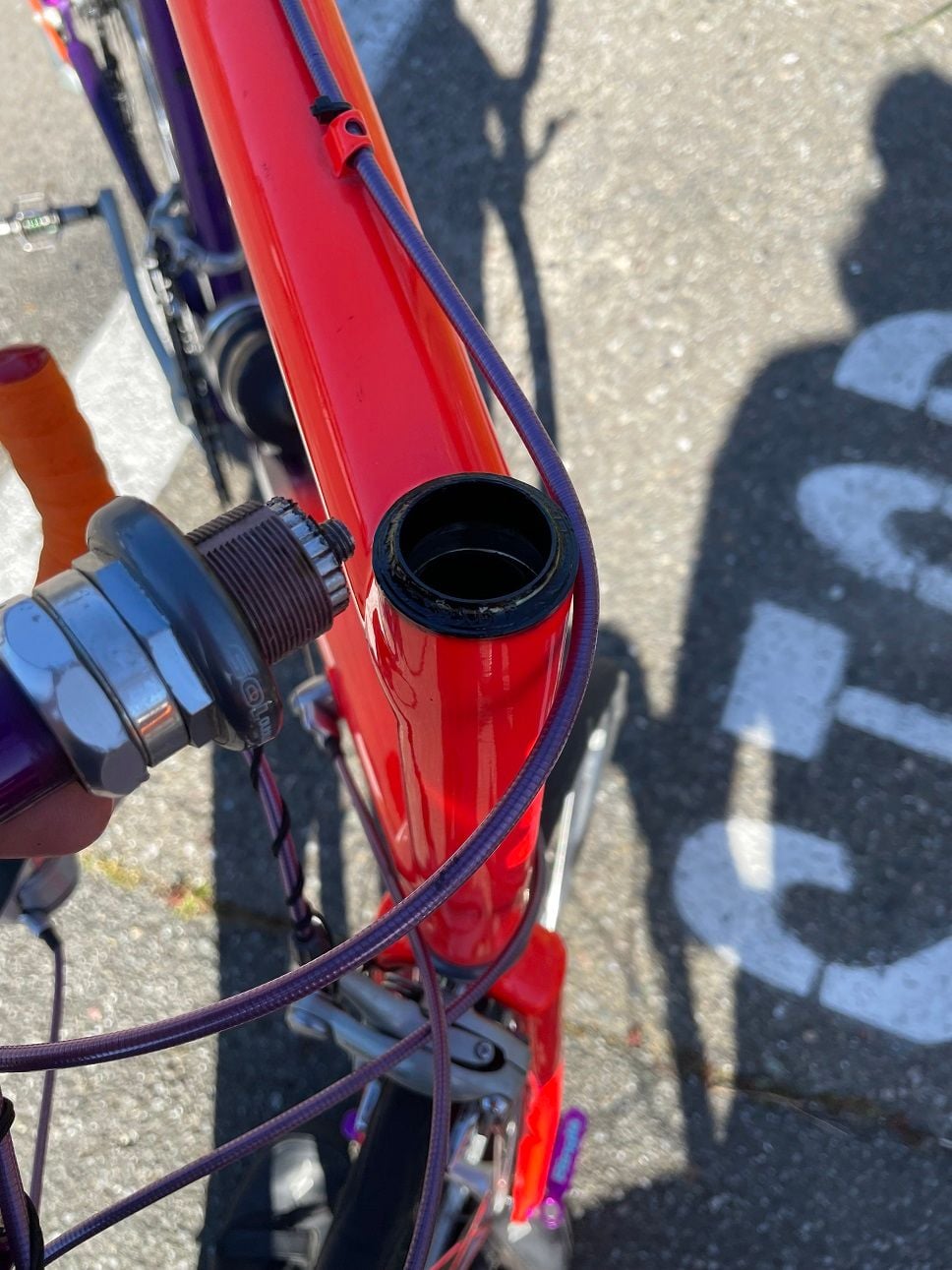
This, thankfully, happened at around 7mph on a lightly used road connecting to a bike path. I hit a bump about to turn right onto the path when the handlebars tweaked down pretty seriously. For some reason, my initial thought was the frame broke. Regardless, I knew something was wrong since the bars started doing their own thing relative to the front wheel and were quite wobbly. It was tricky using the brakes without the bars being anchored but I was able to safely come to a stop and unclip without any drama. When I came to a stop is when I fully realized what had happened. Through sheer luck, this did not happen in a much more inconvenient or downright dangerous situation, such as a 45+mph decent I routinely take on my regular rides, in traffic, etc.
I was with friends and we all had cell phones. After a few phone calls, a friend was able to come pick me up. I was 15 miles away from home so not the end of the world.
WHAT WENT WRONG: This is what is worth explaining.
Fork is the original that came with the frame, which is a 1991 Klein Quantum. It gave the original owner, who I bought it from almost 3 years ago, thousands of trouble free miles. In the first year he owned it, he swapped the original stem out for a Salsa with more rise to improve comfort. I kept the stem and got it powder coated to match. However, the shop did not tape off at the minimum insertion line and the powder coating has too much meat to allow the stem to fit. So, I had to do a bunch of sanding to get it to fit. Anyone who has hand sanded powder coating knows this is annoying and takes a while. I got it to the point where I thought it was dropping in far enough and left it at that. That was clearly not the case and ultimately the root of the problem. If you look at the photo, you can clearly see the stem had effectively no engagement with the steerer beyond the threaded section. The threads are the weak point as that is where the steerer tube is the thinnest. Because of the inadequate engagement of the stem, all of the loading from forces exerted on the handlebars was getting transferred perfectly to the weakest point of the steerer tube and caused an impressively clean break at the lowest thread.
This was not an issue before with the previous owner as the stem had at least 3 inches of engagement with the steerer before I got it powder coated instead of the barely 2 inches afterwards.
What am I going to do from here? Well, this happened yesterday morning so I haven't had the chance to fully figure out what my plan is but I do have options. Since this is the original fork in a very difficult to color match dayglo orange, I'd prefer to fix it. Far as I can tell, there's two possibilities there. First, since it's a pressed and bonded steerer tube, it's theoretically possible to remove the old, now threadless steerer and press in and bond a new one. The bonding material will make that difficult so I don't know how feasible that is.
The other possibility is, since it's thankfully a steel steerer, have it repaired, which I know can be done. It may also prove to be simpler and easier.
I am not confident enough in metal working skills to do either safely so I'm not going to tackle it. Sycip cycles is local and a highly skilled custom frame builder. He's already done several frame repairs for my brother and even repaired one of my frames so if anyone can do it, it's him. My brother has photos and all the details and specs so will ask him this next week.
If it can be fixed, which I think is likely, I'll have the opportunity to make some changes. First, there was much more thread than was needed, so I can have the threads start farther up from the fork crown. I will, of course, also sand off more of the powder coating to get the stem to get the engagement it needs. I may also have the stem lengthened but not by much. Half to three quarters of an inch at most, mainly to compensate for getting the stem to drop in farther. The handlebars are at a very comfortable height and I don't want to change that.
One change which I'm contemplating is converting the fork to threadless. I already have an old school Salsa 1" threadless stem that I could paint just like the old one. If I'm going to make the change to threadless, now's the time.
There's always the route of just getting a complete replacement fork. However, a slightly complicating factor is my bike is tall. I'm 6'3" and comfortably ride a 61cm, which this frame is, making the head tube a monstrous 8 inches long. This means the old steerer was 9.5" long, or 240mm. Forks that tall are out there but not as common as what you would find on a 56cm frame. If I can find a good used threaded fork, it needs to be at least 9.5". If I go threadless, it needs to be around 11.5", or almost 300mm. That nearly puts me in brand new, uncut steerer territory.
THE TAKEAWAY. Stems have a minimum insertion line for a reason. If you're modifying a stem, such as with a powder coat, know before where that line is (I could not make it out with the powder coat, it does a good job of filling in stampings for things like that) or do some measuring to make sure your stem has good engagement with the steerer. I thought I was safely inside that margin but clearly wasn't.