Originally Posted by
Harold74
There are good reasons to believe that improvements in the Zone 2 energy system may have significant health benefits.
As with anything physiological, it seems reasonable to expect that the best way to improve the Z2 energy system is to tax it. And, if one is at all short on training time, to tax it maximally. That, usually, is how physiological adaptations are encouraged.
It is clearly the case that all of the body's energy systems are in play, in some proportion, at all levels of energy expenditure. All roads do lead to Rome in this sense.
What is not clear to me, is whether or not the Z2 system continues to be taxed maximally at levels of expenditure above the Z2 threshold.
Well, I don't think there is anything called the "Zone 2 energy system", but there is fat burning and carbohydrate burning, with fat burning being high in zones 1 and 2 (Coggan zones).
Typical FAT and carbohydrate usage by exercise intensity:
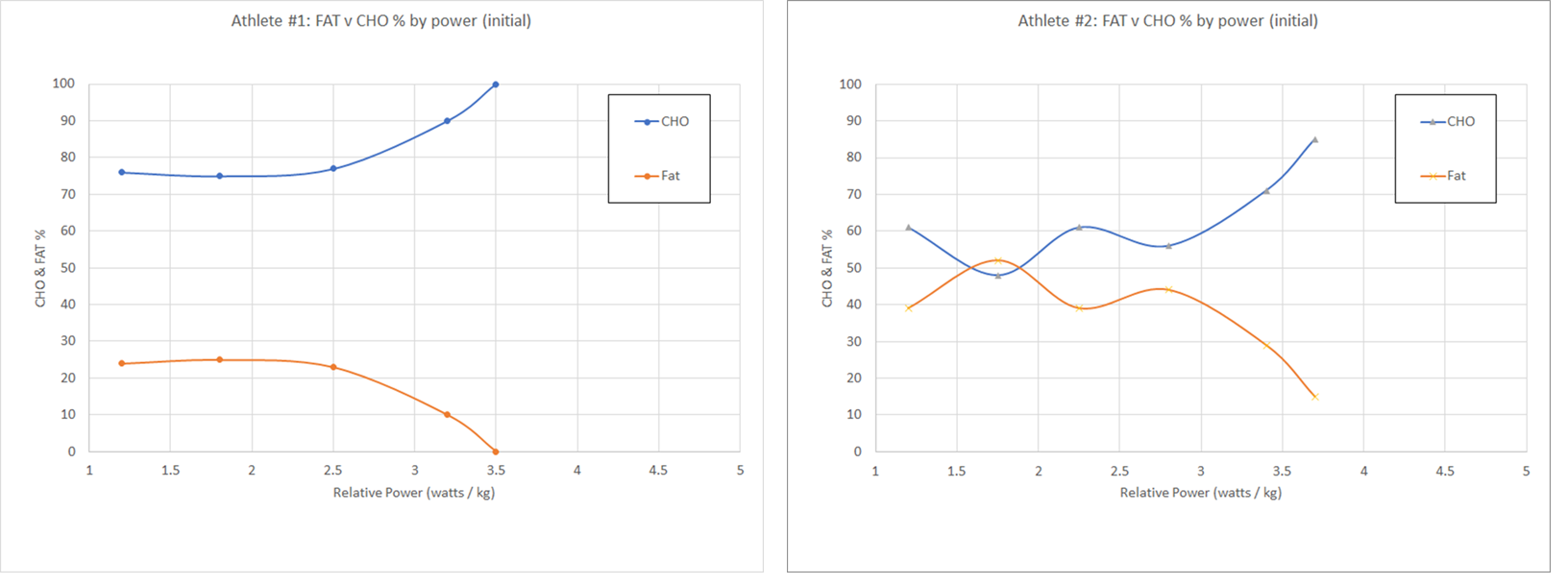 Source: http://www.riderx.info/the-endurance...tual-athletes/
Let's consider fat burning as a desired adaptation. Andy Coggan has said that you don't have to exercise in your maximal fat burning zone to get better at burning fat. The main adaptation for fat burning is mitochondria, which develop more at higher exercise levels. Mitochondria also appear to adapt to volume -- total time spent exercising.
Based on the idea of how mitochondria responds to exercise, here is some general advice:
If fat burning capability is the goal, and you have a short amount of time per week to exercise, you should exercise at the highest level you can sustain, in the amount of time you have, while watching for signs of fatigue.
When you exercise many hours per week, fatigue becomes the limiting factor, then the ideas of "polarized training" and "pyramidal training" become important.