Originally Posted by
terrymorse
No, you don’t have to exercise at your max. Fat burning zone to improve your fat oxidation capacity. Fat burning capacity is about the mitochondria.To improve fat oxidation capacity, build more mitochondria, and improve their function. Build more mitochondria by riding more hours. Improve mitochondria function by riding hard.
That was well put and I agree, at least at the extreme ends of the intensity spectrum.
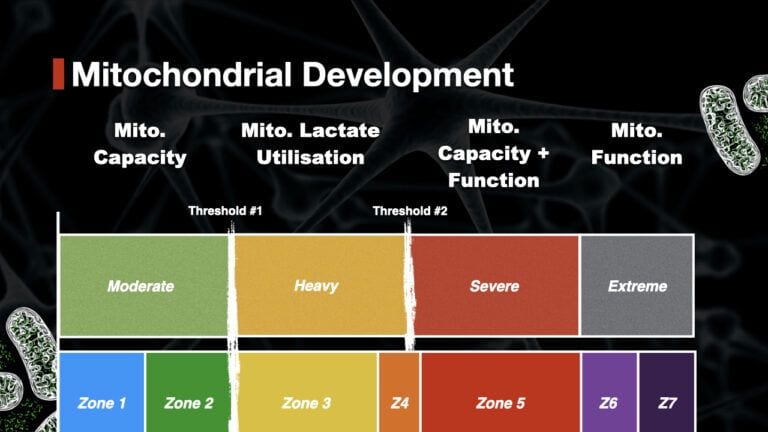
With reference to the graphic below, the part that I'm unsure of is the "heavy" bit between the two thresholds. This is where a lot of my sustained climbing efforts will be. FWIW, this is where I pulled it from:
Link
I understand that stimulating adaptation related to lactate utilization is important for competitive cycling performance. But does this level of intensity still optimally stimulate the mitochondrial capacity and function adaptations that one seeks for general health and longevity? In that heavy zone, is one getting the lactate adaptation as well as the capacity and function adaptations? Or is one
only getting the lactate adaptations?
As a type 2 diabetic, I'm very concerned with insulin resistance and am trying to utilize mitochondrial improvement to help rectify that. I find it frustrating trying to suss out just how I should optimally train for that however. I definitely want to improve mitochondrial capacity. And I'd have to assume that mitochondrial function would help as well. But is lactate utilization important to me? I've not run into anything that explicitly says that it would be. At the same time, one of the hallmarks of T2D is high resting lactate levels. Obviously, I don't expect you to be able answer this part definitively unless you possess medical training that I'm unaware of.