i've been pondering this on and off all day, as well as discussing it with people with actual degrees in engineering, patents on mechanisms made of steel, carbon, plastic, etc.
i would hope we can all agree that a bicycle frame can in no way create energy. it can certainly absorb it (turning to to heat, or noise) and like a spring, store it in some capacity that i'd argue is quite small, even with a period of the input forces on the order of 100hz.
all else being equal, (bold for a reason) it does not compute that this behavior would make a cyclist go meaningfully faster. it might feel better, it might feel worse, you might not be able to tell at all.
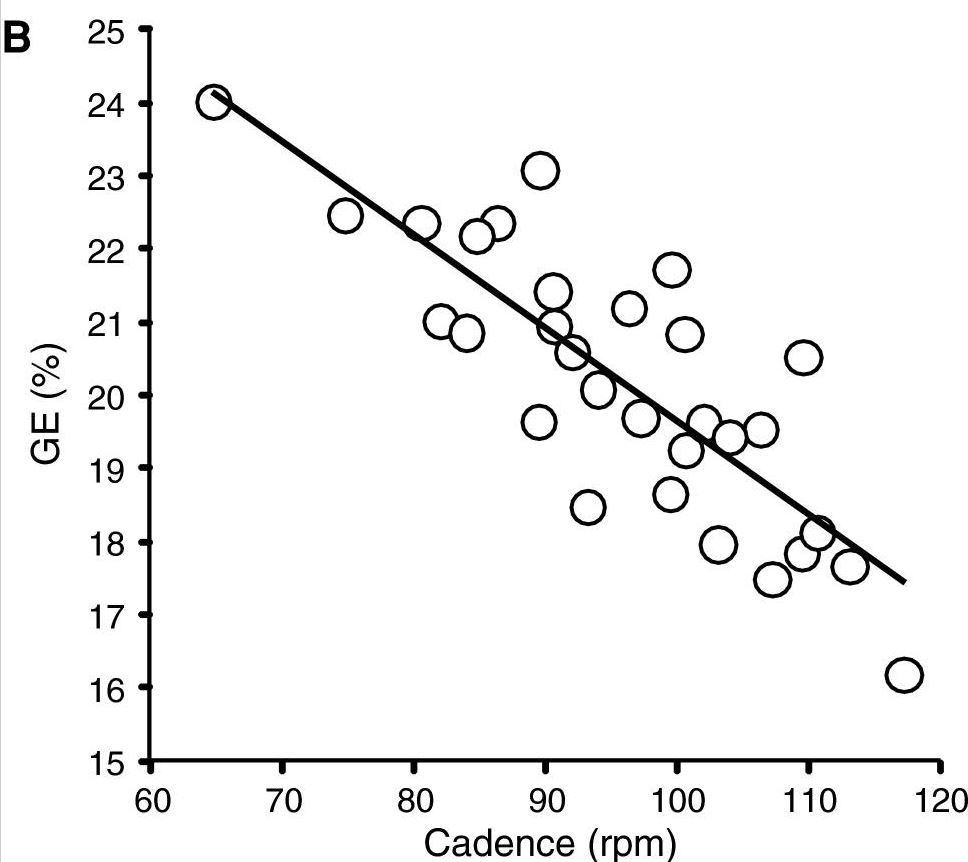
however...maybe all else is not equal. we know from a zillion studies (one graph reproduced here from Leirdal and Ettema) that the general efficiency of the human body in cycling is only in the ballpark of 20%. of course a huge amount of the 80% goes into pushing your blood through your body, moving your lungs and neck and head and powering your brain and all that, but what if the ability to transmit forces into the bike other than directly into the chain during the power stroke increased the efficiency by a point or two? relative to the actual locomotive power, going from 20 to 22 percent would be like 10 percent more power, and even if we say half of it is wasted in the "efficiency" of the spring system, it's significant. would it show up on a power meter? not sure, it would depend how precisely the algorithms of the strain gauges in power meters are tuned to the typical "cycle" of cycling. i'm reminded of the weird power meter results dcrainmaker got from one meter, and the maker (maybe 4iiii) responded that something about his pedaling dynamics were confusing their algorithm, which makes me believe it's working to discern the forces which are traditionally perceived as useful, not "any" force put into the system.
i should add that i don't believe this is true in any meaningful magnitude, but it's at least getting at the potential source of all this "extra" energy. it is the only potential source, and i simply cannot believe the notion that force which could go directly into the chain through a 95%+ efficient "drivetrain" would be more efficiently used compressing a couple steel tubes. maybe this is what
Kontact was trying to get at with the biopace rings. for some people, they
may be more efficient at converting human energy into forward motion.