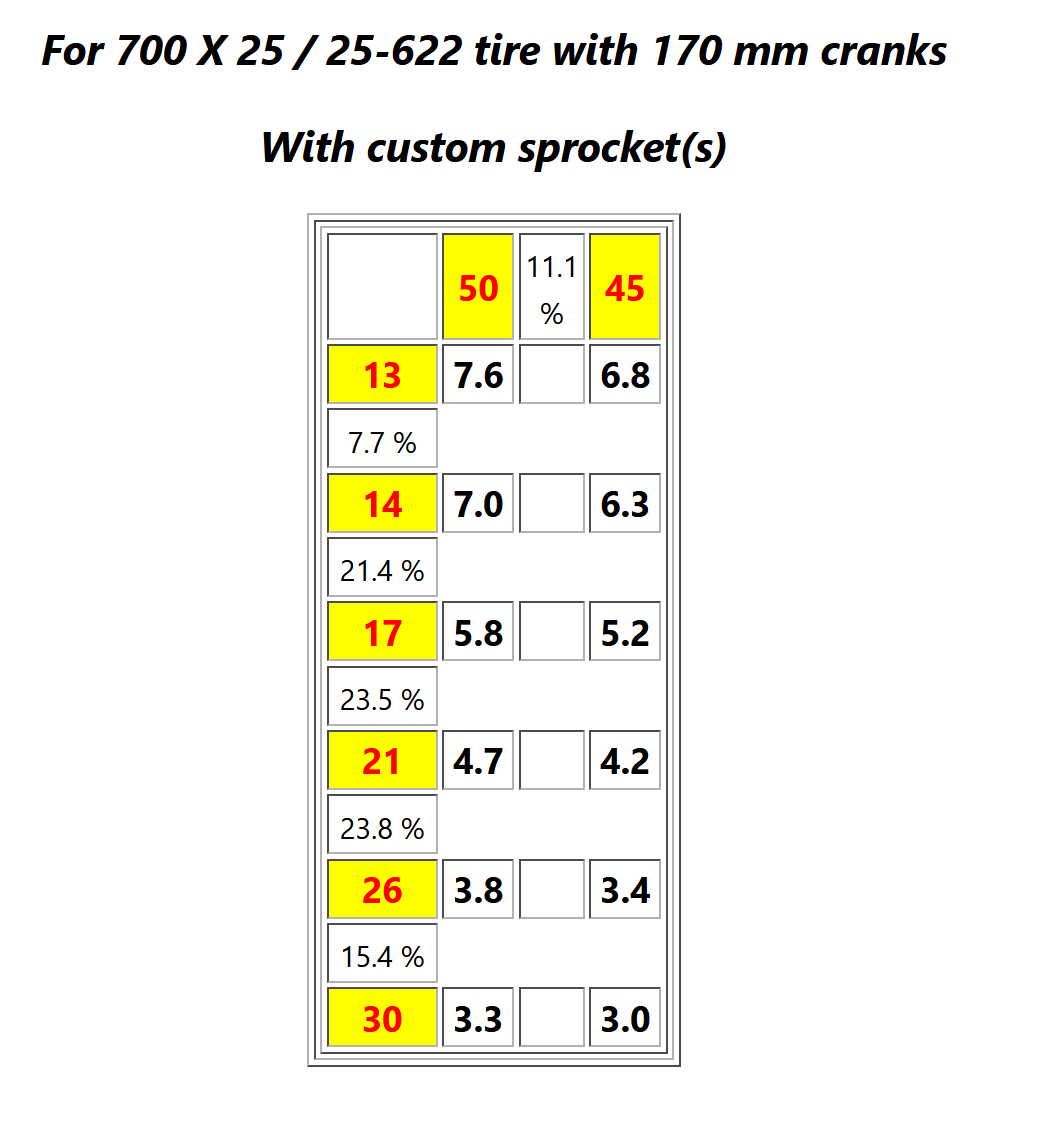
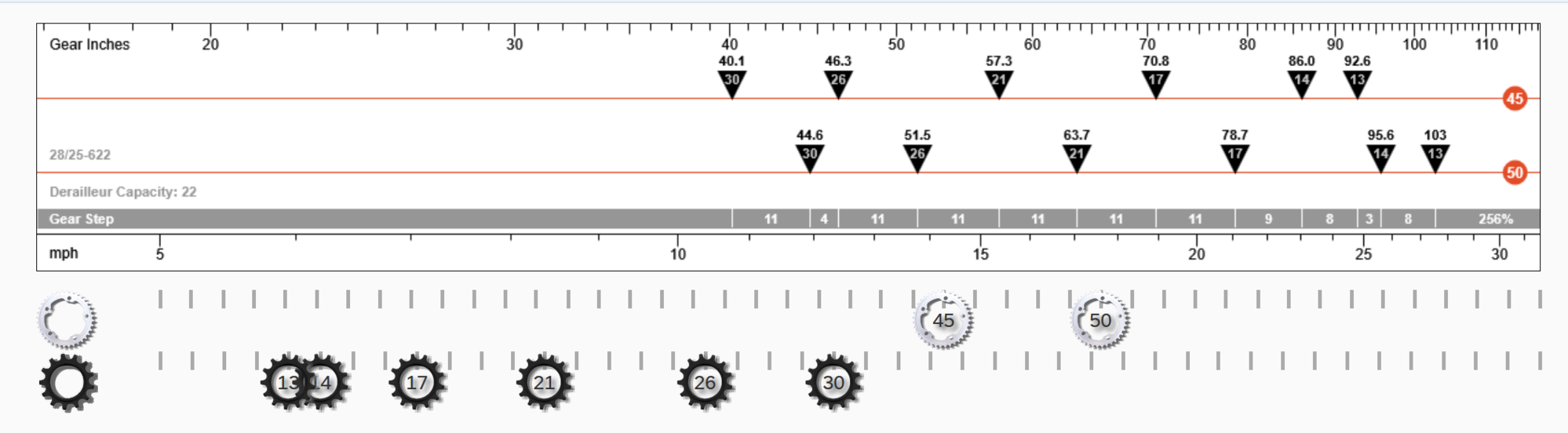
Regarding half-step gearing, I think it's best to have variable steps between gears. Specifically, increasingly large gaps from the 2nd cog to the penultimate, or 2nd to last, cog. And small gaps between the 1st and 2nd cog, as well as the last two cogs.
I have a 6-speed freewheel with 13-14-17-21-26-30. It came on a bike that I purchased, and was really confused by the choice of cogs at first. But, after thinking about halfstep gearing it made total sense.
- Why increasingly larger cogs?
- The gain ratio between two gears, as the number of teeth increases, is less. Said another way as an example, the gain ratio between 9t and 10t cogs compared to 29t and 30t cogs is very differet-- the gain ratio between the small cogs is much, much larger.
- Thus, in order to keep the gain ratio relatively consistent, you have to have consistently larger cog spacing.
- Why small gaps between the 1st and 2nd cog, and the last two cogs?
- Cross chaining.
- For my given example, the current shifting progression is: 1st/1st, 1st/2nd, 2nd/2nd (chainring/cog). Or, using the actual tooth counts: 50/13, 50/14, 45/14.
- If you swapped the 14t cog for a 16t the progression would be: 1st/1st, 2nd/1st, 1st/2nd (chainring,cog). Or, using the actual tooth counts: 50/13, 45/13, 50/16.
- It does mean that the freewheel doesn't have quite as much range, so you'll have to decide what's most important to you.
Ignoring the granny chainring for the moment, with 50/45 chainrings the result is below.