Tom, cylinder hones come with different ball grits and different diameters. Several observations on slitting the seat tube in case there are any beginners reading this subject thread. First the seat tube needs to be reamed and honed before slotting. Otherwise, the slot allows the seat tube hole to open wider while reaming so it is temporally spreading the hole bigger rather than cutting it to size. Second, the slot needs to be about 30 mm long. I did a personal frame only 25mm long one time and I couldn’t get the seatpost to clamp tight. When I extended it another 5mm, the problem was solved.
My procedure is similar to bulgie’s using 2 blades together. I first somehow mark the slot to help guide making a straight cut. If I start to go crooked, I stop and use a slim warding file to straighten it. After I do the cut, I use the warding file to improve the cut. It is easy to break the file if sawing carelessly. What can happen is that if the file comes out of the slot and the point doesn’t go back in, your forward force will snap the file.
I don’t usually drill a stress relieving hole. I use a slim jeweler’s file with a U shape cutting teeth on the rounded edge and is smooth on the sides. This rounds the bottom of the slot so it isn't a stress riser. The problem with drilling a hole 1st is that it is difficult to get the slot to be right in the middle of the hole or the hacksaw blade scars the bottom of the hole with the last stroke. Of course, the hole can be filed larger to make the slot be in the middle and/or remove the scar.
The hacksaw is a very important tool and worth whatever it costs to get the right one. The hacksaw needs to feel comfortable in your hand. I like one that has a knob at the front to support my left thumb. I have 3 in the shop for different teeth per inch blades. 2 are branded Nicholson and the other one a Stanley. They are almost exactly the same and might be made by the same company. The Stanley’s yellow makes it easier to remember what blade it holds. They look like bulgie’s Sandvik except mine have a quick release blade mechanism. This method avoids the blade turning when tightened with a wing nut and allows me to get the blade very tight. I believe VAR makes a nice one too.
I send time with my students showing them how to properly cut with a hacksaw. A surprising number are awkward using one starting out. The students that took my framebuilding classes in the late 70’s came with more hand skill knowledge and ability than today’s younger student. There just isn’t as much opportunity to fix or make things today. Ukrainians are often better than Americans because they have a culture to try and fix things first.
I use Lenox blades from Lowe’s for convenience but by far may favorite brand are ones made by Bahco. What I really don’t like are hacksaw blades that are powder coated. It is always too thick and flakes off with the first use. Bahcos are painted with thin paint so you aren’t having to use extra force to get that thick coat through the slot. A few years ago Dremel came out with a series of quick release cutting wheels. These can do the job much faster but one has to be careful because it is easy to mess up the cut.
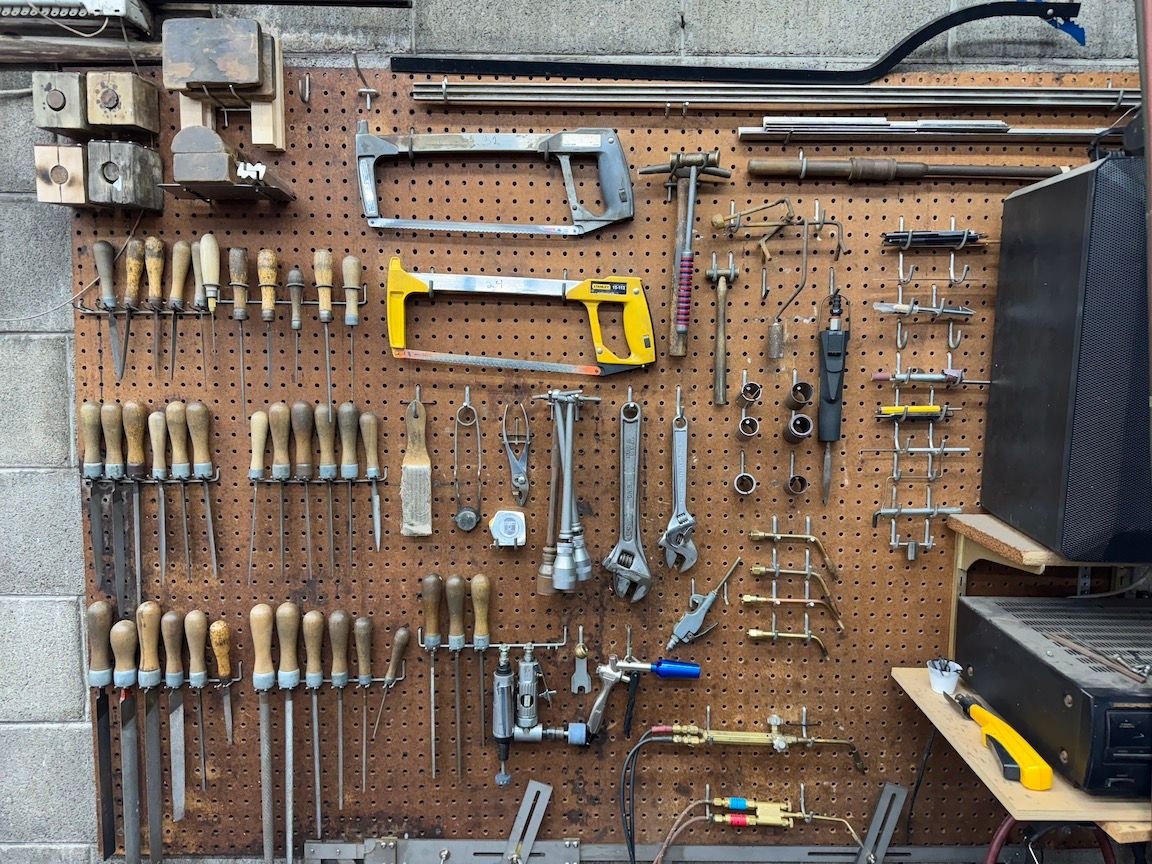 My tool wall next to my main vise