Originally Posted by
kevino
Jeez, even AI is involved.
Yeah, it's everywhere.
Originally Posted by
kevino
I'd hoped seeing the pliers and quick links together would be enough to allow me to see how these work.
Chain pliers work like pliers: insert open ends into chain links that are connected by the quick link, then squeeze. Quick link will disengage with a light pop, you can then pull the two halves apart to 'break' your chain.
Reversing for reassembly can be a little more fiddly depending on quick link design. Use chain pliers to pull open ends of chain together enough to insert quick link halves, then push the two sides into engagement.
Once both pins are properly seated, release the pliers then lightly turning the cranks while holding rear wheel still ought to seat those quick link pins in a jiffy.
Originally Posted by
kevino
I see in a video using a tool to push the rivet in but using my 80# bench vise seems like overkill.
That 'tool' is likely a traditional 'chain breaker':
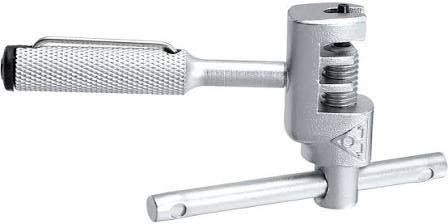
- used to push pin linking two chain links out, then back in once again when it's time to reconnect. You won't
need one of those tools (or your bench vise) if you're using quick links if your chain was originally connected with one.
Quick links do away with the need to break a chain by pushing out a link pin.
Too, newer chains have 'pins' (really 'bushing' is more correct) that are rolled over on their ends so they look like rivets. Push one of those out with a chain breaker, they're done, can't be re-used. That's where quick links come in handy.
Read
this to learn more; start at the beginning, read to the end.