Sad to see that Jim Blackburn passed away. It seems like he got to have fun after he retired!
I met Jim around 1977, he shared an industrial rental unit with Mike Sinyard, Specialized Bicycle founder, in Campbell California. At that time Blackburn was selling the front and rear racks that places the load above the wheels, and bottle cages. He sold a lot of bottle cages back then. Both companies were small, one or two employees each I think. Mike was a good friend from when he started Specialized in 1974, I visited him from time to time. I rode into the joint warehouse after riding from Portland on my new Merz touring bike with the first low rider rack I designed and made. I rode into the shop, Blackburn came over to look at my bike. He looked closely but didn't say anything. Several months later he comes out with his first low rider Blackburn aluminum rack! The load position was the same, but the function was vastly inferior. He was, however, a much better businessman than me and sold a ton of them.
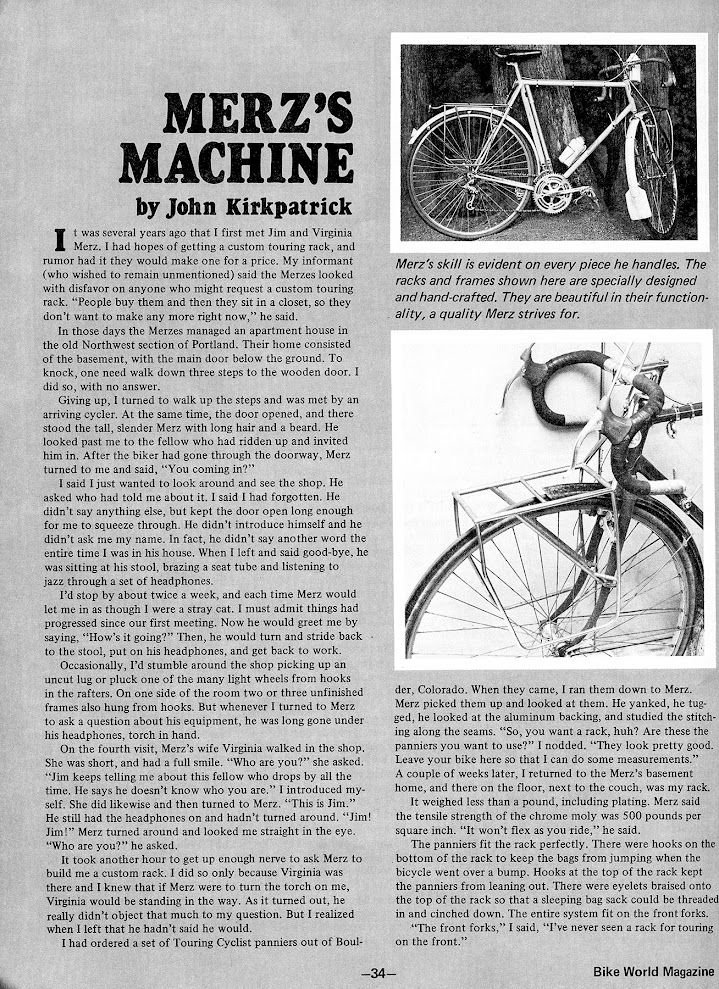
Here are some shots showing my rack designs and where this all started. The first shot is a ride I did in 1964, riding from Portland to Denver, using a Plecher rear rack. It worked but left a lot to be desired, flexy and not very strong, made for carrying a lunch pair to work. The size of the top was a good starting point though. Several years later I rode from Portland to Panama, using a Rayleigh Pro! I designed and made front and rear racks that used 4130 CrMo tubing, clamped onto the mounting points. These racks were very stiff and strong, although weighed only a bit more than the Plecher rack. The magazine article explains the benefits. The last 2 photos show Paul and Michael Sylvester at the start of a one year ride starting in Portland, across the USA at a very fast pace, continuing in Europe covering thousands of miles. Paul's bike included my low rider design. This ride was cycle camping, requiring careful thought to reduce weight. Almost all the load is placed in this front setup, very nice handling and stable. The rack is clamped onto the front fork as shown, this fastening method was used for all of my rack designs. It equals the strength and stiffness of brazing the rack in place, but with the convenance of removal if needed. The only drawback is they have to be custom made for each bike. There is no way to make any adjustable rack that mounts as well with the same light weight. I did make these racks for bikes other than my Merz frames. I don't think there are any racks that work better. I never knew about French and Japanese low rider racks that were around before I came to the same conclusion, put the main load centered on the front axle. My racks were stronger and stiffer than these earlier designs, but were impossible to produce commercially viably. After I closed my shop in Portland to work with Mike Sinyard in 1982, Bruce Gordon started making touring racks to fill the void. His racks were adjustable, a requirement for the market. His were much better, but much more money, than Blackburn racks. Jim Merz