Switchback descents
 04-03-11 | 10:40 PM
#1
Thread Starter
fuggitivo solitario

Joined: Jun 2009
Posts: 9,107
Likes: 13
From: Northern NJ
Switchback descents
This will be the first time I face these things in a race, and I really don't know much about them other than what I see the pros do while descending il Poggio in MSR.
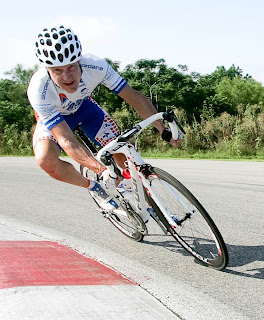
How fast should I enter the turn? I assume 20mph is not too slow? What techniques do you use as far as body/bike lean is concerned? Unfortunately, I don't have many of these around the area on which I can practice
Thanks
Here's the link to course map
https://www.yale.edu/cycling/LuxEtVelocitas/circuit.html
How fast should I enter the turn? I assume 20mph is not too slow? What techniques do you use as far as body/bike lean is concerned? Unfortunately, I don't have many of these around the area on which I can practice
Thanks
Here's the link to course map
https://www.yale.edu/cycling/LuxEtVelocitas/circuit.html
 04-04-11 | 05:27 AM
#3
Senior Member

Joined: Feb 2007
Posts: 15,410
Likes: 188
From: Tariffville, CT
Bikes: Tsunami road bikes, Dolan DF4 track
They'll be like any other hard turn, just you don't slow naturally due to air resistance (because gravity may > air resistance). So no "auto safety" feature of a natural bleeding off of speed.
- look up and ahead. I may look momentarily at spots on the road so I just miss cracks and stuff, but in general I'm looking either where the road goes out of sight (if there are bushes/trees/buildings in the way) or about 180 deg worth of turn (i.e. a full U turn) ahead. I have to put up a Palomar descent clip - the helmet cam doesn't show exactly how far I look because I also turn my eyes in my head, but it's clear that I'm not paying attention to the immediate 50 meters in front of me in some turns because my eyes are looking further out. In others there's nothing to see (mounds of ground in the way) so my head is pointed at the the "end of the road" in my vision line; that might be 10 meters or so.
- Know how to turn technically. Understand that leaning the bike allows you to sharpen a turn; leaning the body gives you more leeway in leaning the bike (i.e. more bike lean available). That's relatively - you're always leaning the bike, but it's the sensation of leaning it a little or jamming your bottom bracket into the ground. Know about pushing the inside of the bar, i.e. to turn right push the right side of the bar forward.
- Enough air pressure in your tires. I prefer higher pressures, especially at the limit. So on my HED wide rims I prefer to run 100-105 psi, not the 85-90 that I see tossed around as appropriate. Lower pressures, to me, make the bike slide more. I had a bunch of scares when I ran my tires at 85-90. Maybe I'm too old school, unwilling to learn, but I'll take a sense of security before a sense of panic. lol.
- Know your bike's limits, or at least know when you're within them. I have some idea of when the bike is gonna let go. When I brake I brake evenly with both brakes - when the rear wheel gets light, starts to skip, or gets slightly airborne, I know I've totally loaded my front tire and I'm at my limit (given that I've already slid my butt back on the saddle etc). It's about weight distribution. Ultimately your back wheel does little during braking on a descent except to give you an idea of how much you've loaded your front wheel. To wit - look at those crazy GP motorcycle racers - they dive into turns with their back tire dancing an inch off the ground, then proceed to accelerate out of them with their front wheel doing the dance thing. I'm still working on making the front wheel dance on the bicycle
- Don't brake in turns if possible. If you have to, use both brakes or, if it's a bail out all out emergency, straighten up while you brake as hard as possible then get off and turn again. If you're in a group that may not be an option.
- Take the right line. Outside inside outside. On switchbacks it'll be single file, or it should be. No diving on the inside because you'll end up crossing another guy's path at some point, if not on that corner then on another.
- Along that point, think late apex. Turn in very late if possible. It gives you more options if you overcook the turn.
As far as Palomar goes, it's I don't know how many hairpins, and I only do the descent once or twice a year. Yet I feel pretty comfortable bombing down the descent.
- look up and ahead. I may look momentarily at spots on the road so I just miss cracks and stuff, but in general I'm looking either where the road goes out of sight (if there are bushes/trees/buildings in the way) or about 180 deg worth of turn (i.e. a full U turn) ahead. I have to put up a Palomar descent clip - the helmet cam doesn't show exactly how far I look because I also turn my eyes in my head, but it's clear that I'm not paying attention to the immediate 50 meters in front of me in some turns because my eyes are looking further out. In others there's nothing to see (mounds of ground in the way) so my head is pointed at the the "end of the road" in my vision line; that might be 10 meters or so.
- Know how to turn technically. Understand that leaning the bike allows you to sharpen a turn; leaning the body gives you more leeway in leaning the bike (i.e. more bike lean available). That's relatively - you're always leaning the bike, but it's the sensation of leaning it a little or jamming your bottom bracket into the ground. Know about pushing the inside of the bar, i.e. to turn right push the right side of the bar forward.
- Enough air pressure in your tires. I prefer higher pressures, especially at the limit. So on my HED wide rims I prefer to run 100-105 psi, not the 85-90 that I see tossed around as appropriate. Lower pressures, to me, make the bike slide more. I had a bunch of scares when I ran my tires at 85-90. Maybe I'm too old school, unwilling to learn, but I'll take a sense of security before a sense of panic. lol.
- Know your bike's limits, or at least know when you're within them. I have some idea of when the bike is gonna let go. When I brake I brake evenly with both brakes - when the rear wheel gets light, starts to skip, or gets slightly airborne, I know I've totally loaded my front tire and I'm at my limit (given that I've already slid my butt back on the saddle etc). It's about weight distribution. Ultimately your back wheel does little during braking on a descent except to give you an idea of how much you've loaded your front wheel. To wit - look at those crazy GP motorcycle racers - they dive into turns with their back tire dancing an inch off the ground, then proceed to accelerate out of them with their front wheel doing the dance thing. I'm still working on making the front wheel dance on the bicycle
- Don't brake in turns if possible. If you have to, use both brakes or, if it's a bail out all out emergency, straighten up while you brake as hard as possible then get off and turn again. If you're in a group that may not be an option.
- Take the right line. Outside inside outside. On switchbacks it'll be single file, or it should be. No diving on the inside because you'll end up crossing another guy's path at some point, if not on that corner then on another.
- Along that point, think late apex. Turn in very late if possible. It gives you more options if you overcook the turn.
As far as Palomar goes, it's I don't know how many hairpins, and I only do the descent once or twice a year. Yet I feel pretty comfortable bombing down the descent.
04-04-11 | 08:11 AM
#4


Version 7.0
Joined: Oct 2006
Posts: 13,844
Likes: 3,859
From: SoCa
Bikes: Road, Track, TT and Gravel
+1 to CDR
- Ride in the drops.
- Brake before the turn gaging how much speed you can handle. The reason is so that you do not shift the weight to the front tire and deform it in the turn.
- Outside foot down with max weight on the pedal to increase tire friction. If you hit something slick, this insures maximum chance of surviving.
- Know you can do it. Believe in yourself. Much like expert skiing, if you think you will fall, you probably will.
- Watch for off camber turns. Typically, not an issue with switchbacks but it can be.
- Ride the course before hand. In the road races I have done with technical descents, the competition dictates the speed so course knowledge and practice is the best.
04-04-11 | 08:17 AM
#5

Senior Member
Joined: May 2007
Posts: 6,169
Likes: 1
From: Santa Cruz Mountains
On switchbacks you can often look farther up the road. So you can see how tight the next corner is. Most switchbacks are far enough apart that you can consider each corner separately. Picking the right line for an s-turn is trickier as sometimes you need to compromise one turn to be faster through the set.
Don't early apex. You'll go slower that way. I like to take a slightly late apex line because when I let off the brakes the bike accelerates. On entry use all of the road that you are allowed to use unless there's someone behind you that may take the inside and take your line away. I plan my line to give about 1 foot leeway on the exit in case there's something in the corner (sand, big bump, other rider) that causes me to change my line.
I try to pre-ride or drive courses so I know the descents.
Don't early apex. You'll go slower that way. I like to take a slightly late apex line because when I let off the brakes the bike accelerates. On entry use all of the road that you are allowed to use unless there's someone behind you that may take the inside and take your line away. I plan my line to give about 1 foot leeway on the exit in case there's something in the corner (sand, big bump, other rider) that causes me to change my line.
I try to pre-ride or drive courses so I know the descents.
04-04-11 | 08:23 AM
#6


pan y agua

Joined: Aug 2005
Posts: 31,812
Likes: 1,234
From: Jacksonville
Bikes: Willier Zero 7; Merlin Extralight; Calfee Dragonfly tandem, Calfee Adventure tandem; Cervelo P2; Motebecane Ti Fly 29er; Motebecanne Phantom Cross; Schwinn Paramount Track bike
Follow a good descender. If you're not confident in your descending skills, it's unlikely you're going to be on a solo break anyway. So follow a good wheel. Just make sure you're not visually locked on that wheel, and you keep aware of what's coming up ahead.
__________________
You could fall off a cliff and die.
You could get lost and die.
You could hit a tree and die.
OR YOU COULD STAY HOME AND FALL OFF THE COUCH AND DIE.
You could fall off a cliff and die.
You could get lost and die.
You could hit a tree and die.
OR YOU COULD STAY HOME AND FALL OFF THE COUCH AND DIE.
04-04-11 | 09:10 AM
#7

ride lots be safe
Joined: Jan 2007
Posts: 5,224
Likes: 1
From: Texas
As a flatlander, the thing that always gets me about switchbacks is that my sense of balance is thrown off because of the somewhat steep approach descent angles. Your sensations of weight on the bars / saddle will be different, and your inner ear might need recalibrating as you are leaning waaaay over and turning sharply.
Closest thing I can do to reproduce that on flat ground is to hit a parking lot and do slow / medium speed turns, leaning waaay over and in an exaggerated body posture, turn radius maybe 20 feet or so, like the inside line of a switchback.
Closest thing I can do to reproduce that on flat ground is to hit a parking lot and do slow / medium speed turns, leaning waaay over and in an exaggerated body posture, turn radius maybe 20 feet or so, like the inside line of a switchback.
04-04-11 | 12:36 PM
#8
Thread Starter
fuggitivo solitario
Joined: Jun 2009
Posts: 9,107
Likes: 13
From: Northern NJ
Thanks for the responses, guys. I do have one other question regarding the late apex as i'm having trouble picturing it in the context of a switchback. So let me know if im thinking of this correctly.
Scrub off most of the speed going into the turn. Go into the turn later than if it were a 90 degree turn (i take it that a very hard lean is required), and let gravity accelerate the bike through the turn. Hold the lean until i reach the bottom section and then straighten the bike.
On another note, how fast have you hit switchbacks in a race? I'm trying to get a sense of what i need to acclimate myself to do when doing practice runs on the course.
Scrub off most of the speed going into the turn. Go into the turn later than if it were a 90 degree turn (i take it that a very hard lean is required), and let gravity accelerate the bike through the turn. Hold the lean until i reach the bottom section and then straighten the bike.
On another note, how fast have you hit switchbacks in a race? I'm trying to get a sense of what i need to acclimate myself to do when doing practice runs on the course.
04-04-11 | 01:01 PM
#9

Senior Member
Joined: Jul 2009
Posts: 322
Likes: 0
Late apex is pretty much as it sounds. Turn in later and clip the inside of the corner after the midpoint. It tends to keep you from running wide because of the geometry of the arc, allows you to pedal sooner, and gives you more options later in the corner if you have to correct your line. Turning in too early makes the required lean angle for the corner much greater (or you have to bleed off speed).
This image shows it pretty well in the context of motorcycles, which follow most of the same principles.
.jpg)
This image shows it pretty well in the context of motorcycles, which follow most of the same principles.
04-04-11 | 01:19 PM
#10

gmt
Joined: Sep 2008
Posts: 12,509
Likes: 3
From: Binghamton, NY
Thanks for the responses, guys. I do have one other question regarding the late apex as i'm having trouble picturing it in the context of a switchback. So let me know if im thinking of this correctly.
Scrub off most of the speed going into the turn. Go into the turn later than if it were a 90 degree turn (i take it that a very hard lean is required), and let gravity accelerate the bike through the turn. Hold the lean until i reach the bottom section and then straighten the bike.
On another note, how fast have you hit switchbacks in a race? I'm trying to get a sense of what i need to acclimate myself to do when doing practice runs on the course.
Scrub off most of the speed going into the turn. Go into the turn later than if it were a 90 degree turn (i take it that a very hard lean is required), and let gravity accelerate the bike through the turn. Hold the lean until i reach the bottom section and then straighten the bike.
On another note, how fast have you hit switchbacks in a race? I'm trying to get a sense of what i need to acclimate myself to do when doing practice runs on the course.
04-04-11 | 01:28 PM
#11
Senior Member
Joined: May 2007
Posts: 6,169
Likes: 1
From: Santa Cruz Mountains
I never look at my speedo. And in any case it'd depend on the radius of the switchback. Some of them are really tight and require lower speed, others aren't so tight and you can go faster.
The problem with the early apex is that you have to slow down on the exit. When I'm descending with a group I often lose a bike length or two on the corner entrance but I exit with more speed and am right back on the wheel.
Late apexing is often a good way to pass.
For pre-riding I just aim to memorize the road. Just knowing "this corner opens up on the exit, the next one has a nasty bump on the inside line so stay outside" helps my confidence, which helps speed.
The problem with the early apex is that you have to slow down on the exit. When I'm descending with a group I often lose a bike length or two on the corner entrance but I exit with more speed and am right back on the wheel.
Late apexing is often a good way to pass.
For pre-riding I just aim to memorize the road. Just knowing "this corner opens up on the exit, the next one has a nasty bump on the inside line so stay outside" helps my confidence, which helps speed.
04-04-11 | 02:38 PM
#12
Senior Member
Joined: Feb 2007
Posts: 15,410
Likes: 188
From: Tariffville, CT
Bikes: Tsunami road bikes, Dolan DF4 track
Early apex example - just find the video of the Gerolsteiner rider that crashed in a recent Milan San Remo. I can't watch it, it's just horrible, but it's out there.
Also look at videos of Levi Leipheimer, Michael Rasmussen, err one or two others who can't descend to save their lives. I know both of them almost crashed on the same turn in some descent, separated by a minute or so, taking the same horrible line.
The common error is the early apex. Nervous, the rider starts turning in early. It's instinctive and you have to fight it by having confidence in your planned line (or planned attack of the line, if you don't know the corner at all). Go straight longer than you think necessary, brake hard just before you dive into the turn, and then dive into the turn as you release the brakes. I sometimes ride the brakes a bit, but by halfway into the turn (before the apex), unless I've made an error, I'm off the brakes and waiting to accelerate.
Watch videos of the field from the helicopter on switchback descents. They try and do a late apex, generally speaking.
Early apex has its times but it's normally not on a switchback descent. It's more for chasing, leading out, and blocking, i.e. tactical times.
For good cornering, watch Cancellara. He's fearless. Great descents from the past include Frederic Vichot, Lemond, Phil Anderson, Sean Yates. Sammy Sanchez is spectacular but part of his spectacularness is the fact that he's not taking the perfect line. Cancellara is smooth, never seems to correct, but is blazing fast.
Also look at videos of Levi Leipheimer, Michael Rasmussen, err one or two others who can't descend to save their lives. I know both of them almost crashed on the same turn in some descent, separated by a minute or so, taking the same horrible line.
The common error is the early apex. Nervous, the rider starts turning in early. It's instinctive and you have to fight it by having confidence in your planned line (or planned attack of the line, if you don't know the corner at all). Go straight longer than you think necessary, brake hard just before you dive into the turn, and then dive into the turn as you release the brakes. I sometimes ride the brakes a bit, but by halfway into the turn (before the apex), unless I've made an error, I'm off the brakes and waiting to accelerate.
Watch videos of the field from the helicopter on switchback descents. They try and do a late apex, generally speaking.
Early apex has its times but it's normally not on a switchback descent. It's more for chasing, leading out, and blocking, i.e. tactical times.
For good cornering, watch Cancellara. He's fearless. Great descents from the past include Frederic Vichot, Lemond, Phil Anderson, Sean Yates. Sammy Sanchez is spectacular but part of his spectacularness is the fact that he's not taking the perfect line. Cancellara is smooth, never seems to correct, but is blazing fast.
04-04-11 | 03:08 PM
#13
Thread Starter
fuggitivo solitario
Joined: Jun 2009
Posts: 9,107
Likes: 13
From: Northern NJ
Early apex example - just find the video of the Gerolsteiner rider that crashed in a recent Milan San Remo. I can't watch it, it's just horrible, but it's out there.
Also look at videos of Levi Leipheimer, Michael Rasmussen, err one or two others who can't descend to save their lives. I know both of them almost crashed on the same turn in some descent, separated by a minute or so, taking the same horrible line.
The common error is the early apex. Nervous, the rider starts turning in early. It's instinctive and you have to fight it by having confidence in your planned line (or planned attack of the line, if you don't know the corner at all). Go straight longer than you think necessary, brake hard just before you dive into the turn, and then dive into the turn as you release the brakes. I sometimes ride the brakes a bit, but by halfway into the turn (before the apex), unless I've made an error, I'm off the brakes and waiting to accelerate.
Watch videos of the field from the helicopter on switchback descents. They try and do a late apex, generally speaking.
Early apex has its times but it's normally not on a switchback descent. It's more for chasing, leading out, and blocking, i.e. tactical times.
For good cornering, watch Cancellara. He's fearless. Great descents from the past include Frederic Vichot, Lemond, Phil Anderson, Sean Yates. Sammy Sanchez is spectacular but part of his spectacularness is the fact that he's not taking the perfect line. Cancellara is smooth, never seems to correct, but is blazing fast.
Also look at videos of Levi Leipheimer, Michael Rasmussen, err one or two others who can't descend to save their lives. I know both of them almost crashed on the same turn in some descent, separated by a minute or so, taking the same horrible line.
The common error is the early apex. Nervous, the rider starts turning in early. It's instinctive and you have to fight it by having confidence in your planned line (or planned attack of the line, if you don't know the corner at all). Go straight longer than you think necessary, brake hard just before you dive into the turn, and then dive into the turn as you release the brakes. I sometimes ride the brakes a bit, but by halfway into the turn (before the apex), unless I've made an error, I'm off the brakes and waiting to accelerate.
Watch videos of the field from the helicopter on switchback descents. They try and do a late apex, generally speaking.
Early apex has its times but it's normally not on a switchback descent. It's more for chasing, leading out, and blocking, i.e. tactical times.
For good cornering, watch Cancellara. He's fearless. Great descents from the past include Frederic Vichot, Lemond, Phil Anderson, Sean Yates. Sammy Sanchez is spectacular but part of his spectacularness is the fact that he's not taking the perfect line. Cancellara is smooth, never seems to correct, but is blazing fast.
Last edited by echappist; 04-04-11 at 03:17 PM. Reason: Typo...
04-04-11 | 04:06 PM
#14
Senior Member
Joined: Feb 2007
Posts: 15,410
Likes: 188
From: Tariffville, CT
Bikes: Tsunami road bikes, Dolan DF4 track
The Gerolsteiner rider - just as a reference, he crashes on the last turn he does (obviously) but the prior corners show him screwing up repeatedly. The two riders with him take good lines. He takes bad ones.
04-04-11 | 06:11 PM
#15
ride lots be safe
Joined: Jan 2007
Posts: 5,224
Likes: 1
From: Texas
here's Frank Schleck, another notoriously bad descender, crashing (apex'd too early)
https://www.youtube.com/watch?v=ycMiRxzV0MA
https://www.youtube.com/watch?v=ycMiRxzV0MA
04-04-11 | 06:21 PM
#16

All you can really do is go with the flow of the race, or if you're on the front then you get to decide.
For me, any advice/planning to this level of detail would be waaaay out the window by the time the action started. I'm impressed if you can remember that diagram above during the race!
For me, any advice/planning to this level of detail would be waaaay out the window by the time the action started. I'm impressed if you can remember that diagram above during the race!
04-04-11 | 06:51 PM
#17
Senior Member
Joined: Jul 2009
Posts: 322
Likes: 0
I'm lucky that my years of racing motorcycles at least helps me remember the theory. I still have to get to the point where I trust a half inch of rubber to not spontaneously slide out from under me. Not being wrapped in dead cows also ups the consequences.
04-04-11 | 08:01 PM
#18

Senior Member
Joined: Dec 2006
Posts: 1,505
Likes: 0
From: Washington, DC
Bikes: 2006 Specialized Roubaix Comp
How fast really depends on the corner. There are some steep hairpin switchbacks that I've done where even if I'm entering the corner at 10mph, I am exiting at 32mph just because I had to let off the brakes. The best thing to do to prepare is to practice that particular descent. This really helps where you have some blind curves.
04-04-11 | 08:04 PM
#19
Killing Rabbits
Joined: Apr 2005
Posts: 5,696
Likes: 217
04-04-11 | 08:29 PM
#20
Senior Member
Joined: Feb 2007
Posts: 15,410
Likes: 188
From: Tariffville, CT
Bikes: Tsunami road bikes, Dolan DF4 track
All you can really do is go with the flow of the race, or if you're on the front then you get to decide.
For me, any advice/planning to this level of detail would be waaaay out the window by the time the action started. I'm impressed if you can remember that diagram above during the race!
For me, any advice/planning to this level of detail would be waaaay out the window by the time the action started. I'm impressed if you can remember that diagram above during the race!
Although I don't do a lot of hairpins on the bike, I have a LOT of practice. It's just that I practice in a car, not a bike. Every entrance and exit ramp is practice for me, as is any "sharper" curve in a road. Every poorly designed curve that changes radius for no reason is practice. In fact I practice a lot of my riding techniques while driving. It includes looking up the road (instead of just in front of my bumper - I even contemplated putting 6" of limo tint on the bottom of my windshield to prevent me from seeing through the bottom of the windshield), looking up around a corner (ditto), practicing good lines like late apexes, cornering steady (i.e. not wiggling the steering wheel around - I try and keep my hands from moving more than about 5-10mm during long turns like entrance/exit ramps, even while at the limit).
I don't take risks necessarily, other than pushing a bit where the worst I'll do is wreck my car and injure myself. But I practice all the time, every time I drive. On my commute I practice different lines, turning in early, turning in late, letting the car almost clip the inside at the apex or the outside at the turn out point.
I used to justify tailgating by saying I was practicing drafting but that's not necessarily true, and it's definitely not safe.
Once late apexes become automatic in cars, it's automatic on a bike.
The best places to practice hot late apexes are extremely poorly designed exit ramps which force the driver to slow to 15 mph or so. The exit off I84 somewhere near Ansonia is a good example. You can approach the exit hot, brake hard, and you have an automatic bailout if you chicken out.
Also, with a car, you should go in a touch slower and accelerate out. It lets you practice a bit more safely, because you do the mechanics of the turn (the braking, choosing a good line, steady steering, etc) without going bonkers. And you can still get the reward of taking a good line through a turn and accelerate nicely out of it.
I also practice all this at normal speeds. When I get off of the Mass Pike to get onto 495 I practice late apex, steady steering, etc, even though I may be behind an 18 wheeler that's going 15 mph. My left turn from 10/202 onto Iron Horse Blvd is the same. 15 mph is not fast but it's still practice.
When I played violin a lot (and I'm a much better violin player than cyclist), I always learned the fast parts slowly, in exquisite agonizing detail. Then I sped things up. I was trained to do this; I didn't make it up.
It's not a matter of riding properly "only when it counts". It should be a habit. You should always ride properly, even if it's just turning into your driveway after a training ride.
 04-04-11 | 10:12 PM
#23
Thread Starter
fuggitivo solitario
Joined: Jun 2009
Posts: 9,107
Likes: 13
From: Northern NJ
oh, another thing. Arm straight or bent when doing a switchback? Just saw videos of the Tour of the Basque Country, and they all seemed to be locking their elbows
Scroll to the 7:45 mark
#at=182
Scroll to the 7:45 mark
04-04-11 | 10:52 PM
#24

Team ABC Cycles
Joined: Jan 2009
Posts: 600
Likes: 0
From: Montreal Qc.
Bikes: 2010 Colnago CX-1 and '12 S-Works Venge
Another thing that was not mentioned yet but should be, is to look through the turn...turn your head, look at your exit as soon as you can see it. This may sound hard to do but but if you come in the turn and look at the exit, you will go where you are looking.
I race cars and instruct for a couple of local clubs and vision is one of the first things we teach. Turn your whole head, not just your eyes. Give it a try.
I race cars and instruct for a couple of local clubs and vision is one of the first things we teach. Turn your whole head, not just your eyes. Give it a try.