The history of the modern derailleur is complex, and today's popular derailleurs owe a debt to both SunTour and Shimano, and even Simplex.
Back in the late 60s, Shimano licensed Simplex's double spring design for their derailleurs.
Here's Shimano's early "Skylark" derailleur:
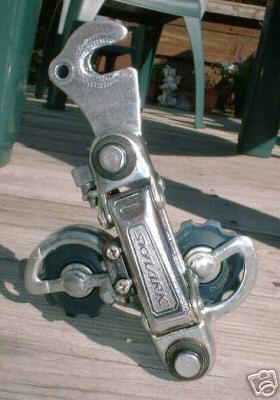
Compare to Simplex's "Criterium:"

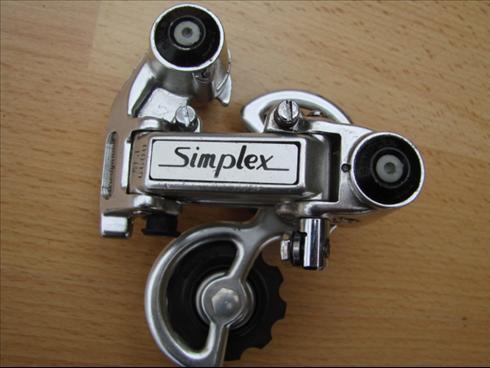
Later, they added a dropped parallelogram to allow the top pulley to track the freewheel more closely. This made shifting quicker and more precise. In the 70s, Simplex licensed back Shimano's dropped parallelogram design. Here's Shimano's top of the line "Crane" derailleur from the mid 70s:

And here's Simplex's version, from the same era:
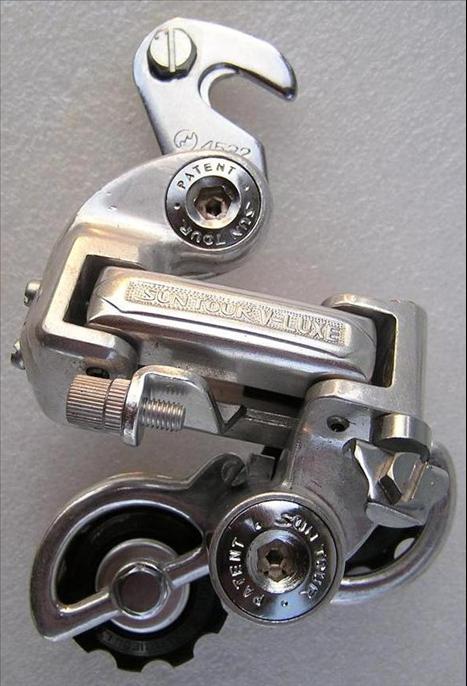
At about the same time, SunTour did one better with the dropped parallelogram by slanting it to further improve top pulley tracking, but Shimano had a lock on the double spring design in Japan this feature was not incorporated into SunTour's derailleurs. Here's the popular V-Luxe:
SunTour and Shimano continued to develop along parallel tracks until the mid 80s when two things happened: first, SunTour's patent on the slanted parallelogram expired, and Shimano introduced "SIS" indexed shifting, which actually worked! Shimano was quick to incorporate the slant paralellogram into their own derailleurs, as evidenced by the Dura-Ace 7400, the first SIS derailleur on the market in 1985:

Alas, SunTour (and a myriad of other companies -- e.g. Huret, Simplex, Maillard, CLB, MAFAC, TDC, Williams, Gian Robert, Zeus, etc.) were unable to compete against the Shimano juggernaut, and went out of business or were swallowed by other companies. Even Campagnolo was circling the drain for several years. But this vacuum did allow for other companies, particularly North American ones, to eventually jump in and fill the void, providing much needed diversity in the bicycle ecosystem.