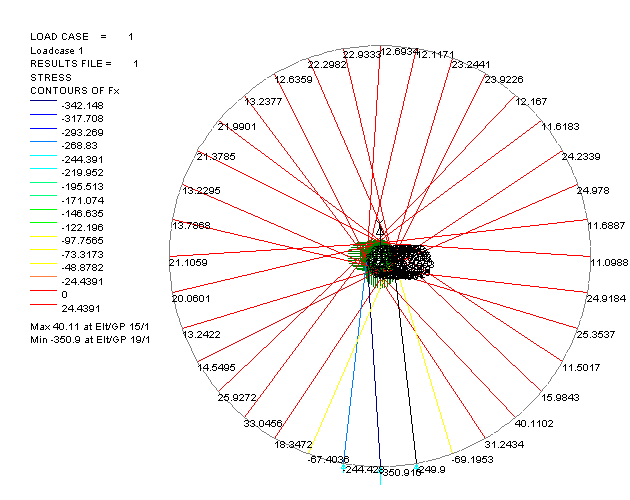
The writer of the article at
http://www.astounding.org.uk/ian/wheel/ claims that compressed spokes carry loads. This is clearly mad as the drawing made by Poko points out. It is obvious that the loads are carried in tension by the majority of the spokes pretty much after the manner of the wire ropes in a suspension bridge carry load or the shrouds holding up a mast on a sailing boat transmit loads into the hull.
What I found interesting is that his model shows that the loads on individual spokes vary greatly as the wheel rotates and the rim distorts minutely at the contact patch. This unloads the lower spokes momentarily, while other become tighter in response to the small change in shape of the rim.
No spokes are taking any load in compression, even though their tension in the positions between five o clock and seven oclock goes temporarily negative. That doesn't mean that the nipples poke through to the tube. In some of those links I read yesterday the lengths of the spokes were pulled and relaxed by only tiny parts of a mm - less than 0.2mm which he gives as the maximum distortion of the rim at the contact point. Where the yellow coloured spokes relax, their neighbours slightly further up (about four spokes up from six o clock on either side) tighten up in response to the rim moving out of true. Look at the values on the diagram. The tension at five and seven o clock rises to 40N and 33N to absorb the load. The spokes at the top of the wheel are lighter loaded.
The links I posted at the top of the thread are pretty interesting and worth looking at I think.
This stuff makes my head hurt.