Hmmm !
Right, Welds; I'm going to have my two-penn'th .... .... ... So I hope no one takes offence.

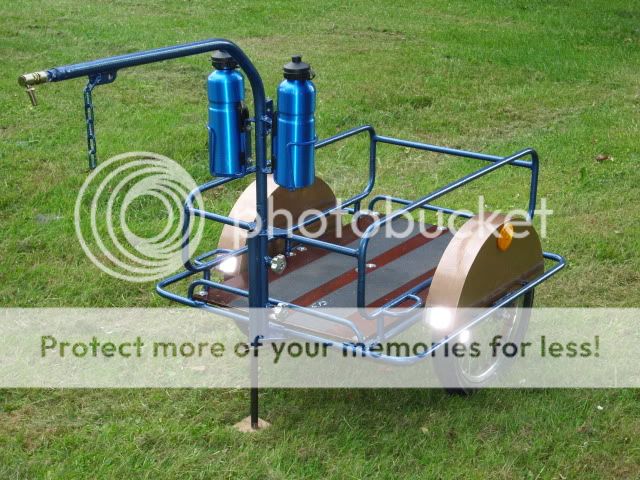
Here is my bike trailer, it is fully welded using a MIG welder; a decent industrial set and with the correct gas mix, but more importantly the tubing is mainly 2 mm wall thickness, and I am qualified and very experienced welder, so all of the joints have been properly prepped; even so, some of the welds were far from perfect, and required rework and rectiyfing.
[img]
[/img]
A 1.5mm gap is sometimes more benifical, allowing a full penetration, full fusion weld, rather than a weak on the surface "blob" that often occurs with butted up joints, especially when working with thin walled tubing.
At the moment I do not have access to any welding gear, either MIG, "Stick" or Oxy/Acet gas. However, I am building a steel single wheel bike trailer for myself. The tubing that I am using is 10 mm |(outside) diametre X 1.5 mm wall thickness hydraulic pipe: All of the joints will be brazed, using a reasonably cheap propane gas torch, flux coated brass rods, an extra tub of flux, and a propane cyclinder.
This I can do at home; I live in a ground floor flat, without any workshop facilities, and I am doing the "Hot work" outside on the communal lawn (the tube bending, cutting, etc. is all being done in my kitchen).
Brazing on steel, or brass welding as it is correctly known is a very forgiving method and is extremely suitable for bicycle related work. After all, up until the widespread use of tig welding only a few years ago, virtually every joint on a steel bike was brazed.
This is the torch that I am using:
http://www.machinemart.co.uk/shop/pr...h-with-nozzles As you can see, it is a realively inexpensive torch set, and it does supply more than sufficent heat to complete the brazing work when using 3 mm flux coated rods.
Propane is a "dirty" burning gas, producing a lot of carbon soot if the flame is not set high enough, that is why I am using extra flux in conjuction with the flux coated rods. Joint preperation is also very important; all of the joints I am making are cleaned throughly with a piece of emery until shiny. I am then using a piece of coarser emery cloth to literally score the joints surace before coating with the made up flux paste. This will allow a better flow of the molten brass into the joints.
Brazing (or brass welding) is also very tough, and will allow a better flexing through the the completed joints. Welding, and especially poor welding can actually weaken a joint resulting in catastrophic failure due to stress cracking. A little flexing is not a bad thing, especially if you take into account the current state of the majority of Britain's roads

OK;
Most tool supply shops, etc. will either stock, or be able to source the propane torch. If you live in a larger town or City, a smaller independent garage or engineering works will often sell you Brazing rods and some flux (ask to see the foreman, charge hand, etc. and offer cash

).
If you live in a more Rural area, go to the local Agricultral or horticultral machine dealer (tractors, mowers, etc.) almost all of these will retail a single Brazing rod and a small tube of flux.
A supplier of Hydraulic pipe can be found in most towns; a full 6 metre length of (uncoated bare steel) 10 mm pipe recently cost me £8+VAT (Stauff UK, Wymondham, Norfolk). If the company also does hydraulic installations, you may be able to purchase a few lengths of off-cuts or scrap tubing for a small donation to the "Tea fund."
Failing all that, if you live in the UK and are still struggling, send me an email or a personal message, and I will see if I can help you further.
Regards
Gareth.