Originally Posted by
unworthy1
I haven't seen one of these "new" Zefals before, and tho the little diagram shows both P and S valves "go here" I'm sure there must be some adjustment to accommodate the 2 different diameters involved. So I'll guess you have to tighten the cap when you fit this to a P valve to compress the washer more and get the all-important seal around the P shaft.
Well unworthy1, in fact you really do not need to make any manual adjustments at all. The rubber washer is flexible enough, and there is enough compression from the cam of the lever, to accommodate either type of valve stem. It is similar to a Topeak single-hole pump head which I have mounted on a floor pump.
Well, I
THOUGHT I had discovered the problem...
The new pump heads have a different construction than earlier models. Rather than a plastic sleeve they now feature a barrel or "piston" made of rigid plastic. When this more solid part is pushed by the locking lever it indeed compresses the valve stem washer with greater force than earlier pumps - pressure sufficient to grip either Schrader or Presta valves. Like the piston of a car engine, that plastic barrel in the pump head has a seal. In this case it is a rubber o-ring placed on the end near the lock lever. I had assumed there was a problem with the o-ring. Alas, this was not the case.
After immersing the end of the pump in a bowl of water, it immediately became obvious that there is air leaking...
but, it is coming from a seal between the pump head and the shaft. This seal is definitely
NOT something which I could easily access or repair. The shaft is not threaded into the pump head, so any seal or gasket (which is concealed by the outer grip) must have been simply pressure fitted during manufacture. So, no easy fix. Looking down into the shaft, it appears to be the same as the construction of earlier HPX pumps... again, not a clue whether those could be repaired either.
Well, at least I did learn some interesting facts about the new pumps during my futile quest for a solution.

Unlike earlier models which offered a loose fitting lever axle (I assume for easier removal of the lever, and then to access the inner parts), this lever pin is not made to be easily slipped out of position. Because there is really no reason to ever remove and reverse the valve stem washer, there is really no reason to disassemble the pump head. However,... the entire mechanism still
can be removed with little difficulty.
Because these pumps are so distinctly different from earlier models, I thought everyone would like to see a closer look at the "guts" of these pump heads.
Note the placement of the o-ring on the piston - all pretty simple!
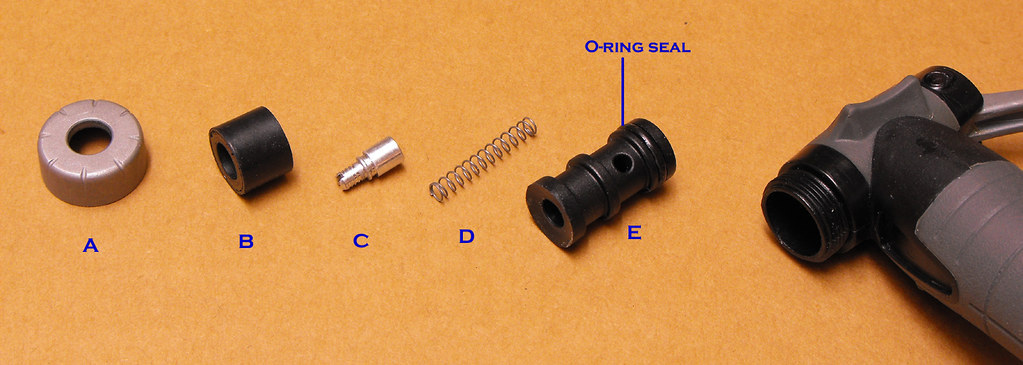 Here is a closer view of the rigid plastic piston with the rubber O-ring seated in the channel at the left.
