


Symptoms of worn chain ring?
 03-01-16 | 12:15 AM
#1
Thread Starter
Senior Member

Joined: Feb 2014
Posts: 572
Likes: 128
From: By theBeach and Palos Verdes, CA adjacent
Bikes: One of each: Road, Hybrid, Trekking
Symptoms of worn chain ring?
Hi all,
I've often read here that the chain rings will last much longer than the chain itself and the rear cassette. What are the symptoms that let you know it is time to change a chain ring?
My hybrid Novara Forza is only about 3 years old. I ride it a ton, though, and live near the beach so ocean air and occasional sand on the bike path take their toll. The bike probably has 6000-7000 miles on it and I recently feel like the large chain ring will slip a tooth. It's a pretty rare occurrence. I routinely check and replace the chain and cassette as needed. I go through a chain every 800 miles or so and a cassette usually lasts for two chains, sometimes three. LBS mechanics I talk to tell me this is about right based on local riding conditions.
Thanks!
I've often read here that the chain rings will last much longer than the chain itself and the rear cassette. What are the symptoms that let you know it is time to change a chain ring?
My hybrid Novara Forza is only about 3 years old. I ride it a ton, though, and live near the beach so ocean air and occasional sand on the bike path take their toll. The bike probably has 6000-7000 miles on it and I recently feel like the large chain ring will slip a tooth. It's a pretty rare occurrence. I routinely check and replace the chain and cassette as needed. I go through a chain every 800 miles or so and a cassette usually lasts for two chains, sometimes three. LBS mechanics I talk to tell me this is about right based on local riding conditions.
Thanks!
 03-01-16 | 01:49 AM
#2
Senior Member
Joined: May 2011
Posts: 3,780
Likes: 17
From: Upstate NY
Bikes: Bianchi San Mateo and a few others
My hybrid Novara Forza is only about 3 years old. I ride it a ton, though, and live near the beach so ocean air and occasional sand on the bike path take their toll. The bike probably has 6000-7000 miles on it and I recently feel like the large chain ring will slip a tooth.
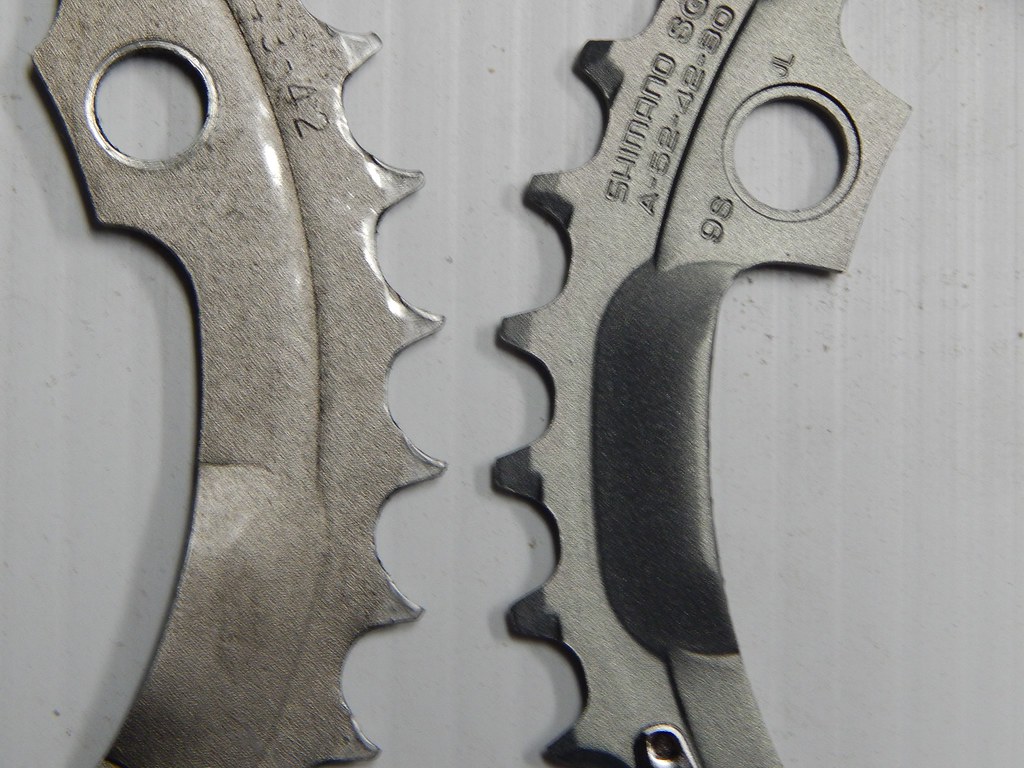
Anyway, worn chainrings can typically be identified visually. As they wear, the chainring's teeth will develop a consistent "shark fin" profile. The reason I specify "consistent" is that many chainrings nowadays have differently-shaped teeth at various points on the ring to aid shifting.
Personally, I'd be pretty darn surprised if you wore out a chainring at 6000-7000 miles, especially since your bike's crankset came with steel chainrings. You should get a LOT more mileage out of those things.
03-01-16 | 09:14 PM
#3

Insane Bicycle Mechanic


Joined: Mar 2008
Posts: 10,168
Likes: 1,135
From: other Vancouver
On the left: worn. On the right: new.
__________________
Jeff Wills
Comcast nuked my web page. It will return soon..
Jeff Wills
Comcast nuked my web page. It will return soon..
Last edited by Jeff Wills; 03-02-16 at 10:20 PM. Reason: Swapped sides.
03-02-16 | 12:02 AM
#5
tcarl
Joined: Dec 2010
Posts: 561
Likes: 9
From: St. Louis, MO
Bikes: Roark, Waterford 1100, 1987 Schwinn Paramount, Nishiki Professional, Bottecchia, 2 Scattantes, 3 Cannondale touring bikes, mtn. bike, cyclocross, hybrid, 1940's era Schwinn
1st - in 40 years of riding I've only worn out one chainring, and it was made of a soft aluminum. 2nd - I've never even heard of a steel chainring getting worn out, but I guess it's possible. 3rd - I'd say if all, or at least a great majority of the teeth are visibly worn down to nubs, then you can see that it's worn out. In other words, you can visibly see when it's worn out. 4th - back to the one chainring I did wear out (1st point above) - I could see that the teeth were becoming very worn and thought I'd keep riding it and see what happened (it was a 52 tooth ring, so I knew the chain wasn't going to start slipping over all the teeth at once as I pedaled). What happened is that eventually it started occasionally shifting to the small chainring on it's own. The "low" teeth (nubs) weren't able to hold the chain laterally and it slid off of them to the side, hence the self-shifting.
 03-02-16 | 10:26 PM
#8

Senior Member
Joined: May 2008
Posts: 9,102
Likes: 6,009
From: Zang's Spur, CO
Even a worn chainring typically won't "slip a tooth" because so many teeth are engaged with the chain. Actually, one of the symptoms of using a worn chainring is exactly the opposite. "Chain suck" is when the chain fails to dis-engage from the chainring and it rides up the back side of the crankset, potentially getting jammed up between your chainrings and the frame, and possibly even doing damage. (Worn chainrings aren't the only cause for chain suck, but it is one possible cause.)
Anyway, worn chainrings can typically be identified visually. As they wear, the chainring's teeth will develop a consistent "shark fin" profile. The reason I specify "consistent" is that many chainrings nowadays have differently-shaped teeth at various points on the ring to aid shifting.
Anyway, worn chainrings can typically be identified visually. As they wear, the chainring's teeth will develop a consistent "shark fin" profile. The reason I specify "consistent" is that many chainrings nowadays have differently-shaped teeth at various points on the ring to aid shifting.
In my experience, a really badly worn one will do just that.
One worn not quite as badly will make a noisy racket as the RD tugs it off of the chainring.
03-03-16 | 01:37 AM
#9

Senior Member


Joined: Nov 2014
Posts: 27,576
Likes: 5,487
From: Eugene, Oregon, USA
One issue I had with my 42T ring was that the teeth didn't wear evenly. So, I think there was much greater wear at the spot perpendicular from the pedals than straight in line with the pedals, due to lots of standing hill climbs, and uneven forces through the stroke. When I replaced the chain, I got a lot of annoying chain noise. I ended up replacing the ring with a 41T ring.
Since then, I've started occasionally rotating my rings (depending on whether a crank guard pin is used on the outer ring, or just rotating the inner ring.
Like with a cassette, a stretched chain can fit in a larger circle, and the chain may try to ride high on the teeth which can be damaging to the teeth and the ring in general.
Since then, I've started occasionally rotating my rings (depending on whether a crank guard pin is used on the outer ring, or just rotating the inner ring.
Like with a cassette, a stretched chain can fit in a larger circle, and the chain may try to ride high on the teeth which can be damaging to the teeth and the ring in general.
03-03-16 | 02:08 AM
#10

Senior Member
Joined: Oct 2008
Posts: 1,619
Likes: 187
From: Frankfurt, Germany
Bikes: Focus trash find commuter, Eddy Merckx Corsa, BP Stealth TT bike, Leader 720 TT bike, Boardman Comp Hybrid drop bar conversion, Quantec CX budget cyclocross build, SerottaNOS frameset ready to build up!
This is what happenend on my commuter - I was tardy changing the chain and it trashed the chainrings. Although it was second hand when I bought the crankset so goodness knows how many miles it had on by the end of its life.
03-03-16 | 07:46 AM
#11
Banned.
Joined: Jul 2006
Posts: 4,287
Likes: 838
Years means nothing. We need to know miles.
I've worn out a few chainrings mostly on my fixed gear but it's shockingly easy to put 10-12,000 miles on a road chainring and have the teeth be in pretty poor shape. Especially if you ride in the rain and cold.
Mountain chainrings are a slightly different story. I've got 600 miles on a modern Deore crankset with a big ring that is looking pretty ratty already.
I've worn out a few chainrings mostly on my fixed gear but it's shockingly easy to put 10-12,000 miles on a road chainring and have the teeth be in pretty poor shape. Especially if you ride in the rain and cold.
Mountain chainrings are a slightly different story. I've got 600 miles on a modern Deore crankset with a big ring that is looking pretty ratty already.

