


How much does hub affect speed?
 12-11-16 | 01:04 AM
#1
Thread Starter
Full Member
Joined: Jan 2015
Posts: 227
Likes: 2
How much does hub affect speed?
I have two wheels with the same cassette. When I put wheel #1 into the bike, spin it, I rotates well and stops slowly. For wheel #2, it rotates and then stops faster than wheel #1. Can I assume the hub on wheel #1 is better and faster? Is there such as a thing as a faster hub and thus a faster bike?
 12-11-16 | 01:14 AM
#2
Senior Member


Joined: Apr 2009
Posts: 39,897
Likes: 3,865
From: New Rochelle, NY
Bikes: too many bikes from 1967 10s (5x2)Frejus to a Sumitomo Ti/Chorus aluminum 10s (10x2), plus one non-susp mtn bike I use as my commuter
This comes up so often it deserves a sticky.
The differences in drag related to how long a wheel spins off the bike are miniscule. They have about as close to zero as possible effect on the drag or speed of a bike.
It's a simple question of inertia, compare the mass of the wheel to the 200# bike and rider as a unit.
The differences in drag related to how long a wheel spins off the bike are miniscule. They have about as close to zero as possible effect on the drag or speed of a bike.
It's a simple question of inertia, compare the mass of the wheel to the 200# bike and rider as a unit.
__________________
FB
Chain-L site
An ounce of diagnosis is worth a pound of cure.
Just because I'm tired of arguing, doesn't mean you're right.
“One accurate measurement is worth a thousand expert opinions” - Adm Grace Murray Hopper - USN
WARNING, I'm from New York. Thin skinned people should maintain safe distance.
FB
Chain-L site
An ounce of diagnosis is worth a pound of cure.
Just because I'm tired of arguing, doesn't mean you're right.
“One accurate measurement is worth a thousand expert opinions” - Adm Grace Murray Hopper - USN
WARNING, I'm from New York. Thin skinned people should maintain safe distance.
Last edited by FBinNY; 12-11-16 at 01:28 AM.
12-11-16 | 01:51 AM
#3

Senior Member
Joined: Aug 2016
Posts: 1,642
Likes: 5
From: Brisbane Aust
Bikes: Giant ToughRoad Giant talon
There is such a thing too tight axle bearings, have you felt the turn of the axle with the wheel off the bike, by twiddling them with your fingers?
12-11-16 | 09:25 AM
#4

Senior Member

Joined: Feb 2004
Posts: 30,225
Likes: 649
From: St Peters, Missouri
Bikes: Catrike 559 I own some others but they don't get ridden very much.
From your description of the relatively sudden stop my bet is that you have an out-of-true rim rubbing the brake rather than too tight bearings on your hub. Either way, I'm agreeing with FBinNY that it isn't affecting your bike speed significantly. If it was my bike, though I'd still fix it.
__________________
My greatest fear is all of my kids standing around my coffin and talking about "how sensible" dad was.
My greatest fear is all of my kids standing around my coffin and talking about "how sensible" dad was.
12-11-16 | 09:36 AM
#5
Senior Member
Joined: Feb 2014
Posts: 1,883
Likes: 10
From: Southern Ontario
I've found that factory wheels often have the hub bearings adjusted way too tight. You are likely seeing that difference. However, it could be the difference between loose bearings and cartridge bearings or a well sealed hub compared to a poorly sealed hub. Or even the difference in freehub pawl drag.
12-11-16 | 09:39 AM
#6

Senior Member
Joined: Nov 2010
Posts: 1,335
Likes: 46
From: Deep South
Bikes: Cannondale SR's and ST's from the '80's
If it is considered that the drive train is connected during this testing, there may be differences between the freehub ratcheting mechanisms that cause the rotating differences you are seeing.
I recently built a wheel with an unused Ritchey hub whose freehub mechanism was fairly stiff compared to that of the previous hub. The only comparison in performance was how fast I coasted down even a shallow grade compared to my riding companions whom I had always outcoasted. I noted no difference with the new hub............
I recently built a wheel with an unused Ritchey hub whose freehub mechanism was fairly stiff compared to that of the previous hub. The only comparison in performance was how fast I coasted down even a shallow grade compared to my riding companions whom I had always outcoasted. I noted no difference with the new hub............
12-11-16 | 10:20 AM
#7

Senior Member
Joined: Apr 2011
Posts: 15,278
Likes: 342
From: Alpharetta, GA
Bikes: Nashbar Road
If it's really tight when you spin it by hand, (holding the axle in your hand for example) then sure loosen up the cone. That's just common sense, but counting spins until it stops isn't a test for friction.
Spinning the wheel without weight on the axle does not translate into spinning while loaded. The test doesn't tell you anything. It would be better to find a slight down-slope, coast from a stop and see how far you go.
Spinning the wheel without weight on the axle does not translate into spinning while loaded. The test doesn't tell you anything. It would be better to find a slight down-slope, coast from a stop and see how far you go.
12-11-16 | 10:47 AM
#8

Senior Member

Joined: Jun 2014
Posts: 3,543
Likes: 456
From: SF Bay Area
Bikes: Now: HPV Gecko FX 20 w/ assist.. Old: Trident Spike 2 recumbent trike w/ e-assist
FWIW, I just replaced a rear wheel because my lbs said the freehub body was shot and could not find a replacement (too old). The difference between that wheel and the new one in terms of pedaling effort is substantial. I was definitely getting a lot more resistance or drag off the old hub. Maybe it only applies is the hub is "broken" but the difference has allowed me to cycle at my preferred cadence in one higher gear for the same effort.
12-11-16 | 11:46 AM
#9

Insane Bicycle Mechanic

Joined: Mar 2008
Posts: 10,162
Likes: 1,125
From: other Vancouver
I have two wheels with the same cassette. When I put wheel #1 into the bike, spin it, I rotates well and stops slowly. For wheel #2, it rotates and then stops faster than wheel #1. Can I assume the hub on wheel #1 is better and faster? Is there such as a thing as a faster hub and thus a faster bike?
(From Bicycle Drag Force Formulas )
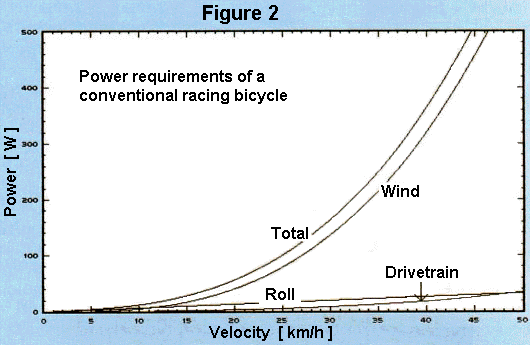
If you want to go faster, work on these things in this order:
1. Your physical condition
2. Your aero position
3. Your bike's implementation
__________________
Jeff Wills
Comcast nuked my web page. It will return soon..
Jeff Wills
Comcast nuked my web page. It will return soon..
12-11-16 | 12:58 PM
#10
Mechanic/Tourist
Joined: Apr 2007
Posts: 7,522
Likes: 12
From: Syracuse, NY
Bikes: 2008 Novara Randonee - love it. Previous bikes:Motobecane Mirage, 1972 Moto Grand Jubilee (my fave), Jackson Rake 16, 1983 C'dale ST500.
FWIW, I just replaced a rear wheel because my lbs said the freehub body was shot and could not find a replacement (too old). The difference between that wheel and the new one in terms of pedaling effort is substantial. I was definitely getting a lot more resistance or drag off the old hub. Maybe it only applies is the hub is "broken" but the difference has allowed me to cycle at my preferred cadence in one higher gear for the same effort.
12-11-16 | 01:10 PM
#11
Senior Member
Joined: Jun 2014
Posts: 3,543
Likes: 456
From: SF Bay Area
Bikes: Now: HPV Gecko FX 20 w/ assist.. Old: Trident Spike 2 recumbent trike w/ e-assist
If it was not the hub, then I magically gained some muscle
 12-11-16 | 01:21 PM
#12
Mechanic/Tourist
Joined: Apr 2007
Posts: 7,522
Likes: 12
From: Syracuse, NY
Bikes: 2008 Novara Randonee - love it. Previous bikes:Motobecane Mirage, 1972 Moto Grand Jubilee (my fave), Jackson Rake 16, 1983 C'dale ST500.
A hub that makes "all kinds of noises" obviously could have a problem serious enough to slow one down. Again, under normal conditions nobody can tell the difference between hubs while riding
12-11-16 | 01:40 PM
#13
Senior Member
Joined: Apr 2009
Posts: 39,897
Likes: 3,865
From: New Rochelle, NY
Bikes: too many bikes from 1967 10s (5x2)Frejus to a Sumitomo Ti/Chorus aluminum 10s (10x2), plus one non-susp mtn bike I use as my commuter
+1 (and repeating myself) that the perceived difference in the hubs is meaningless real world riding.
But, since I know that people are obsessive and can't leave well enough alone, here's things to consider.
1- The differences could be inherent in the design, such as a freewheel ratchet that's a bit stiffer.
2- Viscous drag from more or stiffer grease
3- Seal drag, from tighter or dry seals, or no seals on one.
4- Bearing friction, which is more complex, and which I mention only because others reference tightly adjusted hubs. This is tricky, because an improperly loose hub will have less friction when spinning in your hand, yet more once it's loaded with your weight. So, before you decide to readjust the bearings stop and think.
Spin the axle between your fingers, and feel the drag. Grease and seal drag are very smooth and silky (unless there's dirt contamination). Bearing drag from a tight bearing, feels "mechanical" with a sense of metal to metal contact and vibration. However, a properly adjusted hub has a bit of preload, because that's what the design calls for, and so you should feel it slightly.
Component makers set the hub bearings on the tight side for two reasons.
1- loose bearings are more of a problem, so they err tight. Also it's difficult to properly align a wheel if there's any hub play.
2- a hub adjusted to the tight side will wear to correct tolerance, whereas a loose hub only gets worse.
Without knowing any specifics and having the ability to see if there might be a problem, I repeat my earlier advice.
STOP OBSESSING and ride the bike.
But, since I know that people are obsessive and can't leave well enough alone, here's things to consider.
1- The differences could be inherent in the design, such as a freewheel ratchet that's a bit stiffer.
2- Viscous drag from more or stiffer grease
3- Seal drag, from tighter or dry seals, or no seals on one.
4- Bearing friction, which is more complex, and which I mention only because others reference tightly adjusted hubs. This is tricky, because an improperly loose hub will have less friction when spinning in your hand, yet more once it's loaded with your weight. So, before you decide to readjust the bearings stop and think.
Spin the axle between your fingers, and feel the drag. Grease and seal drag are very smooth and silky (unless there's dirt contamination). Bearing drag from a tight bearing, feels "mechanical" with a sense of metal to metal contact and vibration. However, a properly adjusted hub has a bit of preload, because that's what the design calls for, and so you should feel it slightly.
Component makers set the hub bearings on the tight side for two reasons.
1- loose bearings are more of a problem, so they err tight. Also it's difficult to properly align a wheel if there's any hub play.
2- a hub adjusted to the tight side will wear to correct tolerance, whereas a loose hub only gets worse.
Without knowing any specifics and having the ability to see if there might be a problem, I repeat my earlier advice.
STOP OBSESSING and ride the bike.
__________________
FB
Chain-L site
An ounce of diagnosis is worth a pound of cure.
Just because I'm tired of arguing, doesn't mean you're right.
“One accurate measurement is worth a thousand expert opinions” - Adm Grace Murray Hopper - USN
WARNING, I'm from New York. Thin skinned people should maintain safe distance.
FB
Chain-L site
An ounce of diagnosis is worth a pound of cure.
Just because I'm tired of arguing, doesn't mean you're right.
“One accurate measurement is worth a thousand expert opinions” - Adm Grace Murray Hopper - USN
WARNING, I'm from New York. Thin skinned people should maintain safe distance.
12-11-16 | 01:44 PM
#14
Senior Member
Joined: Jun 2014
Posts: 3,543
Likes: 456
From: SF Bay Area
Bikes: Now: HPV Gecko FX 20 w/ assist.. Old: Trident Spike 2 recumbent trike w/ e-assist
Okay, I get that but then I have to wonder why people spend more money on certain hubs. I am going to try my hand at building wheels and, if this is true, does it matter if I buy a cheaper hub or a more expensive one? What's the benefit of more expensive hubs then?
12-11-16 | 02:06 PM
#15
Insane Bicycle Mechanic
Joined: Mar 2008
Posts: 10,162
Likes: 1,125
From: other Vancouver
I've built my own wheels for 35+ years. Most of the time I use mid-range parts: Shimano Deore, 105, or Ultegra. These are the sweet spot, IMO, between cost and durability.
__________________
Jeff Wills
Comcast nuked my web page. It will return soon..
Jeff Wills
Comcast nuked my web page. It will return soon..
12-11-16 | 02:27 PM
#17

Senior Member
Joined: Sep 2006
Posts: 1,329
Likes: 2
Sometimes you don't have a choice if you want a hub that isn't 32h or 36h. Then you may be limited to either generic hubs or high end (expensive) hubs.
12-11-16 | 04:31 PM
#19
- Soli Deo Gloria -
Joined: Aug 2015
Posts: 14,779
Likes: 743
From: Northwest Georgia
Bikes: 2018 Rodriguez Custom Fixed Gear, 2017 Niner RLT 9 RDO, 2015 Bianchi Pista, 2002 Fuji Robaix
12-11-16 | 07:20 PM
#20

Really Old Senior Member

Joined: Feb 2007
Posts: 14,654
Likes: 1,897
From: Mid Willamette Valley, Orygun
Bikes: 87 RockHopper,2008 Specialized Globe. Both upgraded to 9 speeds. 2019 Giant Explore E+3
I have two wheels with the same cassette. When I put wheel #1 into the bike, spin it, I rotates well and stops slowly. For wheel #2, it rotates and then stops faster than wheel #1. Can I assume the hub on wheel #1 is better and faster? Is there such as a thing as a faster hub and thus a faster bike?
A heavier tire could make it rotate longer.
12-11-16 | 09:39 PM
#21

Senior Member


Joined: Jul 2015
Posts: 7,413
Likes: 3,252
From: NW Oregon
Bikes: 1982 Trek 930R Custom, '91 Diamondback Ascent w/ XT, XTR updates, Fuji Team Pro CF road flyer, Specialized Sirrus Gravel Convert, '09 Comencal Meta 5.5 XC, '02 Marin MBX500, '84 Gitane Criterium bike
This comes up so often it deserves a sticky.
 The differences in drag related to how long a wheel spins off the bike are miniscule. They have about as close to zero as possible effect on the drag or speed of a bike.
It's a simple question of inertia, compare the mass of the wheel to the 200# bike and rider as a unit.
The differences in drag related to how long a wheel spins off the bike are miniscule. They have about as close to zero as possible effect on the drag or speed of a bike.It's a simple question of inertia, compare the mass of the wheel to the 200# bike and rider as a unit.
WRONG. The hub that has the extra drag probably has DAMAGE, and/or has been improperly adjusted. The ONLY thing, other than bearing condition/adjustment/grease, that might cause higher drag would be any rubber seals on the hub.
as to MOMENTUM... the rim and tire/tube weight lends momentum to the wheel when spun in-frame... I always test for bearing tension with the wheel OUT of the frame, and tire/tube removed... i lay the axle on two open fingers after spinning it up... if the axle wants to turn on my open fingers, it gets readjusted or rebuilt as needed.
"slightly tight"... this will cause heat buildup during use... the product of heat is increased friction... the heating can, and DOES, cause melting of the cones' hardened surface! Ever taken a close look at the "worn" cones with pitting going on? yep, MELTED surfaces. Heat and pressure causes GALLING of the surface. Rust can also promote galling... once again, the extra friction from the rust pitted surface causes heat to build up... add pressure, more heat gets produced, expansion of parts involved further increases heating... whalla! time to replace cones and balls....
A properly adjusted set of hubs does in fact effect your "speed", since a dragging hub bearing set WILL slow acceleration, and yes, TOP SPEED. a bit of fresh, light grease, and proper adjustment makes for a happy, FASTER, rider. Rotating mass also plays into enjoyment... Note all those fancy bikes with carbon fiber and aluminum bits all over the place on them... there are good reasons for those pieces!
Grease... too heavy of grease viscosity will cause issues, too... "FLOWBACK" is needed to keep grease on the bearing surfaces... friction sets in... heat builds... guess the rest... i use a bicycle specific grease... it is light enough to allow flowback, without getting too thin during use.
Reduce any ROTATING MASS to improve acceleration... and get those bearings right, if you have the tools and skills needed.
Last edited by maddog34; 12-11-16 at 09:58 PM. Reason: added info
12-12-16 | 06:23 AM
#22
Mechanic/Tourist
Joined: Apr 2007
Posts: 7,522
Likes: 12
From: Syracuse, NY
Bikes: 2008 Novara Randonee - love it. Previous bikes:Motobecane Mirage, 1972 Moto Grand Jubilee (my fave), Jackson Rake 16, 1983 C'dale ST500.
^ ^ Wow, just Wow. The paragraph following "WRONG" does nothing to refute the quote. I would welcome any documentation that can support the claims/beliefs above about melting of cones and any significant effect of minor hub adjustment or weight differences on speed.
Last edited by cny-bikeman; 12-12-16 at 07:00 AM.
12-12-16 | 07:44 AM
#23

Generally bewildered
Joined: Aug 2015
Posts: 3,038
Likes: 344
From: Eastern PA, USA
Bikes: 2014 Trek Domane 6.9, 1999 LeMond Zurich, 1978 Schwinn Superior
As has been said in many different ways, above, the difference between two properly adjusted, lubricated and functioning bearings should be nearly nil. And if a bearing was poorly lubed or maladjusted enough to notice, you'd .... well, you'd notice. Grinding in the bearings, or tough to turn the axle at all. And if the bearing was adjusted to be a bit too tight (to much "preload", in the parlance), and this created friction, it would heat up the axle, lengthening it a bit, to reduce the preload. If the axle does not offer much friction when turned with your fingertips, it's probably not too bad. Seal friction can offer a bit of resistance, and is more pronounced in new bearings.
I guess your question is one of degree. If you spin one wheel and it spins for two minutes, and you spin the other wheel and it goes for one minute, but both wheels appear to have smooth function, read what FBinNY says above: stop obsessing and ride... If the second wheel stops after spinning an eighth of a turn, with a grinding sound... Well, yeah, that will affect your speed.
I guess your question is one of degree. If you spin one wheel and it spins for two minutes, and you spin the other wheel and it goes for one minute, but both wheels appear to have smooth function, read what FBinNY says above: stop obsessing and ride... If the second wheel stops after spinning an eighth of a turn, with a grinding sound... Well, yeah, that will affect your speed.
12-12-16 | 07:46 AM
#24
Generally bewildered
Joined: Aug 2015
Posts: 3,038
Likes: 344
From: Eastern PA, USA
Bikes: 2014 Trek Domane 6.9, 1999 LeMond Zurich, 1978 Schwinn Superior
+1
12-12-16 | 02:40 PM
#25

Keepin it Wheel
Joined: Aug 2011
Posts: 10,965
Likes: 5,240
From: San Diego
Bikes: Surly CrossCheck, Krampus
In general, no. Mechanical resistance is a small portion of the drag on you and the bike and it becomes proportionally less with greater speed. Here's a nice graph:
(From Bicycle Drag Force Formulas )
If you want to go faster, work on these things in this order:
1. Your physical condition
2. Your aero position
3. Your bike's implementation
(From Bicycle Drag Force Formulas )
If you want to go faster, work on these things in this order:
1. Your physical condition
2. Your aero position
3. Your bike's implementation
I agree though, that drag is very low on the impact list. Like if you have knobby tires for road riding, the "Tire" curve on that graph would jump up to rival the wind curve, at least for some range of speeds.