


Change big chainring, cassette range, or?
 07-06-18 | 06:04 PM
#1

Thread Starter
Senior Member

Joined: Nov 2017
Posts: 2,100
Likes: 811
From: Seattle
Bikes: Specialized Roubaix, Obed Boundary, Canyon Inflite AL SLX, Ibis Ripley AF, Priority Continuum Onyx, Santana Vision, Kent Dual-Drive Tandem
Change big chainring, cassette range, or?
I am a spinner, most comfortable pedaling around 95 rpm. I will sometimes drop to the mid-80s on a false flat, but it feels weird. Currently my road bike has Tiagra 4700 with a 50/34 front and 11-32t rear. I use the larger half of the 11-32 almost exclusively, so I'd like tighter gear spacing in what's currently the middle of my gear range because I find myself regularly jumping between 100 and 90 rpm while gear hunting. What would be better/easier/cheaper: getting a smaller big chainring for the front or getting a cassette with tighter spacing such as a 12-30t? Or is there a better option (other than getting used to pedaling slower-- tried that for a month of commutes, never got used to it).
 07-06-18 | 06:56 PM
#2
Senior Member


Joined: Dec 2015
Posts: 918
Likes: 470
From: San Diego
Bikes: 1978 Bruce Gordon, 1977 Lippy, 199? Lippy tandem, Bike Friday NWT, 1982 Trek 720, 2012 Rivendell Atlantis, 1983 Bianchi Specialissima? 1998 Serotta Atlanta, 1981 Dave Moulton
I think your best option, but maybe most expensive depending, would be a triple crank set up as a half step with granny with the cassette you have. I run a 26/42/45 and find it perfect for riding in traffic (your commutes?) on the middle ring without having to worry about awkward double shifts when shifting up front. The half step between the 42 and 45 lets you really dial in the right gear for longer stretches. I will spin out at times but I don’t race or do club rides so no biggie. Use a gear calculator to figure out what gears are best for you and get the best half steps. It is fun to play with if nothing else. I like this one: Mike Sherman's Bicycle Gear Calculator
07-06-18 | 07:05 PM
#3

Senior Member
Joined: Feb 2012
Posts: 19,373
Likes: 5,516
From: Rochester, NY
Bikes: Stewart S&S coupled sport tourer, Stewart Sunday light, Stewart Commuting, Stewart Touring, Co Motion Tandem, Stewart 3-Spd, Stewart Track, Fuji Finest, Mongoose Tomac ATB, GT Bravado ATB, JCP Folder, Stewart 650B ATB
I ran a half step with granny for a couple of decades. It was great as long as I was happy with the 42t middle limit (campy NR 41T rings are rare). But as I aged and wanted a more robust middle range that middle ring had to shrink. Now many of my bikes have a 26/36/46 (or close) and I really like it. As I am now fully indexed (and enjoying the wonders of Shiftmate conversions) my rear cogs have found the useless 11 and 12 tooth cogs. What one hand gives the other takes away. My kingdom for a 13/35 9 speed cassette Andy
Andy
Andy
__________________
AndrewRStewart
AndrewRStewart
07-06-18 | 08:37 PM
#4
Senior Member
Joined: Dec 2015
Posts: 918
Likes: 470
From: San Diego
Bikes: 1978 Bruce Gordon, 1977 Lippy, 199? Lippy tandem, Bike Friday NWT, 1982 Trek 720, 2012 Rivendell Atlantis, 1983 Bianchi Specialissima? 1998 Serotta Atlanta, 1981 Dave Moulton
I ran a half step with granny for a couple of decades. It was great as long as I was happy with the 42t middle limit (campy NR 41T rings are rare). But as I aged and wanted a more robust middle range that middle ring had to shrink. Now many of my bikes have a 26/36/46 (or close) and I really like it. As I am now fully indexed (and enjoying the wonders of Shiftmate conversions) my rear cogs have found the useless 11 and 12 tooth cogs. What one hand gives the other takes away. My kingdom for a 13/35 9 speed cassette Andy
Andy
07-07-18 | 04:45 AM
#5
Mechanic/Tourist
Joined: Apr 2007
Posts: 7,522
Likes: 12
From: Syracuse, NY
Bikes: 2008 Novara Randonee - love it. Previous bikes:Motobecane Mirage, 1972 Moto Grand Jubilee (my fave), Jackson Rake 16, 1983 C'dale ST500.
The best solution depends very much on which ratios you use the most often and what total range of gears you require. However, just changing the chainrings, when you prefer a rather narrow range of cadence, will not solve the problem, because your wide range cassette will still have the same jumps between cogs. A half-step is not for everyone, and a more compact cassette alone may still not meet your needs. I would suggest you track where the holes are and then use a bike gear calculator (Google it) to see whet options will work best for you, of course factoring in the expense..
Unfortunately, the choice of manufacturers to make both an 11 tooth small cog and a 50 tooth larch chainring standard creates extra expense for those who want the maximum amount of useable closely spaced gear ratios on a stock bicycle. A 48 tooth chainring and a 12 tooth small cog would have both made much more sense. I'm with Andy on bemoaning the lack of stock cassettes that don't start with a downhill-only small cog.
Unfortunately, the choice of manufacturers to make both an 11 tooth small cog and a 50 tooth larch chainring standard creates extra expense for those who want the maximum amount of useable closely spaced gear ratios on a stock bicycle. A 48 tooth chainring and a 12 tooth small cog would have both made much more sense. I'm with Andy on bemoaning the lack of stock cassettes that don't start with a downhill-only small cog.
Last edited by cny-bikeman; 07-07-18 at 05:25 AM.
07-07-18 | 05:10 AM
#6
Senior Member
Joined: Sep 2017
Posts: 1,581
Likes: 13
From: Center of Central CA
I would just throw a tighter cassette on there. If you can give up your 30 tooth low gear, maybe a 12-28, those are easy to find. You didn't say how many cogs you're running, but it's basically a matter of figuring out your lowest usable low gear, and highest usable high gear, then let the chips fall where they may on the gears in the middle. The closer together those two numbers are, the tighter the middle gears will be, and that's what you want.
Or if you know the precise sprocket teeth you use the most, build your own cassette. I have one that's closely spaced on the middle gears up to a 24 teeth, then I stuck on a 32 tooth emergency bail-out gear for when I die on climbs. Manufacturers won't sell a cassette like this because it looks kinda funny, but I find it practical.
Or if you know the precise sprocket teeth you use the most, build your own cassette. I have one that's closely spaced on the middle gears up to a 24 teeth, then I stuck on a 32 tooth emergency bail-out gear for when I die on climbs. Manufacturers won't sell a cassette like this because it looks kinda funny, but I find it practical.
07-07-18 | 06:01 AM
#7
Senior Member
Joined: Mar 2017
Posts: 1,923
Likes: 233
From: Madison, WI
Bikes: Giant Toughroad SLR1 and Motobecane Sturgis NX
https://www.gear-calculator.com/
Plug in what you have now and play with options. Most people compare % step increases, but I prefer to compare km/h changes when shifting. Because at high speed a 10% jump is more significant than at low speed.
I never knew the half-step chainring. But I think with higher speed options (9, 10, 11..) this seems redundant nowadays?
Plug in what you have now and play with options. Most people compare % step increases, but I prefer to compare km/h changes when shifting. Because at high speed a 10% jump is more significant than at low speed.
I never knew the half-step chainring. But I think with higher speed options (9, 10, 11..) this seems redundant nowadays?
07-07-18 | 07:05 AM
#8

Senior Member
Joined: Aug 2015
Posts: 2,332
Likes: 373
I am a spinner, most comfortable pedaling around 95 rpm. I will sometimes drop to the mid-80s on a false flat, but it feels weird. Currently my road bike has Tiagra 4700 with a 50/34 front and 11-32t rear. I use the larger half of the 11-32 almost exclusively, so I'd like tighter gear spacing in what's currently the middle of my gear range because I find myself regularly jumping between 100 and 90 rpm while gear hunting. What would be better/easier/cheaper: getting a smaller big chainring for the front or getting a cassette with tighter spacing such as a 12-30t? Or is there a better option (other than getting used to pedaling slower-- tried that for a month of commutes, never got used to it).
Bicycle Gear Calculator
07-07-18 | 07:53 AM
#9
Hack
Joined: Sep 2015
Posts: 1,300
Likes: 210
From: Ottawa, Ontario, Canada
Bikes: TrueNorth CX bike, 88 Bianchi Strada (currently Sturmey'd), Yess World Cup race BMX, Pure Cruiser race BMX, RSD Mayor v3 Fatbike
I'm currently running a 38/48 with a 12-27. I like it, most of my riding is fairly flat and I generally ride alone (no drafting). I may switch the big ring with a compact to have a 38/50 and a 34/48.
07-07-18 | 10:54 AM
#10
Thread Starter
Senior Member
Joined: Nov 2017
Posts: 2,100
Likes: 811
From: Seattle
Bikes: Specialized Roubaix, Obed Boundary, Canyon Inflite AL SLX, Ibis Ripley AF, Priority Continuum Onyx, Santana Vision, Kent Dual-Drive Tandem
How difficult is it to acquire parts and build a custom cassette? I'd like to keep the 32t for steep hills, but I can basically forgo the 11 and even 12 if I could get smaller spacing between 18 to 25 since I like to cruise between 15-20 mph @ 95 rpm.
Playing around with the gear calculator, maybe I should just be in the small ring...
Playing around with the gear calculator, maybe I should just be in the small ring...
07-07-18 | 11:57 AM
#11

Senior Member


Joined: Apr 2011
Posts: 12,760
Likes: 4,873
How difficult is it to acquire parts and build a custom cassette? I'd like to keep the 32t for steep hills, but I can basically forgo the 11 and even 12 if I could get smaller spacing between 18 to 25 since I like to cruise between 15-20 mph @ 95 rpm.
Playing around with the gear calculator, maybe I should just be in the small ring...
Playing around with the gear calculator, maybe I should just be in the small ring...
However, Miche and Shimano offer cassettes for Junior race gearing, so there are modern cassettes out there that start on a 14 or 16.
https://www.bike-discount.de/en/buy/...CABEgJCJfD_BwE
13, 14 and 16 start cogs:
https://www.probikeshop.com/en/gb/mi...ano/71241.html
07-07-18 | 12:34 PM
#12
Senior Member
Joined: Aug 2015
Posts: 2,332
Likes: 373
Generally, you should be able to put together a custom by buying two of the cheapest cassettes, as those are the ones most likely to have individual sprockets rather than clusters that are pinned together. But you will likely run into the lack of bigger 1st position cogs as those are a different internal shape than the rest of them.
However, Miche and Shimano offer cassettes for Junior race gearing, so there are modern cassettes out there that start on a 14 or 16.
https://www.bike-discount.de/en/buy/...CABEgJCJfD_BwE
13, 14 and 16 start cogs:
https://www.probikeshop.com/en/gb/mi...ano/71241.html
However, Miche and Shimano offer cassettes for Junior race gearing, so there are modern cassettes out there that start on a 14 or 16.
https://www.bike-discount.de/en/buy/...CABEgJCJfD_BwE
13, 14 and 16 start cogs:
https://www.probikeshop.com/en/gb/mi...ano/71241.html
07-07-18 | 12:54 PM
#13
Senior Member
Joined: Apr 2011
Posts: 12,760
Likes: 4,873
It looks like 4700 cassettes are solid steel for 10-4, with a carrier unit for 3 to 1. That should work if it is the higher gears are the ones you want to exchange.
Or use Miche or SRAM cassettes instead.
07-07-18 | 01:16 PM
#14
Senior Member
Joined: Aug 2015
Posts: 2,332
Likes: 373
Are the pins structural, or just replacements for the screws Shimano used to use? Unless the cogs you want to swap out are on some sort of carrier, you can remove the pins.
It looks like 4700 cassettes are solid steel for 10-4, with a carrier unit for 3 to 1. That should work if it is the higher gears are the ones you want to exchange.
Or use Miche or SRAM cassettes instead.
It looks like 4700 cassettes are solid steel for 10-4, with a carrier unit for 3 to 1. That should work if it is the higher gears are the ones you want to exchange.
Or use Miche or SRAM cassettes instead.
07-07-18 | 02:18 PM
#16
Senior Member
Joined: Apr 2011
Posts: 12,760
Likes: 4,873
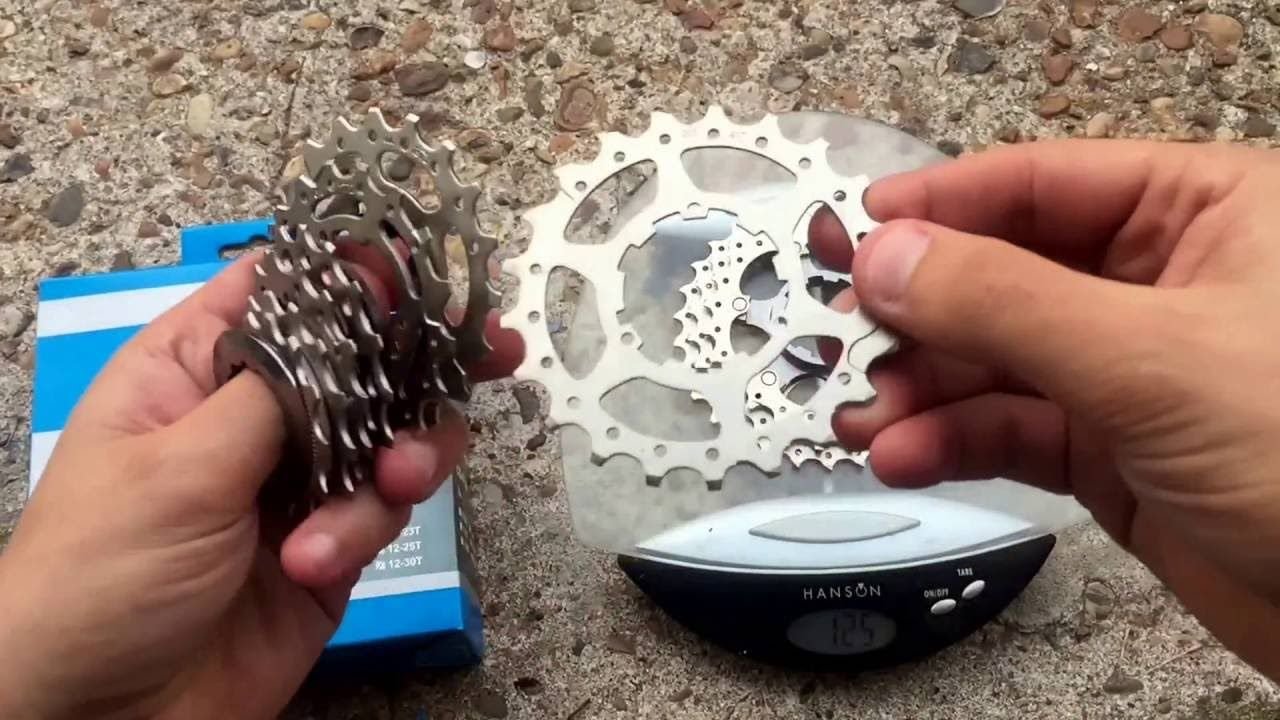
I believe some versions of the 4700 cassette are built this way, with a carrier for the lowest 3 and loose cogs pinned together in the middle. But the pins aren't structural, and they used to be removable screws. You can use the cogs that don't come on alloy carriers individually to mix and match once the pins are out.
07-09-18 | 01:09 PM
#17
Thread Starter
Senior Member
Joined: Nov 2017
Posts: 2,100
Likes: 811
From: Seattle
Bikes: Specialized Roubaix, Obed Boundary, Canyon Inflite AL SLX, Ibis Ripley AF, Priority Continuum Onyx, Santana Vision, Kent Dual-Drive Tandem
And you can drill the heads of those pins out, and end up with this:
I believe some versions of the 4700 cassette are built this way, with a carrier for the lowest 3 and loose cogs pinned together in the middle. But the pins aren't structural, and they used to be removable screws. You can use the cogs that don't come on alloy carriers individually to mix and match once the pins are out.
I believe some versions of the 4700 cassette are built this way, with a carrier for the lowest 3 and loose cogs pinned together in the middle. But the pins aren't structural, and they used to be removable screws. You can use the cogs that don't come on alloy carriers individually to mix and match once the pins are out.
then swap individual cogs,
then remount the cassette
?
Would I need to reattach the cogs or can they just be kept together by the pressure from the lock ring?
It seems that I'll have to do something about my cassette soon. I think one of my cogs is worn, because it's the only one that I experience chain jumping when I stand to pedal, and I don't think it's a chain issue because my original chain wasn't yet at 0.75 (after ~1,3000 miles) when I installed a brand new chain.
The junior racing cassette would be an interesting option, but I prefer to keep the largest cogs since I just started riding up the local mountains and I'll blow out my knees without them.
07-09-18 | 01:28 PM
#18
Senior Member
Joined: Apr 2011
Posts: 12,760
Likes: 4,873
So I should be able to remove pins from my 4700 cassette (and whatever donor cassette(s) I scavenge cogs from),
then swap individual cogs,
then remount the cassette
?
Would I need to reattach the cogs or can they just be kept together by the pressure from the lock ring?
It seems that I'll have to do something about my cassette soon. I think one of my cogs is worn, because it's the only one that I experience chain jumping when I stand to pedal, and I don't think it's a chain issue because my original chain wasn't yet at 0.75 (after ~1,3000 miles) when I installed a brand new chain.
The junior racing cassette would be an interesting option, but I prefer to keep the largest cogs since I just started riding up the local mountains and I'll blow out my knees without them.
then swap individual cogs,
then remount the cassette
?
Would I need to reattach the cogs or can they just be kept together by the pressure from the lock ring?
It seems that I'll have to do something about my cassette soon. I think one of my cogs is worn, because it's the only one that I experience chain jumping when I stand to pedal, and I don't think it's a chain issue because my original chain wasn't yet at 0.75 (after ~1,3000 miles) when I installed a brand new chain.
The junior racing cassette would be an interesting option, but I prefer to keep the largest cogs since I just started riding up the local mountains and I'll blow out my knees without them.
But it shouldn't be hard to combine the low end of a wide range cassette with the high end of a junior cassette so you end up with closer ratio gears. And the cogs you take out may even make for a reasonable cassette that you could resell.
https://cycleseven.org/customising-sh...deore-cassette
07-09-18 | 01:49 PM
#19
Senior Member

Joined: Aug 2005
Posts: 1,837
Likes: 254
seems like people love over complicating things. You want to ride in the tighter section of your cassette and want to keep that 32 in the back for hills right? Replace your 50 tooth chainring with a 46 tooth boom your done. Cheap and easy. Only thing you are giving up is being able to pedal at 35mph which nobody is doing much of anyway.
07-09-18 | 02:53 PM
#20

Senior Member
Joined: Jul 2002
Posts: 40,863
Likes: 3,116
From: Sacramento, California, USA
Bikes: Specialized Tarmac, Canyon Exceed, Specialized Transition, Ellsworth Roots, Ridley Excalibur
seems like people love over complicating things. You want to ride in the tighter section of your cassette and want to keep that 32 in the back for hills right? Replace your 50 tooth chainring with a 46 tooth boom your done. Cheap and easy. Only thing you are giving up is being able to pedal at 35mph which nobody is doing much of anyway.
07-09-18 | 03:05 PM
#21
Thread Starter
Senior Member
Joined: Nov 2017
Posts: 2,100
Likes: 811
From: Seattle
Bikes: Specialized Roubaix, Obed Boundary, Canyon Inflite AL SLX, Ibis Ripley AF, Priority Continuum Onyx, Santana Vision, Kent Dual-Drive Tandem
seems like people love over complicating things. You want to ride in the tighter section of your cassette and want to keep that 32 in the back for hills right? Replace your 50 tooth chainring with a 46 tooth boom your done. Cheap and easy. Only thing you are giving up is being able to pedal at 35mph which nobody is doing much of anyway.
07-09-18 | 03:21 PM
#22
Senior Member
Joined: Jul 2002
Posts: 40,863
Likes: 3,116
From: Sacramento, California, USA
Bikes: Specialized Tarmac, Canyon Exceed, Specialized Transition, Ellsworth Roots, Ridley Excalibur
07-09-18 | 09:15 PM
#23
Senior Member
Joined: Oct 2017
Posts: 1,681
Likes: 799
From: Chapel Hill NC
Bikes: 2000 Litespeed Vortex Chorus 10, 1995 DeBernardi Cromor S/S
If you want to get down into the middle of your cassette, then I would do what Canker above recommended - just get a smaller larger chainring. I like a close ratio cassette, and I used to use a Campag 13-26 (13-14-15-16-17-18-19-21-23-26) with a standard 53/39 crankset. However, for normal flat/rolling terrain, I found that I was spending most of my time in the larger end of the cassette, and not getting the benefit of all those nice consecutive smaller cogs. I swapped the 53T for a TA Zephyr 50T large ring, which dropped me right into the center of the 13-19 "corncob", leaving the large cogs for climbing. Later, having moved to a less hilly region, I swapped the cassette for a 12-23 (12-13-14-15-16-17-18-19-21-23), gaining a 12 for better top end, and losing the 26 which didn't get used anyway. With the now 50/39 crankset, this is an ideal combination for me.
07-09-18 | 09:33 PM
#24
Senior Member
Joined: Apr 2011
Posts: 12,760
Likes: 4,873
07-09-18 | 11:36 PM
#25
Senior Member
Joined: Jul 2002
Posts: 40,863
Likes: 3,116
From: Sacramento, California, USA
Bikes: Specialized Tarmac, Canyon Exceed, Specialized Transition, Ellsworth Roots, Ridley Excalibur

Thread
Thread Starter
Forum
Replies
Last Post
corwin1968
Bicycle Mechanics
9
11-28-11 11:49 AM
