


3X vs 4X Spoke Patterns
 09-17-18 | 07:33 PM
#1

Thread Starter
Senior Member


Joined: Jun 2018
Posts: 1,845
Likes: 723
From: The Urban Shores Of Michigami
Bikes: ........................................ .....Holdsworth "Special"..... .......Falcon "Special".......... .........Miyata 912........... ........................................
3X vs 4X Spoke Patterns
I have several rim and hub pairs that need to be built-up. They are all 36 hole and either 27" or 700c. Each pair will serve a different purpose, either commuting, touring or speeding along a smooth bike path.
What are the advantages and disadvantages of 3X and 4X spoke patterns in road bike wheels?
What are the advantages and disadvantages of 3X and 4X spoke patterns in road bike wheels?
 09-18-18 | 02:58 AM
#2

Senior Member

Joined: Feb 2004
Posts: 30,225
Likes: 649
From: St Peters, Missouri
Bikes: Catrike 559 I own some others but they don't get ridden very much.
It's all about the angles: Ideally you'd like for the spokes to b e tangent at the hub and radial at the rim but you can't have both at the same time. Too many crosses will cause the spokes to overlap the adjacent spoke at the hub flange and, in an extreme case, can lead to spokes breaking at the nipple due to the angle they enter the rim. Too few crosses pull at the hub flange where it's weakest. Radial spoked hubs used to pull apart often enough that Shimano, for one, reinforced at least some of their front hubs.
Having said all that, unless you are using uncommonly large diameter hubs, I can't imagine having any issues with either 3 cross or 4 cross on 27" or 700c wheels. I've personally always built 36 spoke wheels 3 cross and 40 spoke wheels 4 cross.
Having said all that, unless you are using uncommonly large diameter hubs, I can't imagine having any issues with either 3 cross or 4 cross on 27" or 700c wheels. I've personally always built 36 spoke wheels 3 cross and 40 spoke wheels 4 cross.
__________________
My greatest fear is all of my kids standing around my coffin and talking about "how sensible" dad was.
My greatest fear is all of my kids standing around my coffin and talking about "how sensible" dad was.
09-18-18 | 08:09 AM
#3
Thread Starter
Senior Member
Joined: Jun 2018
Posts: 1,845
Likes: 723
From: The Urban Shores Of Michigami
Bikes: ........................................ .....Holdsworth "Special"..... .......Falcon "Special".......... .........Miyata 912........... ........................................
It's all about the angles: Ideally you'd like for the spokes to b e tangent at the hub and radial at the rim but you can't have both at the same time. Too many crosses will cause the spokes to overlap the adjacent spoke at the hub flange and, in an extreme case, can lead to spokes breaking at the nipple due to the angle they enter the rim.
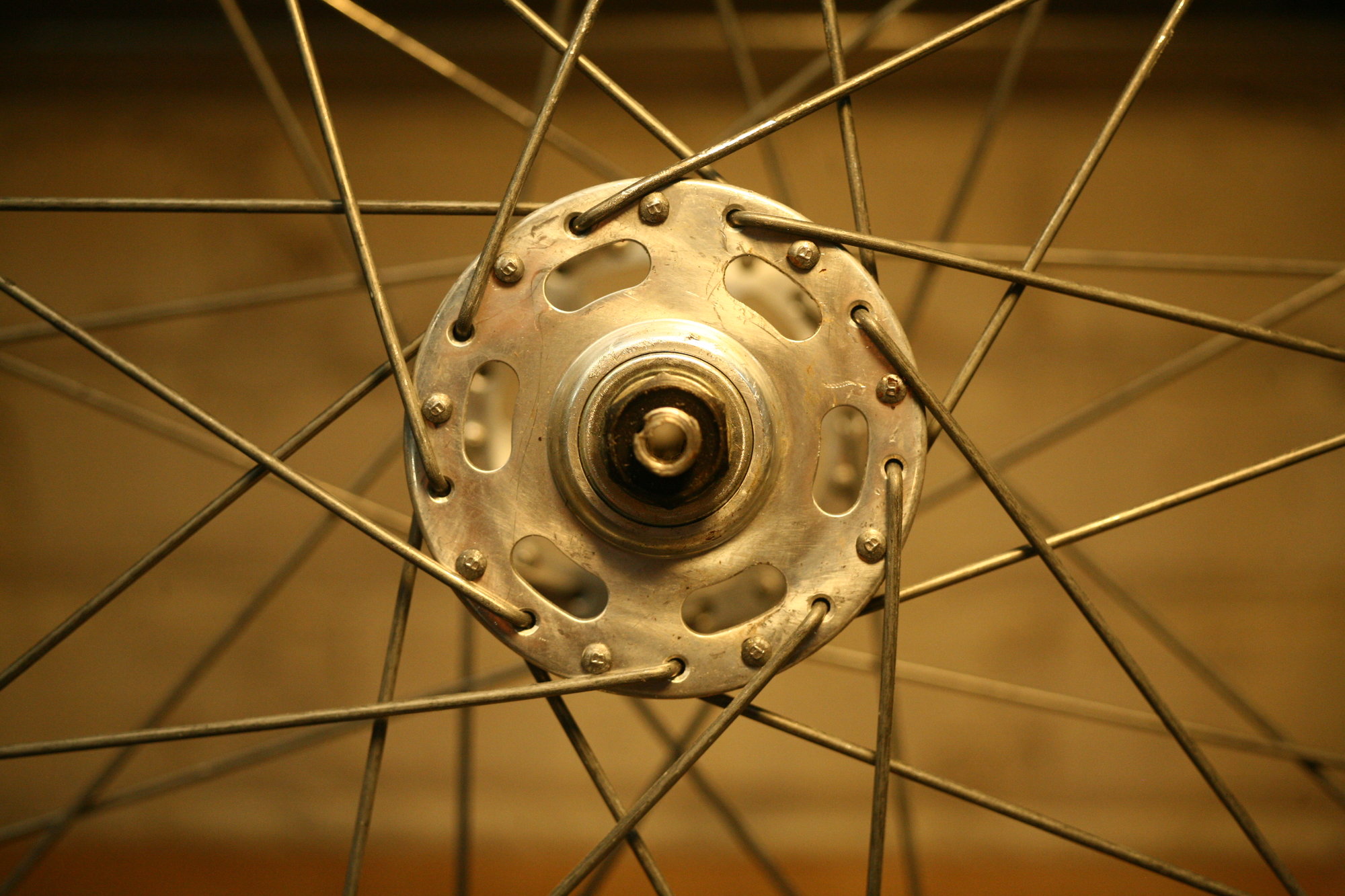
The reason I was curious about 3X vs 4X is because i just picked up a pair of wheels with 27" rims, Normandy HF hubs and 4X spoke pattern and was wondering why someone would build them that way. Would it have been for durability or comfort?
09-18-18 | 09:35 AM
#4
Senior Member

Joined: Mar 2010
Posts: 1,795
Likes: 146
Got it, thanks for clarifying that. I have only built a few pair of 3X wheels on old Normandy high flange hubs, they are slightly smaller in diameter than Campy Record high flange.
The reason I was curious about 3X vs 4X is because i just picked up a pair of wheels with 27" rims, Normandy HF hubs and 4X spoke pattern and was wondering why someone would build them that way. Would it have been for durability or comfort?
The reason I was curious about 3X vs 4X is because i just picked up a pair of wheels with 27" rims, Normandy HF hubs and 4X spoke pattern and was wondering why someone would build them that way. Would it have been for durability or comfort?
One thing about 4X and 630mm rims (ERD about 620, or so) is that you end up with spokes about 307 or 308 mm and it seems uncommon to find spoke longer than about 300 mm listed as stocked, though I've seen some. That seems to indicate to me that not many people are building 622mm and 630 mm rims with 4X anymore. Not everybody can be wrong, can they?
Personally, I rarely build 4X except with 40h Sturmey Archer hubs. Built with some Normandy HF hubs for a Raleigh and used 3X and no singularity occurred.
09-18-18 | 10:28 AM
#5
Banned
Joined: Jun 2010
Posts: 43,586
Likes: 1,380
From: NW,Oregon Coast
Bikes: 8
4 cross, the spokes compress the hub flange aluminum between them ,
as 1st cross is the spoke on the opposite side of the hub flange,
going to the opposite edge of the rim..
3 cross and less the spoke force is pulling in Shear..
Spoke tension , pulling the hole in the aluminum outward towards it's edge..
...
as 1st cross is the spoke on the opposite side of the hub flange,
going to the opposite edge of the rim..
3 cross and less the spoke force is pulling in Shear..
Spoke tension , pulling the hole in the aluminum outward towards it's edge..
...
09-18-18 | 10:29 AM
#6
Senior Member
Joined: Apr 2010
Posts: 2,965
Likes: 518
From: Elevation 666m Edmonton Canada
Bikes: 2013 Custom SA5w / Rohloff Tourster
If the hub is a little 40mm/ hole circle 38mm, then likely use 4 cross.
I recently changed my rim on an old bike, reusing an old but nice front hub. Went from 590 to 584 rim. I goofed and went to 3 cross, thinking the heads would be less overlapped.
So the spoke crossover point moved about 20mm closer to the hub. This resulted in a 1 or 2 mm more bow along the spoke. This is both uglier and more unnecessary stress. And the spoke length would have been the same, darn it. But anyway, I will leave it, likely will be OK. I think 2 cross on really big IGH hubs is best.
I recently changed my rim on an old bike, reusing an old but nice front hub. Went from 590 to 584 rim. I goofed and went to 3 cross, thinking the heads would be less overlapped.
So the spoke crossover point moved about 20mm closer to the hub. This resulted in a 1 or 2 mm more bow along the spoke. This is both uglier and more unnecessary stress. And the spoke length would have been the same, darn it. But anyway, I will leave it, likely will be OK. I think 2 cross on really big IGH hubs is best.
09-18-18 | 11:31 AM
#7

Mostly harmless ™
Joined: Nov 2010
Posts: 4,463
Likes: 244
From: Novi Sad
Bikes: Heavy, with friction shifters
I have several rim and hub pairs that need to be built-up. They are all 36 hole and either 27" or 700c. Each pair will serve a different purpose, either commuting, touring or speeding along a smooth bike path.
What are the advantages and disadvantages of 3X and 4X spoke patterns in road bike wheels?
What are the advantages and disadvantages of 3X and 4X spoke patterns in road bike wheels?
 ) is the max theoretical number of crosses that a wheel can be built with. Generally, for most 26" and greater size rims.
Depending on rim diameter and hub flange diameter, this can vary. Spokecalc I use does warn if, based on effective rim diameter and flange diameter etc, there is a situation that a spoke will overlap the head of adjacent spoke - something that should generally be avoided.
The more crosses, the more the spokes are tangent, which is better (stronger wheel, pluss less stress on the flanges), as the other posters have nicely explained. Up to a point where spokes cross over the heads of adjacent spokes (sober, and still repeating myself, sorry
).
09-18-18 | 07:19 PM
#8
Thread Starter
Senior Member
Joined: Jun 2018
Posts: 1,845
Likes: 723
From: The Urban Shores Of Michigami
Bikes: ........................................ .....Holdsworth "Special"..... .......Falcon "Special".......... .........Miyata 912........... ........................................
09-18-18 | 07:32 PM
#9
Thread Starter
Senior Member
Joined: Jun 2018
Posts: 1,845
Likes: 723
From: The Urban Shores Of Michigami
Bikes: ........................................ .....Holdsworth "Special"..... .......Falcon "Special".......... .........Miyata 912........... ........................................
Divide the number of spokes by 9. The largest whole number (without the .xxx - what's the English word? ) is the max theoretical number of crosses that a wheel can be built with. Generally, for most 26" and greater size rims.
Depending on rim diameter and hub flange diameter, this can vary. Spokecalc I use does warn if, based on effective rim diameter and flange diameter etc, there is a situation that a spoke will overlap the head of adjacent spoke - something that should generally be avoided.
The more crosses, the more the spokes are tangent, which is better (stronger wheel, plus less stress on the flanges), as the other posters have nicely explained. Up to a point where spokes cross over the heads of adjacent spokes (sober, and still repeating myself, sorry ).
) is the max theoretical number of crosses that a wheel can be built with. Generally, for most 26" and greater size rims.Depending on rim diameter and hub flange diameter, this can vary. Spokecalc I use does warn if, based on effective rim diameter and flange diameter etc, there is a situation that a spoke will overlap the head of adjacent spoke - something that should generally be avoided.
The more crosses, the more the spokes are tangent, which is better (stronger wheel, plus less stress on the flanges), as the other posters have nicely explained. Up to a point where spokes cross over the heads of adjacent spokes (sober, and still repeating myself, sorry
).
09-18-18 | 07:58 PM
#10
Thread Starter
Senior Member
Joined: Jun 2018
Posts: 1,845
Likes: 723
From: The Urban Shores Of Michigami
Bikes: ........................................ .....Holdsworth "Special"..... .......Falcon "Special".......... .........Miyata 912........... ........................................
4 cross, the spokes compress the hub flange aluminum between them ,
as 1st cross is the spoke on the opposite side of the hub flange,
going to the opposite edge of the rim..
3 cross and less the spoke force is pulling in Shear..
Spoke tension , pulling the hole in the aluminum outward towards it's edge..
...
as 1st cross is the spoke on the opposite side of the hub flange,
going to the opposite edge of the rim..
3 cross and less the spoke force is pulling in Shear..
Spoke tension , pulling the hole in the aluminum outward towards it's edge..
...
Last edited by branko_76; 09-18-18 at 08:07 PM.
09-18-18 | 08:02 PM
#11
Thread Starter
Senior Member
Joined: Jun 2018
Posts: 1,845
Likes: 723
From: The Urban Shores Of Michigami
Bikes: ........................................ .....Holdsworth "Special"..... .......Falcon "Special".......... .........Miyata 912........... ........................................
If the hub is a little 40mm/ hole circle 38mm, then likely use 4 cross.
I recently changed my rim on an old bike, reusing an old but nice front hub. Went from 590 to 584 rim. I goofed and went to 3 cross, thinking the heads would be less overlapped.
So the spoke crossover point moved about 20mm closer to the hub. This resulted in a 1 or 2 mm more bow along the spoke. This is both uglier and more unnecessary stress. And the spoke length would have been the same, darn it. But anyway, I will leave it, likely will be OK. I think 2 cross on really big IGH hubs is best.
I recently changed my rim on an old bike, reusing an old but nice front hub. Went from 590 to 584 rim. I goofed and went to 3 cross, thinking the heads would be less overlapped.
So the spoke crossover point moved about 20mm closer to the hub. This resulted in a 1 or 2 mm more bow along the spoke. This is both uglier and more unnecessary stress. And the spoke length would have been the same, darn it. But anyway, I will leave it, likely will be OK. I think 2 cross on really big IGH hubs is best.
09-18-18 | 08:05 PM
#12
Thread Starter
Senior Member
Joined: Jun 2018
Posts: 1,845
Likes: 723
From: The Urban Shores Of Michigami
Bikes: ........................................ .....Holdsworth "Special"..... .......Falcon "Special".......... .........Miyata 912........... ........................................
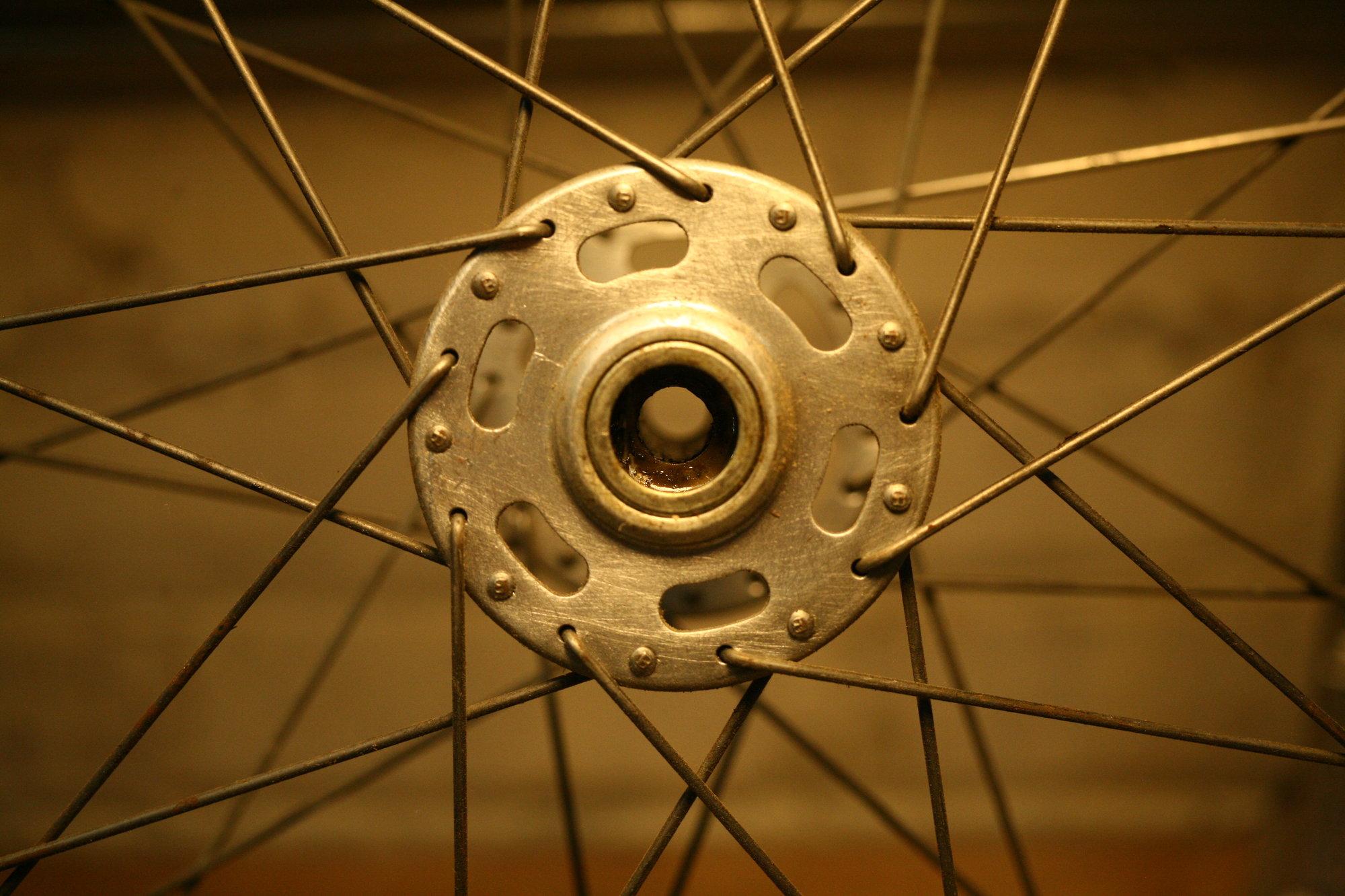
Here's the same hub and rim with 3X pattern...
 09-18-18 | 09:37 PM
#14
Senior Member
Joined: Apr 2015
Posts: 4,272
Likes: 1,304
From: Seattle
More crosses braces a wheel more against torsional forces between hub and rim. But excessive crossing can create issues like the spokes entering the rim at too-oblique angles if the hub flange is too big or rim ERD is too small, and the longer spokes also result in a slightly heavier wheel.
For 36-hole wheels... if these are 700c wheels where the rim is shallow box-section and the hub is low-flange, then you're starting to get into the territory where you can get away with 4-cross, but 3-cross will work too. If you've got a smaller ERD or a high-flange hub, I think you should stick with 3-cross.
For 36-hole wheels... if these are 700c wheels where the rim is shallow box-section and the hub is low-flange, then you're starting to get into the territory where you can get away with 4-cross, but 3-cross will work too. If you've got a smaller ERD or a high-flange hub, I think you should stick with 3-cross.
09-18-18 | 09:56 PM
#15

Senior Member


Joined: Oct 2014
Posts: 14,180
Likes: 5,312
From: Portland, OR
Bikes: (2) ti TiCycles, 2007 w/ triple and 2011 fixed, 1979 Peter Mooney, ~1983 Trek 420 now fixed and ~1973 Raleigh Carlton Competition gravel grinder
I like wheels with the max number of crosses and have built many 4X 36 spoke wheels. Low flange racing wheels, high flange Campy Tipos; probably the biggest common flange diameter out there. My wheels went (and go) a long ways without spoke issues. Several have talked here of the interference between spokes and adjacent heads being an issue. It hasn't been for me and some of my hubs with interference have gone very long distances. I consider it an old wives tale as it matches my experience so poorly. (I build my wheels 4X, note the interference and wonder how long it will be before it gets pointed out I built it "wrong". I still have 2 Tipo front hubs that I still lace up 4X. They are winter wheels so the rims get replaced fairly regularly but I reuse the spokes and pattern.
Edit: One place the extra cross really helps is comfort on chip seal. Riding rural Oregon 4X is a real plus.
Ben
Edit: One place the extra cross really helps is comfort on chip seal. Riding rural Oregon 4X is a real plus.
Ben
Last edited by 79pmooney; 09-18-18 at 10:00 PM.
09-18-18 | 11:11 PM
#16
Mostly harmless ™
Joined: Nov 2010
Posts: 4,463
Likes: 244
From: Novi Sad
Bikes: Heavy, with friction shifters
I like wheels with the max number of crosses and have built many 4X 36 spoke wheels. Low flange racing wheels, high flange Campy Tipos; probably the biggest common flange diameter out there. My wheels went (and go) a long ways without spoke issues. Several have talked here of the interference between spokes and adjacent heads being an issue. It hasn't been for me and some of my hubs with interference have gone very long distances. I consider it an old wives tale as it matches my experience so poorly. (I build my wheels 4X, note the interference and wonder how long it will be before it gets pointed out I built it "wrong". I still have 2 Tipo front hubs that I still lace up 4X. They are winter wheels so the rims get replaced fairly regularly but I reuse the spokes and pattern.
Edit: One place the extra cross really helps is comfort on chip seal. Riding rural Oregon 4X is a real plus.
Ben
Edit: One place the extra cross really helps is comfort on chip seal. Riding rural Oregon 4X is a real plus.
Ben
As for spoke head overlap - similar experience, had no problems, when all done properly. All with 36 spoked 4X wheels. It should be noted that it's not perfect - makes changing a spoke (if needed later) a little bit more complicated and one needst to and can often place an extra bend (over the adjacent spoke head) on the already pretty stressed part of the spoke.
Though, if I'm the one building a wheel (choosing spoke length etc.), I opt for no spoke head overlap.
Last edited by Bike Gremlin; 09-19-18 at 12:15 AM.

Thread
Thread Starter
Forum
Replies
Last Post
avhed
Bicycle Mechanics
13
10-24-13 04:43 PM
bobotech
Bicycle Mechanics
4
09-30-13 07:56 AM
surreal
Bicycle Mechanics
32
01-27-13 09:23 PM
