


App for simulating spoke tensions under load
 12-17-18 | 01:58 PM
#1

Thread Starter
Junior Member
Joined: Nov 2018
Posts: 12
Likes: 0
From: Chicago, IL
Bikes: Velo-Orange Campeur, Dahon Helios P8
App for simulating spoke tensions under load
Hey folks,
I bet many of you are familiar with the wheel deformation calculations done by Jobst Brandt for his book The Bicycle Wheel. I built a web app for designing and testing virtual bicycle wheels. I recently received my PhD in Mechanical Engineering for my thesis on the mechanics and failure modes of bicycle wheels. The web app is based on the theory and simulation code I developed for the thesis. You can find the app at www.bicyclewheel.info
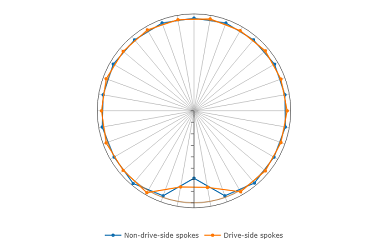
The app calculates spoke tensions and deformation of a bicycle wheel under external forces. For example, the plot below shows the spoke tensions for a wheel supporting weight (a radial load).
You can add whatever forces you want. Below is an example wheel supporting both weight and pedaling torque.

Unlike Brandt's calculation, the web app works in three dimensions, so you can also add lateral loads, and you can use different properties for the DS and NDS spokes. The wheel below has 3-cross spokes on the NDS and radial spokes on the DS and it's supporting weight, pedaling torque, and a lateral load.

Unless you somehow know the exact stiffness of your rim, you will probably want to start with one of the pre-defined rims. The properties of these rims have been measured using the acoustic technique that I developed with Patrick Peng (now at Boeing). Try picking a rim with similar properties and see what happens when you tweak the stiffness.
The app also calculates basic properties like stiffness, mass, effective rotating mass, and maximum tension.
I'm excited to continue improving and updating the app and I'm very interested in hearing feedback from the BikeForums community! Let me know what you think of the app and what improvements you'd like to see.
I bet many of you are familiar with the wheel deformation calculations done by Jobst Brandt for his book The Bicycle Wheel. I built a web app for designing and testing virtual bicycle wheels. I recently received my PhD in Mechanical Engineering for my thesis on the mechanics and failure modes of bicycle wheels. The web app is based on the theory and simulation code I developed for the thesis. You can find the app at www.bicyclewheel.info
The app calculates spoke tensions and deformation of a bicycle wheel under external forces. For example, the plot below shows the spoke tensions for a wheel supporting weight (a radial load).
You can add whatever forces you want. Below is an example wheel supporting both weight and pedaling torque.
Unlike Brandt's calculation, the web app works in three dimensions, so you can also add lateral loads, and you can use different properties for the DS and NDS spokes. The wheel below has 3-cross spokes on the NDS and radial spokes on the DS and it's supporting weight, pedaling torque, and a lateral load.
Unless you somehow know the exact stiffness of your rim, you will probably want to start with one of the pre-defined rims. The properties of these rims have been measured using the acoustic technique that I developed with Patrick Peng (now at Boeing). Try picking a rim with similar properties and see what happens when you tweak the stiffness.
The app also calculates basic properties like stiffness, mass, effective rotating mass, and maximum tension.
I'm excited to continue improving and updating the app and I'm very interested in hearing feedback from the BikeForums community! Let me know what you think of the app and what improvements you'd like to see.


 12-17-18 | 03:31 PM
#3
Senior Member

Joined: Dec 2013
Posts: 2,089
Likes: 350
Thank you for sharing this here. And for doing this study. Am reading now.
Taking a break to suggest you have a nearby resource. Ron Boi of RRB Cycles, Kenilworth, has built a lot of unusual and extraordinary wheels for a very long time. Assisted by his degreed mechanical engineer older brother, Wally. Thirty-five years ago he was building 12-spoke wheels for Lon Haldeman (6'4", over 200#, originator of Race Across AMerica). Those were built from Ambrosio rims taller and heavier and stronger than was common at the time but still well under 500 grams and no one would see them as tall currently. Maybe 20mm tall. Also built quite a few 20 spoke racing wheels with Scheeren rims at about 10mm tall and 200-240 grams, as insubstantial a rim as could be imagined. They worked.
Back to reading.
Taking a break to suggest you have a nearby resource. Ron Boi of RRB Cycles, Kenilworth, has built a lot of unusual and extraordinary wheels for a very long time. Assisted by his degreed mechanical engineer older brother, Wally. Thirty-five years ago he was building 12-spoke wheels for Lon Haldeman (6'4", over 200#, originator of Race Across AMerica). Those were built from Ambrosio rims taller and heavier and stronger than was common at the time but still well under 500 grams and no one would see them as tall currently. Maybe 20mm tall. Also built quite a few 20 spoke racing wheels with Scheeren rims at about 10mm tall and 200-240 grams, as insubstantial a rim as could be imagined. They worked.
Back to reading.
12-17-18 | 04:24 PM
#4

Senior member


Joined: Oct 2004
Posts: 8,368
Likes: 888
From: Oakville Ontario
Thanks for this. Working my way through your thesis now. Much of it goes well over my head, but maybe if I revisit those parts a bunch of times, I'll absorb some of it.
I like that you did actual testing rather than relying exclusively on computer modeling to test your theories. Some great stuff in there.
I like that you did actual testing rather than relying exclusively on computer modeling to test your theories. Some great stuff in there.
12-17-18 | 05:04 PM
#5
Thread Starter
Junior Member
Joined: Nov 2018
Posts: 12
Likes: 0
From: Chicago, IL
Bikes: Velo-Orange Campeur, Dahon Helios P8
Thanks! I was lucky enough to work with a great group of undergraduate students who built a "wheel tacoing machine" -- basically a fixture that fits inside a standard compression testing machine and supports the bicycle wheel, but allows lateral motion of the rim when it tacos. I essentially only used computer modeling to validate the theoretical models, which I consider to be more useful and explanatory.

Thread
Thread Starter
Forum
Replies
Last Post
corrado33
Bicycle Mechanics
9
08-30-16 10:46 AM
