


Wheel building essentials?
 07-31-19 | 02:34 AM
#1
Thread Starter
Senior Member
Joined: Apr 2019
Posts: 262
Likes: 139
From: Honolulu
Wheel building essentials?
Taking a big bite!
Okay, so I'm gonna order this:
TS 2.2 stand
TSB-2.2 base
TM-1 tensioner
ND-1 driver
WAG-4 dish thingy
Any idea what nipple driver I need for Sapim polyax brass nipples?
Searcing the ole tool box I found a SW15 and SW19...I think I used these on my Campag wheels.
Do I need the micrometers or just eyeball it?
Nothing else I need?
TIA
Okay, so I'm gonna order this:
TS 2.2 stand
TSB-2.2 base
TM-1 tensioner
ND-1 driver
WAG-4 dish thingy
Any idea what nipple driver I need for Sapim polyax brass nipples?
Searcing the ole tool box I found a SW15 and SW19...I think I used these on my Campag wheels.
Do I need the micrometers or just eyeball it?
Nothing else I need?
TIA
Last edited by jideta; 07-31-19 at 02:38 AM.
 07-31-19 | 03:09 AM
#2

The dropped

Joined: Oct 2018
Posts: 2,182
Likes: 1,055
From: Columbus, OH
Bikes: Pake C'Mute Touring/Commuter Build, 1989 Kona Cinder Cone, 1995 Trek 5200, 1973 Raleigh Super Course FG, 1969 Raleigh Superbe, 1986 Miyata Nine : 1960/61 Montgomery Ward Hawthorne "thrift" 3 speed, by Hercules (sold), 1966 Schwinn Deluxe Racer (sold)
That's a good start
Will you be building for customers professionally, or just your own wheels? Your listed equipment isn't cheap, and there's plenty of opportunity to save money if it's not going to be a major offering from you. OTOH, if you're offering professional builds, a gauge tensiometer like wheel fanatyk's can help you dial in absolute tension. A dish stick is good for getting dish dialed in to under a millimeter quickly, but not necessary with a stand that also centers. You'll need to decide about the micrometer. Spoke lengths can tolerate some variation, but performing your own quality control on spoke gauge can help you even tension out easily, and build wheels that stay true longer.
IMO the aids all exist to make the job easier and therefore faster. If time is money, saving time is worth a few extra bucks.
IMO the aids all exist to make the job easier and therefore faster. If time is money, saving time is worth a few extra bucks.
Last edited by Unca_Sam; 07-31-19 at 09:17 AM.
07-31-19 | 08:18 AM
#3
With a mighty wind


Joined: May 2015
Posts: 3,488
Likes: 1,538
This is professional quality stuff.
I've built plenty of wheels with nothing but a spoke wrench and flathead screwdriver. Some were very good wheels. I now use a Park clone I got for $150. It came with better wrenches than Park makes.
I've never had any structural problems -spoke breakage, dish, cracking, or ovals.
If I was selling rims, I'd use better tools so I could justify to the customer the price. I don't think all those tools will make your wheels any better once you get the hang of it.
I've built plenty of wheels with nothing but a spoke wrench and flathead screwdriver. Some were very good wheels. I now use a Park clone I got for $150. It came with better wrenches than Park makes.
I've never had any structural problems -spoke breakage, dish, cracking, or ovals.
If I was selling rims, I'd use better tools so I could justify to the customer the price. I don't think all those tools will make your wheels any better once you get the hang of it.
07-31-19 | 08:31 AM
#4

Senior Member
Joined: Aug 2011
Posts: 22,676
Likes: 2,643
From: CID
Bikes: 1991 Bianchi Eros, 1964 Armstrong, 1988 Diamondback Ascent, 1988 Bianchi Premio, 1987 Bianchi Sport SX, 1980s Raleigh mixte (hers), All-City Space Horse (hers)
^ +1. Spoke wrench and flathead screwdriver are the only essential tools, but nice tools are satisfying to use. 
07-31-19 | 08:45 AM
#5
Senior Member

Joined: Dec 2010
Posts: 9,689
Likes: 2,609
From: northern Deep South
Bikes: Fuji Touring, Novara Randonee
I'd call or email the place you're ordering from and ask about the spoke wrench that fits the Sapim nipple you want.
FWIW, the Park Master spoke wrench (SW-20.2 or 22.2) is much nicer than the SW-0 and its cousins, IME.
FWIW, the Park Master spoke wrench (SW-20.2 or 22.2) is much nicer than the SW-0 and its cousins, IME.
07-31-19 | 09:33 AM
#6

Senior Member
Joined: Oct 2014
Posts: 14,180
Likes: 5,313
From: Portland, OR
Bikes: (2) ti TiCycles, 2007 w/ triple and 2011 fixed, 1979 Peter Mooney, ~1983 Trek 420 now fixed and ~1973 Raleigh Carlton Competition gravel grinder
I've been using a $30 cheapo stand for 30 years. An equally cheap dishing tool that I modified so I no longer have to remover the QR or track nut. The colored Park spoke wrenches. I did buy a Park tensioner but matching the pitch of similarly spoked good wheels works just as well. Made a spoke starter from the threaded half of a spoke, screwing a nipple on backwards tightly (so about three threads stick out; just enough to thread nipples on) and bending a loop handle.
All this probably costs less than the OP's most expensive item.
All this probably costs less than the OP's most expensive item.
07-31-19 | 09:38 AM
#7

FLIR Kitten to 0.05C
Joined: Sep 2014
Posts: 5,331
Likes: 409
From: Lincoln, Nebraska
Bikes: Roadie: Seven Axiom Race Ti w/Chorus 11s. CX/Adventure: Carver Gravel Grinder w/ Di2
Taking a big bite!
Okay, so I'm gonna order this:
TS 2.2 stand
TSB-2.2 base
TM-1 tensioner
ND-1 driver
WAG-4 dish thingy
Any idea what nipple driver I need for Sapim polyax brass nipples?
Searcing the ole tool box I found a SW15 and SW19...I think I used these on my Campag wheels.
Do I need the micrometers or just eyeball it?
Nothing else I need?
TIA
Okay, so I'm gonna order this:
TS 2.2 stand
TSB-2.2 base
TM-1 tensioner
ND-1 driver
WAG-4 dish thingy
Any idea what nipple driver I need for Sapim polyax brass nipples?
Searcing the ole tool box I found a SW15 and SW19...I think I used these on my Campag wheels.
Do I need the micrometers or just eyeball it?
Nothing else I need?
TIA
The TM1 is honestly a waste of money. Park should stop even selling it. For the money there are far better tension gauges out there--shoot for $80 you can build your own digital one that will be most accurate and precise both short and long term.
07-31-19 | 10:56 AM
#9
Senior Member
Joined: Aug 2011
Posts: 22,676
Likes: 2,643
From: CID
Bikes: 1991 Bianchi Eros, 1964 Armstrong, 1988 Diamondback Ascent, 1988 Bianchi Premio, 1987 Bianchi Sport SX, 1980s Raleigh mixte (hers), All-City Space Horse (hers)
To add, I've never used one of those dishing tools. Generally, you can flip the wheel around in the stand, or use soup cans on a table, to determine whether the wheel is centered.
07-31-19 | 11:11 AM
#10

Senior Member

Joined: Aug 2005
Posts: 1,224
Likes: 21
From: New Hampshire
Bikes: Niner RLT 9 RDO, Niner RLT9 Alloy
Keep in mind that cheaper stands will be flexier. Not a big deal if you know how to avoid it, but this is one of those cases where a pro quality tool can sometimes actually be better for a beginner who doesn't have the experience to know how to compensate for a tool's weaknesses. That said, the Park TS-2.2 is big, expensive, and takes up a lot of space so if you aren't going to have a permanent place to put it, something cheaper that folds up nicely might be better. Just don't touch the rim when taking a reading or you'll have a hard time truing up a wheel on a flexy stand.
And if I could only have a stand, a spoke wrench, and one more tool, it certainly wouldn't be a nipple driver (it would be a tensiometer without question). I have the classic Bicycle Research Tools nipple driver, and it usually gets the spokes way too tight for this stage of the build. The probe that sets the depth of the spoke in the nipple should really be about twice as long, and the Park ND-1 doesn't look any better. I size my spokes on the short side though (i.e. bottom of the screwdriver slot). If you err on the long side so that you have a thread or two of spoke sticking out of the top of the nipple when you're done, then the nipple drivers might work better.
P.S. One tool you forgot about is a spoke ruler. Very handy for double-checking the length of new spokes, especially when ordering custom-cut spokes.
And if I could only have a stand, a spoke wrench, and one more tool, it certainly wouldn't be a nipple driver (it would be a tensiometer without question). I have the classic Bicycle Research Tools nipple driver, and it usually gets the spokes way too tight for this stage of the build. The probe that sets the depth of the spoke in the nipple should really be about twice as long, and the Park ND-1 doesn't look any better. I size my spokes on the short side though (i.e. bottom of the screwdriver slot). If you err on the long side so that you have a thread or two of spoke sticking out of the top of the nipple when you're done, then the nipple drivers might work better.
P.S. One tool you forgot about is a spoke ruler. Very handy for double-checking the length of new spokes, especially when ordering custom-cut spokes.
Last edited by Metaluna; 07-31-19 at 11:17 AM.
07-31-19 | 11:16 AM
#11
Senior Member
Joined: Dec 2010
Posts: 9,689
Likes: 2,609
From: northern Deep South
Bikes: Fuji Touring, Novara Randonee
I can't agree with this TM-1 assessment. Using the TM-1 on wheels I build/rebuild has meant going from monthly truing checks to annual touch-ups for me over the last ten years. I broke a spoke last year -- or maybe it was the year before, or the year before that. The TM-1 is the least expensive tensiometer I've seen on the market. It was worth every penny I spent on it (although mine was on sale for $50, IIRC). No, it's not a Fanatyk way to spend four C-notes, but it's a decent tool giving decent results at a decent price.
 07-31-19 | 11:38 AM
#12
Senior Member
Joined: Aug 2005
Posts: 1,224
Likes: 21
From: New Hampshire
Bikes: Niner RLT 9 RDO, Niner RLT9 Alloy
I can't agree with this TM-1 assessment. Using the TM-1 on wheels I build/rebuild has meant going from monthly truing checks to annual touch-ups for me over the last ten years. I broke a spoke last year -- or maybe it was the year before, or the year before that. The TM-1 is the least expensive tensiometer I've seen on the market. It was worth every penny I spent on it (although mine was on sale for $50, IIRC). No, it's not a Fanatyk way to spend four C-notes, but it's a decent tool giving decent results at a decent price.
By the way, the Wheel Fanatyk tensiometer just had a significant price drop due to them switching to a cheaper indicator (apparently the one they were using was discontinued). It's still around 3x the price of the Park, though. Like the TM-1, I'm sure there are knockoffs that are much cheaper (the Wheel Fanatyk gauge is itself a well-executed implementation of the Jobst Brandt design, which they openly acknowledge)
07-31-19 | 12:09 PM
#13
Senior Member
Joined: Feb 2009
Posts: 6,660
Likes: 177
I like this one. https://www.wheelfanatyk.com/store/pk-lie-spoke-wrench/
07-31-19 | 12:13 PM
#14

Generally bewildered
Joined: Aug 2015
Posts: 3,038
Likes: 344
From: Eastern PA, USA
Bikes: 2014 Trek Domane 6.9, 1999 LeMond Zurich, 1978 Schwinn Superior
I can't agree with this TM-1 assessment. Using the TM-1 on wheels I build/rebuild has meant going from monthly truing checks to annual touch-ups for me over the last ten years. I broke a spoke last year -- or maybe it was the year before, or the year before that. The TM-1 is the least expensive tensiometer I've seen on the market. It was worth every penny I spent on it (although mine was on sale for $50, IIRC). No, it's not a Fanatyk way to spend four C-notes, but it's a decent tool giving decent results at a decent price.
07-31-19 | 02:00 PM
#15
Senior Member
Joined: Feb 2012
Posts: 3,036
Likes: 1,068
From: Golden, CO and Tucson, AZ
Bikes: 2012 Specialized Elite Disc, 1983 Trek 520
I'm one of the misers who built my first wheels with zero investment. I used an old frame for a stand, made a pretty nice dishing tool from a piece of bed frame and some spare hardware, and used the spoke wrench I already had. For my second set of wheels I bought a nipple driver for less than $10, and I thought that was worth it. (Those were 40-spoke wheels.)
I have a pretty good musical ear, and even with access to a tension meter now I don't use it much.
I have a pretty good musical ear, and even with access to a tension meter now I don't use it much.
07-31-19 | 07:34 PM
#16
Thread Starter
Senior Member
Joined: Apr 2019
Posts: 262
Likes: 139
From: Honolulu
I ended up popping for the Park stand.
Also ordered the Wheel Fanatyk gauge.
So from what I've been reading, no need the dish gauge as long as stand is centered?
First job: re build my Campag wheels.
Also ordered the Wheel Fanatyk gauge.
So from what I've been reading, no need the dish gauge as long as stand is centered?
First job: re build my Campag wheels.
08-01-19 | 10:40 AM
#17
The dropped
Joined: Oct 2018
Posts: 2,182
Likes: 1,055
From: Columbus, OH
Bikes: Pake C'Mute Touring/Commuter Build, 1989 Kona Cinder Cone, 1995 Trek 5200, 1973 Raleigh Super Course FG, 1969 Raleigh Superbe, 1986 Miyata Nine : 1960/61 Montgomery Ward Hawthorne "thrift" 3 speed, by Hercules (sold), 1966 Schwinn Deluxe Racer (sold)
Good luck with it! I feel bad in a way I suggested the wheel fanatyck tension meter because of the cost.  I would be strongly considering a side business building and repairing wheels for that money. You're just missing a spoke cutter and threader for your custom wheel shop
  .
.
I understand spoke tension is important for the strength of the wheel, but also that there's a wide range of acceptable values for tension. After the wheel firms up, relative tension is more important than absolute values, since you'll be in the acceptable tension range then. A cheaper consistent gauge is adequate for the job for my own wheels.
Good luck in your endeavor, I hope it ends up being a rewarding experience!
I would be strongly considering a side business building and repairing wheels for that money. You're just missing a spoke cutter and threader for your custom wheel shop .I understand spoke tension is important for the strength of the wheel, but also that there's a wide range of acceptable values for tension. After the wheel firms up, relative tension is more important than absolute values, since you'll be in the acceptable tension range then. A cheaper consistent gauge is adequate for the job for my own wheels.
Good luck in your endeavor, I hope it ends up being a rewarding experience!
08-01-19 | 11:07 AM
#19
Thread Starter
Senior Member
Joined: Apr 2019
Posts: 262
Likes: 139
From: Honolulu
Good luck with it! I feel bad in a way I suggested the wheel fanatyck tension meter because of the cost. I would be strongly considering a side business building and repairing wheels for that money. You're just missing a spoke cutter and threader for your custom wheel shop .
I understand spoke tension is important for the strength of the wheel, but also that there's a wide range of acceptable values for tension. After the wheel firms up, relative tension is more important than absolute values, since you'll be in the acceptable tension range then. A cheaper consistent gauge is adequate for the job for my own wheels.
Good luck in your endeavor, I hope it ends up being a rewarding experience!
I would be strongly considering a side business building and repairing wheels for that money. You're just missing a spoke cutter and threader for your custom wheel shop .I understand spoke tension is important for the strength of the wheel, but also that there's a wide range of acceptable values for tension. After the wheel firms up, relative tension is more important than absolute values, since you'll be in the acceptable tension range then. A cheaper consistent gauge is adequate for the job for my own wheels.
Good luck in your endeavor, I hope it ends up being a rewarding experience!
If I didn't know about it, I would have eventually and bought it anyways.
All my other tools are Snap On. I'm just like that.
08-01-19 | 11:19 AM
#21

Jedi Master
Joined: Sep 2014
Posts: 3,728
Likes: 501
From: Lake Forest, IL
Bikes: https://stinkston.blogspot.com/p/my-bikes.html
I made this nifty nipple driver out of an old screwdriver and a file handle, and I use two stacks of poker chips on the table for my dishing tool.

08-01-19 | 11:53 AM
#22
Senior Member
Joined: Aug 2005
Posts: 1,224
Likes: 21
From: New Hampshire
Bikes: Niner RLT 9 RDO, Niner RLT9 Alloy
In fact, there's even a build method (described by Wheel Fanatyk in his blog, IIRC) that relies on keeping the dish way off to the drive side until late in the process. Having the wheel centered over the drive side hub flange is supposed to make radial truing much easier, plus keeps the DS tension relatively low for most of the process. Then you finish off the wheel by tensioning the NDS spokes and pulling the rim to the center. Or maybe it's the other way around. Anyway, I've never tried it but it sounds interesting.
A nipple driver with a usefully long, or adjustable, depth gauge should help keep the wheel relatively straight from the start and hopefully would minimize this problem. I've been eyeing the Problem Solvers one that Wheel Fanatyk sells (I also occasionally get close to impulse buying their tensiometer but so far have been able to stop myself
).
Last edited by Metaluna; 08-01-19 at 12:11 PM.
08-01-19 | 12:42 PM
#23
Generally bewildered
Joined: Aug 2015
Posts: 3,038
Likes: 344
From: Eastern PA, USA
Bikes: 2014 Trek Domane 6.9, 1999 LeMond Zurich, 1978 Schwinn Superior
Or your can spring for the Park centering gauge for truing stands. About 80 bucks. I did, and found out that my centering job had been 1mm off. But you're not supposed to use the TS to get the exact dish.
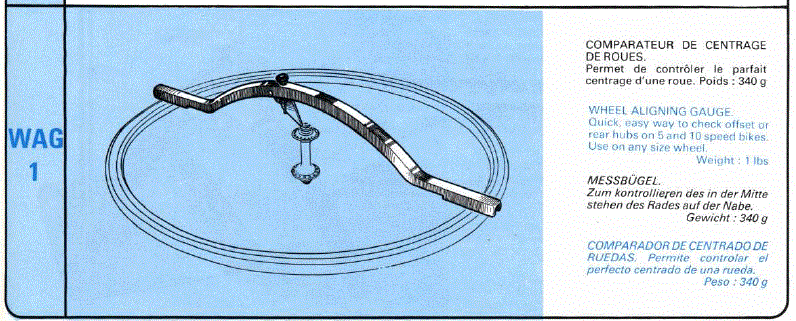
You should be able to create a dish gage with some pieces of wood (1x2 works) and some all-thread with matching washers and nuts. A long enough piece of wood to span the rim, with spacer blocks glued and/or screwed to the ends to give you spacing. Then you drill a hole in the center and install the all-thread (threaded rod) with washers and nuts. In fact, if you drill your hole a little small, your all-thread will probably form threads when you install it. I scored an old VAR WAG-1 dishing tool for cheap (below).
I recently inherited a wheel my step-dad made. He used his own dishing tool (of the blocks of wood variety), and centered the wheel in a frame. It was spot-on center, true, and had all the spokes with nearly identical tension. You've kind of got the Ford F-150 of truing stands (the Rolls Royce is the DT Swiss model but it costs 2 grand). Your model will give you excellent results for a long time.
Last edited by WizardOfBoz; 08-01-19 at 01:59 PM.
08-01-19 | 12:53 PM
#24

Senior Member

Joined: Feb 2004
Posts: 30,225
Likes: 649
From: St Peters, Missouri
Bikes: Catrike 559 I own some others but they don't get ridden very much.
The dish gauge is definitely a nice to have rather than a need to have tool. Depending on your truing stand for perfect, or even adequate, dishing is something I don't do.
__________________
My greatest fear is all of my kids standing around my coffin and talking about "how sensible" dad was.
My greatest fear is all of my kids standing around my coffin and talking about "how sensible" dad was.
08-01-19 | 01:06 PM
#25
The dropped
Joined: Oct 2018
Posts: 2,182
Likes: 1,055
From: Columbus, OH
Bikes: Pake C'Mute Touring/Commuter Build, 1989 Kona Cinder Cone, 1995 Trek 5200, 1973 Raleigh Super Course FG, 1969 Raleigh Superbe, 1986 Miyata Nine : 1960/61 Montgomery Ward Hawthorne "thrift" 3 speed, by Hercules (sold), 1966 Schwinn Deluxe Racer (sold)
