


Weld in bottom bracket?
 06-01-21 | 03:53 PM
#1
Thread Starter
Member
Joined: Apr 2017
Posts: 41
Likes: 4
Weld in bottom bracket?
Hello!
I bought this track frameset recently, and it has a weird weld in the bottom bracket. To me it doesn't make sense - was this done on some BBs or is this just an attempt at a repair job?
Another picture attached shows crimping on the right chainstay which seems relatively normal (for large chainring clearace in this small frame), but I guess could also have been a home job?
Cheers.

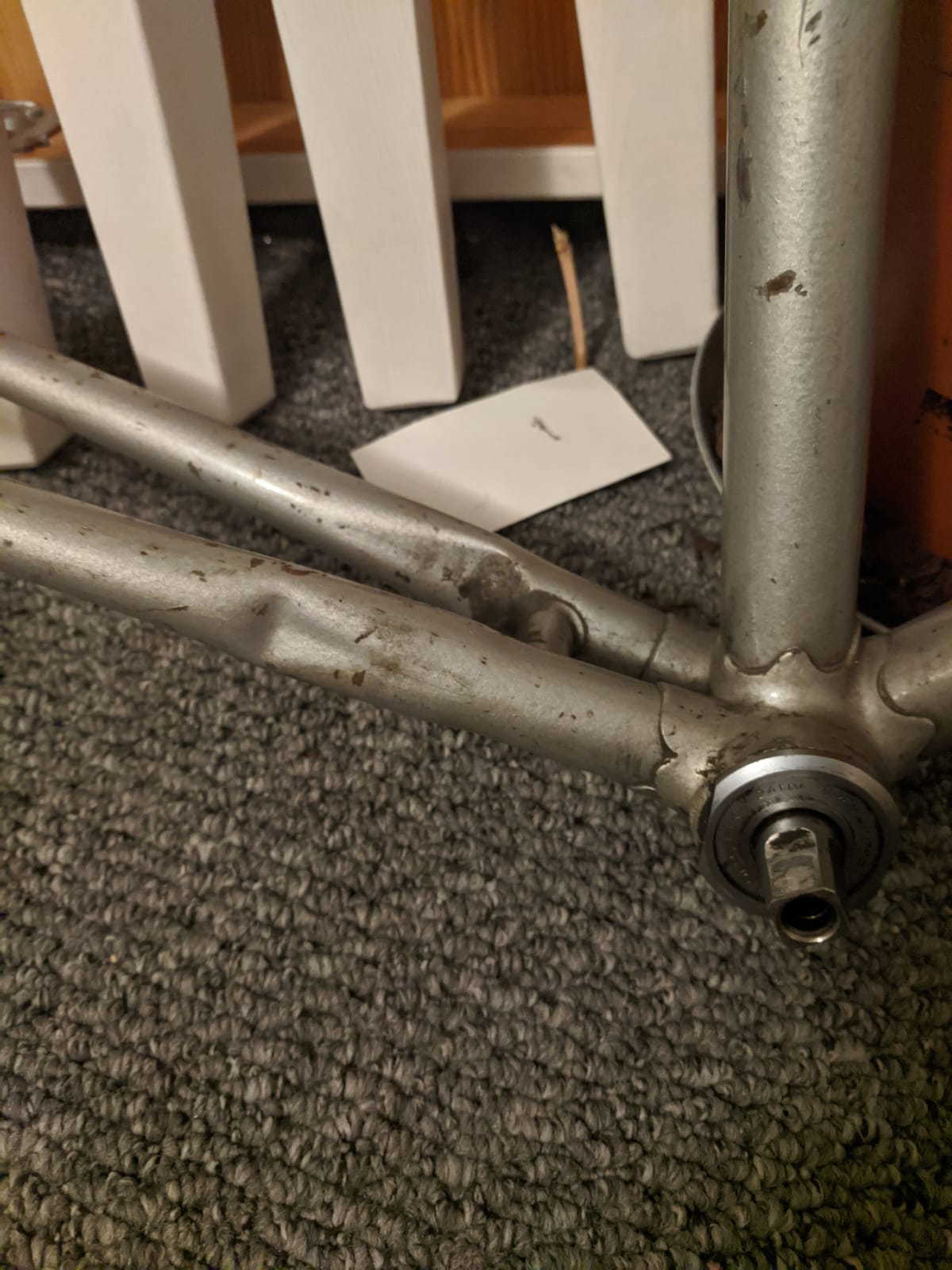
I bought this track frameset recently, and it has a weird weld in the bottom bracket. To me it doesn't make sense - was this done on some BBs or is this just an attempt at a repair job?
Another picture attached shows crimping on the right chainstay which seems relatively normal (for large chainring clearace in this small frame), but I guess could also have been a home job?
Cheers.
 06-01-21 | 04:09 PM
#2

(rhymes with spook)
Joined: Aug 2009
Posts: 2,786
Likes: 749
From: Winslow, AR
Bikes: '83 univega gran turismo x2, '85 schwinn super le tour,'89 miyata triple cross, '91 GT tequesta, '90 yokota grizzly peak, '94 GT backwoods, '95'ish scott tampico, '98 bonty privateer, '93 mongoose crossway 625, '98 parkpre ariel, 2k'ish giant fcr3
1) That looks like factory paint. That in mind, the paint doesn't look to be disturbed or redone in order to make a repair weld or to crimp the stay
2) It also looks to be a "low end" frame. (I don't care to use that term, but it's the best I can do for the moment) and a factory weld like that isn't inconceivable as a way to join the tube. Tubing is either drawn in one piece or rolled and then welded at the seam. You usually find the latter to be the case for more cheaply made frames. Incidentally, a common moniker for cheap frames is "gas pipe" tubing
2) It also looks to be a "low end" frame. (I don't care to use that term, but it's the best I can do for the moment) and a factory weld like that isn't inconceivable as a way to join the tube. Tubing is either drawn in one piece or rolled and then welded at the seam. You usually find the latter to be the case for more cheaply made frames. Incidentally, a common moniker for cheap frames is "gas pipe" tubing
06-01-21 | 04:20 PM
#4

SE Wis

Joined: Apr 2005
Posts: 11,548
Likes: 4,329
From: Milwaukee, WI
Bikes: '68 Raleigh Sprite, '02 Raleigh C500, '84 Raleigh Gran Prix, '91 Trek 400, 2013 Novara Randonee, 1990 Trek 970
06-01-21 | 05:08 PM
#5

Facts just confuse people


Joined: Jul 2017
Posts: 19,317
Likes: 7,048
From: Mississippi
Bikes: Tarmac Disc Comp Di2 - 2020
Not weird at all. You'll see more welds like that the further back in time you go with bikes. They just didn't worry about cleaning up welds as much as they do today.
Many bottom brackets were made from a flat piece of steel. Though it might have been sold to the bike builder as a round piece already.
Many will be surprised at how much tubing and piping is made from flat sheets welded up into a round and then the weld removed by grinding and other processes.
Many bottom brackets were made from a flat piece of steel. Though it might have been sold to the bike builder as a round piece already.
Many will be surprised at how much tubing and piping is made from flat sheets welded up into a round and then the weld removed by grinding and other processes.

 06-01-21 | 07:49 PM
#6
(rhymes with spook)
Joined: Aug 2009
Posts: 2,786
Likes: 749
From: Winslow, AR
Bikes: '83 univega gran turismo x2, '85 schwinn super le tour,'89 miyata triple cross, '91 GT tequesta, '90 yokota grizzly peak, '94 GT backwoods, '95'ish scott tampico, '98 bonty privateer, '93 mongoose crossway 625, '98 parkpre ariel, 2k'ish giant fcr3
i believe the vast majority of bike frames are made from rolled tubes, are they not? even top of the line stuff. seamless tubes are expensive
06-01-21 | 08:33 PM
#7

Senior Member


Joined: Sep 2014
Posts: 3,902
Likes: 680
There's a seam on the BB of my 1963 electro-forged Schwinn. They started with sheet metal and formed it into that shape. I'd say that it was a great idea when it was invented, but succumbed to higher precision and lighter weight techniques.
To make it cheaper, you could eliminate the weld and hope for the best. One of my kids bikes was that way. Fortunately it was outgrown before anything went wrong.
To make it cheaper, you could eliminate the weld and hope for the best. One of my kids bikes was that way. Fortunately it was outgrown before anything went wrong.
06-02-21 | 11:41 PM
#9
Full Member
Joined: May 2020
Posts: 459
Likes: 135
Who came out with investment cast lugs first, was it Cinelli?
"Traditional stamped lugs (aka pressed lugs) are formed by pressing sheet steel over a mandrel, bending them to shape, and then welding the seams. These lugs are of constant thickness resulting in stress risers, if large amounts of file work are not done to alter the thickness of the lug. They are easily identified by the visible seam.[6]
Lugs used today on higher performance bicycles are investment cast (aka lost wax process). Copies of the lugs are made in wax, and they are attached together into a "tree". The tree is surrounded by ceramic and fired in a kiln, thereby melting the wax and setting the ceramic. Finally, molten steel is poured in to produce the lug. Cast lugs have many advantages over stamped lugs: they allow much finer detail, tighter tolerances (and correspondingly less manipulation and file work), and more accurate angles, and they can be made from superior materials (chromoly or stainless steel). The disadvantages of cast lugs are few: casting doesn't allow for long points or cutouts (done for aesthetic appeal), it is difficult to bend the lug to change the angle (requiring framebuilders to order lug sets that precisely match the desired frame geometry), and they are more expensive."
"Traditional stamped lugs (aka pressed lugs) are formed by pressing sheet steel over a mandrel, bending them to shape, and then welding the seams. These lugs are of constant thickness resulting in stress risers, if large amounts of file work are not done to alter the thickness of the lug. They are easily identified by the visible seam.[6]
Lugs used today on higher performance bicycles are investment cast (aka lost wax process). Copies of the lugs are made in wax, and they are attached together into a "tree". The tree is surrounded by ceramic and fired in a kiln, thereby melting the wax and setting the ceramic. Finally, molten steel is poured in to produce the lug. Cast lugs have many advantages over stamped lugs: they allow much finer detail, tighter tolerances (and correspondingly less manipulation and file work), and more accurate angles, and they can be made from superior materials (chromoly or stainless steel). The disadvantages of cast lugs are few: casting doesn't allow for long points or cutouts (done for aesthetic appeal), it is difficult to bend the lug to change the angle (requiring framebuilders to order lug sets that precisely match the desired frame geometry), and they are more expensive."
06-03-21 | 12:01 PM
#10

Old fart
Joined: Nov 2004
Posts: 26,345
Likes: 5,251
From: Appleton WI
Bikes: Several, mostly not name brands.
That's a bulge-formed bottom bracket shell. It starts out as a piece of sheet metal. Spigots for the various tubes are pressed into the sheet. then the sheet is rolled circular to form the bottom bracket shell and the seam welded closed. The ends of the tube spigots are milled off, and the shell tapped for the bottom bracket cups. On a low-end frame, little or no effort may be spent making the weld seam attractive.
 06-03-21 | 06:21 PM
#11

Senior Member
Joined: Jul 2005
Posts: 4,987
Likes: 709
From: Boulder County, CO
Bikes: '80 Masi Gran Criterium, '12 Trek Madone, early '60s Frejus track
Hardly anybody makes mass-market steel frames anymore. It's all aluminum.
Last edited by oldbobcat; 06-03-21 at 06:26 PM.
06-03-21 | 09:08 PM
#12
Randomhead
Joined: Aug 2008
Posts: 25,930
Likes: 4,825
From: Happy Valley, Pennsylvania
It's hard to see from the pictures if this is a low-end frame or not. Most factories didn't grind that weld off, and many European BB shells had a prominent weld there. The lug companies would do a decent job of cleaning up the inside of lugs/bb shells, but left the outside to bike manufacturers. I was impressed by how bad the finish was on Nervex Pro lugs, they were just horrible.
