Rolling Resistance: Hubs
 06-14-24 | 06:48 PM
#51
Senior Member


Joined: Aug 2009
Posts: 3,113
Likes: 1,617
 06-14-24 | 07:16 PM
#52
Senior Member

Joined: Apr 2009
Posts: 39,897
Likes: 3,865
From: New Rochelle, NY
Bikes: too many bikes from 1967 10s (5x2)Frejus to a Sumitomo Ti/Chorus aluminum 10s (10x2), plus one non-susp mtn bike I use as my commuter
Sounds good, Knob Creek and a splash.
__________________
FB
Chain-L site
An ounce of diagnosis is worth a pound of cure.
Just because I'm tired of arguing, doesn't mean you're right.
“One accurate measurement is worth a thousand expert opinions” - Adm Grace Murray Hopper - USN
WARNING, I'm from New York. Thin skinned people should maintain safe distance.
FB
Chain-L site
An ounce of diagnosis is worth a pound of cure.
Just because I'm tired of arguing, doesn't mean you're right.
“One accurate measurement is worth a thousand expert opinions” - Adm Grace Murray Hopper - USN
WARNING, I'm from New York. Thin skinned people should maintain safe distance.
06-14-24 | 07:20 PM
#53

Senior Member


Joined: Apr 2011
Posts: 12,627
Likes: 4,781
Drop a ping pong and ball bearing from a building, the ball bearing hits first because it has a higher terminal velocity. Gravity acts on its greater mass to overcome air resistance much more than the same sized ping pong ball. That's an example unaffected by buoyancy.
06-15-24 | 03:53 AM
#54
Senior Member
Joined: Sep 2021
Posts: 1,596
Likes: 864
From: SW Florida, USA
Bikes: Yes
From what you said above, it appeared to me you didn't realize that a stationary (with respect to linear motion) object that is rotating has rotational inertia. Because otherwise it's hard to see how you missed [MENTION=23624]Trakhak[/MENTION] 's analogy, even if the scenario he presented could be better.
Here's how this relates: at the time of impact with the water, both the ping-pong ball and the bearing ball will have linear momentum (a quantification of its inertia at a given velocity) and linear kinetic energy due to the uniform acceleration of gravity minus aerodynamic drag. Each must shed all of their kinetic energy - and thus momentum - prior to coming to a stop.
Since the items here are of similar size, aerodynamic forces acting on each over a 12" drop would be roughly the same. The relative depth each achieved before stopping would indicate which had the greater kinetic energy (and thus momentum) at time of impact with the water's surface.
Unfortunately, in Trakhak's example the steel ball won't ever be stopped completely because it is denser than water. It will thus and will continue to sink after shedding the kinetic energy acquired before striking the surface.
Had he used a smooth oak sphere (density approx 0.6 to 0.9 g/cm3, depending on variety) the size of a ping-pong ball instead of a steel bearing ball of that size, the analogy might have been easier to grasp. In this revised scenario, both the wooden sphere and ping-pong ball would stop after hitting the water, then float afterwards. But the oak sphere, being far denser, would penetrate the surface to an appreciably greater depth than the ping-pong ball due to its greater momentum and kinetic energy at time of impact. The approximate difference could be determined by measuring the max depth reached by each and comparing them.

Since the items here are of similar size, aerodynamic forces acting on each over a 12" drop would be roughly the same. The relative depth each achieved before stopping would indicate which had the greater kinetic energy (and thus momentum) at time of impact with the water's surface.
Unfortunately, in Trakhak's example the steel ball won't ever be stopped completely because it is denser than water. It will thus and will continue to sink after shedding the kinetic energy acquired before striking the surface.
Had he used a smooth oak sphere (density approx 0.6 to 0.9 g/cm3, depending on variety) the size of a ping-pong ball instead of a steel bearing ball of that size, the analogy might have been easier to grasp. In this revised scenario, both the wooden sphere and ping-pong ball would stop after hitting the water, then float afterwards. But the oak sphere, being far denser, would penetrate the surface to an appreciably greater depth than the ping-pong ball due to its greater momentum and kinetic energy at time of impact. The approximate difference could be determined by measuring the max depth reached by each and comparing them.
Last edited by Hondo6; 06-15-24 at 04:46 AM. Reason: Add reply to previously unnoticed embedded comment.
06-15-24 | 06:14 AM
#55
Senior Member

Joined: Apr 2019
Posts: 3,810
Likes: 1,448
From: UK
 How many years have I been getting this wrong?
06-15-24 | 06:34 AM
How many years have I been getting this wrong?
06-15-24 | 06:34 AM
#56
Senior Member
Joined: Aug 2009
Posts: 3,113
Likes: 1,617
From what you said above, it appeared to me you didn't realize that a stationary (with respect to linear motion) object that is rotating has rotational inertia. Because otherwise it's hard to see how you missed [MENTION=23624]Trakhak[/MENTION] 's analogy, even if the scenario he presented could be better.
Here's how this relates: at the time of impact with the water, both the ping-pong ball and the bearing ball will have linear momentum (a quantification of its inertia at a given velocity) and linear kinetic energy due to the uniform acceleration of gravity minus aerodynamic drag. Each must shed all of their kinetic energy - and thus momentum - prior to coming to a stop.
Since the items here are of similar size, aerodynamic forces acting on each over a 12" drop would be roughly the same. The relative depth each achieved before stopping would indicate which had the greater kinetic energy (and thus momentum) at time of impact with the water's surface.
Unfortunately, in Trakhak's example the steel ball won't ever be stopped completely because it is denser than water. It will thus and will continue to sink after shedding the kinetic energy acquired before striking the surface.
Had he used a smooth oak sphere (density approx 0.6 to 0.9 g/cm3, depending on variety) the size of a ping-pong ball instead of a steel bearing ball of that size, the analogy might have been easier to grasp. In this revised scenario, both the wooden sphere and ping-pong ball would stop after hitting the water, then float afterwards. But the oak sphere, being far denser, would penetrate the surface to an appreciably greater depth than the ping-pong ball due to its greater momentum and kinetic energy at time of impact. The approximate difference could be determined by measuring the max depth reached by each and comparing them.
Here's how this relates: at the time of impact with the water, both the ping-pong ball and the bearing ball will have linear momentum (a quantification of its inertia at a given velocity) and linear kinetic energy due to the uniform acceleration of gravity minus aerodynamic drag. Each must shed all of their kinetic energy - and thus momentum - prior to coming to a stop.
Since the items here are of similar size, aerodynamic forces acting on each over a 12" drop would be roughly the same. The relative depth each achieved before stopping would indicate which had the greater kinetic energy (and thus momentum) at time of impact with the water's surface.
Unfortunately, in Trakhak's example the steel ball won't ever be stopped completely because it is denser than water. It will thus and will continue to sink after shedding the kinetic energy acquired before striking the surface.
Had he used a smooth oak sphere (density approx 0.6 to 0.9 g/cm3, depending on variety) the size of a ping-pong ball instead of a steel bearing ball of that size, the analogy might have been easier to grasp. In this revised scenario, both the wooden sphere and ping-pong ball would stop after hitting the water, then float afterwards. But the oak sphere, being far denser, would penetrate the surface to an appreciably greater depth than the ping-pong ball due to its greater momentum and kinetic energy at time of impact. The approximate difference could be determined by measuring the max depth reached by each and comparing them.
06-15-24 | 06:48 AM
#57
Senior Member
Joined: Sep 2021
Posts: 1,596
Likes: 864
From: SW Florida, USA
Bikes: Yes
But as Commander Scott put it: "Ye canna' change the laws of physics!" And that's true whether you believe it or not.
FWIW: if you're talking about skipping or other odd behaviors, remember: this scenario involves items dropped from about 12" directly above the surface. From that height there won't be enough velocity for air resistance to be much of an issue, and with an impact normal to the surface there won't be any skipping or other aberrant behaviors.
What you will see is the ping-pong ball depress the surface of the water about 1/4" to 3/8" (estimated) as it lands, then bounces nearly straight upwards slightly. That's because the water it displaces via dumping its kinetic energy and momentum into the water while stopping is greater than the amount of water displacement needed to float. When the water level normalizes, it does so quite quickly. At that point, the ping-pong ball receives enough of that dumped energy back to lift off the surface. It then comes to rest (possibly after another, smaller, bounce or two) depressing the water's surface by a small fraction of an inch (I'd estimate maybe 1/16") when it reaches equilibrium. This latter displacement represents the displacement needed to produce the buoyancy necessary for it to float at equilibrium.
Yes, I tried the above. That's what happened with the ping-pong ball. I didn't have a wooden sphere of comparable size, so I didn't bother testing that part with what I had handy (a golf ball) that wouldn't float. I also didn't want to splash water on the floor from the drop of a much heavier item.
Last edited by Hondo6; 06-15-24 at 07:11 AM.
06-15-24 | 10:01 AM
#59
Senior Member
Joined: Sep 2021
Posts: 1,596
Likes: 864
From: SW Florida, USA
Bikes: Yes
10-26-25 | 01:59 PM
#60
Newbie
Joined: Oct 2025
Posts: 21
Likes: 7
From: Headwaters of the mighty Columbia River
Bikes: 2025 Trek Domane, 1991 Giant hybrid, 1993 Santana tandem, Broken 2001 Gary Fisher on trainer
Sorry to revive an old thread, but I have a question or two:
Since all hubs are nearly equal, if I want more aerodynamic wheels or possibly lighter wheels for hills why not just replace just the rim and reuse my perfectly OK existing hubs? The gains seem to be in the rim itself, not the hub. Any weight reduction should also matter more in the rims, farther from the axle. Rims alone are cheaper than a complete wheel with new hubs, even with the cost of building the wheel (I think).
Also, what about lubricants? Are there magic lubes out there that will save a watt or two on wheel (or BB) bearings with little or no durability tradeoffs? Potentially good bang for the buck?
FYI - My rims are Bontrager Paradigm SL alloy, which some say could be better. Hubs are Bontrager alloy sealed bearings with shimano freewheel. 2025 Trek Domane AL5. I ride mostly hilly paved roads with unavoidable 7%+ sections on every ride, that's my concern with hills (but don't you dare say "old man needs an e-bike").
Since all hubs are nearly equal, if I want more aerodynamic wheels or possibly lighter wheels for hills why not just replace just the rim and reuse my perfectly OK existing hubs? The gains seem to be in the rim itself, not the hub. Any weight reduction should also matter more in the rims, farther from the axle. Rims alone are cheaper than a complete wheel with new hubs, even with the cost of building the wheel (I think).
Also, what about lubricants? Are there magic lubes out there that will save a watt or two on wheel (or BB) bearings with little or no durability tradeoffs? Potentially good bang for the buck?
FYI - My rims are Bontrager Paradigm SL alloy, which some say could be better. Hubs are Bontrager alloy sealed bearings with shimano freewheel. 2025 Trek Domane AL5. I ride mostly hilly paved roads with unavoidable 7%+ sections on every ride, that's my concern with hills (but don't you dare say "old man needs an e-bike").
10-27-25 | 07:06 AM
#61

Senior Member

Joined: Apr 2016
Posts: 3,809
Likes: 1,754
Since all hubs are nearly equal, if I want more aerodynamic wheels or possibly lighter wheels for hills why not just replace just the rim and reuse my perfectly OK existing hubs? The gains seem to be in the rim itself, not the hub. Any weight reduction should also matter more in the rims, farther from the axle. Rims alone are cheaper than a complete wheel with new hubs, even with the cost of building the wheel (I think).
Also, what about lubricants? Are there magic lubes out there that will save a watt or two on wheel (or BB) bearings with little or no durability tradeoffs? Potentially good bang for the buck?
FYI - My rims are Bontrager Paradigm SL alloy, which some say could be better. Hubs are Bontrager alloy sealed bearings with shimano freewheel. 2025 Trek Domane AL5. I ride mostly hilly paved roads with unavoidable 7%+ sections on every ride, that's my concern with hills (but don't you dare say "old man needs an e-bike").
Also, what about lubricants? Are there magic lubes out there that will save a watt or two on wheel (or BB) bearings with little or no durability tradeoffs? Potentially good bang for the buck?
FYI - My rims are Bontrager Paradigm SL alloy, which some say could be better. Hubs are Bontrager alloy sealed bearings with shimano freewheel. 2025 Trek Domane AL5. I ride mostly hilly paved roads with unavoidable 7%+ sections on every ride, that's my concern with hills (but don't you dare say "old man needs an e-bike").
Some cyclists have a thing about rotating mass being the worst thing, but mass in the rim isn't necessarily a bad thing - it can act as a flywheel to smooth your pedaling. Overall weight slows you on the climbs, but speeds you on the descents. If you're not competing it won't make a big difference overall, particularly if you end your ride where you started it, just gear for the climbs and accept that you'll drop a few seconds.
There are no magic lubricants; you could keep a set of wheels with full-ceramic bearings run with no lubrication for those special events, but gains are minimal and the bearings are brittle. Bike bearings turn relatively slowly, it's only at significantly higher speeds that fancy bearings and greases make much difference.
 10-27-25 | 09:59 AM
#62

I climb a lot
Joined: Mar 2023
Posts: 2,517
Likes: 5,483
From: NorCal
Bikes: Santa Cruz Blur 4 TR, Santa Cruz Hightower, Canyon Ultimate cf slx(x2), Canyon Endurace cf sl(rain bike,) Obed GVR, Ritchey Swiss Cross v3, Lauf Seigla rigid
Sorry to revive an old thread, but I have a question or two:
Since all hubs are nearly equal, if I want more aerodynamic wheels or possibly lighter wheels for hills why not just replace just the rim and reuse my perfectly OK existing hubs? The gains seem to be in the rim itself, not the hub. Any weight reduction should also matter more in the rims, farther from the axle. Rims alone are cheaper than a complete wheel with new hubs, even with the cost of building the wheel (I think).
Also, what about lubricants? Are there magic lubes out there that will save a watt or two on wheel (or BB) bearings with little or no durability tradeoffs? Potentially good bang for the buck?
FYI - My rims are Bontrager Paradigm SL alloy, which some say could be better. Hubs are Bontrager alloy sealed bearings with shimano freewheel. 2025 Trek Domane AL5. I ride mostly hilly paved roads with unavoidable 7%+ sections on every ride, that's my concern with hills (but don't you dare say "old man needs an e-bike").
Since all hubs are nearly equal, if I want more aerodynamic wheels or possibly lighter wheels for hills why not just replace just the rim and reuse my perfectly OK existing hubs? The gains seem to be in the rim itself, not the hub. Any weight reduction should also matter more in the rims, farther from the axle. Rims alone are cheaper than a complete wheel with new hubs, even with the cost of building the wheel (I think).
Also, what about lubricants? Are there magic lubes out there that will save a watt or two on wheel (or BB) bearings with little or no durability tradeoffs? Potentially good bang for the buck?
FYI - My rims are Bontrager Paradigm SL alloy, which some say could be better. Hubs are Bontrager alloy sealed bearings with shimano freewheel. 2025 Trek Domane AL5. I ride mostly hilly paved roads with unavoidable 7%+ sections on every ride, that's my concern with hills (but don't you dare say "old man needs an e-bike").
10-27-25 | 10:06 AM
#63
[Classified] Member
Joined: Jul 2017
Posts: 423
Likes: 349
No need to make it so hard and do the usual 'Be-Off Topic' (see what I did there? BF topic, 'Be Off - get it?, punny!)
Here's the simplified version - seems easy to me. Can we ride now...
Oh, and don't forget to add the viscous lubricant ramp drag, nor the seal frictional losses, and ramped down frictional reduction due to heating of both bearings and lubricant measured over a logarithmic time period - of course you knew that!
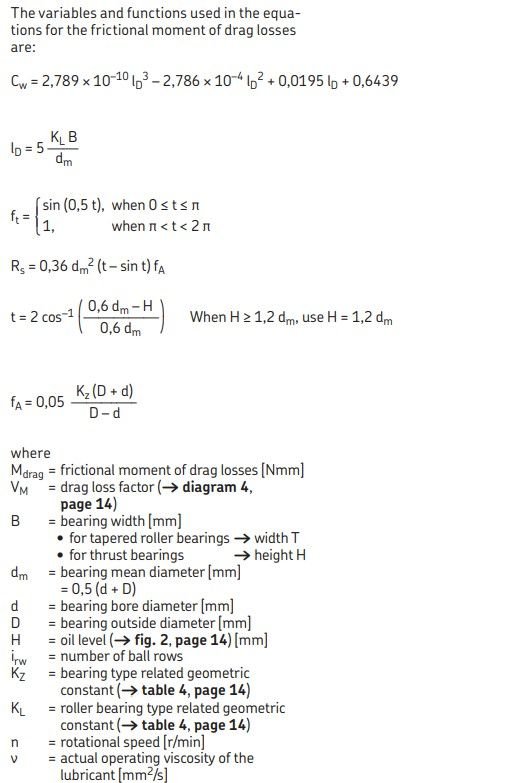
Here's the simplified version - seems easy to me. Can we ride now...
Oh, and don't forget to add the viscous lubricant ramp drag, nor the seal frictional losses, and ramped down frictional reduction due to heating of both bearings and lubricant measured over a logarithmic time period - of course you knew that!
10-27-25 | 08:05 PM
#64
Newbie
Joined: Oct 2025
Posts: 21
Likes: 7
From: Headwaters of the mighty Columbia River
Bikes: 2025 Trek Domane, 1991 Giant hybrid, 1993 Santana tandem, Broken 2001 Gary Fisher on trainer
Thanks for your responses. I understood two of them, lol.
After pondering the principles of physics involved in cycling uphill versus on a level road I have formed some opinions, but I don't want to hijack this thread about hubs. Made me think that performance gain of lightweight rims on steep hills is mostly subjective, but feeling more powerful on hills would actually be fun.
Your comment on spokes made me think that there is a lot more to making a good wheel than matching any rim with any spoke with any hub. They all have to work together to make a nice feeling and nice performing wheel. That's beyond my pay grade for now.
So I am not going to rush out and change anything on my wheels just yet. Thanks for helping to save me from myself.
After pondering the principles of physics involved in cycling uphill versus on a level road I have formed some opinions, but I don't want to hijack this thread about hubs. Made me think that performance gain of lightweight rims on steep hills is mostly subjective, but feeling more powerful on hills would actually be fun.
Your comment on spokes made me think that there is a lot more to making a good wheel than matching any rim with any spoke with any hub. They all have to work together to make a nice feeling and nice performing wheel. That's beyond my pay grade for now.
So I am not going to rush out and change anything on my wheels just yet. Thanks for helping to save me from myself.
11-05-25 | 04:59 PM
#65
Newbie
Joined: Oct 2025
Posts: 33
Likes: 27
Years ago I worked at a bike shop after school in my teens. The old guy who owned the place was a retired aerospace engineer and avid road bike rider. He obsessed with weight and rolling resistance and would go through hours of testing on home built test rigs to prove what worked best before making changes to his bike.
One of the rigs he built used a digital torque gauge that held an axle and he played around with various hubs, bearings, and bearing preload settings.
What he found was that the two biggest things that affected hub rotational resistance were the grease and the bearing preload. He tested about 10 different types of grease, the best he found was a light blue synthetic grease by Phil Wood, and the best set up was loose bearings in a quality hub with a slight, 10 to 12inch pounds of preload on the bearings. Without preload on the bearings, the result was axle flex and poor distribution of the balls. He found that if the bearings were left with zero preload or torque only a two balls at a time were supporting all the weight while the other bearings saw none and actually created even a bit of friction. Although unmeasurable and insignificant, it was there. Back then he swore bu Shimano hubs with machine bearing races and ground cones, which were much nicer than the plain steel, tumbled finish of most Euro made hubs at that time.
We built a lot of wheels using first generation Dura Ace hubs, he would get them in bulk even for lesser bikes. They were smoother but in reality no one who wasn't calculating their weight, rolling resistance, and time down to the most minute fraction would ever notice.
As a big guy in my late teens, built more like a linebacker than a bike racer, I got the longest use out of the run of the mill mid grade components with good grease assembled with some preload.
A bearing that feels a bit tight in hand, even to the point of being snug enough to feel too tight, will roll longer and easier under load because of axle stretch and the little bit of heat generated in use. We aren't talking about being warm to the touch either, it didn't take much rolling to free up a bearing that most felt was too tight on the bench. Not doing this for me usually ended up with a set of battered races and often broken ball bearings.
The key to the bearing surviving and not being a point of friction was simply to keep it clean, well lubed, and with all balls supporting the weight. Any less and my 325 lbs would soon prove the boss's point.
Years later, out of high school, going to school in an area with some big hills, I soon found out how much heat a bike hub can generate under a heavy rider and some steep down hill runs. Keeping the bearings serviced was ever so much more important when you were going 25-35 mph down hill on a flea market found bike with only a couple square inches of brake pad contact area to keep you from hitting speeds it was never meant to attain while carrying a rider more than double the weight any engineer every planned on.
I had an early mountain bike with disc brakes for a bit, I soon found that the disc brake was a terrible idea and that the heat from the hub brakes transmitted into the hub and one of two steep drops meant pretty blue brake rotors and grease bubbling out of the hub and when it all cooled down, a set of rotors that were so warped we would have to heat and stress relieve them to get them flat enough to work again. After a few rounds of that disc brakes were forgotten about.
For an average rider, I'd venture to guess that any hub, regardless of quality, if well greased and properly adjusted likely wouldn't have more than a minute fractional amount of added rolling resistance over the best modern sealed bearing hub sold today.
The way my old boss explained the difference to me was by handing me a case of printer paper, about a 20lb box, and he said 'now add one more sheet of paper' to that box and tell me if it feels any heavier. That was his closes analogy to how much difference there was between all the bearings and hubs he tested, and had spent a year doing so. It turned out that due to the mechanical advantage that the wheel's diameter has over the small diameter bearing made any minute friction in the hub so non consequential no human would ever be able to notice the difference in time, effort, or resistance.
Years later an engineer at work made another analogy when it came to which grease to use in some sealed bearings saying that the resulting improvement would have about as much effect on the longevity or rolling resistance as flapping your arms would have to slow your fall if you jumped off the roof.
One of the rigs he built used a digital torque gauge that held an axle and he played around with various hubs, bearings, and bearing preload settings.
What he found was that the two biggest things that affected hub rotational resistance were the grease and the bearing preload. He tested about 10 different types of grease, the best he found was a light blue synthetic grease by Phil Wood, and the best set up was loose bearings in a quality hub with a slight, 10 to 12inch pounds of preload on the bearings. Without preload on the bearings, the result was axle flex and poor distribution of the balls. He found that if the bearings were left with zero preload or torque only a two balls at a time were supporting all the weight while the other bearings saw none and actually created even a bit of friction. Although unmeasurable and insignificant, it was there. Back then he swore bu Shimano hubs with machine bearing races and ground cones, which were much nicer than the plain steel, tumbled finish of most Euro made hubs at that time.
We built a lot of wheels using first generation Dura Ace hubs, he would get them in bulk even for lesser bikes. They were smoother but in reality no one who wasn't calculating their weight, rolling resistance, and time down to the most minute fraction would ever notice.
As a big guy in my late teens, built more like a linebacker than a bike racer, I got the longest use out of the run of the mill mid grade components with good grease assembled with some preload.
A bearing that feels a bit tight in hand, even to the point of being snug enough to feel too tight, will roll longer and easier under load because of axle stretch and the little bit of heat generated in use. We aren't talking about being warm to the touch either, it didn't take much rolling to free up a bearing that most felt was too tight on the bench. Not doing this for me usually ended up with a set of battered races and often broken ball bearings.
The key to the bearing surviving and not being a point of friction was simply to keep it clean, well lubed, and with all balls supporting the weight. Any less and my 325 lbs would soon prove the boss's point.
Years later, out of high school, going to school in an area with some big hills, I soon found out how much heat a bike hub can generate under a heavy rider and some steep down hill runs. Keeping the bearings serviced was ever so much more important when you were going 25-35 mph down hill on a flea market found bike with only a couple square inches of brake pad contact area to keep you from hitting speeds it was never meant to attain while carrying a rider more than double the weight any engineer every planned on.
I had an early mountain bike with disc brakes for a bit, I soon found that the disc brake was a terrible idea and that the heat from the hub brakes transmitted into the hub and one of two steep drops meant pretty blue brake rotors and grease bubbling out of the hub and when it all cooled down, a set of rotors that were so warped we would have to heat and stress relieve them to get them flat enough to work again. After a few rounds of that disc brakes were forgotten about.
For an average rider, I'd venture to guess that any hub, regardless of quality, if well greased and properly adjusted likely wouldn't have more than a minute fractional amount of added rolling resistance over the best modern sealed bearing hub sold today.
The way my old boss explained the difference to me was by handing me a case of printer paper, about a 20lb box, and he said 'now add one more sheet of paper' to that box and tell me if it feels any heavier. That was his closes analogy to how much difference there was between all the bearings and hubs he tested, and had spent a year doing so. It turned out that due to the mechanical advantage that the wheel's diameter has over the small diameter bearing made any minute friction in the hub so non consequential no human would ever be able to notice the difference in time, effort, or resistance.
Years later an engineer at work made another analogy when it came to which grease to use in some sealed bearings saying that the resulting improvement would have about as much effect on the longevity or rolling resistance as flapping your arms would have to slow your fall if you jumped off the roof.