


Gear inches
 02-14-23 | 05:55 PM
#1
Thread Starter
Junior Member
Joined: Jan 2022
Posts: 188
Likes: 57
Gear inches
Ok, so gear inch equations confuse me, so I'll just tell u good folks what I have on my folder now, and what I'm thinking of doing if feasible. My front ring is a 48. Largest rear gear is 34, 8 speed cassette. I have a ten speed 11-25 I'm itching to put on, as I have a 10 speed shifter also. I know I have to change the chain. What size front ring would I need to put on to get about the same feel/ ratio as the 48-34 combo. I have a 44 teeth but I'm thinking it probably needs to be even smaller since the largest rear is only 25. Any ideas ? Thanks
 02-14-23 | 06:10 PM
#2

Senior Member


Joined: Apr 2011
Posts: 12,782
Likes: 4,886
Gear inches are an imaginary scale that supposes you have a highwheeler bike, and that number is how large your wheel would be.
So go online and find a gear inch chart, and input the cogs and chain rings you have and are considering. Combinations that produce similar gear inch numbers are equivalent gears - like 50×11 = 53×12.
You'll quickly get used to using the tool.
So go online and find a gear inch chart, and input the cogs and chain rings you have and are considering. Combinations that produce similar gear inch numbers are equivalent gears - like 50×11 = 53×12.
You'll quickly get used to using the tool.
02-14-23 | 06:11 PM
#3

Senior Member


Joined: Feb 2012
Posts: 19,381
Likes: 5,527
From: Rochester, NY
Bikes: Stewart S&S coupled sport tourer, Stewart Sunday light, Stewart Commuting, Stewart Touring, Co Motion Tandem, Stewart 3-Spd, Stewart Track, Fuji Finest, Mongoose Tomac ATB, GT Bravado ATB, JCP Folder, Stewart 650B ATB
Have you tried to follow Sheldon Brown's website description of bicycle gears? Sheldon Brown's Bicycle Glossary G
The largest rear cogs are the easiest to pedal, as in up steep/long hills. It's the smallest cogs that are for down hill and high speed use.
But to answer your ring teeth question. 48/34 is about 1.3. So a 25 large cog would need a 32.5 tooth ring to mimic the 48/34. Andy
The largest rear cogs are the easiest to pedal, as in up steep/long hills. It's the smallest cogs that are for down hill and high speed use.
But to answer your ring teeth question. 48/34 is about 1.3. So a 25 large cog would need a 32.5 tooth ring to mimic the 48/34. Andy
__________________
AndrewRStewart
AndrewRStewart
02-14-23 | 06:18 PM
#4

Habitual User

Joined: Jan 2020
Posts: 9,928
Likes: 10,767
From: Altadena, CA
Bikes: 2025 Ritte Esprit, 2023 Niner RLT 9 RDO, 2022 Trek Supercaliber
Forget gear inches (which is stupid anyway). This is simple math.
48 / 34 = 1.412
1.412 x 25 = 35.29
A 35T ring will get you closest, but I don't think I've ever seen a 35. A 36T ring will give you a bit larger low gear. A 34T ring will give you a bit lower low gear.
48 / 34 = 1.412
1.412 x 25 = 35.29
A 35T ring will get you closest, but I don't think I've ever seen a 35. A 36T ring will give you a bit larger low gear. A 34T ring will give you a bit lower low gear.
__________________
RIP 01/08/25...2022 Trek Supercaliber, 2018 Storck Fascenario.3 Platinum, 2018 Trek Procaliber SL Singlespeed, 2017 Bear BR1, 2003 Time VX Special Pro, 2001 Colnago VIP, 1999 Trek 9900 singlespeed, 1977 Nishiki ONP
RIP 01/08/25...2022 Trek Supercaliber, 2018 Storck Fascenario.3 Platinum, 2018 Trek Procaliber SL Singlespeed, 2017 Bear BR1, 2003 Time VX Special Pro, 2001 Colnago VIP, 1999 Trek 9900 singlespeed, 1977 Nishiki ONP
Last edited by Eric F; 02-14-23 at 06:24 PM.
 02-14-23 | 06:20 PM
#5

Mad bike riding scientist

Joined: Nov 2004
Posts: 29,209
Likes: 6,285
From: Denver, CO
Bikes: Some silver ones, a red one, a black and orange one, and a few titanium ones
The equation for gear inches = (Front ring/rear cog)x wheel size. Wheel size is in inches. Do a bit of algebra and solve for Front ring= (gear inch/wheel size) x rear cog. Assuming a 700C wheel, your existing gear, g.i. = (48/34) x 27 = 38 gear inches. For the near low gear of 25 teeth, the ring needed would be front ring = (38 gi/27”) x 25= 35 teeth. If you don’t want to do the math, you can use Gear-Calculator site. Here’s the same calculation I did in graphic form. You can see that dropping to a 35 tooth gear, your high gear is going to suffer significantly. You are going to spin out fairly soon and spend a lot of time coasting.
__________________
Stuart Black
Dreamin' of Bemidji Down the Mississippi (in part)
Plan Epsilon Around Lake Michigan in the era of Covid
Gold Fever Three days of dirt in Colorado
Pokin' around the Poconos A cold ride around Lake Erie
Dinosaurs in Colorado A mountain bike guide to the Purgatory Canyon dinosaur trackway
Solo Without Pie. The search for pie in the Midwest.
Picking the Scablands. Washington and Oregon, 2005. Pie and spiders on the Columbia River!
Stuart Black
Dreamin' of Bemidji Down the Mississippi (in part)
Plan Epsilon Around Lake Michigan in the era of Covid
Gold Fever Three days of dirt in Colorado
Pokin' around the Poconos A cold ride around Lake Erie
Dinosaurs in Colorado A mountain bike guide to the Purgatory Canyon dinosaur trackway
Solo Without Pie. The search for pie in the Midwest.
Picking the Scablands. Washington and Oregon, 2005. Pie and spiders on the Columbia River!
02-14-23 | 06:21 PM
#6

Facts just confuse people
Joined: Jul 2017
Posts: 19,425
Likes: 7,116
From: Mississippi
Bikes: Tarmac Disc Comp Di2 - 2020
If you have to have the same gear inches as you do in the low 48F/34R, and your bike uses 700C wheels, then you'll need a tiny 35 or 36 tooth chain ring to ever get that low.
While some like the gear inches, I'm happy with just gear ratios. Assuming I'm comparing similar bikes it's easier to deal with.
While some like the gear inches, I'm happy with just gear ratios. Assuming I'm comparing similar bikes it's easier to deal with.
02-14-23 | 06:28 PM
#7
Senior Member

Joined: Jul 2005
Posts: 6,944
Likes: 1,293
Right now, your 48 x 34 low gear works out to 26.?". Pretty standard for a folder. My folder has a 53 x 32 low which is higher than usual. The 11 - 25 x anything is a bad idea though IMO. With a 44T up front your low combination, 44 x 25, becomes 32" which is about where mine is. But your top gear will be 'only' 73". Mine is just over 80". It takes a 36T to get your low to where it is now and then your top gear drops to 60". I wouldn't do it.
02-14-23 | 06:34 PM
#8
Senior Member
Joined: Feb 2012
Posts: 19,381
Likes: 5,527
From: Rochester, NY
Bikes: Stewart S&S coupled sport tourer, Stewart Sunday light, Stewart Commuting, Stewart Touring, Co Motion Tandem, Stewart 3-Spd, Stewart Track, Fuji Finest, Mongoose Tomac ATB, GT Bravado ATB, JCP Folder, Stewart 650B ATB
My math mistake, miss hit the calculator buttons. Eric F is right on the math of ratios. I won't say inches of development is stupid. Any system that serves as a basis for understanding and can be used to describe to others and be discussed is not wrong. Andy
__________________
AndrewRStewart
AndrewRStewart

 02-14-23 | 06:41 PM
#9

Senior Member
Joined: Jul 2006
Posts: 11,512
Likes: 4,929
From: San Jose (Willow Glen) Ca
Bikes: Kirk Custom JK Special, 86 De Rosa Pro, '84 Team Miyata,(dura ace old school) 80?? SR Semi-Pro 600 Arabesque
__________________
Life is too short not to ride the best bike you have, as much as you can.
Life is too short not to ride the best bike you have, as much as you can.
02-14-23 | 06:48 PM
#10

Senior Member
Joined: Oct 2014
Posts: 14,191
Likes: 5,326
From: Portland, OR
Bikes: (2) ti TiCycles, 2007 w/ triple and 2011 fixed, 1979 Peter Mooney, ~1983 Trek 420 now fixed and ~1973 Raleigh Carlton Competition gravel grinder
Ok, so gear inch equations confuse me, so I'll just tell u good folks what I have on my folder now, and what I'm thinking of doing if feasible. My front ring is a 48. Largest rear gear is 34, 8 speed cassette. I have a ten speed 11-25 I'm itching to put on, as I have a 10 speed shifter also. I know I have to change the chain. What size front ring would I need to put on to get about the same feel/ ratio as the 48-34 combo. I have a 44 teeth but I'm thinking it probably needs to be even smaller since the largest rear is only 25. Any ideas ? Thanks
So your current low is 48 / 34 X your wheel size (I'll call it 24" for this example) = 34"
Now, you want a 34" low with a 25 tooth cog. So your new chainring is going to be chainring = gear inches X cog / wheel diameter
Chainring = 34 X 25 / 24 = 35 teeth.
I don't know what your current small cog is but we can work backwards to find the now equivalent to your future 11 tooth cog.
Gear inches = 35 / 11 X 24 = 76"
So, with a 48 tooth chainring: cog required = chainring / gear inches X wheel diameter = 48 / 76 X 24 = 15 teeth.
If you keep the same low, you will be losing high end unless your current small cog is a 15 or bigger. (Unlikely.) To get the same high gear as say a 12 tooth cog, you would need a 35 / 96" X 24 = 8.75 ~= 9 teeth.
Math. The curse our legs have to live with.
 And edit: the advantage of math is that you can do it in your head on those long rides with time to kill.
Second edit: Gear inches are easy to visualize, whole numbers between the teens and a little over 100 and completely transferable between bikes and wheels. Three numbers you need to compute but less to carry around in your brain. Yes, less accuracy but hey, it's below the threshold our legs can detect. (Mine anyway.)
Last edited by 79pmooney; 02-14-23 at 06:59 PM.
02-14-23 | 07:18 PM
#11
Senior Member
Joined: Apr 2009
Posts: 39,897
Likes: 3,865
From: New Rochelle, NY
Bikes: too many bikes from 1967 10s (5x2)Frejus to a Sumitomo Ti/Chorus aluminum 10s (10x2), plus one non-susp mtn bike I use as my commuter
Just a quick question to make sure you're getting the info you need.
I gather you have a 1x8 (going 1x10) system. If not, and you have 2 up front, then you should focus on the large/small and the small/large combos.
No response needed, unless it's to say what the other chainring is.
I gather you have a 1x8 (going 1x10) system. If not, and you have 2 up front, then you should focus on the large/small and the small/large combos.
No response needed, unless it's to say what the other chainring is.
__________________
FB
Chain-L site
An ounce of diagnosis is worth a pound of cure.
Just because I'm tired of arguing, doesn't mean you're right.
“One accurate measurement is worth a thousand expert opinions” - Adm Grace Murray Hopper - USN
WARNING, I'm from New York. Thin skinned people should maintain safe distance.
FB
Chain-L site
An ounce of diagnosis is worth a pound of cure.
Just because I'm tired of arguing, doesn't mean you're right.
“One accurate measurement is worth a thousand expert opinions” - Adm Grace Murray Hopper - USN
WARNING, I'm from New York. Thin skinned people should maintain safe distance.
02-14-23 | 09:27 PM
#12
Senior Member
Joined: Apr 2011
Posts: 12,782
Likes: 4,886

Centimeters are stupid! I only use millimeters!
 02-14-23 | 09:28 PM
#13
Thread Starter
Junior Member
Joined: Jan 2022
Posts: 188
Likes: 57
Just a quick question to make sure you're getting the info you need.
I gather you have a 1x8 (going 1x10) system. If not, and you have 2 up front, then you should focus on the large/small and the small/large combos.
No response needed, unless it's to say what the other chainring is.
I gather you have a 1x8 (going 1x10) system. If not, and you have 2 up front, then you should focus on the large/small and the small/large combos.
No response needed, unless it's to say what the other chainring is.
02-14-23 | 09:40 PM
#14
Senior Member
Joined: Apr 2007
Posts: 7,774
Likes: 1,748
Ok, so gear inch equations confuse me, so I'll just tell u good folks what I have on my folder now, and what I'm thinking of doing if feasible. My front ring is a 48. Largest rear gear is 34, 8 speed cassette. I have a ten speed 11-25 I'm itching to put on, as I have a 10 speed shifter also. I know I have to change the chain. What size front ring would I need to put on to get about the same feel/ ratio as the 48-34 combo. I have a 44 teeth but I'm thinking it probably needs to be even smaller since the largest rear is only 25. Any ideas ? Thanks
I never bother with the gear inch charts unless I'm making a meaningful change of tire/wheel size or crank. But even then, the simple ratio gets me what information I actually need or at least close enough for actual riding. When I'm looking at a new drive train, I look at the ratios for the highest and lowest gears and then decide if I want to go lower (I never have wanted to go higher!), or stay about the same.
edit Eric F above has better detail than me
02-14-23 | 10:50 PM
#15
Senior Member
Joined: Jun 2019
Posts: 645
Likes: 419
jdog: it is all amazingly simple math as cyccommute (Stuart) pointed out.
HERE is the Simple Way that SCHWINN and other bike manufacturers calculated comparative GEAR CHARTS back in the sixties and seventies.
Yes, it is so simple that Jethro Bodine could cypher the calculation.
EXAMPLE:
----The FRONT SPROCKET is your Numerator
----The REAR SPROCKET is your Denominator
This example you've got a bicycle with 700C wheels that has a 45 tooth front chainring and has 15 teeth on the rear wheel's sprocket.
So, 45 DIVIDED BY 15 = "Result"
45 divided by 15 = 3
NOW YOU TAKE THE "Result" AND YOU MULTIPLY IT BY the wheel diameter
**** USE 27 as the wheel diameter FOR ALL BICYCLES WITH 700C (622mm) wheels and FOR ALL BICYCLES WITH 27 inch (630mm) wheels.
****USE 26 as the wheel diameter for ALL Bicycles WITH 650, 650a, 650b, 650c wheels , WITH 597mm, 590mm, 584mm, 571mm, or WITH 559mm 26" Wheels
SINCE THE BICYCLE IN OUR EXAMPLE HAS 700C WHEELS, We Will Use 27 as the wheel diameter for this GEAR calculation.
Okay to recap:
45 front teeth DIVIDED BY 15 rear teeth = "Result" of 3
TAKE THAT "Result" AND MULTIPLY IT BY THE WHEEL DIAMETER
"Result" of 3 MULTIPLIED BY 27 (since we use 27 for any bike with 700C wheels..)
So 45 DIVIDED BY 15 = 3
So 3 TIMES 27 = 81 GEAR
3 X 27 = 81 GEAR
YOU GOT THAT !!! IT IS EASY. IT IS AN EXTREMELY SIMPLE AND CRUDE CALCULATION BUT IT IS A VERY MEANINGFUL, VALID, COMPARATIVE Gear Number THAT IS ENTIRELY USEFUL FOR COMPARISON BETWEEN SIMILAR BICYCLES.
obviously you may have some possible significant differences depending upon if you were comparing two bikes with certain extremely different twenty six inch wheelsets for example. *** The comparison is still valid, useful, and nearly perfect When Comparing Bicycles With The Same Exact Wheel & tire combination.***
Just do that GEAR Number calculation again and again for EACH of Your freewheel cog OR cassette cog gears......or for your prospective possible choices for freewheel or cassette and for potential combinations using different prospective front chainwheel configurations.
YEAH, THIS IS ALL DUMBED DOWN AND Jethro Bodine SIMPLE, BUT IT Works Great and It Is A Meaningful Comparative GEAR Number between similar bikes!!
Just do the simple calculations and compile a GEAR CHART like the factory often did in the old days for use in catalogs/print ads/owners manuals/promotional materials.
...................You can even get your 10 year old kids, or your 10 year old grandchildren to calculate the GEAR numbers and make the GEAR CHART compilation if you are too busy or too lazy to do it!!!
HERE is the Simple Way that SCHWINN and other bike manufacturers calculated comparative GEAR CHARTS back in the sixties and seventies.
Yes, it is so simple that Jethro Bodine could cypher the calculation.
EXAMPLE:
----The FRONT SPROCKET is your Numerator
----The REAR SPROCKET is your Denominator
This example you've got a bicycle with 700C wheels that has a 45 tooth front chainring and has 15 teeth on the rear wheel's sprocket.
So, 45 DIVIDED BY 15 = "Result"
45 divided by 15 = 3
NOW YOU TAKE THE "Result" AND YOU MULTIPLY IT BY the wheel diameter
**** USE 27 as the wheel diameter FOR ALL BICYCLES WITH 700C (622mm) wheels and FOR ALL BICYCLES WITH 27 inch (630mm) wheels.
****USE 26 as the wheel diameter for ALL Bicycles WITH 650, 650a, 650b, 650c wheels , WITH 597mm, 590mm, 584mm, 571mm, or WITH 559mm 26" Wheels
SINCE THE BICYCLE IN OUR EXAMPLE HAS 700C WHEELS, We Will Use 27 as the wheel diameter for this GEAR calculation.
Okay to recap:
45 front teeth DIVIDED BY 15 rear teeth = "Result" of 3
TAKE THAT "Result" AND MULTIPLY IT BY THE WHEEL DIAMETER
"Result" of 3 MULTIPLIED BY 27 (since we use 27 for any bike with 700C wheels..)
So 45 DIVIDED BY 15 = 3
So 3 TIMES 27 = 81 GEAR
3 X 27 = 81 GEAR
YOU GOT THAT !!! IT IS EASY. IT IS AN EXTREMELY SIMPLE AND CRUDE CALCULATION BUT IT IS A VERY MEANINGFUL, VALID, COMPARATIVE Gear Number THAT IS ENTIRELY USEFUL FOR COMPARISON BETWEEN SIMILAR BICYCLES.
obviously you may have some possible significant differences depending upon if you were comparing two bikes with certain extremely different twenty six inch wheelsets for example. *** The comparison is still valid, useful, and nearly perfect When Comparing Bicycles With The Same Exact Wheel & tire combination.***
Just do that GEAR Number calculation again and again for EACH of Your freewheel cog OR cassette cog gears......or for your prospective possible choices for freewheel or cassette and for potential combinations using different prospective front chainwheel configurations.
YEAH, THIS IS ALL DUMBED DOWN AND Jethro Bodine SIMPLE, BUT IT Works Great and It Is A Meaningful Comparative GEAR Number between similar bikes!!
Just do the simple calculations and compile a GEAR CHART like the factory often did in the old days for use in catalogs/print ads/owners manuals/promotional materials.
...................You can even get your 10 year old kids, or your 10 year old grandchildren to calculate the GEAR numbers and make the GEAR CHART compilation if you are too busy or too lazy to do it!!!
02-14-23 | 11:01 PM
#16
Senior Member
Joined: Jan 2010
Posts: 1,456
Likes: 98
From: NorCal
Bikes: Haibike Sduro Trekking SL, Rivendell Appaloosa, Concinnity singlespeed, KHS mini velo (Japan market), Trident Spike trike
thanks for all the great replies, great info, I should have mentioned that I'm not at all concerned with the small cogs, the only time I've used the smallest is taking the tire off. The 10 speed cassette has much better increments, by the tools you good lad s have supplied 36 seems to be what I'll need, so I'll have 60ish top I'm guessing. What that maxes out speed wise I have no clue but it's safe to say I only see 15mph when going downhill anyway. 10 mph on the 20 inch wheels is a good pace for this old geezer. Thanks
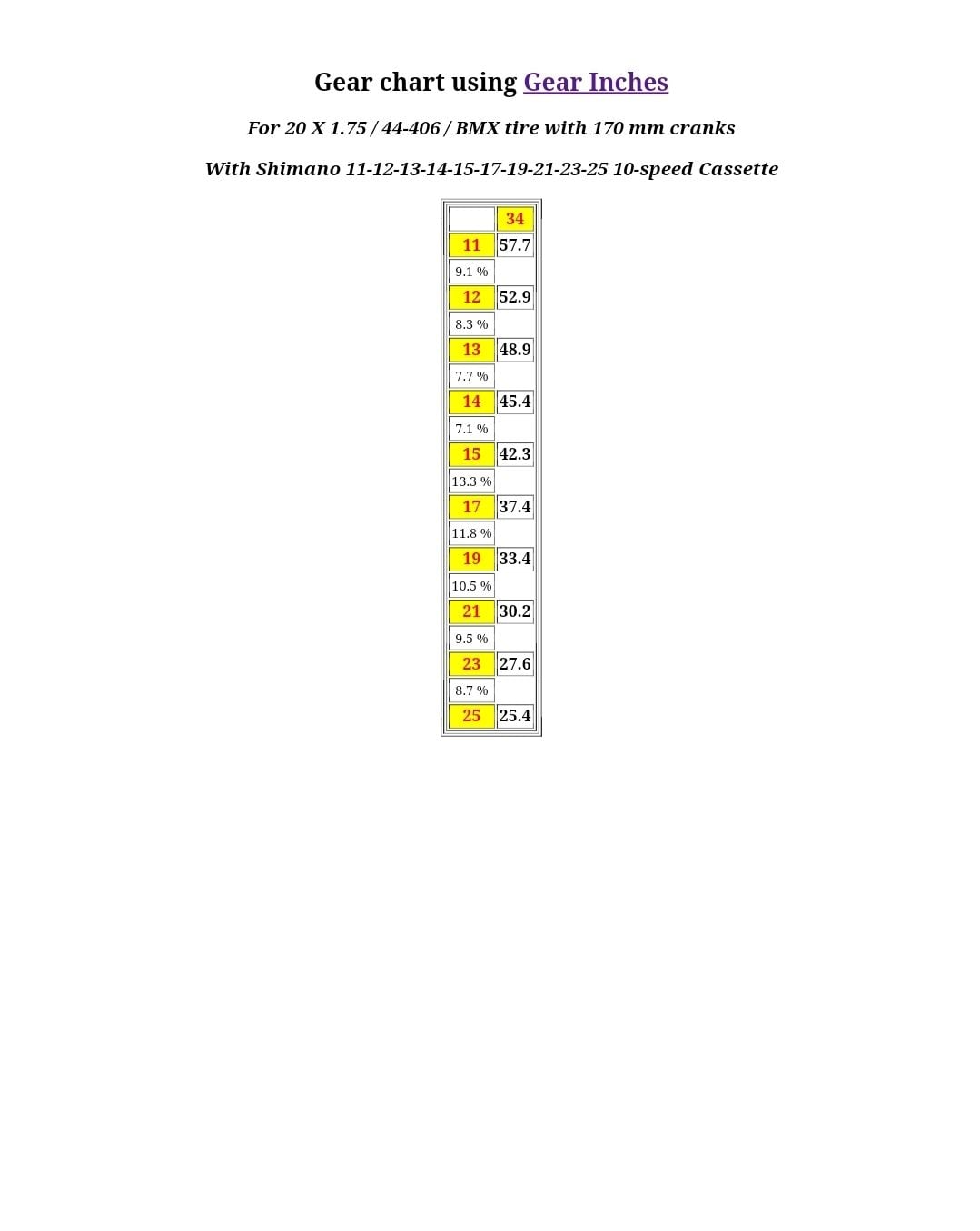
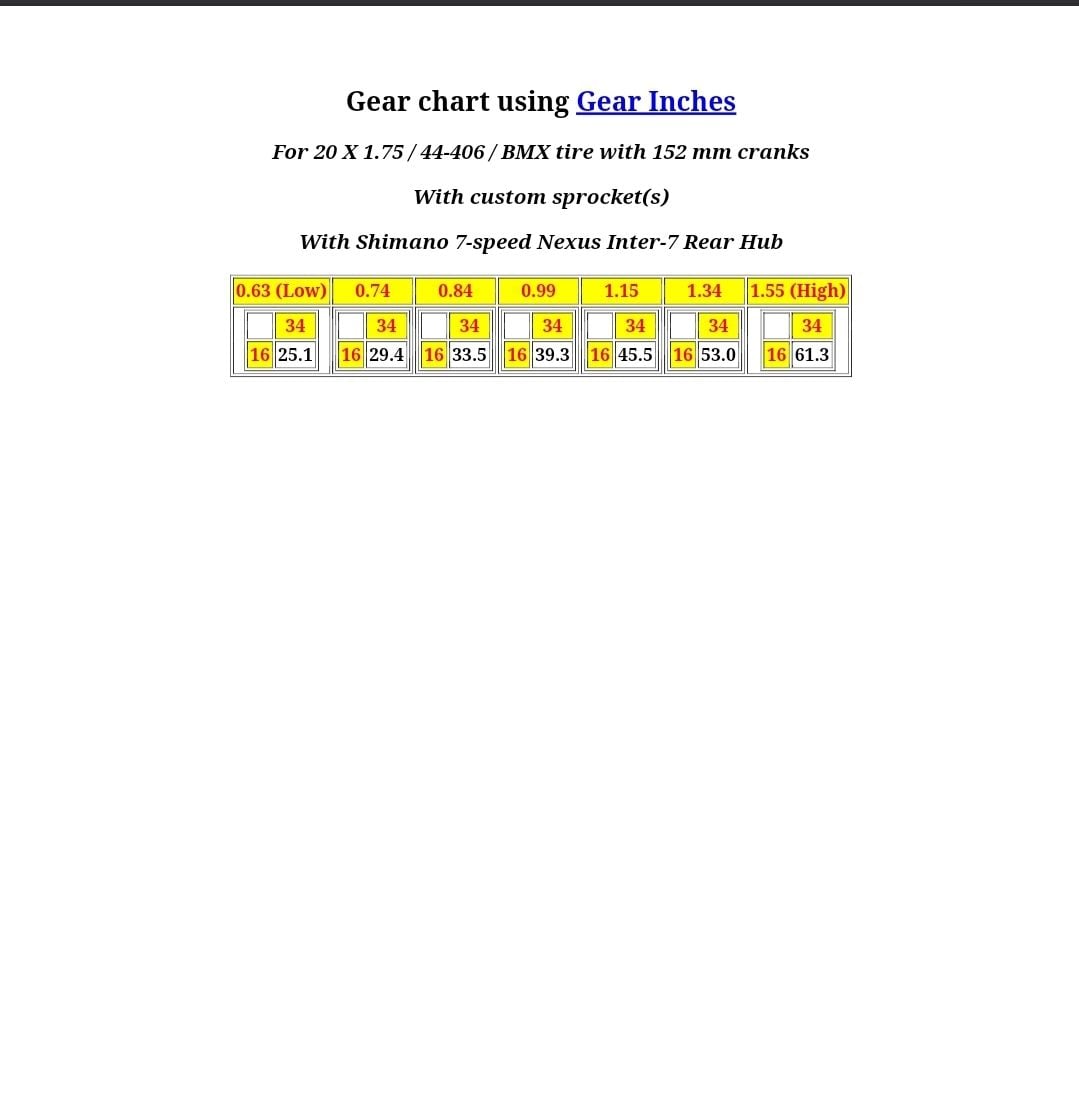
I'm a geezer like you who just wants to get this thing up hills, I don't care about flats/downhill speed, I have a different bike for that. 26.9 would be a bit high for me, if you drop down to a 34t front ring you'll have 25.4-57.7. Yeah you'll spin out quick with that top gear.
Here's mine and the two configurations I estimated for your bike.

02-14-23 | 11:04 PM
#17
Habitual User
Joined: Jan 2020
Posts: 9,928
Likes: 10,767
From: Altadena, CA
Bikes: 2025 Ritte Esprit, 2023 Niner RLT 9 RDO, 2022 Trek Supercaliber
Inches of development (travel along the ground for each pedal revolution) is meaningful and easily understood. However, “gear inches” is the equivalent diameter (not circumference) of the front wheel on a penny-farthing bike. It’s archaic and meaningless, except for this one specific context. I’m sticking with my previous characterization - it’s stupid.
__________________
RIP 01/08/25...2022 Trek Supercaliber, 2018 Storck Fascenario.3 Platinum, 2018 Trek Procaliber SL Singlespeed, 2017 Bear BR1, 2003 Time VX Special Pro, 2001 Colnago VIP, 1999 Trek 9900 singlespeed, 1977 Nishiki ONP
RIP 01/08/25...2022 Trek Supercaliber, 2018 Storck Fascenario.3 Platinum, 2018 Trek Procaliber SL Singlespeed, 2017 Bear BR1, 2003 Time VX Special Pro, 2001 Colnago VIP, 1999 Trek 9900 singlespeed, 1977 Nishiki ONP
02-14-23 | 11:24 PM
#18
Senior Member
Joined: Oct 2014
Posts: 14,191
Likes: 5,326
From: Portland, OR
Bikes: (2) ti TiCycles, 2007 w/ triple and 2011 fixed, 1979 Peter Mooney, ~1983 Trek 420 now fixed and ~1973 Raleigh Carlton Competition gravel grinder
Inches of development (travel along the ground for each pedal revolution) is meaningful and easily understood. However, “gear inches” is the equivalent diameter (not circumference) of the front wheel on a penny-farthing bike. It’s archaic and meaningless, except for this one specific context. I’m sticking with my previous characterization - it’s stupid.
thanks for all the great replies, great info, I should have mentioned that I'm not at all concerned with the small cogs, the only time I've used the smallest is taking the tire off. The 10 speed cassette has much better increments, by the tools you good lad s have supplied 36 seems to be what I'll need, so I'll have 60ish top I'm guessing. What that maxes out speed wise I have no clue but it's safe to say I only see 15mph when going downhill anyway. 10 mph on the 20 inch wheels is a good pace for this old geezer. Thanks
02-15-23 | 12:30 AM
#20
Senior Member
Joined: Oct 2014
Posts: 14,191
Likes: 5,326
From: Portland, OR
Bikes: (2) ti TiCycles, 2007 w/ triple and 2011 fixed, 1979 Peter Mooney, ~1983 Trek 420 now fixed and ~1973 Raleigh Carlton Competition gravel grinder
I don't carry gear charts on my rides. Years and years of Excel make the math easy for the big clusters. Easy to save what I like. Print out what I like in stem friendly formats.
02-15-23 | 12:37 AM
#21
Senior Member
Joined: Jul 2005
Posts: 6,944
Likes: 1,293
02-15-23 | 12:41 AM
#22
Senior Member
Joined: Jan 2010
Posts: 1,456
Likes: 98
From: NorCal
Bikes: Haibike Sduro Trekking SL, Rivendell Appaloosa, Concinnity singlespeed, KHS mini velo (Japan market), Trident Spike trike
02-15-23 | 01:31 AM
#23
Habitual User
Joined: Jan 2020
Posts: 9,928
Likes: 10,767
From: Altadena, CA
Bikes: 2025 Ritte Esprit, 2023 Niner RLT 9 RDO, 2022 Trek Supercaliber
How far I travel across the ground (gear development) with each pedal revolution is something relatable to the activity of cycling. How the gear ratios and wheel size of a multi-geared bicycle compare to the diameter of the front wheel of a penny-farthing bicycle (gear inches) is archaic.
Last edited by Eric F; 02-15-23 at 01:35 AM.
02-15-23 | 06:14 AM
#25
Senior Member
Joined: Apr 2011
Posts: 12,782
Likes: 4,886
How far I travel across the ground (gear development) with each pedal revolution is something relatable to the activity of cycling. How the gear ratios and wheel size of a multi-geared bicycle compare to the diameter of the front wheel of a penny-farthing bicycle (gear inches) is archaic.