


Fixing a failed patch I can't remove
 04-21-23 | 09:12 AM
#1

Thread Starter
Senior Member

Joined: Apr 2017
Posts: 784
Likes: 184
Fixing a failed patch I can't remove
I have a very slow leak coming off the edge of a patch. It's on too tight to pull it off without tearing the tube. I suspect I'll just discard it but it'd be nice if there were some kind of goop that would hold against such a weak leak.


 04-21-23 | 01:28 PM
#4
Senior Member

Joined: Jan 2009
Posts: 4,360
Likes: 1,646
From: San Diego, CA
I've had good luck just taking a cigarette lighter, gas stove flame or something similar to carefully get the patch hot and it will come off easily but sometimes you need to take it off in several pieces. Get it just hot enough to not melt the patch or burn your skin. Clean up the spot on the tube as you would for any new patch and should be good to go.
 04-21-23 | 01:32 PM
#5
Senior Member
Joined: Dec 2010
Posts: 9,684
Likes: 2,602
From: northern Deep South
Bikes: Fuji Touring, Novara Randonee


 04-21-23 | 02:55 PM
#8

Senior Member


Joined: Jul 2013
Posts: 2,781
Likes: 511
From: Missouri
Bikes: Giant Propel, Cannondale SuperX, BMC Time Machine, Univega Alpina Ultima
At some point it's easier to just replace the tube.
__________________
Formerly fastest rider in the grupetto, currently slowest guy in the peloton

Formerly fastest rider in the grupetto, currently slowest guy in the peloton
04-21-23 | 04:44 PM
#9

Senior Member
Joined: Mar 2016
Posts: 2,067
Likes: 573
Bikes: '87-ish Pinarello Montello; '89 Nishiki Ariel; '85 Raleigh Wyoming, '16 Wabi Special, '16 Wabi Classic, '14 Kona Cinder Cone, 2023 Surly Disk Trucker
If you really are heck bent on repairing that patch, I'd opt for one of the Park self-sticky patches and "stitch" it on really well. A quarter works pretty well. One of those might be the better option for repair. If it were my tube, I'm with other posters, I'd replace the tube.
04-23-23 | 09:47 PM
#10

Senior Member
Joined: Feb 2022
Posts: 1,027
Likes: 467
From: GMT-5
What kind of crazy talk is that?
I bin my used tubes as follows:
Straight tubes that have no leaks, verified with a water bath.
Tubes with pin hole leaks. I use tape to marker where the hole is. When I have no more of the above, I grab one of these and repair it with 100% success.
Tubes torn from lack of rim tape tubes, and damage thru the ply. These tubes have perforations up to 3/16", and when I have no more of the above, I also patch these with 50/50 success. I mostly pair these along with a finished or cracked rubber tire so a wheel is complete and the rim is protected during storage. I can't sleep at all when rims are naked.
Then there are popped tubes that are blown out gashed slashed, or valves cut because it wasn't aligned to the rim. Basically unrepairable. These become raw rubber stock to use for DIY rim tape, custom rubber washers gaskets, protecting stays for a rear kickstand install, shim for weird bells that are larger than 22.2mm handles, whatever.
When in doubt, hoard.
I bin my used tubes as follows:
Straight tubes that have no leaks, verified with a water bath.
Tubes with pin hole leaks. I use tape to marker where the hole is. When I have no more of the above, I grab one of these and repair it with 100% success.
Tubes torn from lack of rim tape tubes, and damage thru the ply. These tubes have perforations up to 3/16", and when I have no more of the above, I also patch these with 50/50 success. I mostly pair these along with a finished or cracked rubber tire so a wheel is complete and the rim is protected during storage. I can't sleep at all when rims are naked.
Then there are popped tubes that are blown out gashed slashed, or valves cut because it wasn't aligned to the rim. Basically unrepairable. These become raw rubber stock to use for DIY rim tape, custom rubber washers gaskets, protecting stays for a rear kickstand install, shim for weird bells that are larger than 22.2mm handles, whatever.
When in doubt, hoard.
 04-23-23 | 10:50 PM
#12

Cantilever believer


Joined: Nov 2021
Posts: 3,082
Likes: 4,726
From: Phoenix, AZ
I haven't had a good experience with overlapping patches, but I have had good experiences with removing old patches with a battery powered dremel with a sanding drum attachment.
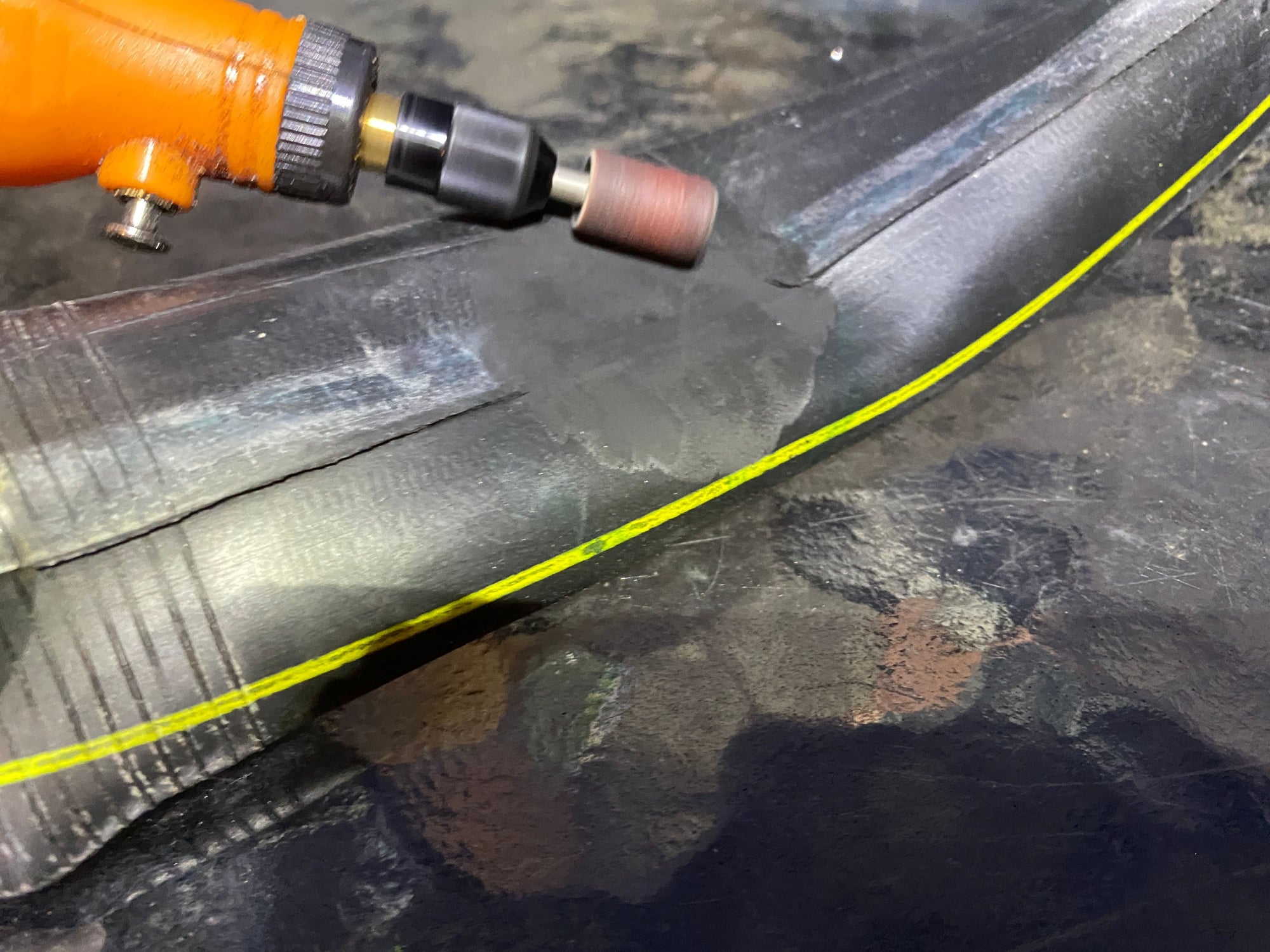
And for patches where it's on the edge of another patch, carefully removing part of the old patch to expose clean rubber for the new patch.

And for patches where it's on the edge of another patch, carefully removing part of the old patch to expose clean rubber for the new patch.
__________________
Richard C. Moeur, PE - Phoenix AZ, USA
https://www.richardcmoeur.com/bikestuf.html
Richard C. Moeur, PE - Phoenix AZ, USA
https://www.richardcmoeur.com/bikestuf.html
 04-23-23 | 10:57 PM
#13

Mostly harmless ™
Joined: Nov 2010
Posts: 4,462
Likes: 243
From: Novi Sad
Bikes: Heavy, with friction shifters
You could put some baking paper over the patch, then use iron (for ironing clothes) to get the patch hot, then remove it (patch glue becomes liquid once heated).
(the baking paper is just to prevent the iron from getting dirty from any glue or rubber)
You could also use a heat gun to do it.
(the baking paper is just to prevent the iron from getting dirty from any glue or rubber)
You could also use a heat gun to do it.
 04-24-23 | 03:20 PM
#16
Senior Member
Joined: Feb 2022
Posts: 1,027
Likes: 467
From: GMT-5
Has anyone ever used ShoeGoo? The silicone/epoxy cocktail?
A few days ago I decided to test it, I repaired a tube with ShoeGoo, cut another piece of tube for the patch, applied it wet and C-clamped it overnite until it cured.
If it works, I won't feel bad about letting them go with the spare rims that I sell (see my previous post in this thread).
Because when I see that a patched tube (patched with a real patch) works, I take it back when I sell a rim.
But a tube that was patched with another piece of tube, buyer can keep it along with that scrap tire.

A few days ago I decided to test it, I repaired a tube with ShoeGoo, cut another piece of tube for the patch, applied it wet and C-clamped it overnite until it cured.
If it works, I won't feel bad about letting them go with the spare rims that I sell (see my previous post in this thread).
Because when I see that a patched tube (patched with a real patch) works, I take it back when I sell a rim.
But a tube that was patched with another piece of tube, buyer can keep it along with that scrap tire.
04-24-23 | 07:36 PM
#17
Senior Member

Joined: Jun 2002
Posts: 3,924
Likes: 589
From: San Jose, CA
Bikes: Too many bikes, too little time to ride
Has anyone ever used ShoeGoo? The silicone/epoxy cocktail?
A few days ago I decided to test it, I repaired a tube with ShoeGoo, cut another piece of tube for the patch, applied it wet and C-clamped it overnite until it cured.
If it works, I won't feel bad about letting them go with the spare rims that I sell (see my previous post in this thread).
Because when I see that a patched tube (patched with a real patch) works, I take it back when I sell a rim.
But a tube that was patched with another piece of tube, buyer can keep it along with that scrap tire.
A few days ago I decided to test it, I repaired a tube with ShoeGoo, cut another piece of tube for the patch, applied it wet and C-clamped it overnite until it cured.
If it works, I won't feel bad about letting them go with the spare rims that I sell (see my previous post in this thread).
Because when I see that a patched tube (patched with a real patch) works, I take it back when I sell a rim.
But a tube that was patched with another piece of tube, buyer can keep it along with that scrap tire.
04-25-23 | 02:53 AM
#18
Thread Starter
Senior Member
Joined: Apr 2017
Posts: 784
Likes: 184
It's always easier to replace the tube.
I've never gotten the self-stick patches to work, even on a fresh puncture. I figure it must be me.
I don't have one of these and am not careful enough to try it
I've done this but sometimes the tube tears instead. I think that's what will happen if I try it in this case.
This is a tempting idea but I'd probably melt the tube. And it's more work than I want to do. Have you ever done this?
I have the plumber's version of Shoe Goo. It's what I had in mind.
You could put some baking paper over the patch, then use iron (for ironing clothes) to get the patch hot, then remove it (patch glue becomes liquid once heated).
(the baking paper is just to prevent the iron from getting dirty from any glue or rubber)
You could also use a heat gun to do it.
(the baking paper is just to prevent the iron from getting dirty from any glue or rubber)
You could also use a heat gun to do it.
I have the plumber's version of Shoe Goo. It's what I had in mind.
04-25-23 | 11:25 AM
#20
Mostly harmless ™
Joined: Nov 2010
Posts: 4,462
Likes: 243
From: Novi Sad
Bikes: Heavy, with friction shifters
Patch glue (including my favourite Rema Tip-Top) is advertised as "vulcanizing cement/fluid" but it doesn't really vulcanize - i.e. the process it creates is reversible with some heat.
Could you burn the tube if you apply enough heat? Probably. But some basic caution should let you get the job done without doing so. In my experience, a faulty (leaking) patch is best taken care of by removing and patching the tube properly. Other methods often don't hold very well, so I consider the "heat treatment" to be in the realm of "nothing to lose."
Note, just in case - it gets hot, gloves are probably a good idea.
Relja
04-25-23 | 01:56 PM
#21

Senior Member
Joined: Apr 2016
Posts: 3,809
Likes: 1,754
I'm good at that - I have a storage crate full of tubes, all different sizes and states of repair, One day I'll take them all out and test them, repair those that need it and put them away neatly labeled. But I can't find the labels under all this stuff.
