


First Flat
 06-12-23 | 10:36 AM
#1
Thread Starter
Newbie
Joined: Apr 2023
Posts: 34
Likes: 27
First Flat
Just got my first flat tire on my mountain bike. Give me some perspective. I've only got 150 miles on the bike. I still consider it brand new. I haven't even figured out how to check the tire pressure yet. Is this normal? Do I have to check the pressure before every ride? Is it okay to walk it 3 miles or did I mess up the rim? How can I be more prepared?
 06-12-23 | 11:01 AM
#2

Senior Member


Joined: Jul 2015
Posts: 7,498
Likes: 3,301
From: NW Oregon
Bikes: 1982 Trek 930R Custom, '91 Diamondback Ascent w/ XT, XTR updates, Fuji Team Pro CF road flyer, Specialized Sirrus Gravel Convert, '09 Comencal Meta 5.5 XC, '02 Marin MBX500, '84 Gitane Criterium bike
Just got my first flat tire on my mountain bike. Give me some perspective. I've only got 150 miles on the bike. I still consider it brand new. I haven't even figured out how to check the tire pressure yet. Is this normal? Do I have to check the pressure before every ride? Is it okay to walk it 3 miles or did I mess up the rim? How can I be more prepared?


 06-12-23 | 11:12 AM
#3

Facts just confuse people


Joined: Jul 2017
Posts: 19,436
Likes: 7,121
From: Mississippi
Bikes: Tarmac Disc Comp Di2 - 2020
It's probably normal that many noobs don't think to check their tire pressure. However they should. Tires and tubes on bicycles lose air pressure with time. So not checking them might be why you flatted.
Get a pump with a gauge on it or just get a gauge. Check often until you know what rate your tires loose air and keep your tires at a consistent pressure.
When you flat, always figure out why you flatted. If a tubed tire, then remove the tube and lay it on top of your tire and inflate it some. Is the air leaking out the rim side? The tread side? or the sidewall side of the tube. Then you'll know where to look for possible causes. And eventually figure out how to prevent them.
Get a pump with a gauge on it or just get a gauge. Check often until you know what rate your tires loose air and keep your tires at a consistent pressure.
When you flat, always figure out why you flatted. If a tubed tire, then remove the tube and lay it on top of your tire and inflate it some. Is the air leaking out the rim side? The tread side? or the sidewall side of the tube. Then you'll know where to look for possible causes. And eventually figure out how to prevent them.
Last edited by Iride01; 06-12-23 at 12:10 PM. Reason: lose not loose
 06-12-23 | 11:16 AM
#4

Recreational Road Cyclist
Joined: Sep 2013
Posts: 613
Likes: 307
From: MetroWest, Mass.
Bikes: 1990 Peter Mooney road bike, 1996 Gary Fisher X-Caliber mountain bike
Do I have to check the pressure before every ride? Is it okay to walk it 3 miles or did I mess up the rim? How can I be more prepared?
You are asking the right questions. Ride on!
06-12-23 | 11:19 AM
#5

Senior Member
Joined: Feb 2012
Posts: 19,381
Likes: 5,528
From: Rochester, NY
Bikes: Stewart S&S coupled sport tourer, Stewart Sunday light, Stewart Commuting, Stewart Touring, Co Motion Tandem, Stewart 3-Spd, Stewart Track, Fuji Finest, Mongoose Tomac ATB, GT Bravado ATB, JCP Folder, Stewart 650B ATB
It would help this discussion if we knew what caused the flat. Too little air pressure for the conditions (rider and trail) can easily lead to a compression flat (pinch flat, snake bite) because on a sharp bump the rim can bottom out on it and the sad tire/tube between gets cut/damaged. The two best ways to reduce this are to keep enough air pressure in the tires and learning to slightly lift your butt off the seat when you ride over bumps. I suggest getting a floor pump with a gauge and learn how to use it. Starting one's ride with enough pressure to prevent the bottoming out really helps a ride be better . For my bikes I find a weekly pressure check and topping off of pressures is the norm, but I like worry free rolling. I suggest getting a small flat repair kit together, use a small under seat bag to hold it and just leave that on the bike all the time so you'll never forget it. Even if you can't do the fixing of the flat yourself having the tools/spares/patches gives a passing by rider a chance to help you.
I doubt you messed up the rim if you took some slight care while walking. Unsure about the tire as it could be, but usually isn't, damaged by slow walking. The initial flat cause might be in play here if there's a huge chunk of (wood/metal/glass) something still stuck in the casing and with each wheel rotation that think re pokes or continues the cutting action. Not the usual though and most flats causes don't that as they are small and sometimes ejected from the casing during the flopping about the rim the casing is doing while walking.
Another data point is whether you are running a tube type tire (the classic and most common arrangement) or a tubeless type. The tire's labeled size gives up even more data about what might be going on and how to learn the right stuff the first time. Some shops, social/civic groups offer flat repair clinics. There's many vids on line. When I taught this stuff with our local club I would suggest finding a tossed out bike wheel/tire to use as a practice device back at home. Andy
. For my bikes I find a weekly pressure check and topping off of pressures is the norm, but I like worry free rolling. I suggest getting a small flat repair kit together, use a small under seat bag to hold it and just leave that on the bike all the time so you'll never forget it. Even if you can't do the fixing of the flat yourself having the tools/spares/patches gives a passing by rider a chance to help you. I doubt you messed up the rim if you took some slight care while walking. Unsure about the tire as it could be, but usually isn't, damaged by slow walking. The initial flat cause might be in play here if there's a huge chunk of (wood/metal/glass) something still stuck in the casing and with each wheel rotation that think re pokes or continues the cutting action. Not the usual though and most flats causes don't that as they are small and sometimes ejected from the casing during the flopping about the rim the casing is doing while walking.
Another data point is whether you are running a tube type tire (the classic and most common arrangement) or a tubeless type. The tire's labeled size gives up even more data about what might be going on and how to learn the right stuff the first time. Some shops, social/civic groups offer flat repair clinics. There's many vids on line. When I taught this stuff with our local club I would suggest finding a tossed out bike wheel/tire to use as a practice device back at home. Andy
__________________
AndrewRStewart
AndrewRStewart
06-12-23 | 11:31 AM
#6

Habitual User
Joined: Jan 2020
Posts: 9,928
Likes: 10,767
From: Altadena, CA
Bikes: 2025 Ritte Esprit, 2023 Niner RLT 9 RDO, 2022 Trek Supercaliber
I top off the pressure in my tires before every ride. This is mostly due to riding multiple bikes on a regular basis. It's pretty common that I won't ride the same bike on consecutive days, and it could easily be a week between rides on the same bike. In a week's time, my tires typically lose enough air that a top-off is a good idea. This is not unusual for bike tires.
__________________
RIP 01/08/25...2022 Trek Supercaliber, 2018 Storck Fascenario.3 Platinum, 2018 Trek Procaliber SL Singlespeed, 2017 Bear BR1, 2003 Time VX Special Pro, 2001 Colnago VIP, 1999 Trek 9900 singlespeed, 1977 Nishiki ONP
RIP 01/08/25...2022 Trek Supercaliber, 2018 Storck Fascenario.3 Platinum, 2018 Trek Procaliber SL Singlespeed, 2017 Bear BR1, 2003 Time VX Special Pro, 2001 Colnago VIP, 1999 Trek 9900 singlespeed, 1977 Nishiki ONP
06-12-23 | 11:50 AM
#7

Senior Member
Joined: Feb 2022
Posts: 1,027
Likes: 467
From: GMT-5
I hope the OP didn't bike home on a flat. Similar smart folks do that with cars too and think the garage is ripping them off when they are told they have to buy a new tire.
That's why for my train station commuters, I can fill it initially to 80 and leave it like that for weeks until I "feel" they are down to 40, which is still above the minimum for my city slicks.
The reality is that most households don't own anything to check, nor put air in a tyre.

That's why for my train station commuters, I can fill it initially to 80 and leave it like that for weeks until I "feel" they are down to 40, which is still above the minimum for my city slicks.
The reality is that most households don't own anything to check, nor put air in a tyre.
06-12-23 | 12:11 PM
#8
Thread Starter
Newbie
Joined: Apr 2023
Posts: 34
Likes: 27
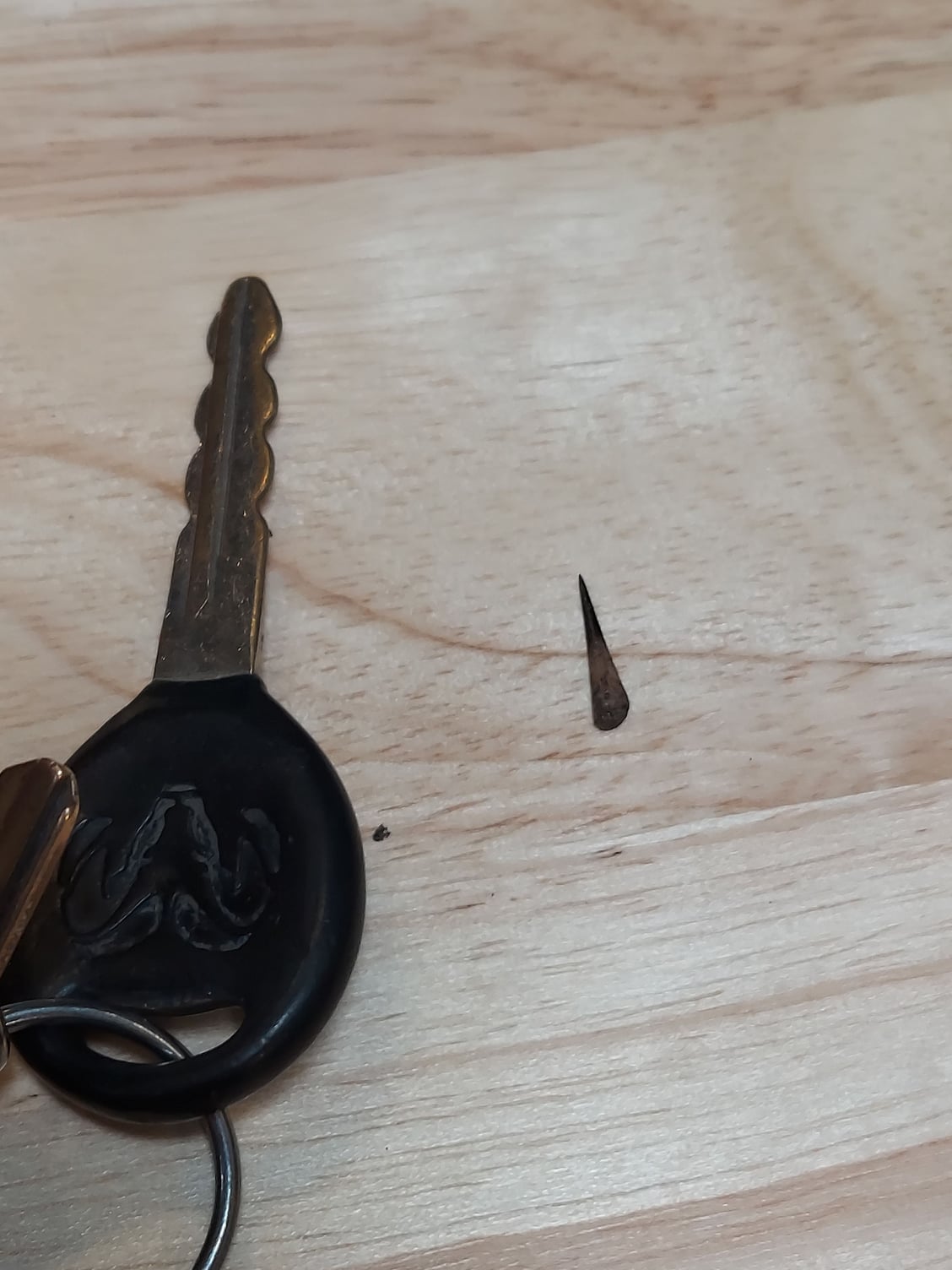
Big thorn. That makes me feel better. If it is from riding, that is okay. I'm proud to have that kind of flat tire.
I took it back to REI. They changed it for free and checked over everything else. And I made sure to have him explain how to use the presta valves.

 06-12-23 | 12:16 PM
#9

Senior Member

Joined: Jul 2008
Posts: 30,506
Likes: 4,579
From: 25 miles northwest of Boston
Bikes: Bottecchia Sprint, GT Timberline 29r, Marin Muirwoods 29er, Trek FX Alpha 7.0
06-12-23 | 02:29 PM
#10
Senior Member
Joined: Feb 2012
Posts: 3,039
Likes: 1,068
From: Golden, CO and Tucson, AZ
Bikes: 2012 Specialized Elite Disc, 1983 Trek 520
I at least pinch the tires, or bounce the bike lightly, every time I get on it. Bouncing the bike identifies parts and accessories getting loose, too. Like those above, I typically top off air every week, usually 5 or 10 psi on a road bike. If it's more than that, I'll look for a leak when I have time. Definitely get a floor pump with gauge at home, and a frame or pack pump for the bike.
As already said, changing a tire should be routine for an active cyclist. In my commuting days, I'd get several flats a month, and I could do a front wheel in just over five minutes, rear in ten. To this day, I always leave an extra ten minutes when cycling to meet someone, in case of a flat tire. If you do it right, have normal strength, and depending on your tire and tube, you may not even need any tools, especially on a MTB. Carry a tube and pump, and a patch kit in case the spare also picks up a thorn before you get home. Or both tires get flat in the same patch of thorns.
As already said, changing a tire should be routine for an active cyclist. In my commuting days, I'd get several flats a month, and I could do a front wheel in just over five minutes, rear in ten. To this day, I always leave an extra ten minutes when cycling to meet someone, in case of a flat tire. If you do it right, have normal strength, and depending on your tire and tube, you may not even need any tools, especially on a MTB. Carry a tube and pump, and a patch kit in case the spare also picks up a thorn before you get home. Or both tires get flat in the same patch of thorns.
 06-12-23 | 03:26 PM
#11
Clark W. Griswold
Joined: Mar 2014
Posts: 18,452
Likes: 6,762
From: ,location, location
Bikes: Foundry Chilkoot Ti W/Ultegra Di2, Salsa Timberjack Ti, Cinelli Mash Work RandoCross Fun Time Machine, 1x9 XT Parts Hybrid, Co-Motion Cascadia, Specialized Langster, Phil Wood Apple VeloXS Frame (w/DA 7400), R+M Supercharger2 Rohloff, Habanero Ti 26
Checking pressure is easy just use your floor pump, a good pump doesn't have to be expensive but a proper pump should be able to do both a standard Presta valve and the car tire valve also known as Schrader or if higher end bike pump just a Presta valve. It will also have a gauge on it and that will be helpful to check for pressure. There are generally two types of pumps you will need to worry about high pressure and high volume. Your typical mountain bike is going to be high volume so you may only need a pump that goes to 40-60PSI and your average road bike is going to be high pressure so having a pump that can go to 120-200+ PSI will be helpful not that you will pump that high or should but it will make it easier.
Once you get a sense of pressure with your pump or a pressure gauge and use your fingers to feel it at that proper pressure you will start to be able to feel before you ride. I recommend checking your tire pressure before each ride and most people on average will pump every week or so sometimes less often sometimes a little more if you are pumping daily that is probably a sign of a slow leak.
If you keep the pressure correct you will be less likely to have a flat. Also wider tires will run lower pressures and those lower pressures will likely lead to fewer flats (up a point obviously stay within the range of the tire and know your weight and the weight of the bike and what you are carrying will effect.
Once you get a sense of pressure with your pump or a pressure gauge and use your fingers to feel it at that proper pressure you will start to be able to feel before you ride. I recommend checking your tire pressure before each ride and most people on average will pump every week or so sometimes less often sometimes a little more if you are pumping daily that is probably a sign of a slow leak.
If you keep the pressure correct you will be less likely to have a flat. Also wider tires will run lower pressures and those lower pressures will likely lead to fewer flats (up a point obviously stay within the range of the tire and know your weight and the weight of the bike and what you are carrying will effect.
06-13-23 | 07:40 AM
#12
Thread Starter
Newbie
Joined: Apr 2023
Posts: 34
Likes: 27
Thanks guys. I still have my old Schwinn from the accident. I'll give it a practice try. Does a new valve come as part of the tube usually? I can't see in the videos where they move the valve to the new tube. How do I buy the correct size tube?
I feel like maybe a patch kit might be a good idea. I tend to ride with my kids and other inexperienced riders. I can't carry every tube, but I might be able to whip out a patch kit and save the day. Maybe one of those CO2 things. Sound like a plan?
I feel like maybe a patch kit might be a good idea. I tend to ride with my kids and other inexperienced riders. I can't carry every tube, but I might be able to whip out a patch kit and save the day. Maybe one of those CO2 things. Sound like a plan?
06-13-23 | 08:53 AM
#13
Senior Member
Joined: Feb 2012
Posts: 19,381
Likes: 5,528
From: Rochester, NY
Bikes: Stewart S&S coupled sport tourer, Stewart Sunday light, Stewart Commuting, Stewart Touring, Co Motion Tandem, Stewart 3-Spd, Stewart Track, Fuji Finest, Mongoose Tomac ATB, GT Bravado ATB, JCP Folder, Stewart 650B ATB
Tubes almost always have the valve molded into the tube, not able to remove or reinstall. Tubeless set ups do have the valve as a separate item and they are able to be removed and reinstalled into the rim, there being no tube.
Generally the tube's size is the same as the tire's. The tire should have the diameter and width listed on it's casing. If in doubt bring the tire/wheel/old tube (assuming it was a good fit) to the LBS and they will guide you. Andy
Generally the tube's size is the same as the tire's. The tire should have the diameter and width listed on it's casing. If in doubt bring the tire/wheel/old tube (assuming it was a good fit
) to the LBS and they will guide you. Andy
__________________
AndrewRStewart
AndrewRStewart
06-13-23 | 08:58 AM
#14
Senior Member
Joined: Jul 2008
Posts: 30,506
Likes: 4,579
From: 25 miles northwest of Boston
Bikes: Bottecchia Sprint, GT Timberline 29r, Marin Muirwoods 29er, Trek FX Alpha 7.0
Thanks guys. I still have my old Schwinn from the accident. I'll give it a practice try. Does a new valve come as part of the tube usually? I can't see in the videos where they move the valve to the new tube. How do I buy the correct size tube?
I feel like maybe a patch kit might be a good idea. I tend to ride with my kids and other inexperienced riders. I can't carry every tube, but I might be able to whip out a patch kit and save the day. Maybe one of those CO2 things. Sound like a plan?
I feel like maybe a patch kit might be a good idea. I tend to ride with my kids and other inexperienced riders. I can't carry every tube, but I might be able to whip out a patch kit and save the day. Maybe one of those CO2 things. Sound like a plan?
tubes come with the valve
not all tubes use the same type of valve, there are 2 popular types (schrader & presta) schrader are like the ones on your car tires
I carry the following
patch kit
small hand pump made for bike frames (for the valves we use)
a co device (for the valves we use)
spare tube(s) for every bike in my family, fortunately everyone uses the same size tube so for a family of 4, I've never needed more that 1 for any group ride
the inflator I carry
Genuine Innovations G2673, AirChuck, Lightweight, Bicycle CO2 Inflator, weight 16g, Black
the pump I carry is a Topeak brand, I think. can't find it on amazon right now but there are lot's to choose from
as for which tube(s) to get, that's a whole other story. I guess try to match what you have now. there is embossed printing on the tire sidewalls, & painted printing on the tubes. a local bike shop can help you out, but I also buy tubes on Amazon
06-13-23 | 09:05 AM
#15
Senior Member
Joined: Jul 2014
Posts: 5,070
Likes: 1,290
From: socal
Bikes: DIY
I don't know whether this was mentioned, but when you learn how to replace a tube in the "wild", the most important aspect (for me) is to check the tire for the cause and remove it before installing the new tube (I don't recommend repairing tubes on the trail; replace , then patch the defective tube at home).
06-13-23 | 09:18 AM
#16

Senior Member
Joined: May 2010
Posts: 5,634
Likes: 2,504
From: Bastrop Texas
Bikes: Univega, Peu P6, Peu PR-10, Ted Williams, Peu UO-8, Peu UO-18 Mixte, Peu Dolomites
Having tools is an on going process. Keep an eye out for useful stuff as your tool kit will change. I consider my tool kit almost as important as my helmet, and my helmet has saved my life...
Annual Tool Kit Check 2023
Annual Tool Kit Check 2023
__________________
 No matter where you're at... There you are... Δf:=f(1/2)-f(-1/2)
06-14-23 | 04:12 AM
#17
Newbie
Joined: Jun 2023
Posts: 31
Likes: 11
From: Rome, Italy
Bikes: Brompton 5-speed, Colalti hybrid, 1979 Raleigh ? in good working order
I confess, I had never thought to adjust for the weight on the tyres. I found a link on goodyearbike.com to a tire pressure calculator that looks to be quite handy.
06-14-23 | 06:55 AM
#18
Recreational Road Cyclist
Joined: Sep 2013
Posts: 613
Likes: 307
From: MetroWest, Mass.
Bikes: 1990 Peter Mooney road bike, 1996 Gary Fisher X-Caliber mountain bike
You need enough pressure in your tires to avoid a pinch flat and to have a stable, non-wallowing ride. Try the calculators and then experiment.
Have fun!
06-14-23 | 10:00 AM
#19
Newbie
Joined: Jun 2023
Posts: 31
Likes: 11
From: Rome, Italy
Bikes: Brompton 5-speed, Colalti hybrid, 1979 Raleigh ? in good working order
That is nice and simple. Recommendation is slightly lower (79 vs 85) than I am used to, which is probably well within the margin of error on my floor pump gauge. An accurate pressure gauge is not high on my list of priorities. Yet.
06-16-23 | 07:25 PM
#20

Senior Member
Joined: Aug 2007
Posts: 1,761
Likes: 1,546
From: Ouest Seattle
Bikes: Mercian King of Mercia, Surly Long Haul Trucker,81 Fuji Gran Tour SE, 83 Fuji S12S LTD, Voyageur 11.8 chrome, , Voyageur 11.8
Thanks guys. I still have my old Schwinn from the accident. I'll give it a practice try. Does a new valve come as part of the tube usually? I can't see in the videos where they move the valve to the new tube. How do I buy the correct size tube?
I feel like maybe a patch kit might be a good idea. I tend to ride with my kids and other inexperienced riders. I can't carry every tube, but I might be able to whip out a patch kit and save the day. Maybe one of those CO2 things. Sound like a plan?
I feel like maybe a patch kit might be a good idea. I tend to ride with my kids and other inexperienced riders. I can't carry every tube, but I might be able to whip out a patch kit and save the day. Maybe one of those CO2 things. Sound like a plan?
Everyone here gives great advice, but I like to start from scratch.
1. Look at your tires on all your bikes from the right side. If built correctly, the Brand/Label on the tire should line up with the valve,( either Mr Presta or Ms Schrader.) This is done for a reason. When you get a flat, that orientation localizes the tube with respect to the tire. So when you put air in the tube and it hisses at you from a hole a 3:00 o'clock from the valve hole, that is exactly where to check your tire for a puncture or foreign object inside the tire. Or even a rim tape failure leaving a spoke exposed. When you remount the tire, try to place it back the same way.
2. The hole type tells you what to look for. Double hole side by side is a "snakebite" from low tire pressure. The tube got pinched between tire and rim at each side. Single hole on outside of tube, think puncture and feel along inner tire at that point. Also, pinch/flex/bend the tread and look for embedded objects. A small piece of glass or metal can burrow in and be hard to see right away. Hole on inner side of tube, look at rim tape (all holes should be covered over the spoke heads). Lastly, look if hole appears at a seam in the tube or at the place where the valve inserts into the tube. These can be manufacturing failure points.
3. Take care with the tube when mounting stuff up. Try not to pinch the tube between rim and tire.
4. Try to get good at mounting tires by hand without levers. Less chance of damage.
And lastly, I think having a floor pump with a pressure gauge is really the best way to go. I watch garage sales and even new are not speedy. The garage sale models I have in my car trunk so no matter which vehicle I toss my bike on I have a pump at hand.
Have fun riding!
06-20-23 | 05:50 AM
#21

Sock Puppet
Joined: Oct 2022
Posts: 1,701
Likes: 865
From: Planet Earth
Bikes: 2014 Cannondale Synapse Carbon, 2017 Jamis Renegade Exploit and too many others to mention.
Just got my first flat tire on my mountain bike. Give me some perspective. I've only got 150 miles on the bike. I still consider it brand new. I haven't even figured out how to check the tire pressure yet. Is this normal? Do I have to check the pressure before every ride? Is it okay to walk it 3 miles or did I mess up the rim? How can I be more prepared?
Mountain bike tires shouldn't need to be checked more than once a month. Road bike tires should be checked at least once a week.
Do you have a local bike shop near you that has a repair clinic. You may want to attend one of these so you can do some basic maintenance yourself.
