


Quick release knackered? Or just the casing?
 09-07-24 | 11:02 AM
#1
Thread Starter
Campagnolo expert
Joined: Mar 2024
Posts: 47
Likes: 12
Quick release knackered? Or just the casing?
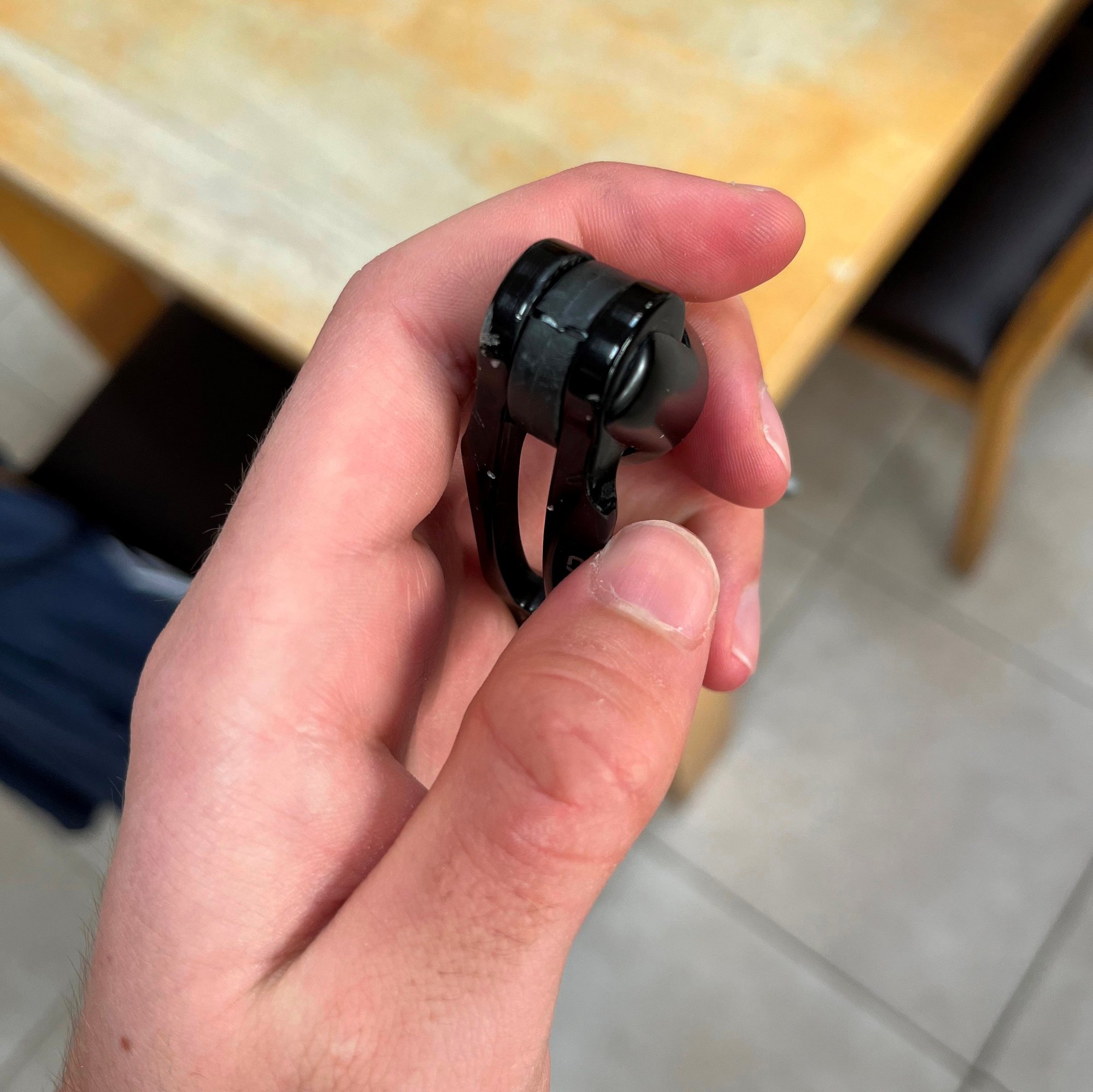
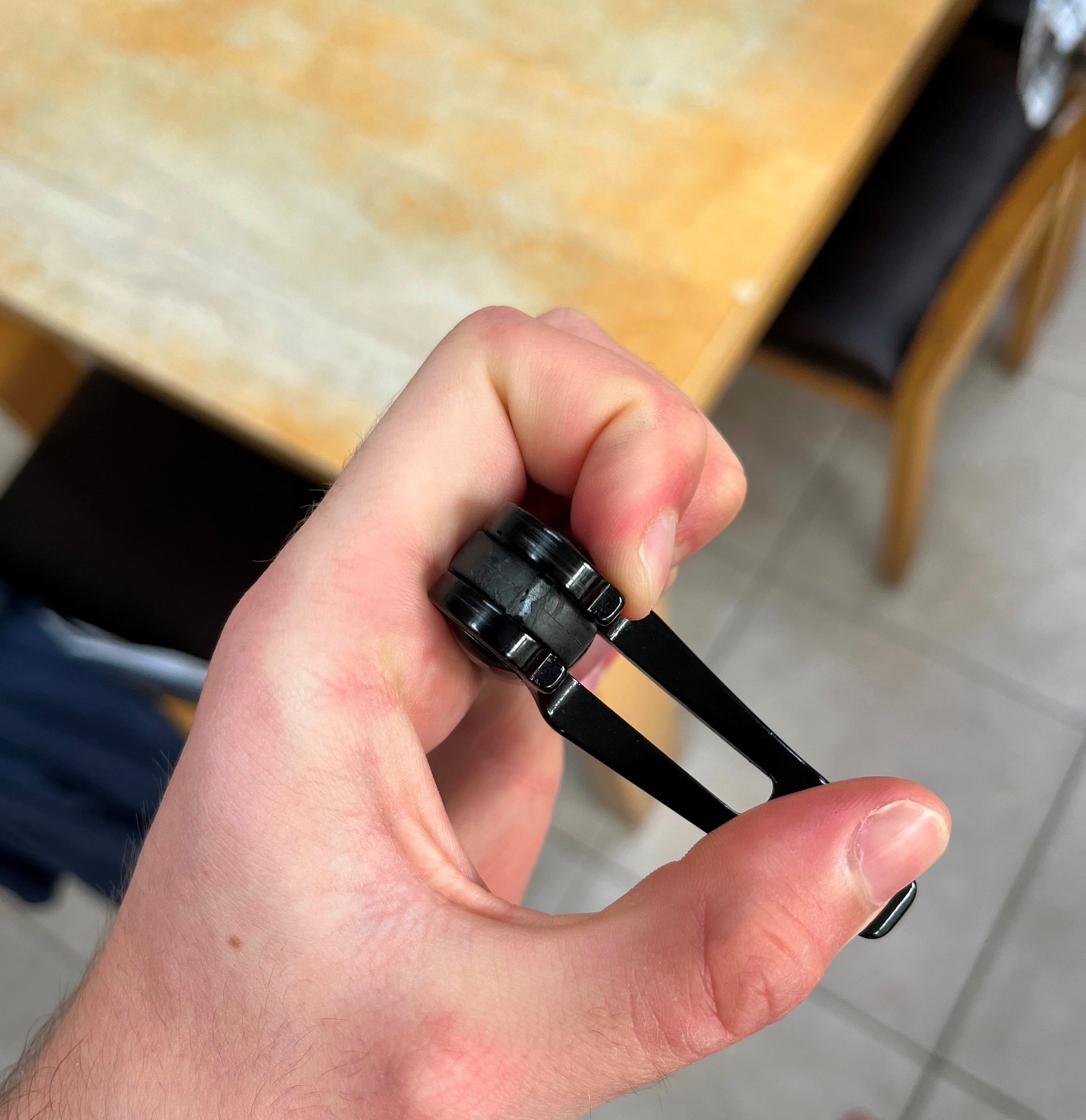
Noticed a crack across this part (RED LINE) of my Zonda skewers. Wondered if it's just plastic casing or something 'important'? Should I replace them?
When I close the quick release lever, the crack widens when pressure is applied, but once past the 'halfway' point and the lever is closed the crack closes again.
On both the front and rear.

When I close the quick release lever, the crack widens when pressure is applied, but once past the 'halfway' point and the lever is closed the crack closes again.
On both the front and rear.
 09-07-24 | 11:37 AM
#2
Senior Member

Joined: Feb 2007
Posts: 1,835
Likes: 548
They look like external cam skewers. For that fact I would replace them even if they weren't cracked. Internal cam QR skewers are still made and that is what I would use. They range in price from $10.00 to up over $150.00 apiece. Paul component engineering make the expensive ones. Shimano makes several.
09-07-24 | 01:27 PM
#3
Senior Member

Joined: Apr 2009
Posts: 39,897
Likes: 3,865
From: New Rochelle, NY
Bikes: too many bikes from 1967 10s (5x2)Frejus to a Sumitomo Ti/Chorus aluminum 10s (10x2), plus one non-susp mtn bike I use as my commuter
I can't tell from the photo, but unless both skewers have a split there, it's toast.
The crack closes again because QR cams are to close beyond top dead center, relaxing the tension slightly. That's a key element of the design which requires the system to get tighter before it opens.
The crack closes again because QR cams are to close beyond top dead center, relaxing the tension slightly. That's a key element of the design which requires the system to get tighter before it opens.
__________________
FB
Chain-L site
An ounce of diagnosis is worth a pound of cure.
Just because I'm tired of arguing, doesn't mean you're right.
“One accurate measurement is worth a thousand expert opinions” - Adm Grace Murray Hopper - USN
WARNING, I'm from New York. Thin skinned people should maintain safe distance.
FB
Chain-L site
An ounce of diagnosis is worth a pound of cure.
Just because I'm tired of arguing, doesn't mean you're right.
“One accurate measurement is worth a thousand expert opinions” - Adm Grace Murray Hopper - USN
WARNING, I'm from New York. Thin skinned people should maintain safe distance.
 09-07-24 | 04:59 PM
#4
Method to My Madness

Joined: Nov 2020
Posts: 4,745
Likes: 2,078
From: Orange County, California
Bikes: Trek FX 2, Cannondale Synapse x2, Cannondale CAAD4, Santa Cruz Stigmata 3
09-07-24 | 05:49 PM
#6

Senior Member

Joined: Jun 2022
Posts: 2,356
Likes: 1,315
From: The Ring of Fire, the Global South, Asia-Pacific, the Tropics...
Bikes: Several, all affordably priced, none exalted cult artifacts or hype jobs
 09-08-24 | 04:08 AM
#8
Thread Starter
Campagnolo expert
Joined: Mar 2024
Posts: 47
Likes: 12
I can't tell from the photo, but unless both skewers have a split there, it's toast.
The crack closes again because QR cams are to close beyond top dead center, relaxing the tension slightly. That's a key element of the design which requires the system to get tighter before it opens.
The crack closes again because QR cams are to close beyond top dead center, relaxing the tension slightly. That's a key element of the design which requires the system to get tighter before it opens.
Yes - slang term for tired but also used for 'broken', usually when something has worn out or has been in use for a while!
Just taken two photos of the crack:
 09-08-24 | 06:30 AM
#9
Senior Member

Joined: Feb 2012
Posts: 3,036
Likes: 1,068
From: Golden, CO and Tucson, AZ
Bikes: 2012 Specialized Elite Disc, 1983 Trek 520
The knacker was who you called to haul away your dead horse, to the glue factory. "Knackered" in an Australian accent sounds like "naked." That was good for a laugh once.
09-08-24 | 06:35 AM
#10
Senior Member


Joined: Apr 2019
Posts: 3,903
Likes: 1,494
From: UK
Knackers can also refer to your testes for some reason.
09-08-24 | 10:15 AM
#11

aged to perfection
Joined: Jun 2009
Posts: 2,242
Likes: 1,660
From: PacNW
Bikes: Dinucci Allez 2.0, Richard Sachs, Alex Singer, Serotta, Masi GC, Raleigh Pro Mk.1, Hetchins, etc
don't ride those anymore. if the front quick release opens while riding you will likely go down.
/markp
/markp
Last edited by mpetry912; 09-08-24 at 01:31 PM.
09-08-24 | 10:27 AM
#12
Senior Member
Joined: Oct 2023
Posts: 1,141
Likes: 1,019
Bikes: *'00 LS Vortex/Chorus 12/Campag Zondas*98 LS Classic - S&S couplers/Chorus 12/Rolf Vector Pros*'95 DeBernardi Cromor S/S, Mavic Open Pros on Phil Wood track hubs*
I have one of these skewers in front of me as I write - the plastic piece with the crack is non-structural and plays no role in the camming or clamping action.
replace it if the crack offends you, but it won’t affect the operation of the skewer
09-08-24 | 10:39 AM
#13

Senior Member

Joined: Sep 2004
Posts: 3,318
Likes: 1,060
From: Chicago area
Bikes: Airborne "Carpe Diem", Motobecane "Mirage", Trek 6000, Strida 2, Dahon "Helios XL", Dahon "Mu XL", Tern "Verge S11i"
09-08-24 | 10:42 AM
#14
Senior Member
Joined: Oct 2023
Posts: 1,141
Likes: 1,019
Bikes: *'00 LS Vortex/Chorus 12/Campag Zondas*98 LS Classic - S&S couplers/Chorus 12/Rolf Vector Pros*'95 DeBernardi Cromor S/S, Mavic Open Pros on Phil Wood track hubs*
They look like external cam skewers. For that fact I would replace them even if they weren't cracked. Internal cam QR skewers are still made and that is what I would use. They range in price from $10.00 to up over $150.00 apiece. Paul component engineering make the expensive ones. Shimano makes several.
Last edited by 13ollocks; 09-08-24 at 10:50 AM.
09-08-24 | 01:38 PM
#16
aged to perfection
Joined: Jun 2009
Posts: 2,242
Likes: 1,660
From: PacNW
Bikes: Dinucci Allez 2.0, Richard Sachs, Alex Singer, Serotta, Masi GC, Raleigh Pro Mk.1, Hetchins, etc
Maybe. on some stuff like quick release skewers, brake blocks etc I consider those safety critical failure points so I don't take chances and I suggest you not do so either.
People normalize failures and eventually something bad happens. Pilots pre-flight their airplane before every flight. Its not a bad practice for bike riders too.
while I agree that this particular part is non structural, as a general rule, if a part shows a crack or defect, I replace it. People have posted pictures of cracked frames, rims etc askiing "is this OK to ride?"
Frankly if you have to ask, it probably isn't ! But you do you
/markp
People normalize failures and eventually something bad happens. Pilots pre-flight their airplane before every flight. Its not a bad practice for bike riders too.
while I agree that this particular part is non structural, as a general rule, if a part shows a crack or defect, I replace it. People have posted pictures of cracked frames, rims etc askiing "is this OK to ride?"
Frankly if you have to ask, it probably isn't ! But you do you
/markp
 09-08-24 | 02:54 PM
#17
Senior Member
Joined: Feb 2007
Posts: 1,835
Likes: 548
13ollocks: The bicycle manufacturing industry found a cheaper way to produce QR Skewers. Open Cam QR skewers need more tightening prior to closing the lever than Internal Cam QR Skewers to hold the wheel securely in place. They also use cheap plastic in the cam mechanism on many of them. The CPSC recalled over a Million of the them because they were dangerous for the wing nut type QR Skewer users. they are second best compared to even an inexpensive Internal Cam QR Skewer. Second best is second best or Internal Cam QR Skewers Good and External Cam QR Skewers Bad.
09-08-24 | 03:09 PM
#18
Senior Member
Joined: Apr 2009
Posts: 39,897
Likes: 3,865
From: New Rochelle, NY
Bikes: too many bikes from 1967 10s (5x2)Frejus to a Sumitomo Ti/Chorus aluminum 10s (10x2), plus one non-susp mtn bike I use as my commuter
Ultimately, this boils down to your skill and judgment.
Looking at the photo, I believe the crack is in a non-critical element, though it's worrisome that it spreads under load.
If you can study the lever and figure out what parts carry load, then you can decide for yourself whether to keep using it.
Otherwise, if you cannot logically judge it OK to use, then send it off to the glue factory.
Looking at the photo, I believe the crack is in a non-critical element, though it's worrisome that it spreads under load.
If you can study the lever and figure out what parts carry load, then you can decide for yourself whether to keep using it.
Otherwise, if you cannot logically judge it OK to use, then send it off to the glue factory.
__________________
FB
Chain-L site
An ounce of diagnosis is worth a pound of cure.
Just because I'm tired of arguing, doesn't mean you're right.
“One accurate measurement is worth a thousand expert opinions” - Adm Grace Murray Hopper - USN
WARNING, I'm from New York. Thin skinned people should maintain safe distance.
FB
Chain-L site
An ounce of diagnosis is worth a pound of cure.
Just because I'm tired of arguing, doesn't mean you're right.
“One accurate measurement is worth a thousand expert opinions” - Adm Grace Murray Hopper - USN
WARNING, I'm from New York. Thin skinned people should maintain safe distance.
09-08-24 | 03:45 PM
#19
Method to My Madness
Joined: Nov 2020
Posts: 4,745
Likes: 2,078
From: Orange County, California
Bikes: Trek FX 2, Cannondale Synapse x2, Cannondale CAAD4, Santa Cruz Stigmata 3
09-08-24 | 05:49 PM
#20
Senior Member
Joined: Oct 2023
Posts: 1,141
Likes: 1,019
Bikes: *'00 LS Vortex/Chorus 12/Campag Zondas*98 LS Classic - S&S couplers/Chorus 12/Rolf Vector Pros*'95 DeBernardi Cromor S/S, Mavic Open Pros on Phil Wood track hubs*
13ollocks: The bicycle manufacturing industry found a cheaper way to produce QR Skewers. Open Cam QR skewers need more tightening prior to closing the lever than Internal Cam QR Skewers to hold the wheel securely in place. They also use cheap plastic in the cam mechanism on many of them. The CPSC recalled over a Million of the them because they were dangerous for the wing nut type QR Skewer users. they are second best compared to even an inexpensive Internal Cam QR Skewer. Second best is second best or Internal Cam QR Skewers Good and External Cam QR Skewers Bad.
As to your other points:
- External-cam is cheaper to produce than internal-cam - I agree - now show me why, in this instance, "cheaper to produce" = "inferior". Lots of things are cheaper to produce - CF frames, for example - doesn't make them bad
- Internal-Cam QRs need more tightening prior to closing the lever than internal-cam QRs - I agree - now show me an example - apart from the obvious one of horizontal dropouts - where the clamping force of external-cam QRs is objectively inadequate
- Many external-cam QRs use "cheap plastic" in the cam mechanism - I agree, although I disagree with your characterization of plastic as "cheap" - if it works, it works. Show me where it doesn't work.
- (External-cam QRs] are second best compared to even an inexpensive Internal Cam QR Skewers - says you - you're entitled to your opinion, but opinions aren't data
I'm not a shill for "Big External-Cam Skewer" - I use both external- and internal-cam skewers - I'm just questioning the apparently-baseless dogma concerning external-cam QRs
Last edited by 13ollocks; 09-08-24 at 05:55 PM.
09-08-24 | 05:51 PM
#21
Senior Member
Joined: Oct 2023
Posts: 1,141
Likes: 1,019
Bikes: *'00 LS Vortex/Chorus 12/Campag Zondas*98 LS Classic - S&S couplers/Chorus 12/Rolf Vector Pros*'95 DeBernardi Cromor S/S, Mavic Open Pros on Phil Wood track hubs*
 09-08-24 | 06:25 PM
#22
Clark W. Griswold
Joined: Mar 2014
Posts: 18,379
Likes: 6,707
From: ,location, location
Bikes: Foundry Chilkoot Ti W/Ultegra Di2, Salsa Timberjack Ti, Cinelli Mash Work RandoCross Fun Time Machine, 1x9 XT Parts Hybrid, Co-Motion Cascadia, Specialized Langster, Phil Wood Apple VeloXS Frame (w/DA 7400), R+M Supercharger2 Rohloff, Habanero Ti 26
They look like external cam skewers. For that fact I would replace them even if they weren't cracked. Internal cam QR skewers are still made and that is what I would use. They range in price from $10.00 to up over $150.00 apiece. Paul component engineering make the expensive ones. Shimano makes several.
My favorite QR skewers are the DT Swiss RWS levers or Paul levers (but I would probably go DT Swiss RWS over the Paul unless MUSA and looks were the requirement). Campagnolo makes good stuff as does Shimano but the DT Swiss seem like a real improvement over the formula and are really easy to use. Sort of the way some people improperly use normal QR levers as wing nuts but this one has an adjustable angle once you have tightened them and supposedly hold with less clamping force. I have used them for 8 years or so and no issues at all and really love them.
In terms of that lever it doesn't look like a mission critical area but as FBinNY see what is carrying the load first and determine for yourself if they are safe. I might also shoot some photos over to Campagnolo and see what they say. In the end what anyone says won't matter if you don't feel confident.
09-08-24 | 07:59 PM
#23
Senior Member
Joined: Feb 2007
Posts: 1,835
Likes: 548
veganbikes: The Campi and the Paul QR Skewers are internal cam and the discontinued Phil Wood QR Skewers are also internal cam. I have a Paul QR Skewer on the rear of my bicycle and a Phil Wood QR Skewer on the front. I have some Campi SS QR Skewers on my Tandem. The DT Swiss QR Skewer is nothing more than a modified Wing Nut and They are easy to strip out the adjusting nut. I will stick with the internal cam style on my bicycles. The cold weather story for the invention of the QR Skewer Is truthful. It is history and the history of things is always written by the winners not the failures. I consider the invention of the QR Skewer to be one of the more important things in bicycle history. When it comes to QR skewers the closed cam is the properly engineered and only type of QR Skewer I will use on a bicycle.
09-08-24 | 08:01 PM
#24
Senior Member
Joined: Sep 2004
Posts: 3,318
Likes: 1,060
From: Chicago area
Bikes: Airborne "Carpe Diem", Motobecane "Mirage", Trek 6000, Strida 2, Dahon "Helios XL", Dahon "Mu XL", Tern "Verge S11i"
I confess to finding it plausible that the internal-cam skewers create more clamping force than the external-cam type, but it *would* be interesting to see some actual measurements.
Two of my frequently-ridden bikes have the internal type. My main road bike came with Ultegra hubs and their internal skewers, but as I was more or less custom-ordering the bike, I opted for the titanium "Airborne" branded skewers which were of the external type. I've used these external skewers for 23 years with no wheel slipping. The bike has vertical rear dropouts, and the front has "lawyer lips", so the acceptable performance is not surprising.
What kind of data would be needed here? Would a measurement of the displacement of the skewer's rod by the cam be a reasonable proxy for clamping force?
Two of my frequently-ridden bikes have the internal type. My main road bike came with Ultegra hubs and their internal skewers, but as I was more or less custom-ordering the bike, I opted for the titanium "Airborne" branded skewers which were of the external type. I've used these external skewers for 23 years with no wheel slipping. The bike has vertical rear dropouts, and the front has "lawyer lips", so the acceptable performance is not surprising.
What kind of data would be needed here? Would a measurement of the displacement of the skewer's rod by the cam be a reasonable proxy for clamping force?
09-08-24 | 08:51 PM
#25
Senior Member
Joined: Apr 2009
Posts: 39,897
Likes: 3,865
From: New Rochelle, NY
Bikes: too many bikes from 1967 10s (5x2)Frejus to a Sumitomo Ti/Chorus aluminum 10s (10x2), plus one non-susp mtn bike I use as my commuter
Some here are very focused on internal vs. external cam designs, which IMO is a distraction. One must step back and analyze QRs as a system, with the parts within having specific functions.
Looked at this way, the cam wouldn't affect holding strength. It's only job is to draw the ends in and compress them against the dropout. It's performance is based on its rise, and smoothness of action, and has no direct impact on holding grip.
Instead focus on what actually affects grip, namely the faces that engage the dropout, their hardness, shape, and dentation. That also includes the axle faces, which are key elements of the system.
BITD, hubs had hardened steel serrated or footed axle faces, designed to bite into the dropout. These are keys to the system. When axle nuts or QRs were tightened, they compressed the dropouts against those biting faces, and that's what provided the hold.
Moving forward, hub axles no longer have hard steel faces and neither do the QRs. This happened after the move to vertical dropouts and was OK because vertical dropouts don't need that much holding strength.
Unfortunately, a generation went by before disc brakes and a return to horizontal dropouts on SS bikes were introduced, and the necessary design elements were lost in the generational turnover.
Looked at this way, the cam wouldn't affect holding strength. It's only job is to draw the ends in and compress them against the dropout. It's performance is based on its rise, and smoothness of action, and has no direct impact on holding grip.
Instead focus on what actually affects grip, namely the faces that engage the dropout, their hardness, shape, and dentation. That also includes the axle faces, which are key elements of the system.
BITD, hubs had hardened steel serrated or footed axle faces, designed to bite into the dropout. These are keys to the system. When axle nuts or QRs were tightened, they compressed the dropouts against those biting faces, and that's what provided the hold.
Moving forward, hub axles no longer have hard steel faces and neither do the QRs. This happened after the move to vertical dropouts and was OK because vertical dropouts don't need that much holding strength.
Unfortunately, a generation went by before disc brakes and a return to horizontal dropouts on SS bikes were introduced, and the necessary design elements were lost in the generational turnover.
Last edited by FBinNY; 09-09-24 at 06:45 AM.