


Cable End Soldering?

 11-25-25 | 06:14 AM
#2

Happy With My Bikes


Joined: Sep 2020
Posts: 2,812
Likes: 3,365
From: Oklahoma
Bikes: Hi-Ten bike boomers, a Trek Domane and some projects
I would only solder SS or galvanized cable. The coated cables are going to just not like heat and solder.
Cut the cable cleanly, use a decent soldering iron (I used to use a 100 watt iron but that's overkill), rosin core solder works well. A little flux helps it wick in but isn't necessary. Heat the last 1/8 to 1/4 inch of the cable and apply the solder to the cable not the iron.
Soldered ends look clean and professional, but I like the little aluminum caps on my old bikes because they look original.
Cut the cable cleanly, use a decent soldering iron (I used to use a 100 watt iron but that's overkill), rosin core solder works well. A little flux helps it wick in but isn't necessary. Heat the last 1/8 to 1/4 inch of the cable and apply the solder to the cable not the iron.
Soldered ends look clean and professional, but I like the little aluminum caps on my old bikes because they look original.
__________________
"One of the most important days of my life was when I learned to ride a bicycle" -- Michael Palin


 11-25-25 | 07:41 AM
#4

Senior Member


Joined: Apr 2011
Posts: 12,752
Likes: 4,866
I worked at a shop 35 years ago that soldered all the cable ends (Turin). They had a big electric solder iron with a trigger that was pretty fast, and the point was that you could pull and reinstall soldered cables - something you can't do with heat shrink or cable ends. So it made subsequent maintenance easier for the mechanics.
However, I thought it didn't work on stainless cables.
However, I thought it didn't work on stainless cables.

 11-25-25 | 07:49 AM
#5
Happy With My Bikes
Joined: Sep 2020
Posts: 2,812
Likes: 3,365
From: Oklahoma
Bikes: Hi-Ten bike boomers, a Trek Domane and some projects
It will work on SS, just not well, it needs flux and it needs to be really hot. I get my cables with caps back through by pulling the caps off. I don't have a proper crimper that crimps well enough they won't come back off so I use my electrical crimpers. My Park 4th hand tool eliminates me pulling on them for occasional adjusting.
__________________
"One of the most important days of my life was when I learned to ride a bicycle" -- Michael Palin
11-25-25 | 07:57 AM
#6
Senior Member
Joined: Jan 2009
Posts: 4,415
Likes: 1,679
From: San Diego, CA
Twist welding.
Yes, it's anal and takes a little longer than soldering or other methods but is the best IMO. I just install the cable, make sure cable is adjusted properly and instead of a using vise, the derailleur is the anchor (Don't burn your bike). You can also use one of those mini-butane torches instead of a big propane torch. This vid is from a small aircraft building and maintenance group. Should be good enough for bikes.
Last edited by Crankycrank; 11-25-25 at 08:09 AM.


 11-25-25 | 08:10 AM
#7

Sr Member on Sr bikes

Joined: Jul 2015
Posts: 3,106
Likes: 1,282
From: Rhode Island (sometimes in SE Florida)
Bikes: Several...from old junk to new all-carbon.
Usually I just use a short piece of heat shrink tubing. But the twist welding is interesting. I may give that a try…will have to test it first with some old cable on the workbench.
Dan
Dan
11-25-25 | 08:17 AM
#8
Senior Member
Joined: Jan 2009
Posts: 4,415
Likes: 1,679
From: San Diego, CA
 11-25-25 | 08:51 AM
#9

Senior Member

Joined: Sep 2004
Posts: 3,318
Likes: 1,060
From: Chicago area
Bikes: Airborne "Carpe Diem", Motobecane "Mirage", Trek 6000, Strida 2, Dahon "Helios XL", Dahon "Mu XL", Tern "Verge S11i"
I worked at a shop 35 years ago that soldered all the cable ends (Turin). They had a big electric solder iron with a trigger that was pretty fast, and the point was that you could pull and reinstall soldered cables - something you can't do with heat shrink or cable ends. So it made subsequent maintenance easier for the mechanics.
However, I thought it didn't work on stainless cables.
However, I thought it didn't work on stainless cables.
A quick Google search reveals some ownership changes and relocations about 12 years ago... looks complicated!
Good point about re-installation. I'm not sure, but I think with the right flux, stainless cables can be soldered. Sounds like an opportunity for a "field test".
 11-25-25 | 08:56 AM
#10
Happy With My Bikes
Joined: Sep 2020
Posts: 2,812
Likes: 3,365
From: Oklahoma
Bikes: Hi-Ten bike boomers, a Trek Domane and some projects
The twist welding looks like a lot of trouble compared to caps, solder, shrink tubing, or super glue. But it would be bulletproof I guess.
__________________
"One of the most important days of my life was when I learned to ride a bicycle" -- Michael Palin
 11-25-25 | 09:30 AM
#12
Senior Member
Joined: Apr 2011
Posts: 12,752
Likes: 4,866
There was a "Turin Cycles" in Evanston, Illinois when I was growing up. Same shop? It was widely known to be a high-end store.
A quick Google search reveals some ownership changes and relocations about 12 years ago... looks complicated!
Good point about re-installation. I'm not sure, but I think with the right flux, stainless cables can be soldered. Sounds like an opportunity for a "field test".
A quick Google search reveals some ownership changes and relocations about 12 years ago... looks complicated!
Good point about re-installation. I'm not sure, but I think with the right flux, stainless cables can be soldered. Sounds like an opportunity for a "field test".
Anyone that has iron soldered stainless cables, let's hear it.
11-25-25 | 09:42 AM
#13
Happy With My Bikes
Joined: Sep 2020
Posts: 2,812
Likes: 3,365
From: Oklahoma
Bikes: Hi-Ten bike boomers, a Trek Domane and some projects
I've soldered SS cable ends. When I worked in automation, we had cable operated encoders on some automated lifts. It wasn't pretty, but it served the purpose of keeping the cable ends from fraying while still being able to occasionally remove and replace the cable. The solder will not adhere to the SS, but it will setup well enough to prevent fraying. We used a 100 watt Weller iron.
I would have never thought in a million years about the twist welding shown above, But I don't know that it would have worked in that application due to the space it was in.
I would have never thought in a million years about the twist welding shown above, But I don't know that it would have worked in that application due to the space it was in.
__________________
"One of the most important days of my life was when I learned to ride a bicycle" -- Michael Palin
11-25-25 | 09:43 AM
#14

Senior Member
Joined: May 2009
Posts: 1,912
Likes: 1,476
From: A different place and time.
11-25-25 | 11:51 AM
#15
Senior Member
Joined: Dec 2010
Posts: 9,689
Likes: 2,609
From: northern Deep South
Bikes: Fuji Touring, Novara Randonee
I tried it once, using standard electronics solder and iron on a stainless cable. The solder melted, formed a ball, and fell off or I flicked it off once it was cool. I've since read you need a special kind of flux, but cable crimps are so easy, why bother?
 11-25-25 | 12:03 PM
#16

Senior Member
Joined: Jul 2006
Posts: 11,495
Likes: 4,912
From: San Jose (Willow Glen) Ca
Bikes: Kirk Custom JK Special, 86 De Rosa Pro, '84 Team Miyata,(dura ace old school) 80?? SR Semi-Pro 600 Arabesque
I have not been succesful with soldering stainless cable, not matter what flux or method i try
__________________
Life is too short not to ride the best bike you have, as much as you can.
Life is too short not to ride the best bike you have, as much as you can.

 11-25-25 | 01:23 PM
#18

Senior Member
Joined: Jul 2023
Posts: 2,027
Likes: 1,250
From: "Driftless" WI
Bikes: 1972 Motobecane Grand Record, 2023 Specialized Tarmac SL7,'26 Spesh Diverge, '22 Kona Dew+
Not to be confused with another Turin Bicycle further south, in Chicago.
More on topic... I soldered 'wire rope' ends decades ago with both acid-core plumbing solder and the rosin cored electrical kind with a WEN soldering gun. Before I discovered proper cable cutters, that was the only way I could manage to use diagonal or electrician's pliers to cut the stuff cleanly.
More recently used a propane torch and silver solder with a liquid (higher acid) flux for stainless cable. It's the stanless's oxide layer that makes soldering tricky, why the liquid flux works better than paste-type chloride stuff. Best to use bicarbonate of soda to neutralize any remaining acid too or corrosion is a very real risk.
I've forsaken soldering cables once I got comfy with epoxy. Now I use a cable cutter for a clean cut end, add a bit of epoxy then a crimp-on type aluminum end that gets crimped as normal while not hard enough to squeeze the epoxy out. Kinda 'belt and suspenders' approach but those ends stay on.
__________________
"Bramo assai,poco spero,nulla chieggio."
"Bramo assai,poco spero,nulla chieggio."
11-25-25 | 01:34 PM
#19

Matt Pendergast
Joined: Mar 2008
Posts: 3,421
Likes: 7,996
From: North Bend, Washington State
Bikes: 1937 Hobbs; 1977 Bruce Gordon; 1987 Bill Holland; 1988 Schwinn Paramount (Fixed gear); 1999 Fat City Yo Eddy (MTB); 2018 Woodrup (Touring) 2016 Ritchey breakaway
I've epoxied the cable ends a couple of times (My Ritchey and Hobbs). It seems to work ok.
11-25-25 | 02:10 PM
#20
Full Member
Joined: Apr 2012
Posts: 447
Likes: 71
From: The valley of heart’s delight
Bikes: 2005 Trek T2000; 2005 Co-motion Speedster Co-pilot; various non-tandem road and mountain bikes
I’ve moved on to these: https://www.yokozunausa.com/shop/yok...6#attr=279,996
 11-25-25 | 03:57 PM
#21
Happy With My Bikes
Joined: Sep 2020
Posts: 2,812
Likes: 3,365
From: Oklahoma
Bikes: Hi-Ten bike boomers, a Trek Domane and some projects
Those reusable cable ends look sexy except for the photo of one on the rear derailleur. Hopefully they don't deform the cable like that and they just used a bad picture on the page.
__________________
"One of the most important days of my life was when I learned to ride a bicycle" -- Michael Palin
11-25-25 | 04:14 PM
#22
Senior Member
Joined: Sep 2004
Posts: 3,318
Likes: 1,060
From: Chicago area
Bikes: Airborne "Carpe Diem", Motobecane "Mirage", Trek 6000, Strida 2, Dahon "Helios XL", Dahon "Mu XL", Tern "Verge S11i"
Here's my "field test", fresh from the basement. I think a soldering iron might work; a soldering gun may not get up to a high enough temperature (I haven't used one of those for years).
I used a "Hanau Torch", which is used by dentists for festooning dentures in the wax-up stage, as well as for silver-soldering small appliances (space maintainers, etc.).
Outcome: Soldering stainless cable ends is possible. I haven't done this, but maybe will start, since it looks nice and I have the torch.
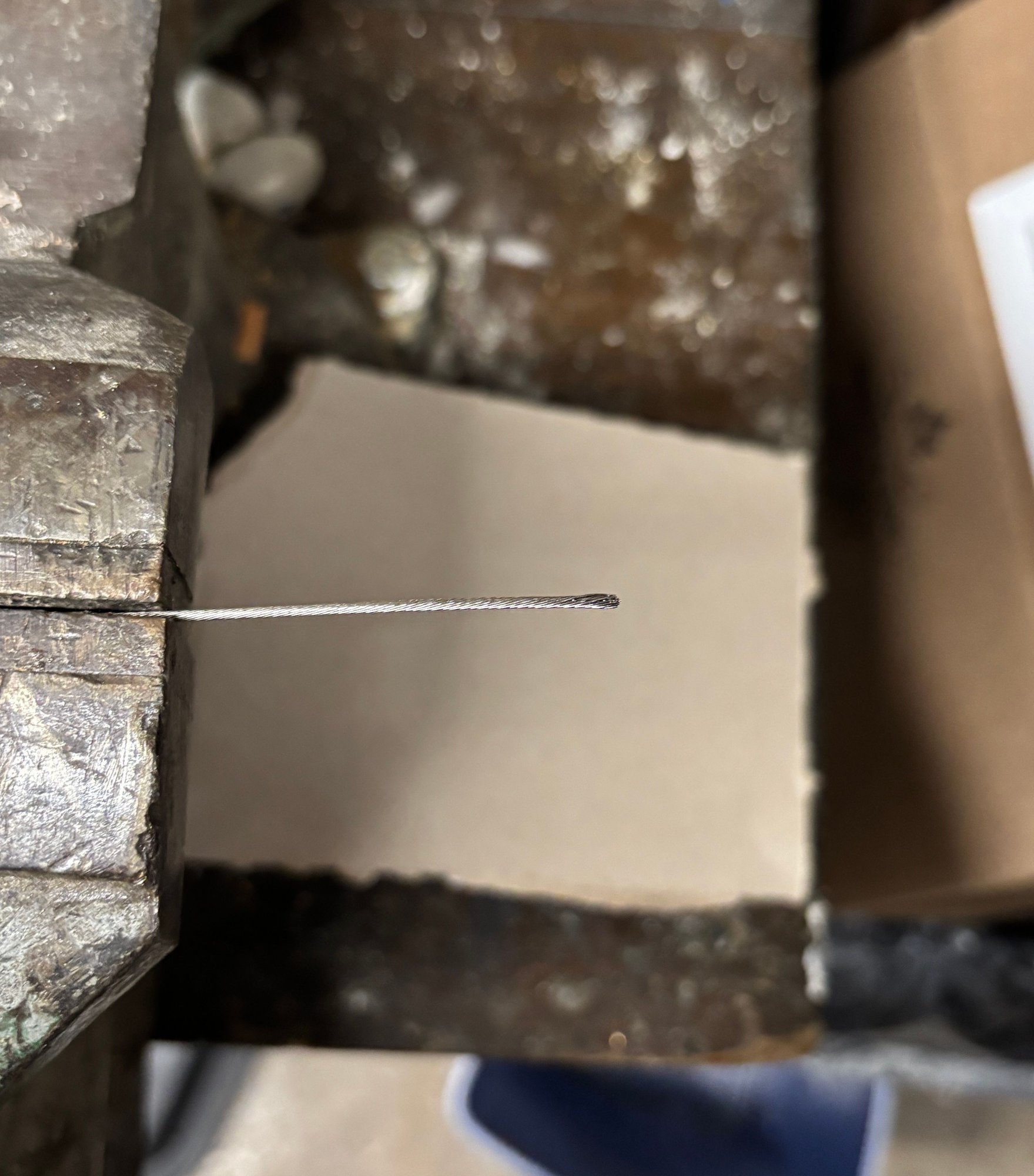
Here's a short piece of stainless cable.

Paste flux applied.
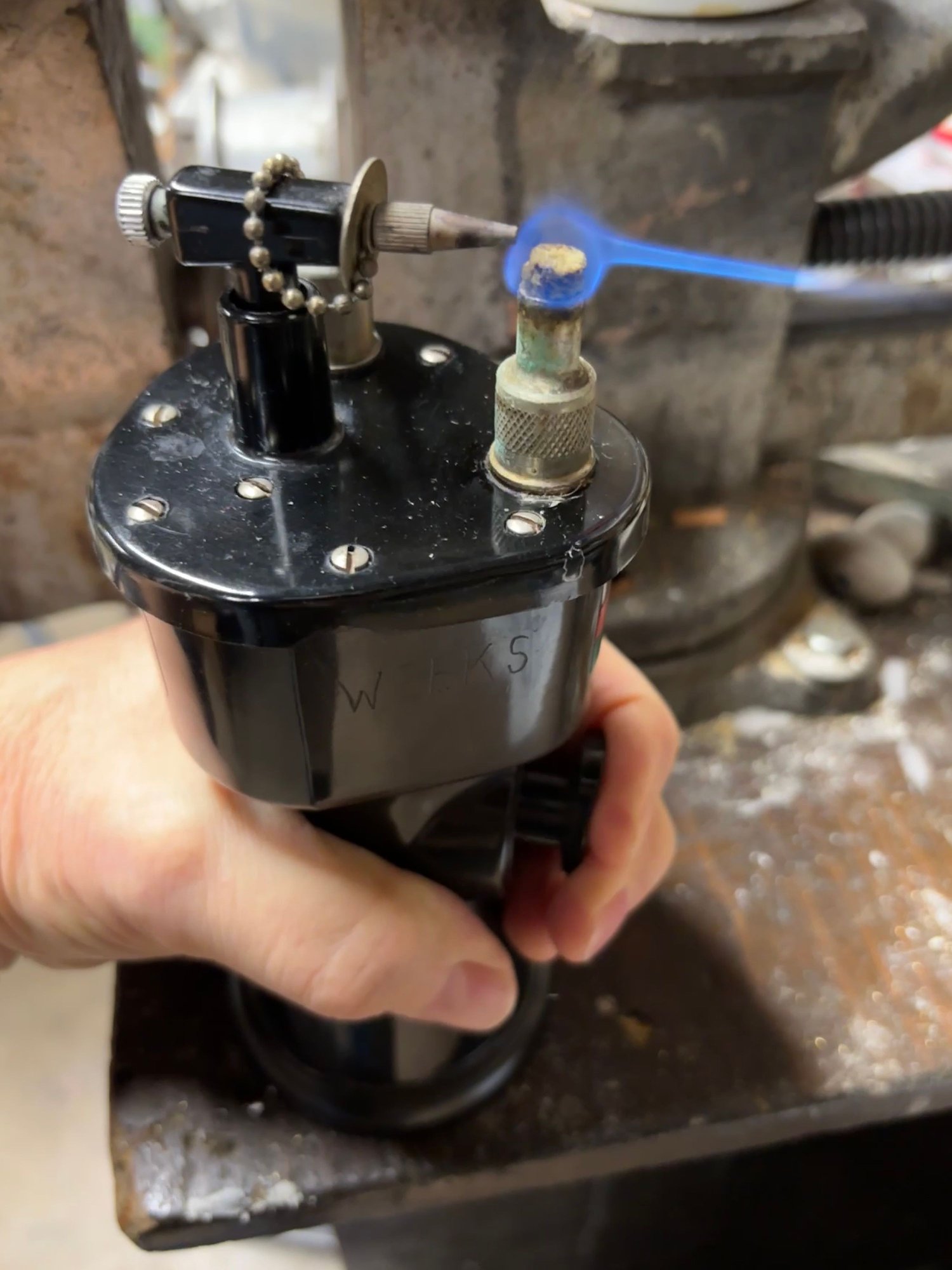
Hanau Torch. This is an alcohol-fueled device with a hand-powered air jet through the flame.
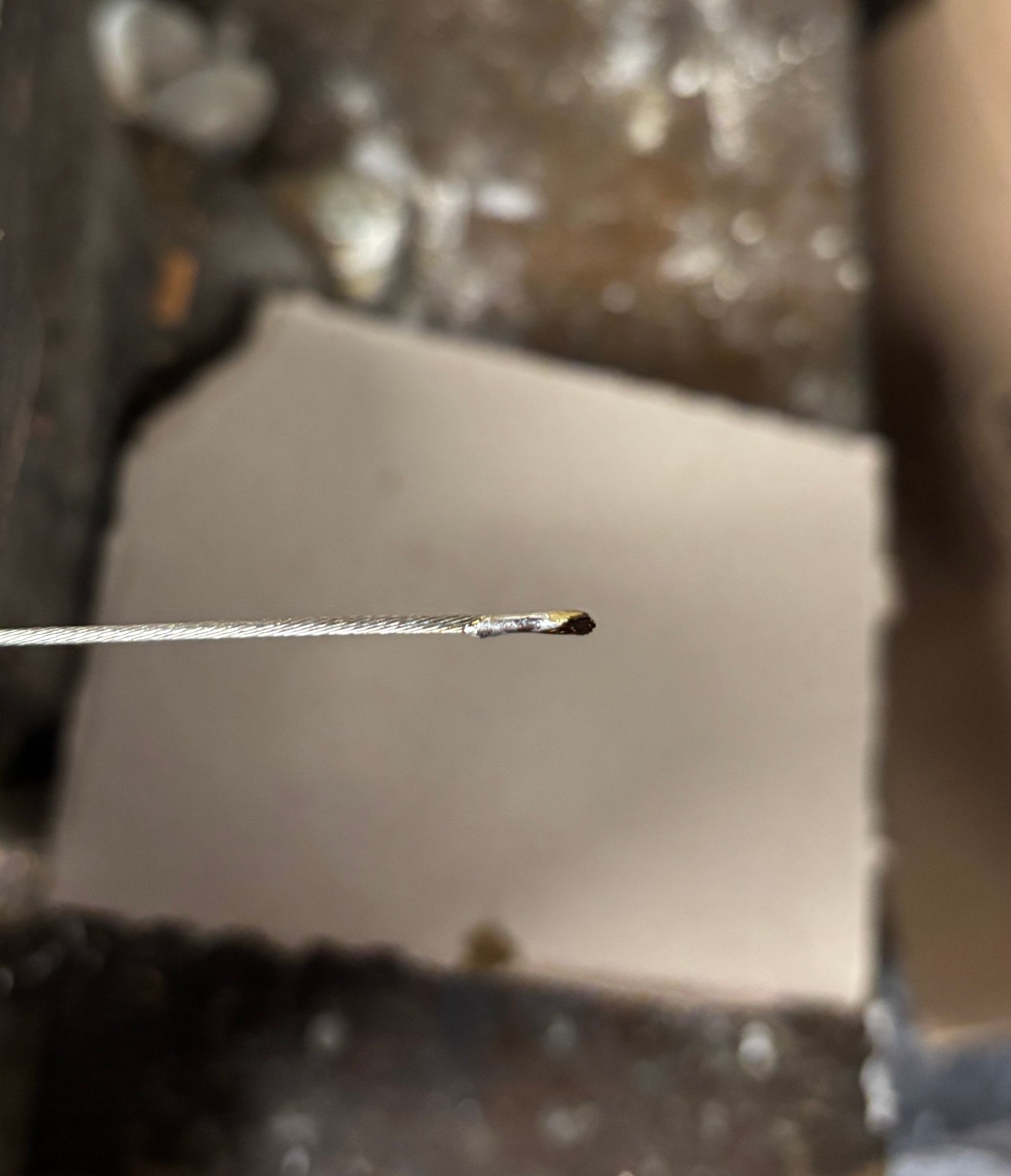
The final product. I should have wiped off the residual flux.
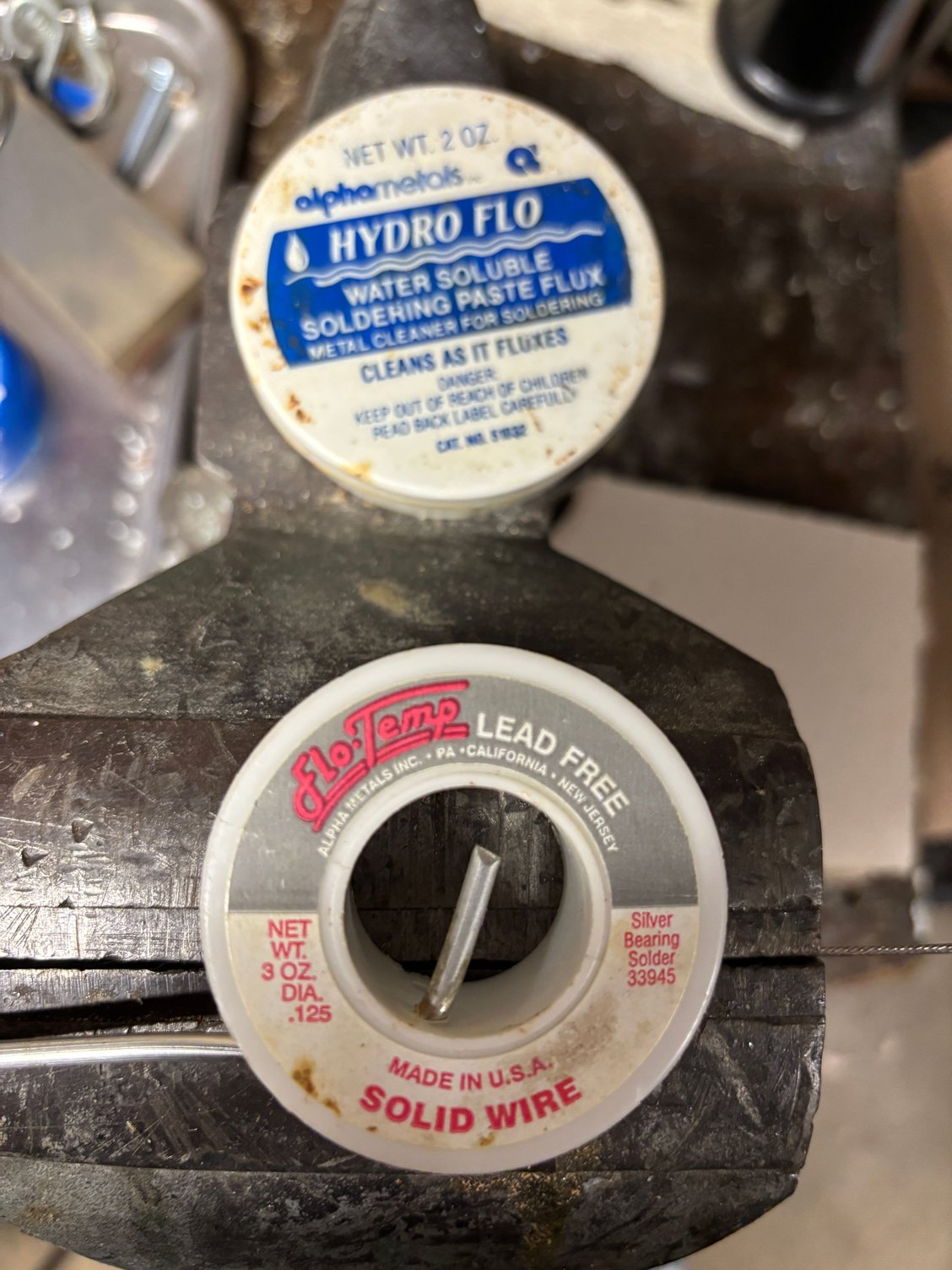
Flux and silver solder suitable for home water plumbing.
I used a "Hanau Torch", which is used by dentists for festooning dentures in the wax-up stage, as well as for silver-soldering small appliances (space maintainers, etc.).
Outcome: Soldering stainless cable ends is possible. I haven't done this, but maybe will start, since it looks nice and I have the torch.
Here's a short piece of stainless cable.
Paste flux applied.
Hanau Torch. This is an alcohol-fueled device with a hand-powered air jet through the flame.
The final product. I should have wiped off the residual flux.
Flux and silver solder suitable for home water plumbing.
 11-25-25 | 04:23 PM
#23

Senior Member
Joined: May 2010
Posts: 5,626
Likes: 2,497
From: Bastrop Texas
Bikes: Univega, Peu P6, Peu PR-10, Ted Williams, Peu UO-8, Peu UO-18 Mixte, Peu Dolomites
Here is another one.
Heat up the end with a butane lighter to burn off residual oils and after it cools place a drop of super glue...
Heat up the end with a butane lighter to burn off residual oils and after it cools place a drop of super glue...
__________________
 No matter where you're at... There you are... Δf:=f(1/2)-f(-1/2)

 11-25-25 | 04:43 PM
#24
Senior Member
Joined: Sep 2005
Posts: 3,838
Likes: 399
From: Michigan
Bikes: Trek 730 (quad), 720 & 830, Bike Friday NWT, Brompton M36R & M6R, Dahon HAT060 & HT060, ...
I solder all my cable ends. The majority are stainless steel. You need to use silver solder and flux that contains muriatic acid - I use Ruby Flux. The soldering iron needs to reach above 500 °C, and I even have a portable one that goes there, for working by the bike. I will try twist welding too - it may yield thinner cable ends.
11-26-25 | 06:46 AM
#25
Newbie
Joined: Nov 2025
Posts: 14
Likes: 11
From: Kentucky
Bikes: Jamis Dragon, Trek 930, Trek 1.2
Never tried stainless but I've soldered plenty of larger steel cables. Soldering the cable then cutting it gives a cleaner result. Keeps the strands together and avoids having a blob of solder on the end of the wire