


Rake on this fork? Help!
 01-24-09 | 01:40 PM
#1
Thread Starter
McNightrider
Joined: Mar 2007
Posts: 389
Likes: 0
Rake on this fork? Help!
Hey All,
I bought a frame, unfortunately the frame did not come with the original fork. The previous owner said the fork had hairline fracture at the steerer-tube, so he throw it out. I have asked the previous owner and he had no clue about rake.
At this moment I am trying to work out the rake of this fork, so I can start restoring the frame to original looks/geometry. Hoping someone can help me...here is the photo:
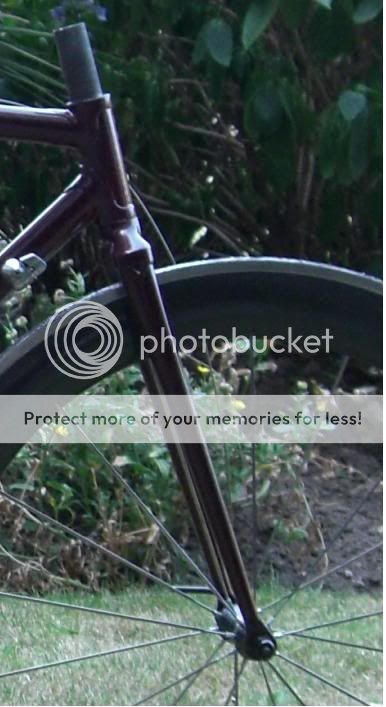
I know this might be a very hard job.
Thanks in Adv,
Dub.
I bought a frame, unfortunately the frame did not come with the original fork. The previous owner said the fork had hairline fracture at the steerer-tube, so he throw it out. I have asked the previous owner and he had no clue about rake.
At this moment I am trying to work out the rake of this fork, so I can start restoring the frame to original looks/geometry. Hoping someone can help me...here is the photo:
I know this might be a very hard job.
Thanks in Adv,
Dub.

 01-24-09 | 02:00 PM
#3
Senior Member
Joined: Aug 2005
Posts: 33,657
Likes: 1,119
From: Pittsburgh, PA
Bikes: '96 Litespeed Catalyst, '05 Litespeed Firenze, '06 Litespeed Tuscany, '20 Surly Midnight Special, All are 3x10. It is hilly around here!
Assuming its a road frame with "conventional" geometry, i.e a head tube angle around 73° and 700c wheels, a fork rake of 40 to 45 mm is almost universal and 43 mm is the most comon configuration.
The fork you show has straight legs so the rake was established by the angle the legs were set into the crown rather than by curving the legs but the result is identical.
The fork you show has straight legs so the rake was established by the angle the legs were set into the crown rather than by curving the legs but the result is identical.
01-24-09 | 02:03 PM
#4


Decrepit Member
Joined: Aug 2005
Posts: 10,488
Likes: 92
From: Santa Rosa, California
Bikes: Waterford 953 RS-22, several Paramounts
You really can't measure the rake accurately from a photograph because of parallax distortion (note the camera is not lined up directly from side of the head tube/fork since both fork blades are showing).
Use a 36" straightedge lining it up on the center of the top headset cup and the center of the bottom headset cup. With the front wheel in precise alignment with the fore-and-aft centerline of the frame, measure the distance from the straightedge (at a right angle to the straightedge) to the center of the front axle. That dimension is the fork rake (or offset as it's often called).
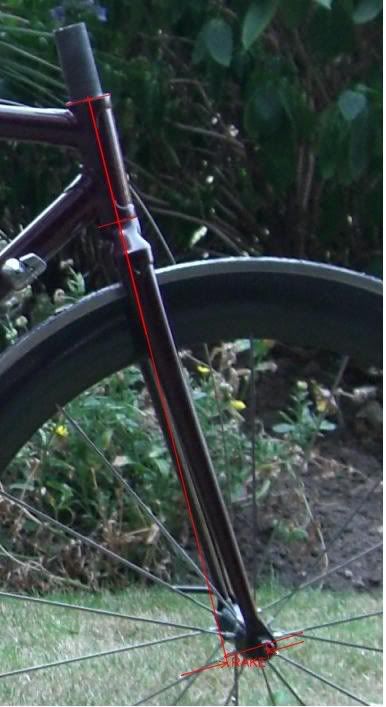
Use a 36" straightedge lining it up on the center of the top headset cup and the center of the bottom headset cup. With the front wheel in precise alignment with the fore-and-aft centerline of the frame, measure the distance from the straightedge (at a right angle to the straightedge) to the center of the front axle. That dimension is the fork rake (or offset as it's often called).
 01-24-09 | 02:07 PM
#5
Thread Starter
McNightrider
Joined: Mar 2007
Posts: 389
Likes: 0
Thanks for all the reply...much appreciated.
For more information, the frame is a lo-pro frame, hence 650c front end. mmmmmh seems like a very small rake to me.
Yer I tried to draw the same line, but not 100% am I doing the right thing.
For more information, the frame is a lo-pro frame, hence 650c front end. mmmmmh seems like a very small rake to me.
Yer I tried to draw the same line, but not 100% am I doing the right thing.
01-24-09 | 02:55 PM
#6

Old fart


Joined: Nov 2004
Posts: 26,318
Likes: 5,231
From: Appleton WI
Bikes: Several, mostly not name brands.
No only that, but there's no headset installed, so the apparent rake is probably more than the actual rake.
01-24-09 | 03:01 PM
#7
Old fart
Joined: Nov 2004
Posts: 26,318
Likes: 5,231
From: Appleton WI
Bikes: Several, mostly not name brands.
It does look like small to nonexistent rake, but you can always add rake if you want:
https://www.instructables.com/id/Easy...Blade-Benders/
01-24-09 | 03:10 PM
#8

Senior Member
Joined: Apr 2005
Posts: 17,195
Likes: 761
From: Ann Arbor, MI
Bikes: 1980 Masi, 1984 Mondonico, 1984 Trek 610, 1980 Woodrup Giro, 2005 Mondonico Futura Leggera ELOS, 1967 PX10E, 1971 Peugeot UO-8
Not probably more, DEFINITELY more.
I would take off the fork and measure it on a flat table. The rake is the distance from the steer tube center line to the hub center when clamped into the drops.
Clamp an unlaced hub in the dropouts, and set the fork down on the table. Using wood blocks, metal blocks, books, or what have you, prop up the steer tube so it is parallel to the table surface. Now you can measure the distance from the side of the steer tube closest to the table and farthest from the table to the table top. The average of these two numbers is the height of the steer tube centerline above the table.
Then measure the height of the center of the hub axle (use the edge where the QR cap is screwed on) to the table top.
Now subtract the hub height from the steer tube centerline height, and that is the rake. If you make all the measurements to the millimeter, you will have an accuracy at the end nearly to the millimeter.
Road Fan
I would take off the fork and measure it on a flat table. The rake is the distance from the steer tube center line to the hub center when clamped into the drops.
Clamp an unlaced hub in the dropouts, and set the fork down on the table. Using wood blocks, metal blocks, books, or what have you, prop up the steer tube so it is parallel to the table surface. Now you can measure the distance from the side of the steer tube closest to the table and farthest from the table to the table top. The average of these two numbers is the height of the steer tube centerline above the table.
Then measure the height of the center of the hub axle (use the edge where the QR cap is screwed on) to the table top.
Now subtract the hub height from the steer tube centerline height, and that is the rake. If you make all the measurements to the millimeter, you will have an accuracy at the end nearly to the millimeter.
Road Fan
01-24-09 | 03:19 PM
#9
Senior Member
Joined: Sep 2008
Posts: 7,296
Likes: 577
From: Loveland, CO
Bikes: Cervelo Rouvida x 2
Measuring the fork rake is not that hard, but you also need to consider the fork length. If the frame is a horizontal TT model, you'll get some idea of incorrect length if the TT is not level after being assembled, but that's kind of late to figure out that you have a problem. The wrong fork length will change the HTA and cause as much or more change to the steering trail as the wrong rake.
A common method of measuring rake with the headset installed would be to measure the front-center with the fork in it's normal position, then rotate 180 degrees and measure the difference. Divide by two to get the rake.
If you have a local machine shop and tell them you want to measure the distance between a line through the steering axis and a parallel line through the center of the axle, they'd have no problem setting that up. It can even be done with reasonable accuracy on a flat countertop with a precision scale and a smooth board of uniform thickness to hold the fork crown off the countertop, but you have to know what you're doing.
A common method of measuring rake with the headset installed would be to measure the front-center with the fork in it's normal position, then rotate 180 degrees and measure the difference. Divide by two to get the rake.
If you have a local machine shop and tell them you want to measure the distance between a line through the steering axis and a parallel line through the center of the axle, they'd have no problem setting that up. It can even be done with reasonable accuracy on a flat countertop with a precision scale and a smooth board of uniform thickness to hold the fork crown off the countertop, but you have to know what you're doing.
Last edited by DaveSSS; 01-24-09 at 03:24 PM.
01-24-09 | 04:23 PM
#10

Senior Member
Joined: Jul 2005
Posts: 11,754
Likes: 26
From: Mesa, AZ
Bikes: Moots RCS, tandem, beach-cruiser, MTB, Specialized-Allez road-bike, custom track-bike
Easy way to measure fork-rake is to stick a broomstick into the steerer and have it extended down between the dropouts. I have one that coincidentally is 22.2mm and fits exactly into the centre of the steerer with no wobbles. Then insert a bare axle or big screwdriver between the dropouts. Using calipers, measure C-t-C distance between axle and broomstick (normal to broomstick).
01-24-09 | 08:05 PM
#11
Senior Member
Joined: Apr 2005
Posts: 17,195
Likes: 761
From: Ann Arbor, MI
Bikes: 1980 Masi, 1984 Mondonico, 1984 Trek 610, 1980 Woodrup Giro, 2005 Mondonico Futura Leggera ELOS, 1967 PX10E, 1971 Peugeot UO-8
DaveSSS, that's exactly the procedure I gave in the previous post.
01-24-09 | 08:07 PM
#12
Senior Member
Joined: Apr 2005
Posts: 17,195
Likes: 761
From: Ann Arbor, MI
Bikes: 1980 Masi, 1984 Mondonico, 1984 Trek 610, 1980 Woodrup Giro, 2005 Mondonico Futura Leggera ELOS, 1967 PX10E, 1971 Peugeot UO-8
Easy way to measure fork-rake is to stick a broomstick into the steerer and have it extended down between the dropouts. I have one that coincidentally is 22.2mm and fits exactly into the centre of the steerer with no wobbles. Then insert a bare axle or big screwdriver between the dropouts. Using calipers, measure C-t-C distance between axle and broomstick (normal to broomstick).
Danno, how does that work with a Columbus tube frame that has a butted steer tube?
Other than that, I like this idea. A lot.
 01-25-09 | 09:46 AM
#14
Senior Member
Joined: Sep 2008
Posts: 7,296
Likes: 577
From: Loveland, CO
Bikes: Cervelo Rouvida x 2
01-25-09 | 10:02 AM
#15

Senior Member
Joined: Dec 2005
Posts: 1,383
Likes: 2
From: Boulder, Colorado
Bikes: Cinelli Supercoursa 69, Ritchey Breakaway Cross, Mondonico Diamond Extra 05, Coors Light Greg Lemond (built by Scapin) 88, Scapin MTB, Stumpjumper 83, Specialized Stumpjumper M4, Lemond Poprad 2001
Depending on the tube thickness that was used to make that fork it can have a pretty good spring. I have ridden a bike with straight forks that was made with a thinner walled tubing that was pretty comfortable. The bike I rode had a 42mm rake. I can't tell for sure but the bike looks like it has pressed bearings installed as the fork steerer tube is even at the top.
