


Bendix 20 Hub Operation - Need Assistance
 11-25-12 | 02:14 PM
#1
Thread Starter
Newbie
Joined: Nov 2012
Posts: 4
Likes: 0
Bendix 20 Hub Operation - Need Assistance
Hi all,
I recently found an old derby bicycle in a garage. The Bendix 20 hub does not seem to work properly. The sprocket spins without turning the hub. I took the hub apart but cannot seen to locate the issue. Can someone advise on this, or explain how this hub is suppose to work. Thanks, Andrew
I recently found an old derby bicycle in a garage. The Bendix 20 hub does not seem to work properly. The sprocket spins without turning the hub. I took the hub apart but cannot seen to locate the issue. Can someone advise on this, or explain how this hub is suppose to work. Thanks, Andrew
 11-25-12 | 02:27 PM
#2
Senior Member


Joined: Apr 2009
Posts: 39,897
Likes: 3,865
From: New Rochelle, NY
Bikes: too many bikes from 1967 10s (5x2)Frejus to a Sumitomo Ti/Chorus aluminum 10s (10x2), plus one non-susp mtn bike I use as my commuter
I'm not familiar with the specific model 20 hub, but the basics of all Bendix hubs are the same. They work on the principle of a spiral clutch on the driver (attached to the sprocket). When you pedal forward the spiral draws the clutch to the right where it engages the hub shell. When you coast and the hub is spinning faster than the sprocket, the clutch goes down the spiral and disengages. When you back pedal the clutch moves to the left to engage the brake side of the hub and apply the brake (the actual brake side varies from hub to hub).
Usually there's a spring on one side or the other to start the process.
There are lots of free tutorials on rebuilding coaster brakes, so I suggest reviewing a few until the light goes on and figure out what you're missing (either part or understanding)
Usually there's a spring on one side or the other to start the process.
There are lots of free tutorials on rebuilding coaster brakes, so I suggest reviewing a few until the light goes on and figure out what you're missing (either part or understanding)
__________________
FB
Chain-L site
An ounce of diagnosis is worth a pound of cure.
Just because I'm tired of arguing, doesn't mean you're right.
“One accurate measurement is worth a thousand expert opinions” - Adm Grace Murray Hopper - USN
WARNING, I'm from New York. Thin skinned people should maintain safe distance.
FB
Chain-L site
An ounce of diagnosis is worth a pound of cure.
Just because I'm tired of arguing, doesn't mean you're right.
“One accurate measurement is worth a thousand expert opinions” - Adm Grace Murray Hopper - USN
WARNING, I'm from New York. Thin skinned people should maintain safe distance.
11-25-12 | 02:52 PM
#3

Senior member

Joined: Oct 2004
Posts: 8,371
Likes: 898
From: Oakville Ontario
Also, check that the 3 drive tabs on the cog are not sheared or worn off, and the cog spins without turning the driver. Best way to check that is to remove the snap ring holding the cog on, and lift the cog off. I have seen this happen more than once, although that was on bikes (trikes actually) in heavy duty usage. Still worth checking before you get too deep into it.
11-25-12 | 04:00 PM
#4
Senior Member
Joined: Apr 2009
Posts: 39,897
Likes: 3,865
From: New Rochelle, NY
Bikes: too many bikes from 1967 10s (5x2)Frejus to a Sumitomo Ti/Chorus aluminum 10s (10x2), plus one non-susp mtn bike I use as my commuter
This is a good point, and worth checking if you haven't taken it apart yet. You can check it without popping the snap ring, by simply turning the sprocket while looking at the center of the driver. If the driver doesn't turn, then it's simply a matter of a new sprocket. As Dan said, this is bery rare, but why not check first. Once you have it apart, it's harder to check this without popping the snap ring since it's hard to apply enough torque.
__________________
FB
Chain-L site
An ounce of diagnosis is worth a pound of cure.
Just because I'm tired of arguing, doesn't mean you're right.
“One accurate measurement is worth a thousand expert opinions” - Adm Grace Murray Hopper - USN
WARNING, I'm from New York. Thin skinned people should maintain safe distance.
FB
Chain-L site
An ounce of diagnosis is worth a pound of cure.
Just because I'm tired of arguing, doesn't mean you're right.
“One accurate measurement is worth a thousand expert opinions” - Adm Grace Murray Hopper - USN
WARNING, I'm from New York. Thin skinned people should maintain safe distance.
11-26-12 | 11:12 PM
#5
Senior Member
Joined: Sep 2012
Posts: 69
Likes: 0
From: Tampa FL
Bikes: 2004 Cannondale R3000, 1972 Raleigh Professional, 1976 Raleigh International 1990 Jamis Explorer, 1989 Bottecchia SLX
Most common cause for this symptom is old grease hardened up and not allowing the clutch cone to engage. disassemble, clean in solvent and reassemble with new grease. Barring the forementioned tabs on the cog being worn off, and rarely the clutch one being worn out, 9 times out of 10 this will fix your problem.
11-26-12 | 11:18 PM
#6

Insane Bicycle Mechanic

Joined: Mar 2008
Posts: 10,165
Likes: 1,133
From: other Vancouver
Most common cause for this symptom is old grease hardened up and not allowing the clutch cone to engage. disassemble, clean in solvent and reassemble with new grease. Barring the forementioned tabs on the cog being worn off, and rarely the clutch one being worn out, 9 times out of 10 this will fix your problem.
__________________
Jeff Wills
Comcast nuked my web page. It will return soon..
Jeff Wills
Comcast nuked my web page. It will return soon..
11-27-12 | 08:50 AM
#7
Thread Starter
Newbie
Joined: Nov 2012
Posts: 4
Likes: 0
Thanks again,
Andrew
11-27-12 | 08:02 PM
#8
Insane Bicycle Mechanic
Joined: Mar 2008
Posts: 10,165
Likes: 1,133
From: other Vancouver
Hi all, thanks for the quick responses. The 3 drive tabs on the cog are not worn down. The cog & sprocket are engaged tightly. When the sprocket is rotated via the bike chain, the entire inners of the hub (spiral clutch, shaft, brakes,) all spin as one unit. Nothing seems to catch the hub from the inside to make it spin. The grease inside is original to the bike and extremely viscous. Almost like spackle. I will clean it with solvent and re grease. I'll also try to find some videos on Youtube, and will post my results in a couple days.
Thanks again,
Andrew
Thanks again,
Andrew
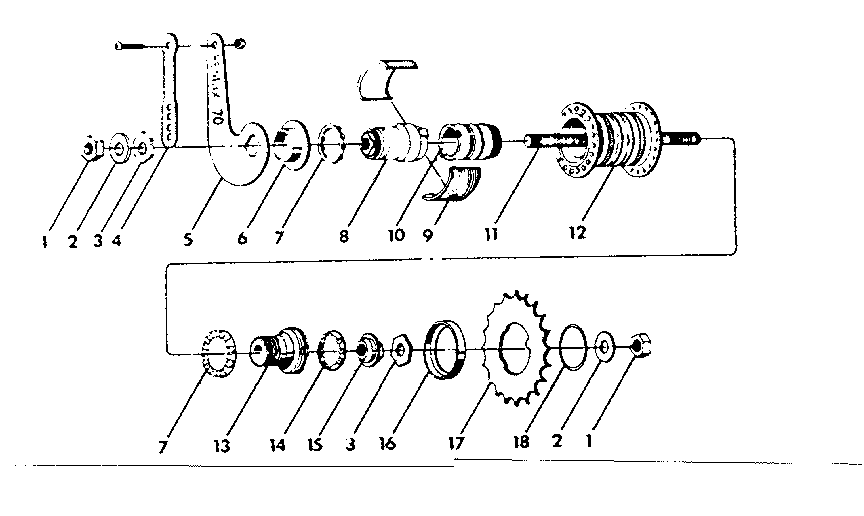
Below: driver is part #13, clutch cone is #10
__________________
Jeff Wills
Comcast nuked my web page. It will return soon..
Jeff Wills
Comcast nuked my web page. It will return soon..

