


Maximum Difference Between Double Chainrings
 10-08-14 | 01:46 AM
#1

Thread Starter
Senior Member
Joined: Aug 2014
Posts: 392
Likes: 1
From: Yreka, CA, US
Bikes: Fuji Aloha, ...
Maximum Difference Between Double Chainrings
Instead of gravedigging https://www.bikeforums.net/bicycle-me...ing-sizes.html, I'll start anew.
I want to know what is the largest range possible with a 110mm or 130mm double. Can one have a 48/28 -- like a 48/38/28 without the middle ring? How about a 52/26? What are the functional limitations and tradeoffs? Are there specific makers that cater to oddball setups like this?
On the flip side, what is the smallest difference between double rings that is at all useful? Is there any situation where a 53/48 or a 52/48 is useful?
I know that someone will say "just get a triple" somewhere along the line. I'm not necessarily going to run out an install a max-range double whatever the answers say. I'm trying to get a feel for what is reasonably possible, not the conventional wisdom, not the current trend.
I want to know what is the largest range possible with a 110mm or 130mm double. Can one have a 48/28 -- like a 48/38/28 without the middle ring? How about a 52/26? What are the functional limitations and tradeoffs? Are there specific makers that cater to oddball setups like this?
On the flip side, what is the smallest difference between double rings that is at all useful? Is there any situation where a 53/48 or a 52/48 is useful?
I know that someone will say "just get a triple" somewhere along the line. I'm not necessarily going to run out an install a max-range double whatever the answers say. I'm trying to get a feel for what is reasonably possible, not the conventional wisdom, not the current trend.
 10-08-14 | 06:48 AM
#2
Mechanic/Tourist
Joined: Apr 2007
Posts: 7,522
Likes: 12
From: Syracuse, NY
Bikes: 2008 Novara Randonee - love it. Previous bikes:Motobecane Mirage, 1972 Moto Grand Jubilee (my fave), Jackson Rake 16, 1983 C'dale ST500.
The answer on largest range will vary due to type of chainrings, spacing between the two, derailleur, and chain, but I believe 48/28 is impractical due to the steep, low angle climb and drop. The derailleur pushes the chain sideways, not up, and the chainwheels are designed with certain assumptions. The derailleur will not in my opinion be able to push the chain that high, and in the other direction the chain will likely travel right past the small chainwheel due to the steep drop. Other large differences present similar problems. What you will get here is anecdotal evidence that may not apply to your equipment, as there is no definitive answer.
As to the smallest difference there is also not a single answer. With today's 11 and 12 tooth small cogs I don't think 53 is very useful, let alone paired with a 48. How often do you expect to be going 40+ mph when coasting is not the better alternative?
As to the smallest difference there is also not a single answer. With today's 11 and 12 tooth small cogs I don't think 53 is very useful, let alone paired with a 48. How often do you expect to be going 40+ mph when coasting is not the better alternative?
10-08-14 | 06:56 AM
#3

Old fart


Joined: Nov 2004
Posts: 26,347
Likes: 5,254
From: Appleton WI
Bikes: Several, mostly not name brands.
The functional problem is that the wider the range the front derailleur must cover, the longer the cage it needs. With too short a cage, the chain will drag on the derailleur when it's on the small ring. SunTour made a wide range front derailleur with a cage extension for this purpose, but the longer cage proved more flexible and didn't shift very smoothly.
10-08-14 | 07:56 AM
#4
Senior Member
Joined: Aug 2005
Posts: 33,657
Likes: 1,119
From: Pittsburgh, PA
Bikes: '96 Litespeed Catalyst, '05 Litespeed Firenze, '06 Litespeed Tuscany, '20 Surly Midnight Special, All are 3x10. It is hilly around here!
The largest difference with a 130 mm BCD is a 38T small ring (the smallest that will fit) and what ever large ring you want, typically a 53. The smallest chainring that will fit a 110 mm BCD crank is a 33T and, again the large ring is limited to what's available, probably a 52 or 53T. So in either case, a 28T chainring is not an option.
As to big gaps, I have run a 53/42/26T chairing set up on a Campy triple crank and the 42 to 26 shift and back were acceptable even with the front derailleur mounted way to high for those rings.
As to big gaps, I have run a 53/42/26T chairing set up on a Campy triple crank and the 42 to 26 shift and back were acceptable even with the front derailleur mounted way to high for those rings.
10-08-14 | 07:58 AM
#5
Senior Member
Joined: Jun 2011
Posts: 693
Likes: 2
From: Madison, AL
Bikes: 2010 Felt DA, 2012/6 Felt F5, 2015 Felt AR FRD
The max difference on most derailleurs is 16t, which is why we have the options 50/34, and 52/36 for compact and mid compact. The ultimate low gearing solutions are on the back of the bike, you can lower the gear inch on a drivetrain more easily in the cassette.
Unless you want a mountain crank, that is.
Unless you want a mountain crank, that is.
10-08-14 | 08:04 AM
#6

Senior Member

Joined: Aug 2011
Posts: 22,676
Likes: 2,642
From: CID
Bikes: 1991 Bianchi Eros, 1964 Armstrong, 1988 Diamondback Ascent, 1988 Bianchi Premio, 1987 Bianchi Sport SX, 1980s Raleigh mixte (hers), All-City Space Horse (hers)
Instead of gravedigging https://www.bikeforums.net/bicycle-me...ing-sizes.html, I'll start anew.
I want to know what is the largest range possible with a 110mm or 130mm double. Can one have a 48/28 -- like a 48/38/28 without the middle ring? How about a 52/26? What are the functional limitations and tradeoffs? Are there specific makers that cater to oddball setups like this?
On the flip side, what is the smallest difference between double rings that is at all useful? Is there any situation where a 53/48 or a 52/48 is useful?
I know that someone will say "just get a triple" somewhere along the line. I'm not necessarily going to run out an install a max-range double whatever the answers say. I'm trying to get a feel for what is reasonably possible, not the conventional wisdom, not the current trend.
I want to know what is the largest range possible with a 110mm or 130mm double. Can one have a 48/28 -- like a 48/38/28 without the middle ring? How about a 52/26? What are the functional limitations and tradeoffs? Are there specific makers that cater to oddball setups like this?
On the flip side, what is the smallest difference between double rings that is at all useful? Is there any situation where a 53/48 or a 52/48 is useful?
I know that someone will say "just get a triple" somewhere along the line. I'm not necessarily going to run out an install a max-range double whatever the answers say. I'm trying to get a feel for what is reasonably possible, not the conventional wisdom, not the current trend.

Gear Theory for Bicyclists
Last edited by ThermionicScott; 10-08-14 at 10:01 AM.
10-08-14 | 08:22 AM
#7

Senior Member
Joined: Jun 2007
Posts: 7,552
Likes: 135
10-08-14 | 08:36 AM
#8

Si Senior
Joined: Nov 2004
Posts: 2,669
Likes: 11
From: Naperville, Illinois
Bikes: Too Numerous (not)
Minimum chainring sizes for 130 and 110 were mentioned. If other BCD's are allowed, the question becomes derailer capacity --and that is a function of derailer design. I'm currently experimenting with a 44-28 (no ramps or pins to aid the climb), and use the IRD compact road triple derailer. It works absolutely fine, BUT I've also installed a chain catcher at the low end and a chain guard at the high side. Shifts appear to be a simple slap on the brifters. I have not been on a long trip yet --which is where the real behavior will emerge. But it seems to be fine and I suspect 44 - 26 would also.
[adding: this derailer appears to be able to handle up to 48 big ring.]
[adding pic]

[adding: not sure I'd want a 48 - 26, but I bet this derailer could handle it.]
[adding: this derailer appears to be able to handle up to 48 big ring.]
[adding pic]
[adding: not sure I'd want a 48 - 26, but I bet this derailer could handle it.]
Last edited by dbg; 10-08-14 at 08:51 AM. Reason: changed something
10-08-14 | 09:10 AM
#9
Senior Member
Joined: Aug 2005
Posts: 33,657
Likes: 1,119
From: Pittsburgh, PA
Bikes: '96 Litespeed Catalyst, '05 Litespeed Firenze, '06 Litespeed Tuscany, '20 Surly Midnight Special, All are 3x10. It is hilly around here!
There is a limit to this too. Current front derailleur's have the inner cage plate significantly deeper than the outer so a minimum chainring difference must be maintained or the inner plate will hit the smaller chainring and keep the derailleur from shifting to the larger chainring unless the derailleur is set too high above the big ring. Older fd's had the two cage plates about the same depth which is why half-step gearing was practical but newer designs don't.
10-08-14 | 10:06 AM
#10
Senior Member
Joined: Aug 2011
Posts: 22,676
Likes: 2,642
From: CID
Bikes: 1991 Bianchi Eros, 1964 Armstrong, 1988 Diamondback Ascent, 1988 Bianchi Premio, 1987 Bianchi Sport SX, 1980s Raleigh mixte (hers), All-City Space Horse (hers)
There is a limit to this too. Current front derailleur's have the inner cage plate significantly deeper than the outer so a minimum chainring difference must be maintained or the inner plate will hit the smaller chainring and keep the derailleur from shifting to the larger chainring unless the derailleur is set too high above the big ring. Older fd's had the two cage plates about the same depth which is why half-step gearing was practical but newer designs don't.
10-08-14 | 11:30 AM
#11
Full Member
Joined: Apr 2014
Posts: 457
Likes: 10
From: Central Oregon
Bikes: Redline Conquest Pro, Kona Cinder Cone, Trek Fuel EX8(RIP) Pivot Mach 5 frankenbike
While its rated capacity is still only 16T the Shimano CX70 front derailleur is worth a look for smaller than usual doubles since its cage is shaped for a 46T outer chain ring so it should be a good fit for a 30-46 Randonneur style crank. Also FSA used to make compact double specific front derailleurs with specially shaped cages.
10-08-14 | 12:53 PM
#12
Si Senior
Joined: Nov 2004
Posts: 2,669
Likes: 11
From: Naperville, Illinois
Bikes: Too Numerous (not)
Just reiterating ...I have found nothing to match this derailer for my wide range sub compact doubles with road shifters. It's capacity has to approach 24 T and max big ring ~48. I've used it in two builds so far and really like it (both with 44 T half step big ring).

IRD Alpina-d Compact Road Triple Front Derailleur - Harris Cyclery bicycle shop - West Newton, Massachusetts
IRD Alpina-d Compact Road Triple Front Derailleur - Harris Cyclery bicycle shop - West Newton, Massachusetts
10-10-14 | 07:21 PM
#13
Thread Starter
Senior Member
Joined: Aug 2014
Posts: 392
Likes: 1
From: Yreka, CA, US
Bikes: Fuji Aloha, ...
Somewhere or another... Ahh, here... Sheldon Brown references a TA Cyclotouriste crankset with a huge gap between ring sizes. According to this, the official name of these are the Pro Vis 5 and they are possibly no longer manufactured. It also seems to require old, no longer manufactured derailers. Is this a totally unique product line as far as range between rings goes? If not, what else is there? Anything similar that can be bought without scavenging e-bay or garage sales?
but I believe 48/28 is impractical due to the steep, low angle climb and drop. The derailleur pushes the chain sideways, not up, and the chainwheels are designed with certain assumptions. The derailleur will not in my opinion be able to push the chain that high, and in the other direction the chain will likely travel right past the small chainwheel due to the steep drop.
Also, while the FD will be far more important in this regard, what difference does the chain and the RD and cassette make?
Again, this is not an "I want this on my bike" post, rather I'm hoping to learn from those with unusual experience and knowledge just for the sake of learning. Hope that makes sense.
10-10-14 | 11:34 PM
#14
tcarl
Joined: Dec 2010
Posts: 561
Likes: 9
From: St. Louis, MO
Bikes: Roark, Waterford 1100, 1987 Schwinn Paramount, Nishiki Professional, Bottecchia, 2 Scattantes, 3 Cannondale touring bikes, mtn. bike, cyclocross, hybrid, 1940's era Schwinn
Regarding your other question, the smallest difference, once upon a time (early 1970's and earlier) a common "racing" gearing was the so-called "half step" gearing. A typical set up would be 49/52 chainrings and something like a 14-16-18-21-24 freewheel. The gear ratios on the smaller chainring were half way between those of the larger, so lowest to highest gears would be 1 6 2 7 3 8 4 9 5 10. You probably wouldn't use gears 6 and 5 very often. As straight block freewheels and more gears became more common 42/52 and 13-14-15-16-17-19(-21) became the standard. A touring set-up would be "half step plus granny" - an example being 36/49/52 with a 14-16-18-21-24-28.
I really liked the half step gearing. You could have the "fine tuning" gear change - just change chainrings, or a slightly wider gear change by switching freewheel cogs. The front derailleurs always shifted really smoothly with only the 3 tooth difference. Nowadays brifters, indexing, many more cogs, and freehubs are all great improvements, but with the technology and parts of that era half step gearing worked well. I can just imaging using it today - since they probably wouldn't remember it or understand the reasoning or principle behind it, I can just imaging my cycling buddies reaction to my having a 3 tooth difference in my chainrings. Maybe I'll set a bike up that way sometime just to see their reaction.
I really liked the half step gearing. You could have the "fine tuning" gear change - just change chainrings, or a slightly wider gear change by switching freewheel cogs. The front derailleurs always shifted really smoothly with only the 3 tooth difference. Nowadays brifters, indexing, many more cogs, and freehubs are all great improvements, but with the technology and parts of that era half step gearing worked well. I can just imaging using it today - since they probably wouldn't remember it or understand the reasoning or principle behind it, I can just imaging my cycling buddies reaction to my having a 3 tooth difference in my chainrings. Maybe I'll set a bike up that way sometime just to see their reaction.
10-11-14 | 08:13 AM
#15
Banned
Joined: Jun 2010
Posts: 43,586
Likes: 1,380
From: NW,Oregon Coast
Bikes: 8
in 1985*, a companion from England , riding the California Coast [SF South] with Me, used a Classic TA 50-28t Cyclotourist crankset.
Functionally such a big upshift out of the 28t would be done at the crest of a hill , so the strain on the chain is near zero.
* the freewheel, as I recall he used, was a 13-28t .. a 6 speed would be in that period.
My current rig (folding Brompton) the double is even wider , but the chain is not derailed, there is a gear box in the crankset,
the arms turn at a different rate, faster than the chainring, in Low reduction gear, range.
It ia functionally as if a 50 - 20 t double .. I combine it with a 3 speed IGH in the back wheel.. 6 speed, no overlap, results.
Both being planetary, 3<>4 is a quick double shift.
Functionally such a big upshift out of the 28t would be done at the crest of a hill , so the strain on the chain is near zero.
* the freewheel, as I recall he used, was a 13-28t .. a 6 speed would be in that period.
My current rig (folding Brompton) the double is even wider , but the chain is not derailed, there is a gear box in the crankset,
the arms turn at a different rate, faster than the chainring, in Low reduction gear, range.
It ia functionally as if a 50 - 20 t double .. I combine it with a 3 speed IGH in the back wheel.. 6 speed, no overlap, results.
Both being planetary, 3<>4 is a quick double shift.
Last edited by fietsbob; 10-11-14 at 08:32 AM.
10-11-14 | 11:14 AM
#16
Senior Member
Joined: May 2013
Posts: 4,400
Likes: 106
From: SF Bay Area
Bikes: Bianchi Infinito (Celeste, of course)
Compact road cranksets are typically designed for 16T. Modern MTB gear sets are 14T max difference. In a light duty application, you could probably run a MTB FD to 16T for on-road use (low load & vibration).
Either way anything beyond 16T is going to be suboptimal. The main problem is the FD not having enough rise to avoid crashing into things.
A better solution is a wide range MTB cassette. With a MTB RD you can run a compact double (or mountain double), and an 11-36 (or even 10-42 [11spd]).
Either way anything beyond 16T is going to be suboptimal. The main problem is the FD not having enough rise to avoid crashing into things.
A better solution is a wide range MTB cassette. With a MTB RD you can run a compact double (or mountain double), and an 11-36 (or even 10-42 [11spd]).
10-11-14 | 03:36 PM
#17
Thread Starter
Senior Member
Joined: Aug 2014
Posts: 392
Likes: 1
From: Yreka, CA, US
Bikes: Fuji Aloha, ...
... I really liked the half step gearing. ... I can just imaging using it today - since they probably wouldn't remember it or understand the reasoning or principle behind it, I can just imaging my cycling buddies reaction to my having a 3 tooth difference in my chainrings. Maybe I'll set a bike up that way sometime just to see their reaction.
 I like that spirit! Perhaps I'm just an innate hacker. Perhaps growing up with a grandfather who grew up in the Original Depression and who worked for years at Western Electric led me to see most non-living things as simply objects with engineering potential. The common, "If they don't sell it, it must not be worthwhile." sentiment is somewhat frustrating to me. As is the "If racers don't use it, it must be crap." sentiment.
 I just ran into a great guy at the LBS -- I managed to use my last patch and my spare tube in the same ride and needed an emergency replacement -- who has just biked from Portland, OR to Yreka, CA on an awesome frankenbike. He happened to need an emergency spoke. It make me happy and inspired to see a truly serious cyclist who had built up his bike with components chosen individually for his riding style and his budget, not something thrown together by a marketing or inventory management team.
Regarding the meat of your post, I've read about that 1/2 step setup on sheldonbrown.com and elsewhere -- both in historical perspective and on classic bikes now. I can see how that would work really well for certain cyclists on certain terrain. For someone without sufficient leg strength or facing roads with many quick grade changes, it might be a bit limiting. But, somehow it seems that learning to double shift should be pretty easily mastered in a couple of hours of riding. I can't imagine it working for me at the moment, since I do not have the strength, experience or flat roads to really appreciate anything smaller than a 12% difference between gears on most of my rides.
But, thank you for the input!
10-11-14 | 03:52 PM
#18
Thread Starter
Senior Member
Joined: Aug 2014
Posts: 392
Likes: 1
From: Yreka, CA, US
Bikes: Fuji Aloha, ...
in 1985*, a companion from England , riding the California Coast [SF South] with Me, used a Classic TA 50-28t Cyclotourist crankset. Functionally such a big upshift out of the 28t would be done at the crest of a hill , so the strain on the chain is near zero.
* the freewheel, as I recall he used, was a 13-28t .. a 6 speed would be in that period.
* the freewheel, as I recall he used, was a 13-28t .. a 6 speed would be in that period.
My current rig (folding Brompton) the double is even wider , but the chain is not derailed, there is a gear box in the crankset,
the arms turn at a different rate, faster than the chainring, in Low reduction gear, range. It ia functionally as if a 50 - 20 t double .. I combine it with a 3 speed IGH in the back wheel.. 6 speed, no overlap, results. Both being planetary, 3<>4 is a quick double shift.
the arms turn at a different rate, faster than the chainring, in Low reduction gear, range. It ia functionally as if a 50 - 20 t double .. I combine it with a 3 speed IGH in the back wheel.. 6 speed, no overlap, results. Both being planetary, 3<>4 is a quick double shift.
08-03-16 | 10:54 AM
#19
Newbie
Joined: Dec 2015
Posts: 3
Likes: 0
For those still interested in this topic,here a list of non-standard road double "very" compact cranks i know:
Sugino: OX601 and OX901D, 110/74mm.
Renè Herse: 70mm.
Specialitès TA: Carmina and Vega, 94mm (with spider).
Middleburn: Double Incy, 110/58mm (with spider).
White industries: VBC, variable mm (with spider/chain ring).
Sugino: OX601 and OX901D, 110/74mm.
Renè Herse: 70mm.
Specialitès TA: Carmina and Vega, 94mm (with spider).
Middleburn: Double Incy, 110/58mm (with spider).
White industries: VBC, variable mm (with spider/chain ring).
08-03-16 | 11:04 AM
#20
Banned.
Joined: Jul 2016
Posts: 2,717
Likes: 10
From: downtown Bulverde, Texas
Bikes: '74 Raleigh International utility; '98 Moser Forma road; '92 Viner Pro CX upright
here's my compact double built on a Sugino XD2 triple crank, guard + 42/25T
works great with an Ultegra CX70 FD and Microshift R10 RD, 12-29t 9-sp rear
here's the gear analysis
have to plug in 38mm for the tires to see the actual
The overlap fills in the gaps where the custom cassette goes wide.
But for the most part it acts like two 1x9 drivetrains (or two sequential 1x7 and splits out easily at 50")
The crank and chainline work great with a 111mm BB
well over 5000 mi on this in steep hills, and it's a joy - shifting this with index is totally mindless
Max ring size on the CX70 FD is 48T, so this FD would work great if you wanted 48/28T double
I derived the compact double from my cyclotouriste triple, half-steps plus granny 46/42/26T, wide-7 rear 12-32t
Cyclone GT RD, Shimano 600 EX FD - with a low-Q cyclotouriste triple, you use a road double FD, and hard to beat this one.
Chain wrap capacity is one link short, but never a need to cross-chain 12t in the rear with 26T in the front
Here's the gear analysis (32mm tires)
This one needs 121mm asymmetric BB (best) or 126mm symmetric.
over 10,000 mi on this setup, and it's a different joy - get into the big ring as soon as you can and use the half step first for climb
Both double FD make the wide jump with aplomb - a triple FD would just get in the way.
works great with an Ultegra CX70 FD and Microshift R10 RD, 12-29t 9-sp rear

here's the gear analysis
have to plug in 38mm for the tires to see the actual
The overlap fills in the gaps where the custom cassette goes wide.
But for the most part it acts like two 1x9 drivetrains (or two sequential 1x7 and splits out easily at 50")
The crank and chainline work great with a 111mm BB
well over 5000 mi on this in steep hills, and it's a joy - shifting this with index is totally mindless
Max ring size on the CX70 FD is 48T, so this FD would work great if you wanted 48/28T double
I derived the compact double from my cyclotouriste triple, half-steps plus granny 46/42/26T, wide-7 rear 12-32t
Cyclone GT RD, Shimano 600 EX FD - with a low-Q cyclotouriste triple, you use a road double FD, and hard to beat this one.
Chain wrap capacity is one link short, but never a need to cross-chain 12t in the rear with 26T in the front

Here's the gear analysis (32mm tires)
This one needs 121mm asymmetric BB (best) or 126mm symmetric.
over 10,000 mi on this setup, and it's a different joy - get into the big ring as soon as you can and use the half step first for climb
Both double FD make the wide jump with aplomb - a triple FD would just get in the way.
Last edited by bulldog1935; 08-03-16 at 12:14 PM.
08-03-16 | 11:54 AM
#21

Senior Member
Joined: Oct 2014
Posts: 14,160
Likes: 5,286
From: Portland, OR
Bikes: (2) ti TiCycles, 2007 w/ triple and 2011 fixed, 1979 Peter Mooney, ~1983 Trek 420 now fixed and ~1973 Raleigh Carlton Competition gravel grinder
A lot of naysaying in the early responses here. 16t the max that can be done? In 2016? 50 years ago Peugeot was doing that with hard to shift 3/32" chains, no pins or ramps on the teeth and a crude rod front derailleur.
Try it! 50-28 ought to be doable. 52-26 would be fun! 2:1! I'd pick the ring I had to have and just start playing with to other and see how far I can go. Indexing may be a struggle, esp for the upshift. (I will point out that front derailleurs don't lift the chain at all. They push the chain into the path of the teeth of the large chainring. The chain hitting or dragging on the bottom of the derailleur cage in small-small cogs is only an issue if 1) it catches on the cage. (Now that is a real problem. Very fast destruction of the derailleur.) 2) The noise bugs you and 3) Wear to the cage when you use those gears is unacceptable to you or your wallet.
I have used smaller derailleurs than the chainring difference called for many times, running a 53-42-28. I will happily run the 28-13 for a stretch of flattish road on tough climbs rather than double shift twice. Some of those front derailleurs went a long ways despite doing that. (Actually, you probably won't be doing much of that since a large small-small cross-over and a big chainring difference = an automatic shift into a much bigger gear!) What could be a challenge is index shifting which I guess is your current mode. You can step back a few years and install a friction derailleur for the front, perhaps a downtube of stem shifter mounted on the aero bars (if this is for the Fuji Aloha of your intro). Get the SunTour ratchet shifter if you can find one. It will come as a double; I doubt it was ever made as a front only and I don't think I have ever seen a rear only. That shifter should be perfect for the huge shifts you are talking.
Also, use a chain catcher. I use the Deda one and the one that started it (whose name I forgot) on my three triples. If you Google "chain catcher" you will see options that didn't even exist last time I looked.
Ben
Try it! 50-28 ought to be doable. 52-26 would be fun! 2:1! I'd pick the ring I had to have and just start playing with to other and see how far I can go. Indexing may be a struggle, esp for the upshift. (I will point out that front derailleurs don't lift the chain at all. They push the chain into the path of the teeth of the large chainring. The chain hitting or dragging on the bottom of the derailleur cage in small-small cogs is only an issue if 1) it catches on the cage. (Now that is a real problem. Very fast destruction of the derailleur.) 2) The noise bugs you and 3) Wear to the cage when you use those gears is unacceptable to you or your wallet.
I have used smaller derailleurs than the chainring difference called for many times, running a 53-42-28. I will happily run the 28-13 for a stretch of flattish road on tough climbs rather than double shift twice. Some of those front derailleurs went a long ways despite doing that. (Actually, you probably won't be doing much of that since a large small-small cross-over and a big chainring difference = an automatic shift into a much bigger gear!) What could be a challenge is index shifting which I guess is your current mode. You can step back a few years and install a friction derailleur for the front, perhaps a downtube of stem shifter mounted on the aero bars (if this is for the Fuji Aloha of your intro). Get the SunTour ratchet shifter if you can find one. It will come as a double; I doubt it was ever made as a front only and I don't think I have ever seen a rear only. That shifter should be perfect for the huge shifts you are talking.
Also, use a chain catcher. I use the Deda one and the one that started it (whose name I forgot) on my three triples. If you Google "chain catcher" you will see options that didn't even exist last time I looked.
Ben
08-03-16 | 12:12 PM
#23
Banned.
Joined: Jul 2016
Posts: 2,717
Likes: 10
From: downtown Bulverde, Texas
Bikes: '74 Raleigh International utility; '98 Moser Forma road; '92 Viner Pro CX upright
Mine have like 4" steps on the granny, and it's very easy to shift up and down in the rear as the grade waxes and wanes
I'll use the 50" gears on the granny for approach before dropping to 30" gears as needed.
I'll use the 50" gears on the granny for approach before dropping to 30" gears as needed.
Last edited by bulldog1935; 08-03-16 at 12:19 PM.
08-03-16 | 01:23 PM
#24
Senior Member
Joined: Jun 2016
Posts: 625
Likes: 0
I set up a triple as a 50/30 double once and it did shift. It didn't even shift that badly except that it liked to try throwing the chain, although obviously you're not going to shift under load. The only thing special needed about the FD was it did not have a shaped cage.
I would just run a triple though, the only reason why it wasn't run as a triple is the FD didn't have enough throw to shift all three rings.
If you want optimal performance, you should stick to ramped and pinned matched pairs of rings, within the spec ranges of the FD. There is a noticeable difference on how well things will shift.
I would just run a triple though, the only reason why it wasn't run as a triple is the FD didn't have enough throw to shift all three rings.
If you want optimal performance, you should stick to ramped and pinned matched pairs of rings, within the spec ranges of the FD. There is a noticeable difference on how well things will shift.
Last edited by 2lo8; 08-03-16 at 01:28 PM.
08-07-16 | 08:40 PM
#25
Senior Member


Joined: Aug 2010
Posts: 10,307
Likes: 9,845
From: Utah
Bikes: Paletti,Pinarello Monviso,Duell Vienna,Giordana XL Super,Lemond Maillot Juane.& custom,PDG Paramount,Fuji Opus III,Davidson Impulse,Pashley Guv'nor,Evans,Fishlips,Y-Foil,Softride, Tetra Pro, CAAD8 Optimo,
I'm running Wickwerks 53/34 chain rings on my Tourmelet shifting with a standard Dura Ace 7800 FD. It works wonderfully, in fact I think it's the best shifting setup I have on all my bikes. I've yet to have any problem at all.
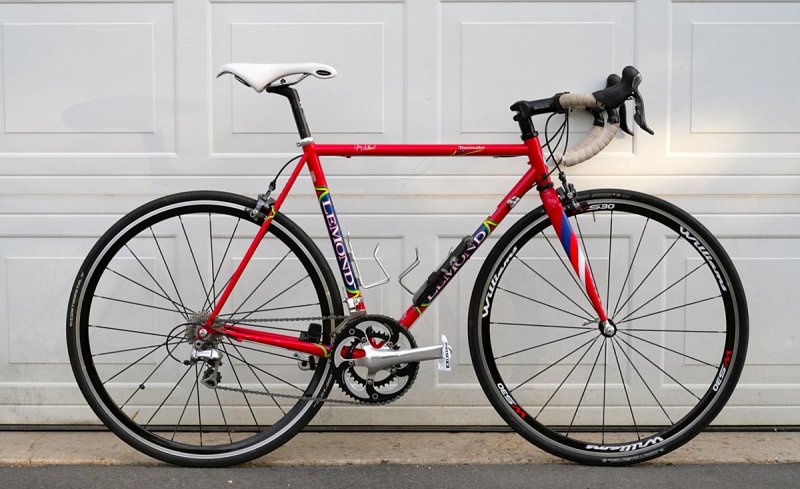
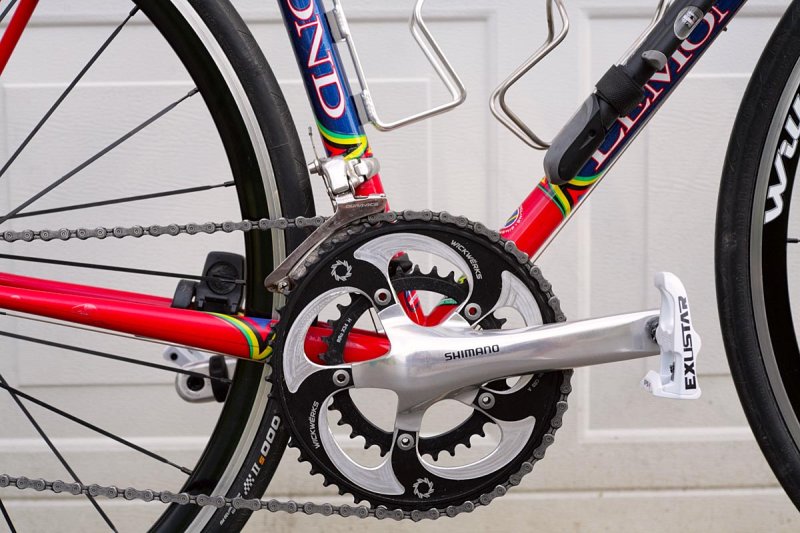
As I've mentioned before, these shift up to the big chain ring super quickly. Like before I even finish making the throw with the lever.
If interested in the wickwerks here's a link:
https://wickwerks.com/
As I've mentioned before, these shift up to the big chain ring super quickly. Like before I even finish making the throw with the lever.
If interested in the wickwerks here's a link:
https://wickwerks.com/
__________________
Steel is real...and comfy.
Steel is real...and comfy.