


Classic Bike Identification Chart
 12-03-16 | 03:08 PM
#1
Thread Starter
Senior Member
Joined: Nov 2016
Posts: 77
Likes: 0
From: Detroit, Michigan
Bikes: '16 Fuji Tread 1.7, '96 Cannondale R400, '88 Miyata 112
Classic Bike Identification Chart
I am just beginning to look at classic bikes. I've learned a couple of brand names, but the difference between a desirable frame and entry-level baffles me. I really wish someone would make a chart like this for classic bikes:

 12-03-16 | 03:24 PM
#2

Full Member


Joined: Jan 2015
Posts: 268
Likes: 8
From: Toronto
Bikes: Schwinn Voyageur SP | Sekine SHS-271 | Wabi Special
Maybe not a chart, but randyjawa (who posts here frequently) built and catalogued a website for your exact purpose: FREE SITE 1
The site has a whole resource on what to look for when trying to find quality vs. garbage.
My apologies in advance for erasing the rest of your free time for the weekend.
The site has a whole resource on what to look for when trying to find quality vs. garbage.
My apologies in advance for erasing the rest of your free time for the weekend.
12-03-16 | 03:54 PM
#3
Banned.
Joined: Jul 2016
Posts: 2,717
Likes: 10
From: downtown Bulverde, Texas
Bikes: '74 Raleigh International utility; '98 Moser Forma road; '92 Viner Pro CX upright
Italy actually made some pretty good airplanes.

did you know they still wear feathered helmets today? (rhetorical question)

did you know they still wear feathered helmets today? (rhetorical question)
Last edited by bulldog1935; 12-03-16 at 04:04 PM.
12-03-16 | 04:30 PM
#4

Phyllo-buster

Joined: Jan 2010
Posts: 9,276
Likes: 2,698
From: Nova Scotia
Bikes: roadsters, club bikes, fixed and classic
For every airplane model there's likely 1000 bikes so your chart will be a little unwieldy. Quality begins in the frame details so start studying, taking pics and use search engines to do your research. It's often said it takes 10,000 hours to become an expert or truly adept at any discipline so start now!
 12-03-16 | 05:31 PM
#6

Senior Member
Joined: Jun 2012
Posts: 558
Likes: 49
From: Prior Lake
Bikes: 1989 Tommasini Super Prestige, 1985 Chris Kvale, 1977 Colnago Super, 1992 Serotta Colorado, 1984 Schwinn Cimarron
I have a couple of family members on my side and the gal's side that do quite a bit of garage sale-ing(?).
I've made them a quick guide of things to look for when looking at a vintage road bike. Side by side pictures of stamped/forged dropouts, 1-piece/3-piece crank, shifter locations, etc. If something hits most or all of the boxes, text me.
I've made them a quick guide of things to look for when looking at a vintage road bike. Side by side pictures of stamped/forged dropouts, 1-piece/3-piece crank, shifter locations, etc. If something hits most or all of the boxes, text me.
 12-03-16 | 07:53 PM
#9

Senior Member
Joined: Apr 2013
Posts: 1,662
Likes: 46
From: Amsterdam
Bikes: 1980 Koga-Miyata Gentsluxe-S, 1998 Eddy Merckx Corsa 01, 1983 Tommasini Racing, 2012 Gulf Western CAAD10, 1980 Univega Gran Premio
Signs of vintage entry level bikes: turkey levers (extensions off the normal brake levers), stem shifters, big metal or plastic dork disks (between freewheel and spokes on rear wheel), protective rim outside of big chain ring. Lots of exceptions, and those things can be removed fairly easily, but usually original owners, and lazy bike flippers, leave those things alone.
If it has a sticker on the seat tube (usual location) that states the tubing type (531, Columbus, Champion, etc), then that's a good sign. The list of quality tubesets is much shorter than the list of quality bike models.
The components are a whole additional huge topic. Generally Campagnolo was on the better bikes, but again that stuff can be stripped off, so a great frame may end up with lesser components.
It's a deep subject. Probably the quickest way to learn is post on the appraisals C&V forum whatever cool bikes you see on Craigslist, and read all the threads you see like that. But do a quick search here first, you'll start figuring out a lot of it on your own.
Save

 12-03-16 | 08:06 PM
#12

Senior Member

Joined: Nov 2003
Posts: 5,366
Likes: 629
From: Soviet of Oregon or Pensacola FL
Bikes: Still have a few left!
Just look for these "Axle Adjusting Screws" on the rear drop outs. Almost always found on a quality frame, but I did once see them on a Sekai Hi Ten steel frame, so not a foolproof guide. Don
Last edited by ollo_ollo; 12-03-16 at 08:08 PM. Reason: missing "
12-03-16 | 08:51 PM
#14
Senior Member
Joined: Nov 2004
Posts: 23,212
Likes: 3,123
The friend vs. foe airchaft charts were intended to train ground and air crews in quick and proper identification of aircraft types. The charts give no indication of the abilities of the aircraft which were established in combat situations and became a matter of reputation. As such, the charts provide no more information than knowing the brand and model of a bicycle.
 12-03-16 | 10:01 PM
#16

Senior Member
Joined: Jul 2004
Posts: 13,358
Likes: 665
From: northern michigan
Bikes: '77 Colnago Super, '76 Fuji The Finest, '88 Cannondale Criterium, '86 Trek 760, '87 Miyata 712
12-03-16 | 10:08 PM
#17

Fat Guy on a Little Bike
Joined: Jun 2008
Posts: 15,946
Likes: 371
From: Philadelphia, PA
Bikes: Two wheeled ones
Here's some quick identifiers to let you know it's probably something of decent quality...
Unscientific - but lift it up. Lighter is usually better.
Forged drop outs are a pretty good indicator.
The lugs and details.
The parts on the bike can be a good indicator - learn your levels of Shimano, campagnolo, etc.
Tubing says a lot. Learn your Reynolds, Columbus, tange and Ishiwata stickers...most 531 is quality, but there's a big difference between a Raleigh supercourse and an Ephgrave.
Generally (not always) a kick stand, suicide levers, and turkey stems come on lower end bikes.
Brand/model preferences are often biases from nostalgia, or they can be based on experience. Some brands/models are more prestigious than others, but it's always debateable. You have folks with bikes that are distinctly less desireable who love them...price/demand isn't always quality. We all have biases, and there are a LOT of bikes out there that may be good for different people. I have bikes I like.
Unscientific - but lift it up. Lighter is usually better.
Forged drop outs are a pretty good indicator.
The lugs and details.
The parts on the bike can be a good indicator - learn your levels of Shimano, campagnolo, etc.
Tubing says a lot. Learn your Reynolds, Columbus, tange and Ishiwata stickers...most 531 is quality, but there's a big difference between a Raleigh supercourse and an Ephgrave.
Generally (not always) a kick stand, suicide levers, and turkey stems come on lower end bikes.
Brand/model preferences are often biases from nostalgia, or they can be based on experience. Some brands/models are more prestigious than others, but it's always debateable. You have folks with bikes that are distinctly less desireable who love them...price/demand isn't always quality. We all have biases, and there are a LOT of bikes out there that may be good for different people. I have bikes I like.
12-03-16 | 10:11 PM
#18
Banned.
Joined: Jul 2016
Posts: 2,717
Likes: 10
From: downtown Bulverde, Texas
Bikes: '74 Raleigh International utility; '98 Moser Forma road; '92 Viner Pro CX upright
Actually forged dropouts are good starting point
not that every bike with stamped dropouts is a dog, either - it's just usually the first step up in quality.
Choice of lugs picked for the frame is a little more subtle.
The choice of steel tubing affects the weight and performance of the frame. There's straight gage and butted (thicker at the joined ends than in the center of the tube length), and grades of butted (double, triple, quad). If you're looking for a lightweight quality bike, you're looking for butted tubing.
Some like Tange made it very obvious by giving you 5 thickness grades and numbering them. Others like Columbus can be a little strange with names that changed every 4 or 5 years.
A sport-touring bike built with the heavy gage tubing is going to on the low-cost end, but a touring bike with one of heavier butted grades was built that way to haul a substantial load. (Think of it as a Lancaster and you're the 4 Rolls Merlins)
Picking the frame probably depends on what you want to do with it - lightweight road bike (classic racer) vs. utility bike and load hauler - there are geometric differences in the frame and fork that makes these two types of frames handle differently, and a sport-touring bike tends to fall in between the two geometric extremes, may be light weight and sporty and good at handling a front load. Within any of these styles of bikes, there are quality levels and extremes.
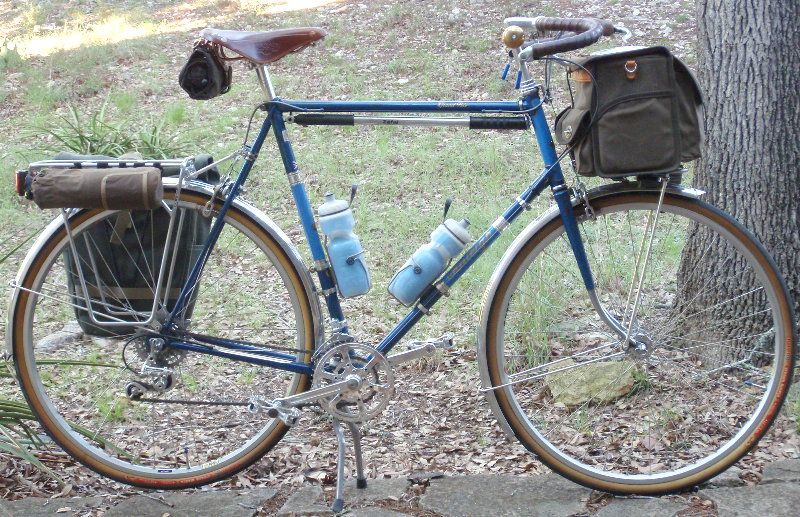
Again, I'm going to throw out my old Raleigh Grand Prix that I kept rebuilding for 40 years as a well-designed economical frame.
Fast and sporty, stable with a load, certainly heavy.
But even today people hunt these bikes out to build them into tour bikes (especially tall people because of the sizes available).
Yes, stamped dropouts and straight-gage steel, but Carlton geometry and a stable low-trail fork.
Though the fit is very similar, it's not going to compare to the turn-in quickness and acceleration of a good Italian road bike, but you'd be hard pressed to find a better load-hauling utility bike. And still, this is a fast bike - it's just heavy.
If your goal is not bulletproof load hauler, you should be looking at lighter, sportier frames.
not that every bike with stamped dropouts is a dog, either - it's just usually the first step up in quality.
Choice of lugs picked for the frame is a little more subtle.
The choice of steel tubing affects the weight and performance of the frame. There's straight gage and butted (thicker at the joined ends than in the center of the tube length), and grades of butted (double, triple, quad). If you're looking for a lightweight quality bike, you're looking for butted tubing.
Some like Tange made it very obvious by giving you 5 thickness grades and numbering them. Others like Columbus can be a little strange with names that changed every 4 or 5 years.
A sport-touring bike built with the heavy gage tubing is going to on the low-cost end, but a touring bike with one of heavier butted grades was built that way to haul a substantial load. (Think of it as a Lancaster and you're the 4 Rolls Merlins)
Again, I'm going to throw out my old Raleigh Grand Prix that I kept rebuilding for 40 years as a well-designed economical frame.
Fast and sporty, stable with a load, certainly heavy.
But even today people hunt these bikes out to build them into tour bikes (especially tall people because of the sizes available).
Yes, stamped dropouts and straight-gage steel, but Carlton geometry and a stable low-trail fork.
Though the fit is very similar, it's not going to compare to the turn-in quickness and acceleration of a good Italian road bike, but you'd be hard pressed to find a better load-hauling utility bike. And still, this is a fast bike - it's just heavy.
If your goal is not bulletproof load hauler, you should be looking at lighter, sportier frames.
Last edited by bulldog1935; 12-03-16 at 10:56 PM.
12-04-16 | 06:09 AM
#19

Senior Member
Joined: Oct 2014
Posts: 2,539
Likes: 743
From: GWN
Nice job with the painting some of us can barely draw stick people.
Last edited by Wileyone; 12-04-16 at 08:12 AM.
12-04-16 | 07:25 AM
#20


feros ferio

Joined: Jul 2000
Posts: 22,410
Likes: 1,876
From: www.ci.encinitas.ca.us
Bikes: 1959 Capo Modell Campagnolo; 1960 Capo Sieger (2); 1962 Carlton Franco Suisse; 1970 Peugeot UO-8; 1982 Bianchi Campione d'Italia; 1988 Schwinn Project KOM-10;
No boat anchors, but I have an otherwise full gamut, from a humble, very common, basic entry level frame of ordinary carbon steel (Peugeot UO-8) to a rare and highly collectible frame made with double-butted Reynolds 531 (Capo Sieger). I find that riding pleasure and overall utility depend more on frame geometry than anything else, and every bike in my stable fills a valuable niche for me. Above all else, make sure whatever you buy fits you properly, or can be made to with judicious adjustment of saddle position and stem reach.
__________________
"Far and away the best prize that life offers is the chance to work hard at work worth doing." --Theodore Roosevelt
Capo: 1959 Modell Campagnolo, S/N 40324; 1960 Sieger (2), S/N 42624, 42597
Carlton: 1962 Franco Suisse, S/N K7911
Peugeot: 1970 UO-8, S/N 0010468
Bianchi: 1982 Campione d'Italia, S/N 1.M9914
Schwinn: 1988 Project KOM-10, S/N F804069
"Far and away the best prize that life offers is the chance to work hard at work worth doing." --Theodore Roosevelt
Capo: 1959 Modell Campagnolo, S/N 40324; 1960 Sieger (2), S/N 42624, 42597
Carlton: 1962 Franco Suisse, S/N K7911
Peugeot: 1970 UO-8, S/N 0010468
Bianchi: 1982 Campione d'Italia, S/N 1.M9914
Schwinn: 1988 Project KOM-10, S/N F804069


 12-04-16 | 09:01 AM
#23
Banned.
Joined: Jul 2016
Posts: 2,717
Likes: 10
From: downtown Bulverde, Texas
Bikes: '74 Raleigh International utility; '98 Moser Forma road; '92 Viner Pro CX upright
12-04-16 | 09:15 AM
#25
Senior Member
Joined: Nov 2004
Posts: 23,212
Likes: 3,123
Speaking of the Soviets, I see no mention of the Yakolev Yak-3, which was arguably the best dogfighter of WWII. Their kill ratio was so impressive that the Luftwaffe issued orders to avoid combat with them at altitudes below 5000m. The Free French squadrons operating in Russia reportedly turned down Spitfires and Mustangs in favour of the Yak-3.