


How do Trek model "numbers" work?
 07-12-17 | 06:55 PM
#1
Thread Starter
Senior Member
Joined: Jun 2013
Posts: 4,094
Likes: 2
From: Bozeman
Bikes: 199? Landshark Roadshark, 198? Mondonico Diamond, 1987 Panasonic DX-5000, 1987 Bianchi Limited, Univega... Chrome..., 1989 Schwinn Woodlands, Motobecane USA Record, Raleigh Tokul 2
How do Trek model "numbers" work?
The "polarizing Trek" thread got me thinking. How the heck do Trek model numbers work?
I had always assumed that the lower first number (hundreds) was earlier years, and that the higher the last two numbers (tens and ones) was a higher quality bike.
So, for example, a trek 330 would be older and lesser quality than say a trek 870.
Then I went to look it up... And I was wrong, mostly.
In some of the older catalogs they specced the bikes by "component group" which made up the "ones" value in the model number, but I rarely see treks with anything other than "0" in the ones value.
Many years they produced many different model numbers, anything from 400-630 in 1983.
So... can anyone explain to me how trek model numbers work? Why did some years have 800s and others only went up to 600s? I tried looking it up, but I only found lots of info on the trek serial number.
IIRC trek moved to thousands when they moved to aluminum bikes?
I had always assumed that the lower first number (hundreds) was earlier years, and that the higher the last two numbers (tens and ones) was a higher quality bike.
So, for example, a trek 330 would be older and lesser quality than say a trek 870.
Then I went to look it up... And I was wrong, mostly.
In some of the older catalogs they specced the bikes by "component group" which made up the "ones" value in the model number, but I rarely see treks with anything other than "0" in the ones value.
Many years they produced many different model numbers, anything from 400-630 in 1983.
So... can anyone explain to me how trek model numbers work? Why did some years have 800s and others only went up to 600s? I tried looking it up, but I only found lots of info on the trek serial number.
IIRC trek moved to thousands when they moved to aluminum bikes?
 07-12-17 | 07:58 PM
#2

Extraordinary Magnitude


Joined: Aug 2009
Posts: 14,081
Likes: 2,136
From: Waukesha WI
Bikes: 1978 Trek TX700; 1978/79 Trek 736; 1984 Specialized Stumpjumper Sport; 1984 Schwinn Voyageur SP; 1985 Trek 620; 1985 Trek 720; 1986 Trek 400 Elance; 1987 Schwinn High Sierra; 1990 Miyata 1000LT
With a few exceptions- Super easy until 1985-
First number is frame material
900 is Columbus/Columbus Fork & Stays
700 is Reynolds 531/531 Fork and Stays
600 is 531 main tubes with either Mangalloy or CrMo stays & fork
500 is CrMo/CrMo fork and stays
400 is Mangalloy or CrMo with Hi-Ten stays and fork
300 & 200 from the early days were Hi-Ten and with different dropouts.
800s were the All-Terrain bikes
The early bikes (until 78) were prefaced with TX and the frame material designation- they were all touring geometry- except the TX900 which was a racing frame (shorter chainstays)
The second number is the geometry type (78-85)
x0x is "sport"
x1x is "touring" and then "sport"
x2x is touring
x3x is Racing
x6x is racing
x7x is racing
The last digit was usually the component group- with the higher the number, the higher prestige of the group.
In 78 2 and 4 was Suntour VX (and different cranksets), 6 was Shimano 600, 7 was Campagnolo NR and 8 was Campagnolo SR.
For example, a 736 would be a racing frame with 531 frame, fork and stays, and the Shimano 600 group.
In 1986 a lot of that went kind of out the window- they started using 531 in 400 and 300 series bikes- my 86 400 Elance has a 531 frame with Tange CrMo stays and fork- essentially what a 600 series bike was in the years before.
First number is frame material
900 is Columbus/Columbus Fork & Stays
700 is Reynolds 531/531 Fork and Stays
600 is 531 main tubes with either Mangalloy or CrMo stays & fork
500 is CrMo/CrMo fork and stays
400 is Mangalloy or CrMo with Hi-Ten stays and fork
300 & 200 from the early days were Hi-Ten and with different dropouts.
800s were the All-Terrain bikes
The early bikes (until 78) were prefaced with TX and the frame material designation- they were all touring geometry- except the TX900 which was a racing frame (shorter chainstays)
The second number is the geometry type (78-85)
x0x is "sport"
x1x is "touring" and then "sport"
x2x is touring
x3x is Racing
x6x is racing
x7x is racing
The last digit was usually the component group- with the higher the number, the higher prestige of the group.
In 78 2 and 4 was Suntour VX (and different cranksets), 6 was Shimano 600, 7 was Campagnolo NR and 8 was Campagnolo SR.
For example, a 736 would be a racing frame with 531 frame, fork and stays, and the Shimano 600 group.
In 1986 a lot of that went kind of out the window- they started using 531 in 400 and 300 series bikes- my 86 400 Elance has a 531 frame with Tange CrMo stays and fork- essentially what a 600 series bike was in the years before.
__________________
*Recipient of the 2006 Time Magazine "Person Of The Year" Award*
Commence to jigglin’ huh?!?!
"But hey, always love to hear from opinionated amateurs." -says some guy to Mr. Marshall.
Commence to jigglin’ huh?!?!
"But hey, always love to hear from opinionated amateurs." -says some guy to Mr. Marshall.
Last edited by The Golden Boy; 07-12-17 at 08:38 PM.
07-12-17 | 09:25 PM
#3
Thread Starter
Senior Member
Joined: Jun 2013
Posts: 4,094
Likes: 2
From: Bozeman
Bikes: 199? Landshark Roadshark, 198? Mondonico Diamond, 1987 Panasonic DX-5000, 1987 Bianchi Limited, Univega... Chrome..., 1989 Schwinn Woodlands, Motobecane USA Record, Raleigh Tokul 2
07-13-17 | 11:01 AM
#4

Senior Member

Joined: Oct 2014
Posts: 2,539
Likes: 743
From: GWN
With a few exceptions- Super easy until 1985-
First number is frame material
900 is Columbus/Columbus Fork & Stays
700 is Reynolds 531/531 Fork and Stays
600 is 531 main tubes with either Mangalloy or CrMo stays & fork
500 is CrMo/CrMo fork and stays
400 is Mangalloy or CrMo with Hi-Ten stays and fork
300 & 200 from the early days were Hi-Ten and with different dropouts.
800s were the All-Terrain bikes
The early bikes (until 78) were prefaced with TX and the frame material designation- they were all touring geometry- except the TX900 which was a racing frame (shorter chainstays)
The second number is the geometry type (78-85)
x0x is "sport"
x1x is "touring" and then "sport"
x2x is touring
x3x is Racing
x6x is racing
x7x is racing
The last digit was usually the component group- with the higher the number, the higher prestige of the group.
In 78 2 and 4 was Suntour VX (and different cranksets), 6 was Shimano 600, 7 was Campagnolo NR and 8 was Campagnolo SR.
For example, a 736 would be a racing frame with 531 frame, fork and stays, and the Shimano 600 group.
In 1986 a lot of that went kind of out the window- they started using 531 in 400 and 300 series bikes- my 86 400 Elance has a 531 frame with Tange CrMo stays and fork- essentially what a 600 series bike was in the years before.
First number is frame material
900 is Columbus/Columbus Fork & Stays
700 is Reynolds 531/531 Fork and Stays
600 is 531 main tubes with either Mangalloy or CrMo stays & fork
500 is CrMo/CrMo fork and stays
400 is Mangalloy or CrMo with Hi-Ten stays and fork
300 & 200 from the early days were Hi-Ten and with different dropouts.
800s were the All-Terrain bikes
The early bikes (until 78) were prefaced with TX and the frame material designation- they were all touring geometry- except the TX900 which was a racing frame (shorter chainstays)
The second number is the geometry type (78-85)
x0x is "sport"
x1x is "touring" and then "sport"
x2x is touring
x3x is Racing
x6x is racing
x7x is racing
The last digit was usually the component group- with the higher the number, the higher prestige of the group.
In 78 2 and 4 was Suntour VX (and different cranksets), 6 was Shimano 600, 7 was Campagnolo NR and 8 was Campagnolo SR.
For example, a 736 would be a racing frame with 531 frame, fork and stays, and the Shimano 600 group.
In 1986 a lot of that went kind of out the window- they started using 531 in 400 and 300 series bikes- my 86 400 Elance has a 531 frame with Tange CrMo stays and fork- essentially what a 600 series bike was in the years before.

 07-13-17 | 02:05 PM
#6

Senior Member
Joined: Feb 2014
Posts: 1,542
Likes: 271
From: Fort Collins, CO
Bikes: 1974 Paramount ~ 1974 Raleigh Pro ~ 1977 Pro-Tour ~ 1978 TX900 ~ IronMan 85,87:E/M,88:M/Pro,89:E ~ 98 Peugeot Festina Replica
1985 til early 90's its not as detailed but.
400,500,600,some 700 Series are road (still same lower the number the lower level bike it was. except the 170 which was high...)
1000 series Aluminum Road
2000 series Carbon Road
800,900 series are MTB
700 Series can also be a multitrack, which is a 700c hybrid
after that you get into the thousands series stuff which can get confusing. or the new X.X (eg 1.2)
I feel like im missing stuff, i am in no way saying this is complete list just that after 85 there was some hierarchy also.
400,500,600,some 700 Series are road (still same lower the number the lower level bike it was. except the 170 which was high...)
1000 series Aluminum Road
2000 series Carbon Road
800,900 series are MTB
700 Series can also be a multitrack, which is a 700c hybrid
after that you get into the thousands series stuff which can get confusing. or the new X.X (eg 1.2)
I feel like im missing stuff, i am in no way saying this is complete list just that after 85 there was some hierarchy also.

 07-13-17 | 02:51 PM
#8

Senior Member
Joined: Dec 2004
Posts: 618
Likes: 7
From: Cincinnati, Ohio, USA
Bikes: 1974 Schwinn Paramount, 1980 Raleigh Competition GS, 1986 Vitus 979, 1988 Trek 360, 1991 Trek 7000 MTB, 1999 Burley Rumba tandem
I know in the early 90's at least, the 4-digit designations seemed to indicate non-traditional tube materials; i.e,. aluminum, carbon fiber composite.
1400 Aluminum (Road)
1420 Aluminum (Road)
1000 Aluminum (Road)
1100 Aluminum (Road)
1200 Aluminum (Road)
2100 Composite (Road)
2300 Composite (Road)
5200 Composite Competition
5500 Composite Competition
And of course the T-prefix was Tandem.
Not sure the span of years for which this is valid.
https://www.vintage-trek.com/images/t...ikecatalog.pdf
1400 Aluminum (Road)
1420 Aluminum (Road)
1000 Aluminum (Road)
1100 Aluminum (Road)
1200 Aluminum (Road)
2100 Composite (Road)
2300 Composite (Road)
5200 Composite Competition
5500 Composite Competition
And of course the T-prefix was Tandem.
Not sure the span of years for which this is valid.
https://www.vintage-trek.com/images/t...ikecatalog.pdf
09-02-20 | 07:16 AM
#10

Sunshine
Joined: Aug 2014
Posts: 18,706
Likes: 10,240
From: Des Moines, IA
Bikes: '18 class built steel roadbike, '19 Fairlight Secan, '88 Schwinn Premis , Black Mountain Cycles Monstercross V4, '89 Novara Trionfo
It was a mountain bike model in the 90s and 00s...not sure when it stopped. The ones I have seen from both the 90s and 00s were good quality- air forks, deore xt, hydraulic brakes early in the adoption, etc.
09-02-20 | 08:48 AM
#11
Senior Member

Joined: Jun 2017
Posts: 1,021
Likes: 277
Bikes: Diamond Back Apex, Mongoose IBOC Aluminum Road Bike, SR road bike
Hmm.
09-02-20 | 09:00 AM
#12
Senior Member
Joined: May 2008
Posts: 10,106
Likes: 2,758
From: Fredericksburg, Va
Bikes: ? Proteous, '65 Frejus TDF, '73 Bottecchia Giro d'Italia, '83 Colnago Superissimo, '84 Trek 610, '84 Trek 760, '88 Pinarello Veneto, '88 De Rosa Pro, '89 Pinarello Montello, 'Litespeed Catalyst'94 Burley Duet, 97 Specialized RockHopper, 2010 Langster
IIRC the 1984 760 was a race bike with 531c adorned with mostly Suntour Superbe/Pro.
__________________
Bikes don't stand alone. They are two tired.
Bikes don't stand alone. They are two tired.
01-27-21 | 04:10 PM
#13

Junior Member
Joined: Sep 2018
Posts: 161
Likes: 7
I absolutely am not an authority on anything connected to bicycles, especially TREK bicycles. However, that has not stopped me from studying Trek model numbering deeply and forming conclusion.
CONCLUSION 1: Recent Trek road bike model numbers are connected to the Madone line forking into two products.
CONCLUSION 2: Some of the Madone and Domane model numbers are the same.
SLR9 Madone and Domane
SLR8 Madone and Domane
SLR7 Madone and Domane
SLR6 Madone and Domane
SL7 Domane only
SL6 Domane only
SL5 Domane only
SL4 Domane only
GRIEVANCE 1: There is a difference between SL and SLR which is difficult to discover and remember.
I would like to take this opportunity to report that I communicated with Trek on this matter today.
Today's Domane bicycles have a shape similar to the shape of Madone bicycles, until that line forked into two models. The old Madone became the new Domane, and the new Madone is something new, breaking away from what Domane had been.
I thought Trek had moved beyond and discontinued anything resembling Madone 5-series or Madone 6-series in their road bikes. This was just plain ignorant of me, because right on their website they have for sale today:
Madone SL6
Madone SL7
Madone SL9
While I was at it, I was looking at the Domane lineup, and it looked to me like the Domane has lines similar to the Madone 5.2 I ride:
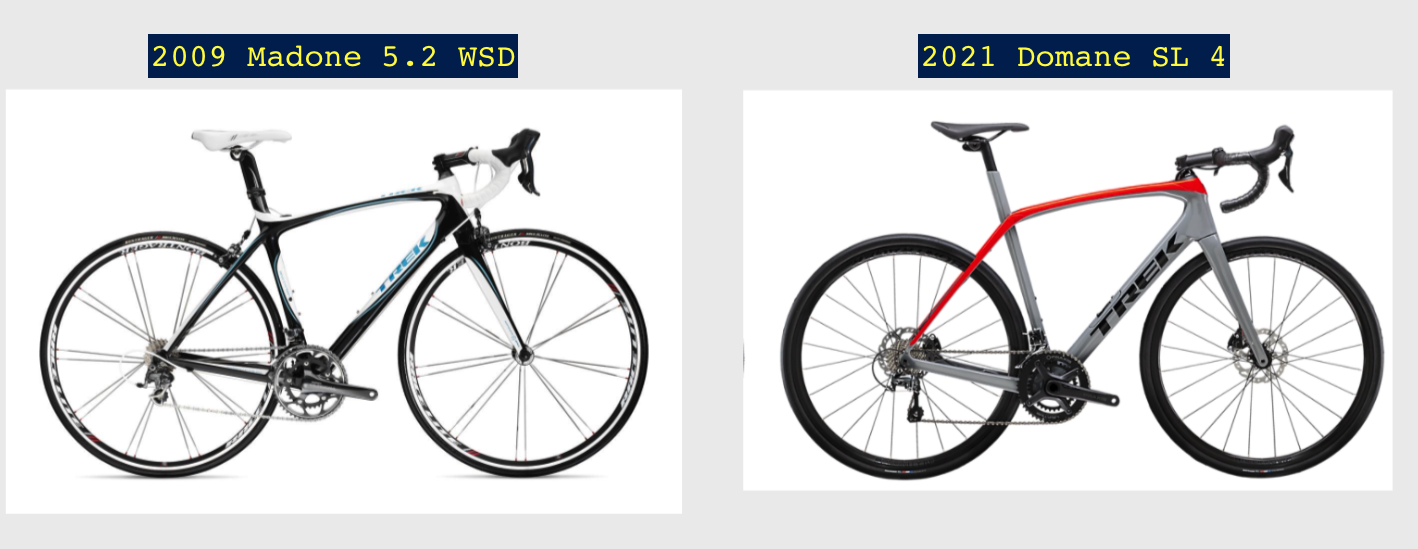
Then I noticed for sale today, in 2021:
Domane SL4
Domane SL5
Domane SL6
Domane SL7
Domane SL9
That got me wondering what the differences and similarities are among these.
The first think all these have in common is their frames are shaped the same way as the Madone 5.2 from way back in 2009. That got me wondering when this shape originated. To me, it looks like it was first made public in 2008:
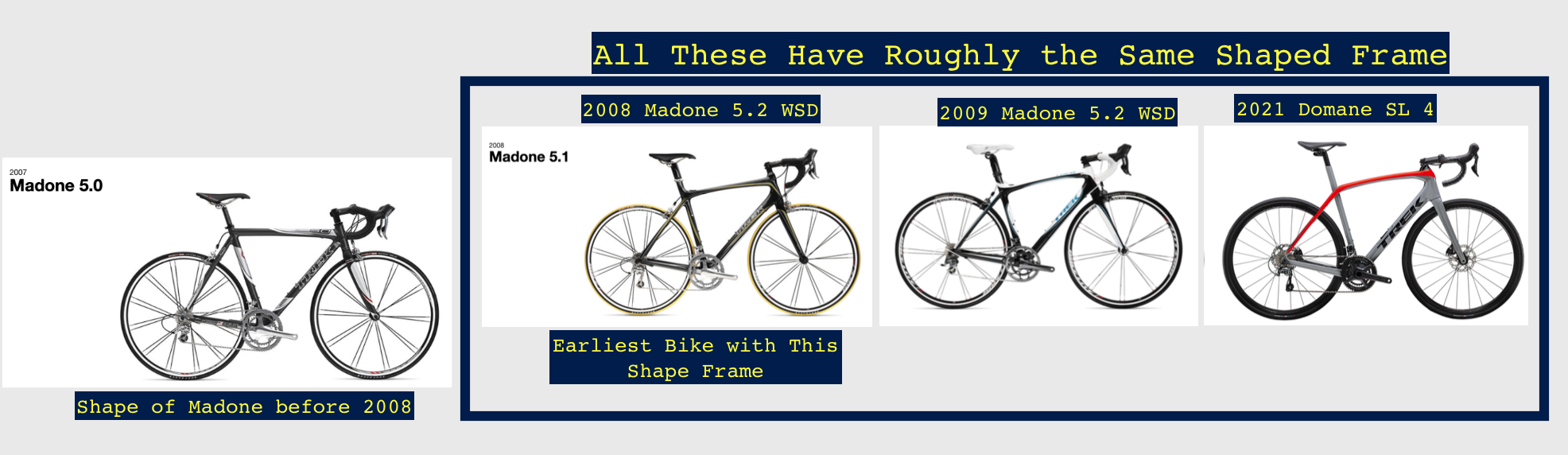
Once I knew when we first got the bike that looks like today's Domane,
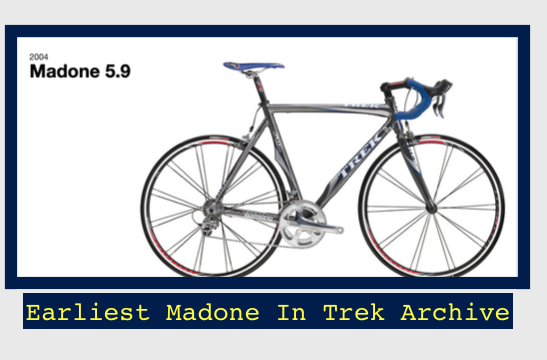
I got to wondering what the Madone looked like when it first came out.
The earliest reference I can find in the Trek bike archive is 2004. This Madone is numbered 5.9, so maybe there are models that came before it, I just do not see them:
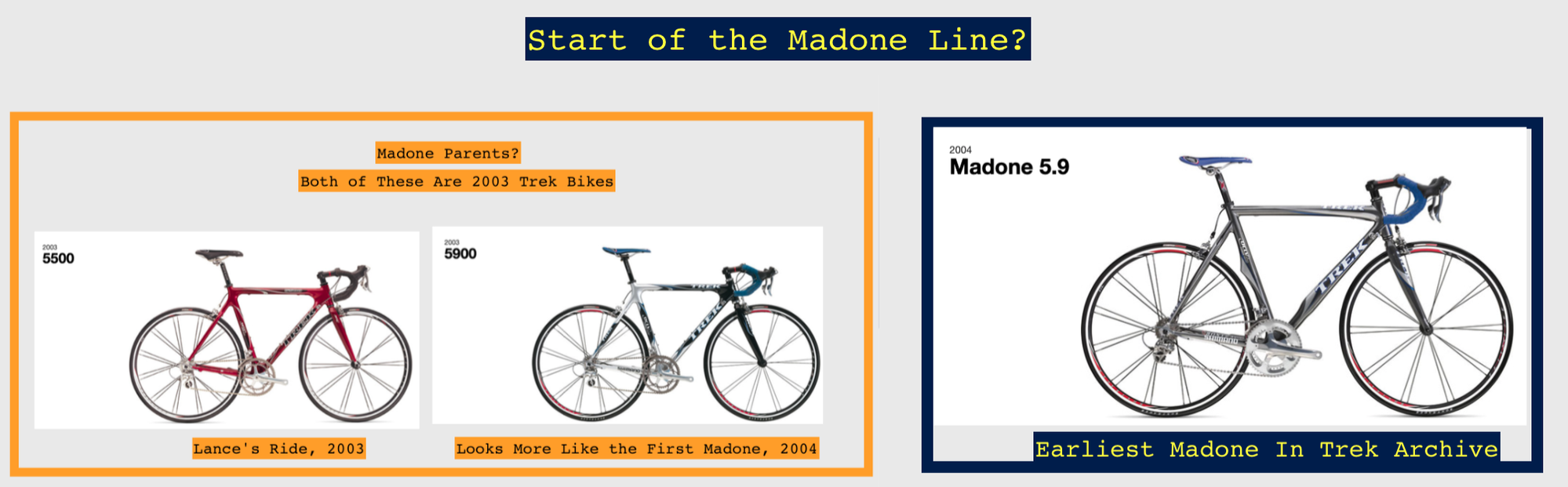
CONCLUSION 1: Recent Trek road bike model numbers are connected to the Madone line forking into two products.
CONCLUSION 2: Some of the Madone and Domane model numbers are the same.
SLR9 Madone and Domane
SLR8 Madone and Domane
SLR7 Madone and Domane
SLR6 Madone and Domane
SL7 Domane only
SL6 Domane only
SL5 Domane only
SL4 Domane only
GRIEVANCE 1: There is a difference between SL and SLR which is difficult to discover and remember.
I would like to take this opportunity to report that I communicated with Trek on this matter today.
TREK Thank you for your feedback, i will pass it along to our web team
Is there anything else I can help you out with today Dan?
ME: Here is a simple, but I think devastating example of how Trek, great as it is, sucks at communicating what you offer.
What does SL mean? What does SLR mean? Before you tell me, picture the 20 times I have had that question... so what did I do? Besides look on your site where I could not find the answer? I asked the politically evil search engine of my choice, and it gave me the answer, by providing information from a site not yours.
This link goes to a screenshot of the search result I got
https://legacy-systems.biz/longview2...nix/treksl.png
TREK: We are here to help, but I am limited in my ability and authority.
ME: I made one more image and this is the link to it.
https://legacy-systems.biz/longview2...one_domane.png
Is there anything else I can help you out with today Dan?
ME: Here is a simple, but I think devastating example of how Trek, great as it is, sucks at communicating what you offer.
What does SL mean? What does SLR mean? Before you tell me, picture the 20 times I have had that question... so what did I do? Besides look on your site where I could not find the answer? I asked the politically evil search engine of my choice, and it gave me the answer, by providing information from a site not yours.
This link goes to a screenshot of the search result I got
https://legacy-systems.biz/longview2...nix/treksl.png
TREK: We are here to help, but I am limited in my ability and authority.
ME: I made one more image and this is the link to it.
https://legacy-systems.biz/longview2...one_domane.png
Today's Domane bicycles have a shape similar to the shape of Madone bicycles, until that line forked into two models. The old Madone became the new Domane, and the new Madone is something new, breaking away from what Domane had been.
I thought Trek had moved beyond and discontinued anything resembling Madone 5-series or Madone 6-series in their road bikes. This was just plain ignorant of me, because right on their website they have for sale today:
Madone SL6
Madone SL7
Madone SL9
While I was at it, I was looking at the Domane lineup, and it looked to me like the Domane has lines similar to the Madone 5.2 I ride:
Then I noticed for sale today, in 2021:
Domane SL4
Domane SL5
Domane SL6
Domane SL7
Domane SL9
That got me wondering what the differences and similarities are among these.
The first think all these have in common is their frames are shaped the same way as the Madone 5.2 from way back in 2009. That got me wondering when this shape originated. To me, it looks like it was first made public in 2008:
Once I knew when we first got the bike that looks like today's Domane,
I got to wondering what the Madone looked like when it first came out.
The earliest reference I can find in the Trek bike archive is 2004. This Madone is numbered 5.9, so maybe there are models that came before it, I just do not see them:
Last edited by danallen; 01-27-21 at 04:19 PM.

