


Old Bicycle Shoes


 10-12-17 | 05:39 PM
#3

Senior Member

Joined: Feb 2008
Posts: 5,319
Likes: 4,828
From: Peoria, IL
a fellow called Rob has a flickr account with a shot of a catalog showing some old bike shoes. The text with the photo says :
"In "his" magazine Le Cycliste, May 1948, editor-in-chief André Rabault considers footwear for cyclotourists. Leather cycling shoes for racers had been perfected by then, but coureurs didn't walk much. Cyclos needed a simple and lightweight shoe both on and off the bicycle."
https://www.flickr.com/photos/cycledefrance/18263269448
There must be more & better info about the history of bike shoes, though...
Steve in Peoria
"In "his" magazine Le Cycliste, May 1948, editor-in-chief André Rabault considers footwear for cyclotourists. Leather cycling shoes for racers had been perfected by then, but coureurs didn't walk much. Cyclos needed a simple and lightweight shoe both on and off the bicycle."
https://www.flickr.com/photos/cycledefrance/18263269448
There must be more & better info about the history of bike shoes, though...
Steve in Peoria
10-12-17 | 08:50 PM
#4

Me duelen las nalgas

Joined: Aug 2015
Posts: 13,519
Likes: 2,832
From: Texas
Bikes: Centurion Ironman, Trek 5900, Univega Via Carisma, Globe Carmel
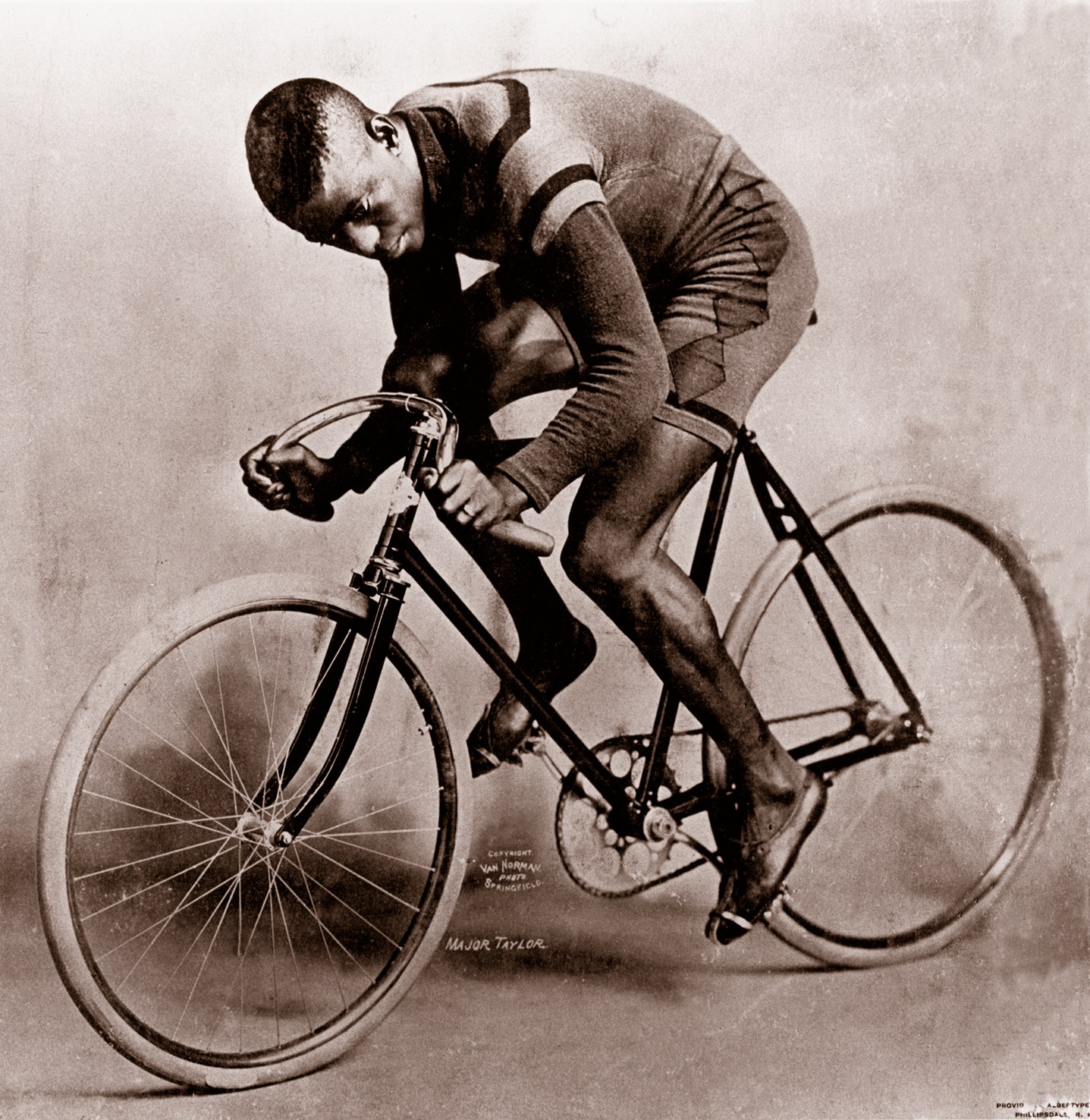
Very early on. Photos of Major Taylor (and others of his era) taken between the mid-1890s and early 1900s show him wearing lightweight cycling shoes with toe clips. No straps or cleats are visible in the photos I've found.
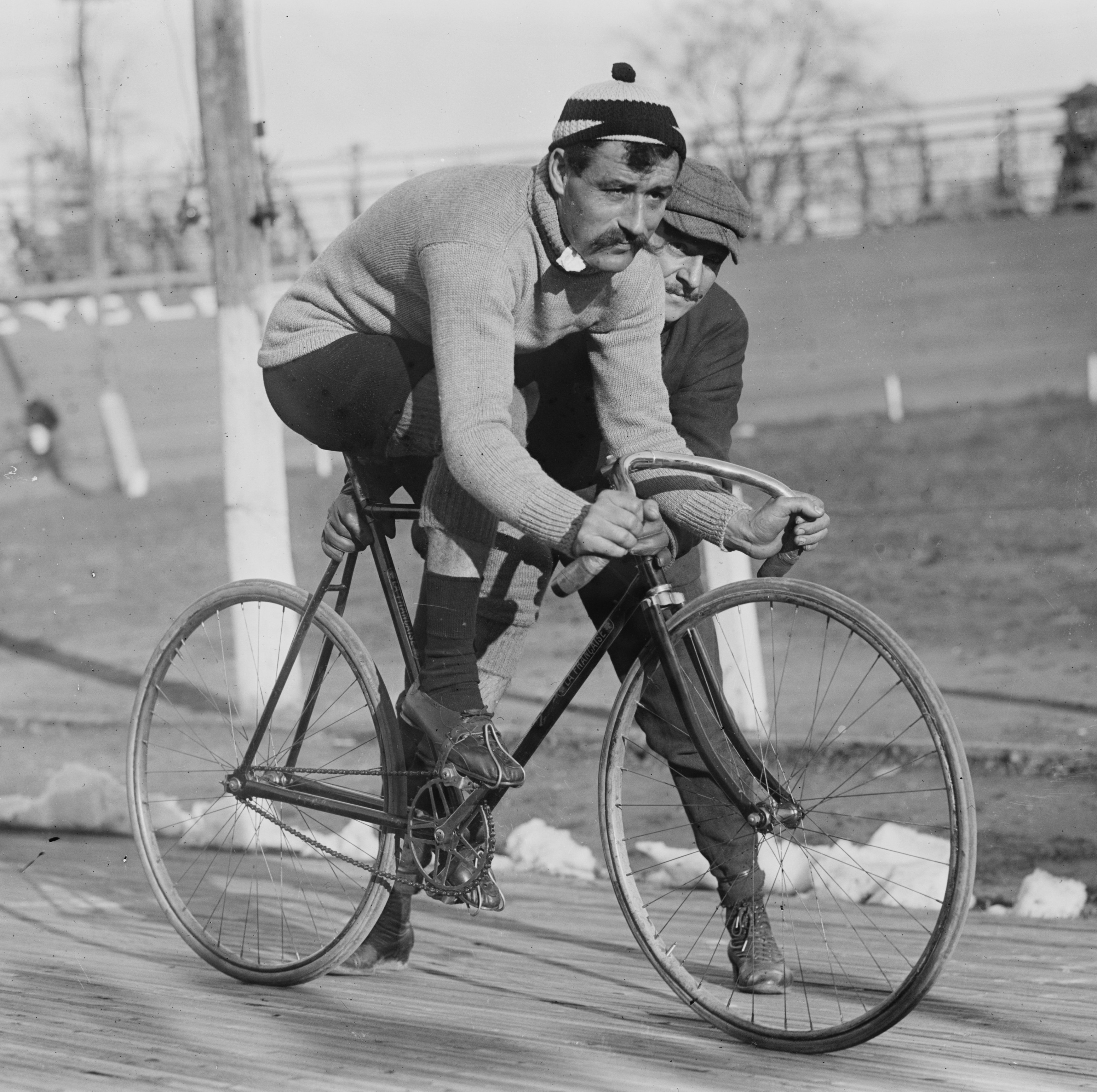
Note also what appears to be a direct shaft drive on the bike in this photo:

Note also what appears to be a direct shaft drive on the bike in this photo:

 10-12-17 | 09:04 PM
#7
Me duelen las nalgas
Joined: Aug 2015
Posts: 13,519
Likes: 2,832
From: Texas
Bikes: Centurion Ironman, Trek 5900, Univega Via Carisma, Globe Carmel
Those shoes look almost identical to my 1970s era Detto Pietros, including the soles. Cleats are very low tech and almost certainly used by the 1890s-early 1900s. The pedals are already suitable for those simple cleats.
10-13-17 | 04:55 PM
#9

curmudgineer
Joined: Dec 2009
Posts: 4,417
Likes: 113
From: Chicago SW burbs
Bikes: 2 many 2 fit here
Fascinating... I wonder what the motivation for a shaft drive was. It couldn't be mechanical efficiency... with two 90 degree bevel gear pairs running in the open, I doubt it was even 90%. Musta sounded pretty interesting at full song
10-13-17 | 06:16 PM
#10
Senior Member
Joined: Feb 2008
Posts: 5,319
Likes: 4,828
From: Peoria, IL
Other than the issue of mechanical losses, there was also the issue of how the shaft drive complicated removal of the wheel for flat tire repair.
Still, it is a neat concept, and the inherent tidiness does have an appeal!
Steve in Peoria
10-13-17 | 07:47 PM
#11
Senior Member
Joined: Feb 2008
Posts: 5,319
Likes: 4,828
From: Peoria, IL
the photo of Maj. Taylor and his bike suggested to me that he wasn't using bevel gear.. at least not in the front.
It reminded me that I had seen photos of a shaft drive bike that used rollers instead of gear teeth, and that the rollers engaged each other. Yeah... it's a weird idea, so I had to do some digging in my archives. Fortunately, I was able to find the article, or at least one with a photo that was suitable.
The article is from an issue of Bicycling... August 1997, and written by the esteemed Jim Langley. I hope I don't get in too much trouble for sharing it.

pm me for a higher resolution version.
Steve in Peoria
(and I really should be doing something more valuable instead of searching through the archives)
10-14-17 | 10:54 AM
#12
Senior Member

Joined: Nov 2004
Posts: 23,212
Likes: 3,123
The story of 19th century shaft drive bicycles is fascinating. The first models appeared circa 1895 and industry leader Colonel Pope of Columbia bicycle fame, promptly bought the patent. The bicycles weren't marketed as 'shaft drive' but as 'chainless' to ensure there were two distinct camps; 'chain' and 'chainless'. Columbia literature touted it as "the simplest, safest, cleanest and most durable form of power transmission".
Chainless models were also marketed as more efficient and quieter than chains of the day. Initially, this would seem to be marketing hyperbole but when considering chain technology of the era, it could be true. Certainly, they give the impression of improved efficiency due to the reduced backlash versus a chain. The chainless bicycle would respond to every pedal movement, quicker than chain drive and regardless of how small. This would be appealing to the competitive cyclist.
There is no doubt that they were cleaner. On consumer models, the gears ran in an oil bath in an enclosed case, preventing oil from being thrown onto clothes. The gear case undoubtedly dampened the sounds, so it may well have been quieter than chains. The oil bath eliminated the need for constant oiling and the enclosures protected the gears from the dusty conditions of the dirt roads of the day, reducing wear and resulting in claims of increased longevity over a chain.
Chainless bicycles were also less prone to mechanical failures. A chain could break or fall off a sprocket (especially when caught in a skirt or pant cuff), leaving a cyclist (particularly a female) stranded or injured.
Wheel removal for flat tyres were more complicated but the process was facilitated by the incorporation of a hinged axle holder. They were heavier, with a 4lb penalty over Columbia's previous chain model. They were also 25% more expensive, but this exactly what Pope wanted.
The USA had experienced a bicycle boom in the mid-1890s that dwarfed the one seen in the early 1970s. This attracted many new manufacturers, increasing competition and eroding profit margins as the market became increasingly saturated. Pope's Columbia brand was the oldest, most popular and prestigious in the industry but by 1896 he had been forced to suffer the ultimate embarrassment of marketing his bicycles in department stores , in order to remain solvent.
By introducing a chainless model Pope hoped to stimulate new sales and justify a premium price, increasing his profit margins. Once demand was created, he could license the rights to select manufacturers, earning a royalty on every chainless model. By carefully managing the licensing process, Pope hoped to control the market. Of course, this all hinged on the ability to create demand. As the industry leader, Pope had a high credibility with the consumer and he could afford to stretch the claims in the marketing campaign.
Getting a rider as famous as Major Thomas to be photographed on a chainless was a publicity coup of immense importance. It would establish instant credibility for chainless models with a large portion of the market, regardless of the brand and whether or not he ever competed on one.
Magazine writers of the day were also happy to publish accolades for the chainless models. After all, their jobs hinged on the market. As sales slipped, advertising decreased, magazines folded and jobs were lost.
In the end, chainless models had limited success. There were relatively few riders willing to upgrade. Price was still the prime factor, especially in a saturated market. On top of that, chain technology was constantly improving and chain models started to offer the new coaster brake hubs, which were easy to operate and had freewheeling capability. Few were willing to put up with a premium price, heavier weight, fixed gearing and plunger brakes for the limited advantages that chainless models still offered.
Chainless models were also marketed as more efficient and quieter than chains of the day. Initially, this would seem to be marketing hyperbole but when considering chain technology of the era, it could be true. Certainly, they give the impression of improved efficiency due to the reduced backlash versus a chain. The chainless bicycle would respond to every pedal movement, quicker than chain drive and regardless of how small. This would be appealing to the competitive cyclist.
There is no doubt that they were cleaner. On consumer models, the gears ran in an oil bath in an enclosed case, preventing oil from being thrown onto clothes. The gear case undoubtedly dampened the sounds, so it may well have been quieter than chains. The oil bath eliminated the need for constant oiling and the enclosures protected the gears from the dusty conditions of the dirt roads of the day, reducing wear and resulting in claims of increased longevity over a chain.
Chainless bicycles were also less prone to mechanical failures. A chain could break or fall off a sprocket (especially when caught in a skirt or pant cuff), leaving a cyclist (particularly a female) stranded or injured.
Wheel removal for flat tyres were more complicated but the process was facilitated by the incorporation of a hinged axle holder. They were heavier, with a 4lb penalty over Columbia's previous chain model. They were also 25% more expensive, but this exactly what Pope wanted.
The USA had experienced a bicycle boom in the mid-1890s that dwarfed the one seen in the early 1970s. This attracted many new manufacturers, increasing competition and eroding profit margins as the market became increasingly saturated. Pope's Columbia brand was the oldest, most popular and prestigious in the industry but by 1896 he had been forced to suffer the ultimate embarrassment of marketing his bicycles in department stores , in order to remain solvent.
By introducing a chainless model Pope hoped to stimulate new sales and justify a premium price, increasing his profit margins. Once demand was created, he could license the rights to select manufacturers, earning a royalty on every chainless model. By carefully managing the licensing process, Pope hoped to control the market. Of course, this all hinged on the ability to create demand. As the industry leader, Pope had a high credibility with the consumer and he could afford to stretch the claims in the marketing campaign.
Getting a rider as famous as Major Thomas to be photographed on a chainless was a publicity coup of immense importance. It would establish instant credibility for chainless models with a large portion of the market, regardless of the brand and whether or not he ever competed on one.
Magazine writers of the day were also happy to publish accolades for the chainless models. After all, their jobs hinged on the market. As sales slipped, advertising decreased, magazines folded and jobs were lost.
In the end, chainless models had limited success. There were relatively few riders willing to upgrade. Price was still the prime factor, especially in a saturated market. On top of that, chain technology was constantly improving and chain models started to offer the new coaster brake hubs, which were easy to operate and had freewheeling capability. Few were willing to put up with a premium price, heavier weight, fixed gearing and plunger brakes for the limited advantages that chainless models still offered.
Last edited by T-Mar; 10-14-17 at 11:08 AM.

