


1960s Japanese bicycle exports
 01-01-18 | 04:15 PM
#1

Thread Starter
Senior Member

Joined: Sep 2010
Posts: 1,410
Likes: 282
From: Rupert's Land
Bikes: 1981 Raleigh GP, 1985 Norco Bush Pilot, . . .
1960s Japanese bicycle exports
In 1960, exports of bicycles from Japan to the USA and Canada began to increase. Prior to 1960 most Japanese bicycle exports went to Asia, South America and Africa.
In 1967, Japan became the largest exporter by value of bicycles and bicycle parts, in the world.
In that year, Japan's exports surpassed those of the UK and West Germany.
Edit: Japan was the largest exporter for about the next 10 years.
Most of the bicycle exports in the 1960s where contract builds for North American distributors, as oppossed to exports of Japanese brand names which became more common in the 1970s.
So what kind of bicycles were exported? Single speed juvenile, 3-speed, and 10 speed.
Here are two examples of 1960s Japanese contract builds from Kuwahara.
The TCI Fastback was imported by TransCan Imports of Edmonton, Alberta.
The Deelite Apollo was imported into Canada by Fred Deeley of Vancouver BC.
As dated by components, the TCI Fastback is from 1965 and the Deelite Apollo is from 1967.
The frames, although 2 years different in age, are almost identical. Different seat lug and fork crown. The 1965 frame had no brazed on features, while the 1967 frame has two features for cable stops. Same seat tube diameter for seat posts.
Edit: BB shell notes are added in a later post.
Both bicycles had Shimano hubs, shifters, derailleurs and cable stops. Same Takagi crankset and DiaCompe center pull brakes.
Different seat posts. The 1965 version had a sleeve (or shim) in the seat tube to fit a 25.4mm post. The sleeve is very similar to that used on early 1970 Peugeot PA-10 (and other models).
The 1967 Apollo has stem shifters and the associated brake lever extentions.
(A lot of people on this forum make derogatory remarks about brake lever extensions. They make a lot of sense with stem shifters, for more upright riding. Hybrid bikes, for more upright riding, had not yet been thought of.
Yes, they can be set up to brake effecively.)
As you would expect these bicycles with original components are heavy.
They are not racing bikes, nor were they intended to be.
I usually remove cottered cranksets and BB spindles to save weight. When equipped with relatively lighter components both these bicyles have a nice ride. The steering is true, no pull to one side or the other.
I particularly like the 1965 TCI Fastback. With a leather saddle, lighter stem, bar and wrap it is very ridable. I put on a triple crank to help with hills.
In 1967, Japan became the largest exporter by value of bicycles and bicycle parts, in the world.
In that year, Japan's exports surpassed those of the UK and West Germany.
Edit: Japan was the largest exporter for about the next 10 years.
Most of the bicycle exports in the 1960s where contract builds for North American distributors, as oppossed to exports of Japanese brand names which became more common in the 1970s.
So what kind of bicycles were exported? Single speed juvenile, 3-speed, and 10 speed.
Here are two examples of 1960s Japanese contract builds from Kuwahara.
The TCI Fastback was imported by TransCan Imports of Edmonton, Alberta.
The Deelite Apollo was imported into Canada by Fred Deeley of Vancouver BC.
As dated by components, the TCI Fastback is from 1965 and the Deelite Apollo is from 1967.
The frames, although 2 years different in age, are almost identical. Different seat lug and fork crown. The 1965 frame had no brazed on features, while the 1967 frame has two features for cable stops. Same seat tube diameter for seat posts.
Edit: BB shell notes are added in a later post.
Both bicycles had Shimano hubs, shifters, derailleurs and cable stops. Same Takagi crankset and DiaCompe center pull brakes.
Different seat posts. The 1965 version had a sleeve (or shim) in the seat tube to fit a 25.4mm post. The sleeve is very similar to that used on early 1970 Peugeot PA-10 (and other models).
The 1967 Apollo has stem shifters and the associated brake lever extentions.
(A lot of people on this forum make derogatory remarks about brake lever extensions. They make a lot of sense with stem shifters, for more upright riding. Hybrid bikes, for more upright riding, had not yet been thought of.
Yes, they can be set up to brake effecively.)
As you would expect these bicycles with original components are heavy.
They are not racing bikes, nor were they intended to be.
I usually remove cottered cranksets and BB spindles to save weight. When equipped with relatively lighter components both these bicyles have a nice ride. The steering is true, no pull to one side or the other.
I particularly like the 1965 TCI Fastback. With a leather saddle, lighter stem, bar and wrap it is very ridable. I put on a triple crank to help with hills.
Last edited by Hummer; 01-02-18 at 10:49 AM. Reason: more info, clarification
 01-01-18 | 04:42 PM
#2

Cyclotouriste

Joined: Aug 2009
Posts: 11,792
Likes: 7,015
From: South Holland, NL
Bikes: Yes, please.
Thanks for that post, [MENTION=205648]Hummer[/MENTION]. Very nice to see these bikes get some attention.
I'm with you on the brake lever extensions and stem shifters. They do make sense on bikes meant for casual touring, and the stem shifters are especially nice if you ride a large frame size. They work best with a really short stem, where you can operate them with thumbs and forefingers without taking your hands from the bars.
However, I also like steel cranks. As long as it's not too hilly, the extra weight is offset by an added smoothness in the drivetrain.
I'm with you on the brake lever extensions and stem shifters. They do make sense on bikes meant for casual touring, and the stem shifters are especially nice if you ride a large frame size. They work best with a really short stem, where you can operate them with thumbs and forefingers without taking your hands from the bars.
However, I also like steel cranks. As long as it's not too hilly, the extra weight is offset by an added smoothness in the drivetrain.
 01-01-18 | 05:41 PM
#4

Senior Member

Joined: Feb 2013
Posts: 15,369
Likes: 4,393
From: Alta California
-----
Thanks very much Hummer for this history post.
Fascinating information.
One thing which immediately caught my eye in the photos is the seat tube transfer on the TCI Fastback. I have seen this transfer employed on bicycles of several differing brand names. If the five pointed gold star is a crest for TCI the transfer maker must have had a plug in their die/stencil which allows this centre symbol to be easily changed. Suspect it must have been fitted for a good six or eight years on assorted Kuwahara contract jobs.
-----
Thanks very much Hummer for this history post.
Fascinating information.
One thing which immediately caught my eye in the photos is the seat tube transfer on the TCI Fastback. I have seen this transfer employed on bicycles of several differing brand names. If the five pointed gold star is a crest for TCI the transfer maker must have had a plug in their die/stencil which allows this centre symbol to be easily changed. Suspect it must have been fitted for a good six or eight years on assorted Kuwahara contract jobs.
-----
01-01-18 | 06:21 PM
#5
Thread Starter
Senior Member
Joined: Sep 2010
Posts: 1,410
Likes: 282
From: Rupert's Land
Bikes: 1981 Raleigh GP, 1985 Norco Bush Pilot, . . .
[MENTION=173992]non-fixie[/MENTION], [MENTION=207730]3speedslow[/MENTION], [MENTION=333224]juvela[/MENTION]: thank-you for the kind comments.
Sekine and Fuji were two of the early Japanese exports with their own brand name on the bicycle, not contract builds.
More seat tube transfer. These were popular into the 1970s, but most of them do not stay on for more than a few years.
Sekine and Fuji were two of the early Japanese exports with their own brand name on the bicycle, not contract builds.
More seat tube transfer. These were popular into the 1970s, but most of them do not stay on for more than a few years.
01-01-18 | 06:45 PM
#6


Nishiki before it used that name was American Eagle.
My parents asked my opinion on a 5 speed American Eagle muscle bike... It was cheaper than the three speed Schwinn Sting-Ray with stick shift... The Schwinn won thankfully.
My parents asked my opinion on a 5 speed American Eagle muscle bike... It was cheaper than the three speed Schwinn Sting-Ray with stick shift... The Schwinn won thankfully.
 01-01-18 | 07:07 PM
#8
Thread Starter
Senior Member
Joined: Sep 2010
Posts: 1,410
Likes: 282
From: Rupert's Land
Bikes: 1981 Raleigh GP, 1985 Norco Bush Pilot, . . .
[MENTION=57478]repechage[/MENTION] , yes, American Eagle was one of the Japanese contract builds from the 1960s.
Thanks for pointing out muscle bike, a staple of the North American bicycle market in the 1960s. Many of these were made in Japan under contract for the North American market.
Thanks for pointing out muscle bike, a staple of the North American bicycle market in the 1960s. Many of these were made in Japan under contract for the North American market.
01-01-18 | 07:12 PM
#9

feros ferio

Joined: Jul 2000
Posts: 22,410
Likes: 1,876
From: www.ci.encinitas.ca.us
Bikes: 1959 Capo Modell Campagnolo; 1960 Capo Sieger (2); 1962 Carlton Franco Suisse; 1970 Peugeot UO-8; 1982 Bianchi Campione d'Italia; 1988 Schwinn Project KOM-10;
The American Eagle Semi-Pro (Nishiki Competition), introduced to the U.S. market ca. 1967, was arguably the first upper-mid-level mass market Japanese import. My 1971 model was surprising heavy and leaden-feeling for a double-butted CrMo frame, but by the late 1970s, Kawamura was building some world-class frames under Nishiki and other marques.
__________________
"Far and away the best prize that life offers is the chance to work hard at work worth doing." --Theodore Roosevelt
Capo: 1959 Modell Campagnolo, S/N 40324; 1960 Sieger (2), S/N 42624, 42597
Carlton: 1962 Franco Suisse, S/N K7911
Peugeot: 1970 UO-8, S/N 0010468
Bianchi: 1982 Campione d'Italia, S/N 1.M9914
Schwinn: 1988 Project KOM-10, S/N F804069
"Far and away the best prize that life offers is the chance to work hard at work worth doing." --Theodore Roosevelt
Capo: 1959 Modell Campagnolo, S/N 40324; 1960 Sieger (2), S/N 42624, 42597
Carlton: 1962 Franco Suisse, S/N K7911
Peugeot: 1970 UO-8, S/N 0010468
Bianchi: 1982 Campione d'Italia, S/N 1.M9914
Schwinn: 1988 Project KOM-10, S/N F804069
01-01-18 | 11:07 PM
#10
Senior Member
Joined: Feb 2013
Posts: 15,369
Likes: 4,393
From: Alta California
-----
In looking at the image of the TCI Fastback it occurred to me that the douglas fir which provided the lumber to construct the new steps may not have been alive when the cycle was manufactured.
-----
In looking at the image of the TCI Fastback it occurred to me that the douglas fir which provided the lumber to construct the new steps may not have been alive when the cycle was manufactured.
-----
01-02-18 | 10:46 AM
#11
Thread Starter
Senior Member
Joined: Sep 2010
Posts: 1,410
Likes: 282
From: Rupert's Land
Bikes: 1981 Raleigh GP, 1985 Norco Bush Pilot, . . .
I forgot to mention BB shells in the original post.
The width of the BB shell on both bikes is 70mm. This was a common width for Japanese bicycles with cottered cranksets. I have seen the same width on other Japanese manfacturers frames from the 1960s and 1970s.
The shell on the TCI bicycle has a unique edge on the drive side. I do not know the correct technical name for this.
There was also a washer with the same pattern that fit around the drive side BB cup. I presume this was intended to help keep the BB cup from becoming loose. I do not see any advantage to keeping BB cup in place with this technique. The Apollo from 1967 does not have this.
This same type of fitting was also used with headsets for threaded fork tubes. I think this idea works better on the headsets and threaded fork tubes.
Also included a picture of the seat post sleeve
The width of the BB shell on both bikes is 70mm. This was a common width for Japanese bicycles with cottered cranksets. I have seen the same width on other Japanese manfacturers frames from the 1960s and 1970s.
The shell on the TCI bicycle has a unique edge on the drive side. I do not know the correct technical name for this.
There was also a washer with the same pattern that fit around the drive side BB cup. I presume this was intended to help keep the BB cup from becoming loose. I do not see any advantage to keeping BB cup in place with this technique. The Apollo from 1967 does not have this.
This same type of fitting was also used with headsets for threaded fork tubes. I think this idea works better on the headsets and threaded fork tubes.
Also included a picture of the seat post sleeve
01-02-18 | 12:46 PM
#12
Senior Member
Joined: Feb 2013
Posts: 15,369
Likes: 4,393
From: Alta California
-----
Shell width may measure 70mm but nominal on these is 71mm. This figure is a copy of one employed in Britain at one time.
Always possible that washer behind fixed cup is there to fine tune chainline.
However there were systems employed in Japan involving a toothed washer to keep fixed cup from loosening. When this is used the face of the fixed side of the shell will exhibit a square notch to accept the square tooth on the washer.
The TCI's arrangement is one I have not before encountered.
-----
Shell width may measure 70mm but nominal on these is 71mm. This figure is a copy of one employed in Britain at one time.
Always possible that washer behind fixed cup is there to fine tune chainline.
However there were systems employed in Japan involving a toothed washer to keep fixed cup from loosening. When this is used the face of the fixed side of the shell will exhibit a square notch to accept the square tooth on the washer.
The TCI's arrangement is one I have not before encountered.
-----
01-02-18 | 02:17 PM
#14
Senior Member
Joined: Feb 2013
Posts: 15,369
Likes: 4,393
From: Alta California
-----
Forgot to mention that in the toothed washer arrangement the washer has tabs which are crimped onto the fixed cup. (Have searched online more than once for illustrative images of this design without success.)
Hummer describes his washer as fitting "around" the fixed cup so it sounds like a similar idea.
---
Edit: found some illustrations of this design. The first three pictures show a notched shell made to accommodate the washer with the square tooth. The fourth image shows the arrangement in place but on the adjustable side(!).


-----
Forgot to mention that in the toothed washer arrangement the washer has tabs which are crimped onto the fixed cup. (Have searched online more than once for illustrative images of this design without success.)
Hummer describes his washer as fitting "around" the fixed cup so it sounds like a similar idea.
---
Edit: found some illustrations of this design. The first three pictures show a notched shell made to accommodate the washer with the square tooth. The fourth image shows the arrangement in place but on the adjustable side(!).
-----
Last edited by juvela; 01-02-18 at 02:32 PM. Reason: add images
01-03-18 | 07:20 AM
#15
feros ferio
Joined: Jul 2000
Posts: 22,410
Likes: 1,876
From: www.ci.encinitas.ca.us
Bikes: 1959 Capo Modell Campagnolo; 1960 Capo Sieger (2); 1962 Carlton Franco Suisse; 1970 Peugeot UO-8; 1982 Bianchi Campione d'Italia; 1988 Schwinn Project KOM-10;
-----
Shell width may measure 70mm but nominal on these is 71mm. This figure is a copy of one employed in Britain at one time.
Always possible that washer behind fixed cup is there to fine tune chainline.
However there were systems employed in Japan involving a toothed washer to keep fixed cup from loosening. When this is used the face of the fixed side of the shell will exhibit a square notch to accept the square tooth on the washer.
The TCI's arrangement is one I have not before encountered.
-----
Shell width may measure 70mm but nominal on these is 71mm. This figure is a copy of one employed in Britain at one time.
Always possible that washer behind fixed cup is there to fine tune chainline.
However there were systems employed in Japan involving a toothed washer to keep fixed cup from loosening. When this is used the face of the fixed side of the shell will exhibit a square notch to accept the square tooth on the washer.
The TCI's arrangement is one I have not before encountered.
-----
Why secure a fixed cup that is LH-threaded, and therefore self-tightening? The only fixed cups that have ever come loose for me have been RH-threaded: one on a French-threaded Peugeot and one on an Italian-threaded Bianchi.
__________________
"Far and away the best prize that life offers is the chance to work hard at work worth doing." --Theodore Roosevelt
Capo: 1959 Modell Campagnolo, S/N 40324; 1960 Sieger (2), S/N 42624, 42597
Carlton: 1962 Franco Suisse, S/N K7911
Peugeot: 1970 UO-8, S/N 0010468
Bianchi: 1982 Campione d'Italia, S/N 1.M9914
Schwinn: 1988 Project KOM-10, S/N F804069
"Far and away the best prize that life offers is the chance to work hard at work worth doing." --Theodore Roosevelt
Capo: 1959 Modell Campagnolo, S/N 40324; 1960 Sieger (2), S/N 42624, 42597
Carlton: 1962 Franco Suisse, S/N K7911
Peugeot: 1970 UO-8, S/N 0010468
Bianchi: 1982 Campione d'Italia, S/N 1.M9914
Schwinn: 1988 Project KOM-10, S/N F804069
09-25-24 | 09:02 PM
#16
Newbie
Joined: Sep 2024
Posts: 14
Likes: 1
In 1960, exports of bicycles from Japan to the USA and Canada began to increase. Prior to 1960 most Japanese bicycle exports went to Asia, South America and Africa.
In 1967, Japan became the largest exporter by value of bicycles and bicycle parts, in the world.
In that year, Japan's exports surpassed those of the UK and West Germany.
Edit: Japan was the largest exporter for about the next 10 years.
Most of the bicycle exports in the 1960s where contract builds for North American distributors, as oppossed to exports of Japanese brand names which became more common in the 1970s.
So what kind of bicycles were exported? Single speed juvenile, 3-speed, and 10 speed.
Here are two examples of 1960s Japanese contract builds from Kuwahara.
The TCI Fastback was imported by TransCan Imports of Edmonton, Alberta.
The Deelite Apollo was imported into Canada by Fred Deeley of Vancouver BC.
As dated by components, the TCI Fastback is from 1965 and the Deelite Apollo is from 1967.
The frames, although 2 years different in age, are almost identical. Different seat lug and fork crown. The 1965 frame had no brazed on features, while the 1967 frame has two features for cable stops. Same seat tube diameter for seat posts.
Edit: BB shell notes are added in a later post.
Both bicycles had Shimano hubs, shifters, derailleurs and cable stops. Same Takagi crankset and DiaCompe center pull brakes.
Different seat posts. The 1965 version had a sleeve (or shim) in the seat tube to fit a 25.4mm post. The sleeve is very similar to that used on early 1970 Peugeot PA-10 (and other models).
The 1967 Apollo has stem shifters and the associated brake lever extentions.
(A lot of people on this forum make derogatory remarks about brake lever extensions. They make a lot of sense with stem shifters, for more upright riding. Hybrid bikes, for more upright riding, had not yet been thought of.
Yes, they can be set up to brake effecively.)
As you would expect these bicycles with original components are heavy.
They are not racing bikes, nor were they intended to be.
I usually remove cottered cranksets and BB spindles to save weight. When equipped with relatively lighter components both these bicyles have a nice ride. The steering is true, no pull to one side or the other.
I particularly like the 1965 TCI Fastback. With a leather saddle, lighter stem, bar and wrap it is very ridable. I put on a triple crank to help with hills.
In 1967, Japan became the largest exporter by value of bicycles and bicycle parts, in the world.
In that year, Japan's exports surpassed those of the UK and West Germany.
Edit: Japan was the largest exporter for about the next 10 years.
Most of the bicycle exports in the 1960s where contract builds for North American distributors, as oppossed to exports of Japanese brand names which became more common in the 1970s.
So what kind of bicycles were exported? Single speed juvenile, 3-speed, and 10 speed.
Here are two examples of 1960s Japanese contract builds from Kuwahara.
The TCI Fastback was imported by TransCan Imports of Edmonton, Alberta.
The Deelite Apollo was imported into Canada by Fred Deeley of Vancouver BC.
As dated by components, the TCI Fastback is from 1965 and the Deelite Apollo is from 1967.
The frames, although 2 years different in age, are almost identical. Different seat lug and fork crown. The 1965 frame had no brazed on features, while the 1967 frame has two features for cable stops. Same seat tube diameter for seat posts.
Edit: BB shell notes are added in a later post.
Both bicycles had Shimano hubs, shifters, derailleurs and cable stops. Same Takagi crankset and DiaCompe center pull brakes.
Different seat posts. The 1965 version had a sleeve (or shim) in the seat tube to fit a 25.4mm post. The sleeve is very similar to that used on early 1970 Peugeot PA-10 (and other models).
The 1967 Apollo has stem shifters and the associated brake lever extentions.
(A lot of people on this forum make derogatory remarks about brake lever extensions. They make a lot of sense with stem shifters, for more upright riding. Hybrid bikes, for more upright riding, had not yet been thought of.
Yes, they can be set up to brake effecively.)
As you would expect these bicycles with original components are heavy.
They are not racing bikes, nor were they intended to be.
I usually remove cottered cranksets and BB spindles to save weight. When equipped with relatively lighter components both these bicyles have a nice ride. The steering is true, no pull to one side or the other.
I particularly like the 1965 TCI Fastback. With a leather saddle, lighter stem, bar and wrap it is very ridable. I put on a triple crank to help with hills.
09-25-24 | 11:01 PM
#17
Thread Starter
Senior Member
Joined: Sep 2010
Posts: 1,410
Likes: 282
From: Rupert's Land
Bikes: 1981 Raleigh GP, 1985 Norco Bush Pilot, . . .
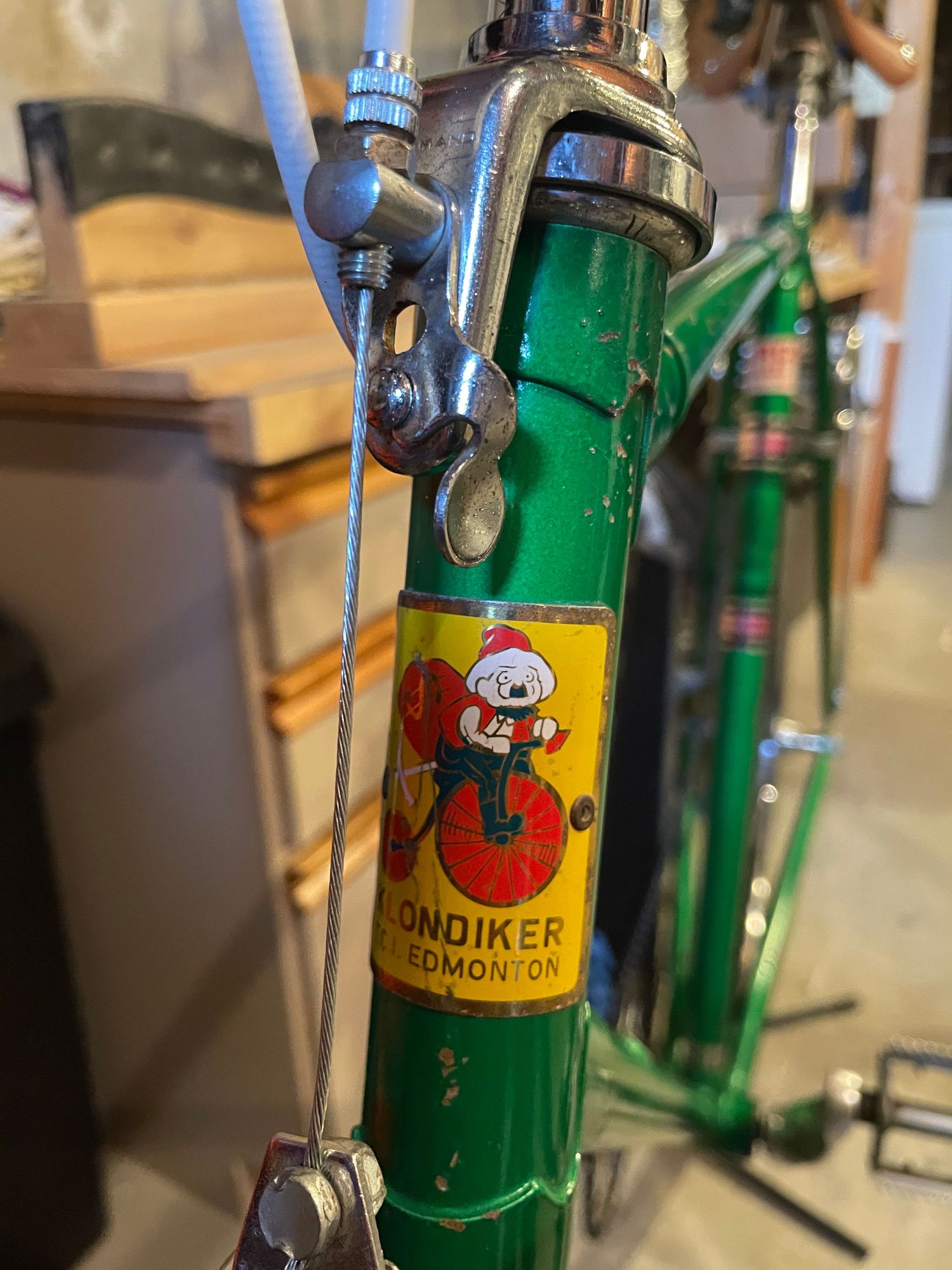
This is likely a long shot on a thread this old. I purchased a Klondiker TCI Edmonton recently. I am having trouble finding any information on line. This is the first forum I was able to find that had some reference to Klondiker bikes. Would you happen to have any information on the Klondiker TCI Edmonton?
The company imported bicycles under the brand Klondiker and possibly Unival. They also imported some Europen brand names.
Many of the Klondiker bicycle frames were from Kuwahara in Japan. The name comes from Klondike Days and the headbadge features Klondike Mike and his mule.
I would be interested to see pictures of your Klondiker.
09-26-24 | 01:46 PM
#18
Newbie
Joined: Sep 2024
Posts: 14
Likes: 1
TCI is Trans-Can Imports. The company started in the 1960s in Sherwood Park and moved to Edmonton. The company still exists and deals in small engine components. The company distributed bicycles to several hardware stores in Alberta. They got out of the bicycle business in about 1980.
The company imported bicycles under the brand Klondiker and possibly Unival. They also imported some Europen brand names.
Many of the Klondiker bicycle frames were from Kuwahara in Japan. The name comes from Klondike Days and the headbadge features Klondike Mike and his mule.
I would be interested to see pictures of your Klondiker.
The company imported bicycles under the brand Klondiker and possibly Unival. They also imported some Europen brand names.
Many of the Klondiker bicycle frames were from Kuwahara in Japan. The name comes from Klondike Days and the headbadge features Klondike Mike and his mule.
I would be interested to see pictures of your Klondiker.
09-27-24 | 08:49 PM
#19
Newbie
Joined: Sep 2024
Posts: 14
Likes: 1
TCI is Trans-Can Imports. The company started in the 1960s in Sherwood Park and moved to Edmonton. The company still exists and deals in small engine components. The company distributed bicycles to several hardware stores in Alberta. They got out of the bicycle business in about 1980.
The company imported bicycles under the brand Klondiker and possibly Unival. They also imported some Europen brand names.
Many of the Klondiker bicycle frames were from Kuwahara in Japan. The name comes from Klondike Days and the headbadge features Klondike Mike and his mule.
I would be interested to see pictures of your Klondiker.
The company imported bicycles under the brand Klondiker and possibly Unival. They also imported some Europen brand names.
Many of the Klondiker bicycle frames were from Kuwahara in Japan. The name comes from Klondike Days and the headbadge features Klondike Mike and his mule.
I would be interested to see pictures of your Klondiker.
09-27-24 | 09:01 PM
#20
Thread Starter
Senior Member
Joined: Sep 2010
Posts: 1,410
Likes: 282
From: Rupert's Land
Bikes: 1981 Raleigh GP, 1985 Norco Bush Pilot, . . .
Picture assist:

I was wrong. He does not have his mule.
The serial number will be on the lower seat tube.
LDudar's Album
 10-17-24 | 04:13 PM
#22
Thread Starter
Senior Member
Joined: Sep 2010
Posts: 1,410
Likes: 282
From: Rupert's Land
Bikes: 1981 Raleigh GP, 1985 Norco Bush Pilot, . . .
Kuwahara serial numbers
That is the format found on Kuwahara frames prior to the last quarter of 1974. At the end of 1974 Kuwahara serial numbers began to include digits for the year and month.
10-17-24 | 04:26 PM
#23
Newbie
Joined: Sep 2024
Posts: 14
Likes: 1
Thanks for the info Hummer. Your knowledge and that of others in the forum is amazing. Based on that Serbian number is it possible to determine the year?
10-17-24 | 04:52 PM
#24
Thread Starter
Senior Member
Joined: Sep 2010
Posts: 1,410
Likes: 282
From: Rupert's Land
Bikes: 1981 Raleigh GP, 1985 Norco Bush Pilot, . . .
The year is difficult to say based upon the serial number. My guess is 1967. Some of the components may have date codes, particularly the crank arms which may have numbers for the year and month of manufacture.
10-17-24 | 07:46 PM
#25
Senior Member
Joined: Feb 2013
Posts: 15,369
Likes: 4,393
From: Alta California
-----
spots to check for possible date marking -
backside of crank arms
portion of stem down inside steerer
portion of saddle pillar down inside seat tube
right end of bar beneath wrap
centre section of bottom bracket spindle
hub barrels, wheels appear unmatched so presumably at least one is a replacement
wheel rims
brake caliper arms
steerer
-----
spots to check for possible date marking -
backside of crank arms
portion of stem down inside steerer
portion of saddle pillar down inside seat tube
right end of bar beneath wrap
centre section of bottom bracket spindle
hub barrels, wheels appear unmatched so presumably at least one is a replacement
wheel rims
brake caliper arms
steerer
-----