


Campy Bottom Bracket compatibility
 02-03-18 | 06:01 PM
#26

Senior Member


Joined: Apr 2011
Posts: 12,649
Likes: 4,791
A couple of things:
No one but the shop guys noticed what was loose or why. There is an assumption that it was the BB, but it sounded like the crankarm to me.
A 113mm DA spindle could be pre or post 1985, and the one in the picture looks like the post '85 Japanese taper 7400 version.
The other thing is that it is said that all the different kinds of tapers are 2° in the various 3rd party manuals, but this doesn't appear to be true. Has anyone else ever actually compared the tapers by holding different spindle tapers against each other to see if the spindles remain parallel?
I have, and Mavic or Campy spindles do not remain parallel to Shimano spindles when you do this. One of them is either more or less than 2°.
If the DA spindle works, then it works. But that isn't the information we had when the thread started, and if the BB or crank arms develop play again I would seriously consider looking more closely at that Japanese spindle.
The other thing to watch out for is the crank bottoming out on either cup. I've seen that, too.
No one but the shop guys noticed what was loose or why. There is an assumption that it was the BB, but it sounded like the crankarm to me.
A 113mm DA spindle could be pre or post 1985, and the one in the picture looks like the post '85 Japanese taper 7400 version.
The other thing is that it is said that all the different kinds of tapers are 2° in the various 3rd party manuals, but this doesn't appear to be true. Has anyone else ever actually compared the tapers by holding different spindle tapers against each other to see if the spindles remain parallel?
I have, and Mavic or Campy spindles do not remain parallel to Shimano spindles when you do this. One of them is either more or less than 2°.
If the DA spindle works, then it works. But that isn't the information we had when the thread started, and if the BB or crank arms develop play again I would seriously consider looking more closely at that Japanese spindle.
The other thing to watch out for is the crank bottoming out on either cup. I've seen that, too.
 02-03-18 | 06:53 PM
#27
Senior Member
Joined: Jul 2009
Posts: 786
Likes: 6
In any case, I think we're all glad it was the easiest to fix.
The other thing is that it is said that all the different kinds of tapers are 2° in the various 3rd party manuals, but this doesn't appear to be true. Has anyone else ever actually compared the tapers by holding different spindle tapers against each other to see if the spindles remain parallel?
I have, and Mavic or Campy spindles do not remain parallel to Shimano spindles when you do this. One of them is either more or less than 2°.
I have, and Mavic or Campy spindles do not remain parallel to Shimano spindles when you do this. One of them is either more or less than 2°.
Here's what Sutherland's says about the matter: "Except for 3-degree axles, differences in the taper angle of individual axles due to manufacturing tolerances are greater than the average differences between brands."
This is not to sound dismissive; they're not my words, I'm only the messenger. I would add that crank taper holes are subject to the same looseness of tolerance. In any case, within a range of tolerance, the crank taper holes will form to the spindle anyway. So long as everything is installed properly, these tolerance differences should not cause problems.
FWIW, both ISO and JIS spec the 2° taper. The ISO includes a tolerance limit (±5 minutes of angle per side, or 1/12 of a degree.)
Perhaps. The Campagnolo 115.5 would have been the better one to start with. At this point, however, the taper hole is formed to the Shimano. So as long as the bolt isn't bottomed on the spindle end, the crankarm isn't bottomed on the taper shoulder or cup, and nothing is hitting anything on the frame, I'd say to stick with it.
02-03-18 | 07:20 PM
#28
Senior Member
Joined: Apr 2011
Posts: 12,649
Likes: 4,791
FWIW, both ISO and JIS spec the 2° taper. The ISO includes a tolerance limit (±5 minutes of angle per side, or 1/12 of a degree.)
Perhaps. The Campagnolo 115.5 would have been the better one to start with. At this point, however, the taper hole is formed to the Shimano. So as long as the bolt isn't bottomed on the spindle end, the crankarm isn't bottomed on the taper shoulder or cup, and nothing is hitting anything on the frame, I'd say to stick with it.
All that said, when I bought my Mavic starfish cranks years ago, everyone swore up and down that it was JIS, so I put it on a recommended Shimano BB. I'm not going to change it now, and whatever spindle length that was suggested put the chainline dead on. But later I did get a chance to compare a Mavic to Campy and they were the same angle, while Mavic to Shimano and Campy to Shimano were not.
02-03-18 | 09:21 PM
#29
Thread Starter
Junior Member
Joined: Feb 2018
Posts: 5
Likes: 0
Wow! Thanks for all the info people! I’m a newbie to the vintage scene, so all these comments are pretty useful.
To answer a previous question, the bolts aren’t in contact with the spindle. That being said, do I need to crank those bolts down til the arms are touching the taper close to the bb? They seem pretty tight, but might need to tighten more. Afraid of damaging something. Excuse my ignorance. The pic shows the current spacing and the “new” ride I’m installing it on. ‘88 Colnago Master?
[ATTACH]CFB715F2-D22D-4C3C-B895-C9939F878681.jpg
70847F8A-B3AA-4AE2-9199-3F07AE34B331.jpg[/ATTACH]
To answer a previous question, the bolts aren’t in contact with the spindle. That being said, do I need to crank those bolts down til the arms are touching the taper close to the bb? They seem pretty tight, but might need to tighten more. Afraid of damaging something. Excuse my ignorance. The pic shows the current spacing and the “new” ride I’m installing it on. ‘88 Colnago Master?
[ATTACH]CFB715F2-D22D-4C3C-B895-C9939F878681.jpg
70847F8A-B3AA-4AE2-9199-3F07AE34B331.jpg[/ATTACH]
02-03-18 | 09:30 PM
#30

FLIR Kitten to 0.05C
Joined: Sep 2014
Posts: 5,331
Likes: 409
From: Lincoln, Nebraska
Bikes: Roadie: Seven Axiom Race Ti w/Chorus 11s. CX/Adventure: Carver Gravel Grinder w/ Di2
Crank bolts need tightened to torque spec. Typically something on the order of 35-40Nm IIRC. Get out or buy a torque wrench if you don't have one--crank bolts are one of those things Shade Tree Mechanics tend not to tighten enough. Make sure you're tightening the crank bolt and not a dust cover.
https://www.parktool.com/blog/repair...icle-section-4
https://www.parktool.com/blog/repair...icle-section-4
02-03-18 | 10:15 PM
#31


Senior Member

Joined: Apr 2005
Posts: 17,196
Likes: 761
From: Ann Arbor, MI
Bikes: 1980 Masi, 1984 Mondonico, 1984 Trek 610, 1980 Woodrup Giro, 2005 Mondonico Futura Leggera ELOS, 1967 PX10E, 1971 Peugeot UO-8
Yes, "different" is the word. They are not even close; you can tell them apart from 100 ft. away.
Super Record of course has some differences from Record as well. The crankarms themselves are the same. Not just similar, but same part number. The only difference is the chainrings.
A true Super Record BB, on the other hand, will have a titanium spindle. Record, Nuovo Record, and C-Record have steel spindles, but all different from each other, and not compatible with each others' cups. The only cups that will interchange are the SR and CR.
With all due respect, it's not a "decent approximation." It's a factory specification.
The original spindle length for Record, Nuovo Record, and Super Record was 113mm, and yes, not symmetrical. Depending on the spindle, it was originally 1-2mm longer DS than NDS. Their Record triple spindle was 118mm, 5mm wider, and all on the drive side.
In 1978, Campagnolo widened all their spindles by 2.5mm to accommodate the changes in the FD and cranks mandated by the CPSC. They added 1mm to the left and 1.5mm to the right of all the previous spindle specs. That spec was stamped onto the spindles for the first year or so, then they changed the stampings permanently. That's how you end up at 115.5mm.
Or you could just get the right Record/Super/Nuovo Record BB and not have to spend any time in trial assembly. The titanium are like unicorn horns, and about as expensive. But the steel ones aren't that rare.
A little lucky, maybe. As I previously noted, the original spindle length for Record/Super Record (Italian thread) was 113mm. Which is, as we now know, exactly what he has. Lucky? Perhaps the person who put it in there knew what they were doing. Which is very likely, because this compatibility issue was rather better known back then than it appears to be now.
Super Record of course has some differences from Record as well. The crankarms themselves are the same. Not just similar, but same part number. The only difference is the chainrings.
A true Super Record BB, on the other hand, will have a titanium spindle. Record, Nuovo Record, and C-Record have steel spindles, but all different from each other, and not compatible with each others' cups. The only cups that will interchange are the SR and CR.
With all due respect, it's not a "decent approximation." It's a factory specification.
The original spindle length for Record, Nuovo Record, and Super Record was 113mm, and yes, not symmetrical. Depending on the spindle, it was originally 1-2mm longer DS than NDS. Their Record triple spindle was 118mm, 5mm wider, and all on the drive side.
In 1978, Campagnolo widened all their spindles by 2.5mm to accommodate the changes in the FD and cranks mandated by the CPSC. They added 1mm to the left and 1.5mm to the right of all the previous spindle specs. That spec was stamped onto the spindles for the first year or so, then they changed the stampings permanently. That's how you end up at 115.5mm.
Or you could just get the right Record/Super/Nuovo Record BB and not have to spend any time in trial assembly. The titanium are like unicorn horns, and about as expensive. But the steel ones aren't that rare.
A little lucky, maybe. As I previously noted, the original spindle length for Record/Super Record (Italian thread) was 113mm. Which is, as we now know, exactly what he has. Lucky? Perhaps the person who put it in there knew what they were doing. Which is very likely, because this compatibility issue was rather better known back then than it appears to be now.
Another point, 111 versus 113. The 111 mm sealed BBs from Campy are 1 mm longer on the drive side, but it's not easy to measure. If one spends the much bigger bucks and buys the 111 mm Symmetrical Record, one will have Campagnolo's track BB and it will be exactly symmetrical. I have a track Record, several assymmetrical 111s, and a 115.5. If the desired 113 spindle is symmetrical, and it fits the cup holes and bearing races correctly, then the 113 willnot be much different on each side from the 111. Is that really a major mismatch between the two options? As far as mixing in Shimano, not ready to go there. But, I think a 111 mm Asymmetric is worth trying, if it doesn't cost the OP too much.
02-03-18 | 11:02 PM
#32
Senior Member
Joined: Apr 2011
Posts: 12,649
Likes: 4,791
Another point, 111 versus 113. The 111 mm sealed BBs from Campy are 1 mm longer on the drive side, but it's not easy to measure. If one spends the much bigger bucks and buys the 111 mm Symmetrical Record, one will have Campagnolo's track BB and it will be exactly symmetrical. I have a track Record, several assymmetrical 111s, and a 115.5. If the desired 113 spindle is symmetrical, and it fits the cup holes and bearing races correctly, then the 113 willnot be much different on each side from the 111. Is that really a major mismatch between the two options? As far as mixing in Shimano, not ready to go there. But, I think a 111 mm Asymmetric is worth trying, if it doesn't cost the OP too much.
To answer a previous question, the bolts aren’t in contact with the spindle. That being said, do I need to crank those bolts down til the arms are touching the taper close to the bb? They seem pretty tight, but might need to tighten more. Afraid of damaging something. Excuse my ignorance. The pic shows the current spacing and the “new” ride I’m installing it on. ‘88 Colnago Master?
02-04-18 | 12:00 AM
#33
Newbie
Joined: Feb 2018
Posts: 1
Likes: 0
Hmm. I'm not sure about that LBS guy's comment. It sounds too pat. There are a lot of variables. The real questions are: Where in the crank/BB assembly is the play occurring? In the BB itself or in the joint(s) between spindle and arm(s)? If you pull the spindle out do the bearings appear to be riding at the correct height? Might the BB bearings just need careful adjustment? Do the bearing cups thread into the BB shell with sufficient threads? Is the chainline reasonably close or do the rings need to be moved in or out?
The Campagnolo B.B. has an ISO taper and the Shimano one has a JIS taper. These have different taper angles.
Although they ‘appear’ to be interchangeable they really are not.
02-04-18 | 12:09 AM
#34
Senior Member
Joined: Apr 2011
Posts: 12,649
Likes: 4,791
Great. What is the difference in taper angles between JIS and ISO?
02-04-18 | 12:32 AM
#35
Senior Member
Joined: Jul 2009
Posts: 786
Likes: 6
The Campagnolo crank has a Campagnolo taper.
The Shimano Dura-Ace spindle he has has a copy of the Campagnolo taper.
The reason they do not have ISO or JIS tapers is that those standards did not exist when the parts were made.
The taper thing doesn't matter anyway because the problem is that his fixed cup was unscrewing because sometimes Italian thread cups do that unscrewing thing.
The bike shop is therefore wrong in more ways than one.
The End.
02-04-18 | 12:42 AM
#36
Senior Member
Joined: Jul 2009
Posts: 786
Likes: 6
Crank bolts need tightened to torque spec. Typically something on the order of 35-40Nm IIRC. Get out or buy a torque wrench if you don't have one--crank bolts are one of those things Shade Tree Mechanics tend not to tighten enough. Make sure you're tightening the crank bolt and not a dust cover.
https://www.parktool.com/blog/repair...icle-section-4
https://www.parktool.com/blog/repair...icle-section-4
The reason the Campagnolo wrench is the size it is, is that it is relatively easy for the average ragazzo to torque the bolts correctly, and rather more difficult to overtorque them. Use anti-seize or at least grease on the bolt threads, and goop a little on the bottom of the bolt head where it contacts the washer too. (At the risk of starting a religious war, don't grease the tapers. Campagnolo lore says no.)
02-04-18 | 06:31 AM
#37

What??? Only 2 wheels?

Joined: Apr 2010
Posts: 13,497
Likes: 943
From: Boston-ish, MA
Bikes: 72 Peugeot UO-8, 82 Peugeot TH8, 87 Bianchi Brava, 76? Masi Grand Criterium, 74 Motobecane Champion Team, 86 & 77 Gazelle champion mondial, 81? Grandis, 82? Tommasini, 83 Peugeot PF10
The difference between ISO and JIS is not angle, it's nominal width. I don't recall which is which. Since it is a taper the crank arm will always go on and seat properly, subject to two limitations.
If the spindle is wider the arm won't go on as far as it should. The chain line will be affected because the arm will be slightly too far outboard, but if the spindle is nominally too short the chain line may be fine. There won't be as much contact between arm and spindle as it was designed to have. If the rider is big and strong the inside of the aluminum arm may deform and the arm may even break. If the ride is lighter and spins rather than mashes, it may not be a problem at all.
If the spindle is narrower the arm will go on too far, with two possible consequences. The spindle may protrude past the hole in the arm so that the crank bolt tightens against the spindle instead of the arm. The arm may bump up against the flare at the inner end of the taper before the sides are seated.
Neither of these issues is guaranteed to come up. For example, if the taper is wider but just slightly longer than spec in the outward direction it could accommodate a smaller hole, since it is effectively a narrow taper with "too much" length at the wide end. It could accommodate a wider hole as long as the extra length isn't so much that it sticks out too far.
The point is, some combinations may work even when not ideal.
__________________
Real cyclists use toe clips.
With great bikes comes great responsibility.
jimmuller
Real cyclists use toe clips.
With great bikes comes great responsibility.
jimmuller
02-04-18 | 08:23 AM
#38
Senior Member
Joined: Apr 2005
Posts: 17,196
Likes: 761
From: Ann Arbor, MI
Bikes: 1980 Masi, 1984 Mondonico, 1984 Trek 610, 1980 Woodrup Giro, 2005 Mondonico Futura Leggera ELOS, 1967 PX10E, 1971 Peugeot UO-8
How did you get down to 111 when the correct length is 115 and the substitute 113mm Dura Ace is JIS?
You don't need to tighten it to a location, just a torque. With the wrench in one hand and the opposition crank arm in the other, you should be tightening until it becomes rather difficult to get the bolt any tighter. This requires a little muscle, but not blowing a vein in your forehead. About the equivalent of lifting 30 pounds in each fist. You really have to either wimp out early or be trying to prove something to get it wrong.
You don't need to tighten it to a location, just a torque. With the wrench in one hand and the opposition crank arm in the other, you should be tightening until it becomes rather difficult to get the bolt any tighter. This requires a little muscle, but not blowing a vein in your forehead. About the equivalent of lifting 30 pounds in each fist. You really have to either wimp out early or be trying to prove something to get it wrong.
For this last comment, you are replying to the wrong person, but writing it as if you are replying to me. Please stop doing that.
For the first comment: I don't see a clear story that 115.5 is the correct length. And if it is, my main point is that a few mm difference might not be significant for the OP once it's all installed and torqued. One thing we don't know is how good the Campy cup/Dura spindle installation was: Q, Chainline, symmetry, chain stay clearance, clean chain running. This is where I would do trial assemblies, to make sure (if it was me) that my new installation is not worse than my original installation.
Honestly, I don't think we even have clear evidence that the chainset is Super Record or something older. And if the cups were for Super Record, the cup is made for 3/16" balls, and hence ¼" balls are not going to fit the races right, and the lateral relationship between even a correct spindle and the cups (hence the frame) will not be right.
02-04-18 | 09:41 AM
#39

Old fart
Joined: Nov 2004
Posts: 26,347
Likes: 5,254
From: Appleton WI
Bikes: Several, mostly not name brands.
Honestly, I don't think we even have clear evidence that the chainset is Super Record or something older. And if the cups were for Super Record, the cup is made for 3/16" balls, and hence ¼" balls are not going to fit the races right, and the lateral relationship between even a correct spindle and the cups (hence the frame) will not be right.
OP states the bike has a Record bottom bracket with an anomalous Shimano spindle:
https://www.os2.dhs.org/~john/campy-BB-specs.pdf
Last edited by JohnDThompson; 02-04-18 at 09:46 AM.
02-04-18 | 11:19 AM
#40
Senior Member
Joined: Jul 2009
Posts: 786
Likes: 6
One thing we don't know is how good the Campy cup/Dura spindle installation was: Q, Chainline, symmetry, chain stay clearance, clean chain running. This is where I would do trial assemblies, to make sure (if it was me) that my new installation is not worse than my original installation.
In any case, this is the original installation as the OP received the bike. OP reported it was working fine until the DS cup unscrewed. Bike shop failed to diagnose the problem correctly, and prescribed a "fix" that was not only erroneous but also irrelevant, and flawed in its reasoning. I'm sure they are doing their best, but it was simply not what the OP needed. And then we had to put the whole irrelevant JIS/ISO distraction to bed a couple times.
I have never told the OP not to do any test fitting or measuring. Once he figured out what had happened, I told him not to buy what the bike shop was selling so he wouldn't have to mess with redoing what was working fine, epicyclic forces excepted. Then I set out to see whether or not, as best as anyone can tell without laying hands on it IRL, that his setup is acceptable. Please see below for further calculations.
Honestly, I don't think we even have clear evidence that the chainset is Super Record or something older. And if the cups were for Super Record, the cup is made for 3/16" balls, and hence ¼" balls are not going to fit the races right, and the lateral relationship between even a correct spindle and the cups (hence the frame) will not be right.
If you have a Sutherland's, you can use their tables to estimate how good a fit a particular mixed set of cups and spindle might be. (Note that their "factors" are their own calculations and represent mm, but are not simply dimensional measurements.)
According to their chart, The correct Campagnolo 70-SS spindle has a center width factor of 72 and an axle end factor of 9.
The Dura-Ace 70 W 113 has a center width factor of 71 and an end factor of 11.
Total factor difference is +1 to Dura-Ace. Generally speaking, close enough to work. More than likely, the crankarm will be 1 or 2mm more outboard DS than the Campagnolo 115.5mm. Left side might be a couple mm closer to the frame. Judge for yourself if this is going to be a problem but in my experience, classic steel frames have more than enough clearance for that.
The lock ring will engage about one less thread. And that's probably fine, BB shells are IME more often under width than over width because of facing.
Like you said, a couple mm difference might not be significant.
Not that it matters, but it is my belief that BITD someone did these same calculations and put the BB together as the OP found it. These reference materials were fairly common in bike shops before the internet.
12-21-23 | 07:58 AM
#41

Newbie
Joined: Nov 2023
Posts: 12
Likes: 1
From: Bilbao
Bikes: french Toulouse style, campy style Torrot, Peugeot PX40M, Marin INdian Fire Trail, BH Top Line Alu
Thanks
 12-21-23 | 08:31 AM
#42

Senior Member
Joined: Apr 2009
Posts: 2,884
Likes: 1,911
From: NorCal
AND you don't need loctite ! A couple wraps of plumber teflon tape on the fixed cup, lite grease in the bottom bracket, and decent tightening will suffice. It does not require beating into submission. (Take a look at the bottom bracket tool in the Campy tool box and notice that it doesn't appear to have been designed to beat on) I haven't ever had a fixed cup come loose over the last 35 years or so.
Same goes for the tapers. Lite grease and proper torque has always worked for me. Once again the Campy tool will provide a fine reference.
Aluminium/steel/no lube ? ? I don't think so.
YMMV of course. It's your bike, do as you like
Same goes for the tapers. Lite grease and proper torque has always worked for me. Once again the Campy tool will provide a fine reference.
Aluminium/steel/no lube ? ? I don't think so.
YMMV of course. It's your bike, do as you like
Last edited by Steel Charlie; 12-21-23 at 08:35 AM.
12-21-23 | 12:44 PM
#43

señor miembro
Joined: Dec 2018
Posts: 3,517
Likes: 8,879
From: Pac NW
Bikes: '70s - '80s Campagnolo
 12-21-23 | 05:05 PM
#44

Ride, Wrench, Swap, Race
Joined: Jan 2010
Posts: 9,813
Likes: 1,790
From: Northern California
Bikes: Cheltenham-Pedersen racer, Boulder F/S Paris-Roubaix, Varsity racer, '52 Christophe, '62 Continental, '92 Merckx, '75 Limongi, '76 Presto, '72 Gitane SC, '71 Schwinn SS, etc.
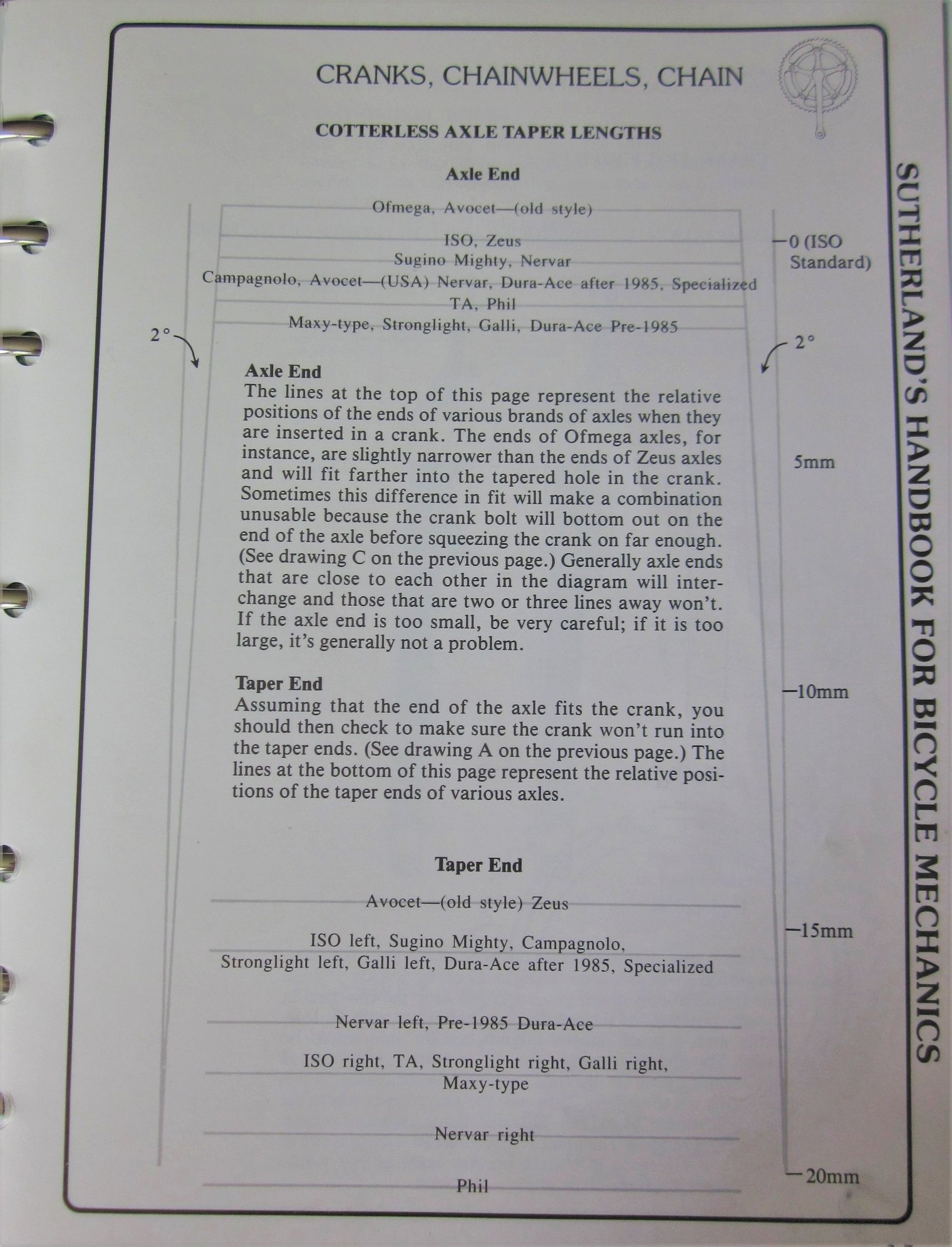
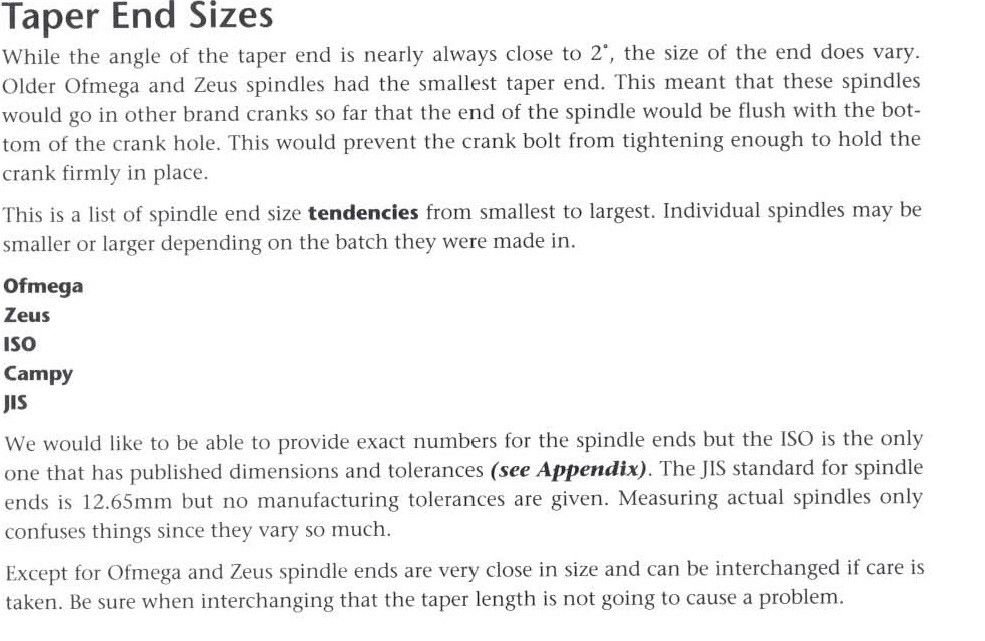
One big oddity with the above chart has to do with Stronglight tapers, which for our purposes means 1970's since those were the years of so many of them coming to the US.
I have many times measured such tapers alongside other tapers such as ISO, Campagnolo (both old and newer cartridge style), JIS and so on.
The Stronglight taper on a typical Competition bottom bracket is considerably smaller than Campagnolo's cup/cone spindle tapers, and smaller yet than any JIS taper.
Yet their chart shows it is larger, like JIS.
I've responded to other's posts about this over the years, as they had obviously sourced their info from Sutherlands.
I find it most easy to compare spindle lengths and tapers directly, whereby the accuracy of the measurement caliper matters not.
I encourage such comparison on the spot when choosing from possibly-compatible spindle choices, as all that is needed is a caliper, better yet with a locking feature which most digital and dial calipers have.
Setting the caliper at 13mm locked, two spindles can immediately be compared for how far that the taper passes through the jaws.
Alternately, perhaps for creating a database, I place the 3mm-wide jaws flat on a table top and then stand the spindle up on the table between the jaws.
Closing the jaws over the flats measures the taper width at the reference distance from the end of the spindle equal to the jaw thickness of approximately 3mm, so the same caliper can then be confidently used on other spindles being measured for the same database (or being compared directly for immediate use).
So there are two good ways of comparing the spindles before bolting them to a crankarm for final fit evaluation.
Lastly, I've measured several examples of Superbe/Mighty spindle tapers alongside the later cartridge-style, ISO-spec Campagnolo bottom brackets, and all of these tapers measure identical.
These are among the narrowest of tapers by the way, only Stronglight measures that small among non-Ofmega-made spindles.
Below, I was (over ten years ago) measuring a Dura-Ace 7400 spindle taper. Curiously, from memory, that number 12.9mm jibes with all of the JIS spindles that I have ever measured, and which tend to fall into a very narrow size range (despite many of them appearing to lack any final machining of the taper surfaces).
But as I mentioned above, for comparing measurement numbers, the spindles being compared really should be measured using the same caliper in the same time frame instead of looking at the numbers all of these years later!
And perhaps also, this might be a "pre-1985" Dura-Ace spindle because I can't quite make out the visible date code on it.
For comparison, numbers wise, the ISO and Stronglight spindles measure near 12.7mm, while the cone-bearing Campagnolo spindles measure just under 12.8mm
Tolerances on TA spindles can be so bad that I've seen different measurements between different pairs of opposing flats on the same end of a TA spindle!
Always check your caliper's accuracy before making measurements to be entered into a database (which is super easy to do using any decent grade of new bearing ball having a known size).

I have many times measured such tapers alongside other tapers such as ISO, Campagnolo (both old and newer cartridge style), JIS and so on.
The Stronglight taper on a typical Competition bottom bracket is considerably smaller than Campagnolo's cup/cone spindle tapers, and smaller yet than any JIS taper.
Yet their chart shows it is larger, like JIS.
I've responded to other's posts about this over the years, as they had obviously sourced their info from Sutherlands.
I find it most easy to compare spindle lengths and tapers directly, whereby the accuracy of the measurement caliper matters not.
I encourage such comparison on the spot when choosing from possibly-compatible spindle choices, as all that is needed is a caliper, better yet with a locking feature which most digital and dial calipers have.
Setting the caliper at 13mm locked, two spindles can immediately be compared for how far that the taper passes through the jaws.
Alternately, perhaps for creating a database, I place the 3mm-wide jaws flat on a table top and then stand the spindle up on the table between the jaws.
Closing the jaws over the flats measures the taper width at the reference distance from the end of the spindle equal to the jaw thickness of approximately 3mm, so the same caliper can then be confidently used on other spindles being measured for the same database (or being compared directly for immediate use).
So there are two good ways of comparing the spindles before bolting them to a crankarm for final fit evaluation.
Lastly, I've measured several examples of Superbe/Mighty spindle tapers alongside the later cartridge-style, ISO-spec Campagnolo bottom brackets, and all of these tapers measure identical.
These are among the narrowest of tapers by the way, only Stronglight measures that small among non-Ofmega-made spindles.
Below, I was (over ten years ago) measuring a Dura-Ace 7400 spindle taper. Curiously, from memory, that number 12.9mm jibes with all of the JIS spindles that I have ever measured, and which tend to fall into a very narrow size range (despite many of them appearing to lack any final machining of the taper surfaces).
But as I mentioned above, for comparing measurement numbers, the spindles being compared really should be measured using the same caliper in the same time frame instead of looking at the numbers all of these years later!
And perhaps also, this might be a "pre-1985" Dura-Ace spindle because I can't quite make out the visible date code on it.
For comparison, numbers wise, the ISO and Stronglight spindles measure near 12.7mm, while the cone-bearing Campagnolo spindles measure just under 12.8mm
Tolerances on TA spindles can be so bad that I've seen different measurements between different pairs of opposing flats on the same end of a TA spindle!
Always check your caliper's accuracy before making measurements to be entered into a database (which is super easy to do using any decent grade of new bearing ball having a known size).
Last edited by dddd; 12-21-23 at 10:57 PM.
 12-22-23 | 12:40 PM
#45
Old fart
Joined: Nov 2004
Posts: 26,347
Likes: 5,254
From: Appleton WI
Bikes: Several, mostly not name brands.
Campagnolo bottom brackets went through a number of changes, 1960s through 70s. The introduction of the Nuovo Record bottom bracket, with its thick, rifled cups required a spindle with the bearing races significantly closer together than the Record and Gran Sport bottom brackets. The Super Record bottom bracket, with a titanium spindle, used smaller (3/16" vs 1/4") balls, so its cups and spindle do not interchange with Record or Nuovo Record. Super Record crank arms, OTOH, are the same as Record and Nuovo Record, and will mount on either bottom bracket. CPSC-required changes in the late 70s meant the drive side crank arm needed more offset to clear the CPSC-compliant "lipped" front derailleur and a correspondingly longer spindle. All in all, a "hot mess." Campagnolo USA published this article to explain things:
https://drive.google.com/file/d/1TZw...usp=drive_link
https://drive.google.com/file/d/1TZw...usp=drive_link

Thread
Thread Starter
Forum
Replies
Last Post
gaucho777
Classic & Vintage
2
08-26-10 11:48 AM
