


Sudden Tire Deflation
 08-21-18 | 10:00 AM
#1

Thread Starter
Fillet-Brazed Member
Joined: Sep 2015
Posts: 488
Likes: 21
From: Brooklyn, New York
Bikes: ⊕
Sudden Tire Deflation
I had some new wheels built, and put some tubes and tires on, I inflated them, and put them aside. A few days later the rear was deflated all the way, the front seemed and still seems fine.
I pumped the rear up again, and kept checking it as I walked by.
Last night, maybe 3 days after re-inflating it for the first time, it was still inflated.
I sat down at my computer, and heard the air suddenly escape, completely deflated.
The wheels are Mavic G 40 with Panaracer folding 27 x 1 1/4 Pasela tires. There is a Velox rim strip on each rim. The spokes I provided are too short, especially on the rear (likely 2mm too short, that was the ERD discrepancy), so I may have it or both rebuilt (I don't think this is related).
Any ideas?
I always screw down the valve head pin thing, and screw on a plastic cap.
I pumped the rear up again, and kept checking it as I walked by.
Last night, maybe 3 days after re-inflating it for the first time, it was still inflated.
I sat down at my computer, and heard the air suddenly escape, completely deflated.
The wheels are Mavic G 40 with Panaracer folding 27 x 1 1/4 Pasela tires. There is a Velox rim strip on each rim. The spokes I provided are too short, especially on the rear (likely 2mm too short, that was the ERD discrepancy), so I may have it or both rebuilt (I don't think this is related).
Any ideas?
I always screw down the valve head pin thing, and screw on a plastic cap.


 08-21-18 | 10:59 AM
#4
Senior Member

Joined: Jul 2013
Posts: 2,611
Likes: 919
From: So Cal, for now
Bikes: 1974 Bob Jackson - Nuovo Record, Brooks Pro, Clips & Straps
From where is the air escaping? Is it the valve, a hole in the rubber tube,... where?
Answer this question and the remedy will become apparent.
Answer this question and the remedy will become apparent.
08-21-18 | 11:15 AM
#6
Thread Starter
Fillet-Brazed Member
Joined: Sep 2015
Posts: 488
Likes: 21
From: Brooklyn, New York
Bikes: ⊕
I'll check the core tonight -- this is a Presta valve. I don't know where it's leaking. I only put in ~ 70 - 80 PSI (tires are 95 PSI I think).
I don't know if these rims have a PSI limit, but they might be considered somewhat narrow for the 27 x 1 1/4" tires I am using (though the other wheel seems fine) ...
Both wheels look pretty normal with these tires (the tires don't look too wide for the rim).
I may just replace the tube and check the tape to make sure the valve hole doesn't have any rough edges.
It is hotter in this room than in the rest of my apartment, maybe around 80 degrees F.
I don't know if these rims have a PSI limit, but they might be considered somewhat narrow for the 27 x 1 1/4" tires I am using (though the other wheel seems fine) ...
Both wheels look pretty normal with these tires (the tires don't look too wide for the rim).
I may just replace the tube and check the tape to make sure the valve hole doesn't have any rough edges.
It is hotter in this room than in the rest of my apartment, maybe around 80 degrees F.
08-21-18 | 11:20 AM
#7
Thread Starter
Fillet-Brazed Member
Joined: Sep 2015
Posts: 488
Likes: 21
From: Brooklyn, New York
Bikes: ⊕
The rims while Mavic G 40 also say Module E, I'm not sure if that's particularly narrow. I believe the tube is 27 x 1 1/8 to 27 x 1 1/4.
The specs according to leonard.io/edd
Mavic E2- G40- Mod E
ERD: 620 mm
OSB: 0 mm
Size: 27"
The specs according to leonard.io/edd
Mavic E2- G40- Mod E
ERD: 620 mm
OSB: 0 mm
Size: 27"
Last edited by specialmonkey; 08-21-18 at 11:25 AM.
08-21-18 | 11:43 AM
#9


feros ferio

Joined: Jul 2000
Posts: 22,411
Likes: 1,876
From: www.ci.encinitas.ca.us
Bikes: 1959 Capo Modell Campagnolo; 1960 Capo Sieger (2); 1962 Carlton Franco Suisse; 1970 Peugeot UO-8; 1982 Bianchi Campione d'Italia; 1988 Schwinn Project KOM-10;
Can you dunk the tube into a bath and look for bubbles, starting at the valve core and the base of the valve stem?
__________________
"Far and away the best prize that life offers is the chance to work hard at work worth doing." --Theodore Roosevelt
Capo: 1959 Modell Campagnolo, S/N 40324; 1960 Sieger (2), S/N 42624, 42597
Carlton: 1962 Franco Suisse, S/N K7911
Peugeot: 1970 UO-8, S/N 0010468
Bianchi: 1982 Campione d'Italia, S/N 1.M9914
Schwinn: 1988 Project KOM-10, S/N F804069
"Far and away the best prize that life offers is the chance to work hard at work worth doing." --Theodore Roosevelt
Capo: 1959 Modell Campagnolo, S/N 40324; 1960 Sieger (2), S/N 42624, 42597
Carlton: 1962 Franco Suisse, S/N K7911
Peugeot: 1970 UO-8, S/N 0010468
Bianchi: 1982 Campione d'Italia, S/N 1.M9914
Schwinn: 1988 Project KOM-10, S/N F804069
 08-21-18 | 06:48 PM
#11

Ride, Wrench, Swap, Race

Joined: Jan 2010
Posts: 9,831
Likes: 1,809
From: Northern California
Bikes: Cheltenham-Pedersen racer, Boulder F/S Paris-Roubaix, Varsity racer, '52 Christophe, '62 Continental, '92 Merckx, '75 Limongi, '76 Presto, '72 Gitane SC, '71 Schwinn SS, etc.
I suspect that the stem is starting to pull free from it's vulcanized attachment to the tube., or that the tube is tearing away from the thicker rubber pad surrounding the valve stem.
Such a narrow rim, especially with a relatively wide tire, often causes problems near the valve stem, especially when a relatively narrow tube is used.
What happens is that initially the rubber pad around the valve stem is up in the tire. Initial inflation inflates the tube which becomes pinned by pressure and friction against the inside of the tire, but not far into the rim cavity between the narrowly-spaced beads of the tire.
So while most of the tube continues to inflate into the rim cavity, dragging some of it's circumference with it, the thicker rubber surrounding the valve stem hangs up inside of the tire until the thinner rubber at it's periphery at some point may tear free from the pad.
The two things that improve matters with wider tires on narrow rims are 1) to use a tube with greater width, and 2) to tug on the valve stem after the first few psi have been pumped into the tube, which helps the rubber pad seat itself between the beads of the tire in the rim channel before higher air pressure pins it against the inside of the tire.
Valve stem area leaks are notorious for their on-again, off-again leaking and generally unpredictable and inconsistent leakage, and are generally not worth attempting a fix on.
Wider tubes suffer less in the way of tension stress that can lead to perforation, thus do not leak as fast when punctured, and allow sealants to work more effectively as punctures do not stretch open.
Such a narrow rim, especially with a relatively wide tire, often causes problems near the valve stem, especially when a relatively narrow tube is used.
What happens is that initially the rubber pad around the valve stem is up in the tire. Initial inflation inflates the tube which becomes pinned by pressure and friction against the inside of the tire, but not far into the rim cavity between the narrowly-spaced beads of the tire.
So while most of the tube continues to inflate into the rim cavity, dragging some of it's circumference with it, the thicker rubber surrounding the valve stem hangs up inside of the tire until the thinner rubber at it's periphery at some point may tear free from the pad.
The two things that improve matters with wider tires on narrow rims are 1) to use a tube with greater width, and 2) to tug on the valve stem after the first few psi have been pumped into the tube, which helps the rubber pad seat itself between the beads of the tire in the rim channel before higher air pressure pins it against the inside of the tire.
Valve stem area leaks are notorious for their on-again, off-again leaking and generally unpredictable and inconsistent leakage, and are generally not worth attempting a fix on.
Wider tubes suffer less in the way of tension stress that can lead to perforation, thus do not leak as fast when punctured, and allow sealants to work more effectively as punctures do not stretch open.
Last edited by dddd; 08-21-18 at 06:51 PM.
08-21-18 | 08:07 PM
#12
Thread Starter
Fillet-Brazed Member
Joined: Sep 2015
Posts: 488
Likes: 21
From: Brooklyn, New York
Bikes: ⊕
Valve was tight.
There was a hole in the tube ~ 90° away from the valve (doh!).
It was a brand new tube and the hole was on the seam, on the rim / tape side. I didn't see or feel anything there.
I patched this tube and will keep in saddle bag for commuting.
I replaced it with another new tube, fingers are crossed.
There was a hole in the tube ~ 90° away from the valve (doh!).
It was a brand new tube and the hole was on the seam, on the rim / tape side. I didn't see or feel anything there.
I patched this tube and will keep in saddle bag for commuting.
I replaced it with another new tube, fingers are crossed.
08-21-18 | 08:09 PM
#13

Extraordinary Magnitude

Joined: Aug 2009
Posts: 14,085
Likes: 2,140
From: Waukesha WI
Bikes: 1978 Trek TX700; 1978/79 Trek 736; 1984 Specialized Stumpjumper Sport; 1984 Schwinn Voyageur SP; 1985 Trek 620; 1985 Trek 720; 1986 Trek 400 Elance; 1987 Schwinn High Sierra; 1990 Miyata 1000LT
I'm glad you've posted this thread- I have a tube with a leak that I can't find. grrr....
__________________
*Recipient of the 2006 Time Magazine "Person Of The Year" Award*
Commence to jigglin’ huh?!?!
"But hey, always love to hear from opinionated amateurs." -says some guy to Mr. Marshall.
Commence to jigglin’ huh?!?!
"But hey, always love to hear from opinionated amateurs." -says some guy to Mr. Marshall.
08-22-18 | 07:39 PM
#14

curmudgineer
Joined: Dec 2009
Posts: 4,417
Likes: 113
From: Chicago SW burbs
Bikes: 2 many 2 fit here
Cheapskate that I am, on several occasions I have spliced in the complete, good stem section of a tube that was otherwise beyond repair, to an otherwise good tube with an unrepairable leak right at the stem.
Last edited by old's'cool; 08-22-18 at 07:40 PM. Reason: spaced out
08-22-18 | 11:06 PM
#15
Ride, Wrench, Swap, Race
Joined: Jan 2010
Posts: 9,831
Likes: 1,809
From: Northern California
Bikes: Cheltenham-Pedersen racer, Boulder F/S Paris-Roubaix, Varsity racer, '52 Christophe, '62 Continental, '92 Merckx, '75 Limongi, '76 Presto, '72 Gitane SC, '71 Schwinn SS, etc.
Valve was tight.
There was a hole in the tube ~ 90° away from the valve (doh!).
It was a brand new tube and the hole was on the seam, on the rim / tape side. I didn't see or feel anything there.
I patched this tube and will keep in saddle bag for commuting.
I replaced it with another new tube, fingers are crossed.
There was a hole in the tube ~ 90° away from the valve (doh!).
It was a brand new tube and the hole was on the seam, on the rim / tape side. I didn't see or feel anything there.
I patched this tube and will keep in saddle bag for commuting.
I replaced it with another new tube, fingers are crossed.
On narrower tubes, the reinforced rubber pad surrounding the valve stem goes about half way around the tube, and hardly stretches at all. So as the narrow tube expands to fill the volume of the larger tire, half as much rubber ends up having to do all the stretching needed for the tube to inflate to the tire's cross-sectional diameter, which is apparently enough to cause any additional stress concentration (such as a seam, or at the pad's periphery) to perforate.
If the perforation is indeed facing the rim channel, then the pad surrounding the valve stem never settled into the rim channel, so on an older tube there will be tell-tale stretch marks in the thinner rubber evident there.
08-23-18 | 04:48 AM
#16

What??? Only 2 wheels?
Joined: Apr 2010
Posts: 13,501
Likes: 995
From: Boston-ish, MA
Bikes: 72 Peugeot UO-8, 82 Peugeot TH8, 87 Bianchi Brava, 76? Masi Grand Criterium, 74 Motobecane Champion Team, 86 & 77 Gazelle champion mondial, 81? Grandis, 82? Tommasini, 83 Peugeot PF10
I've seen defective tubes.
You said 90deg from the valve. Does that mean around the wheel or on the side of the tube? The latter may indicate a pinch hole from when you squeezed the tire on the rim. Tire irons can be deadly to tubes.
__________________
Real cyclists use toe clips.
With great bikes comes great responsibility.
jimmuller
Real cyclists use toe clips.
With great bikes comes great responsibility.
jimmuller
08-23-18 | 06:59 AM
#17
Senior Member

Joined: Nov 2004
Posts: 23,212
Likes: 3,123
Or maybe, during installation, the tube was was pinched between the tyre bead and rim, causing the puncture. The puncture would be sealed by the pressure of the rim and tyre bead, until the tube slipped out from under the bead, at which point it would quickly deflate.
.
.
08-23-18 | 07:05 AM
#18
Thread Starter
Fillet-Brazed Member
Joined: Sep 2015
Posts: 488
Likes: 21
From: Brooklyn, New York
Bikes: ⊕
On narrower tubes, the reinforced rubber pad surrounding the valve stem goes about half way around the tube, and hardly stretches at all. So as the narrow tube expands to fill the volume of the larger tire, half as much rubber ends up having to do all the stretching needed for the tube to inflate to the tire's cross-sectional diameter, which is apparently enough to cause any additional stress concentration (such as a seam, or at the pad's periphery) to perforate.
If the perforation is indeed facing the rim channel, then the pad surrounding the valve stem never settled into the rim channel, so on an older tube there will be tell-tale stretch marks in the thinner rubber evident there.
If the perforation is indeed facing the rim channel, then the pad surrounding the valve stem never settled into the rim channel, so on an older tube there will be tell-tale stretch marks in the thinner rubber evident there.
Is that finger-cross thing 3x or 4x?
I've seen defective tubes.
You said 90deg from the valve. Does that mean around the wheel or on the side of the tube? The latter may indicate a pinch hole from when you squeezed the tire on the rim. Tire irons can be deadly to tubes.
I've seen defective tubes.
You said 90deg from the valve. Does that mean around the wheel or on the side of the tube? The latter may indicate a pinch hole from when you squeezed the tire on the rim. Tire irons can be deadly to tubes.

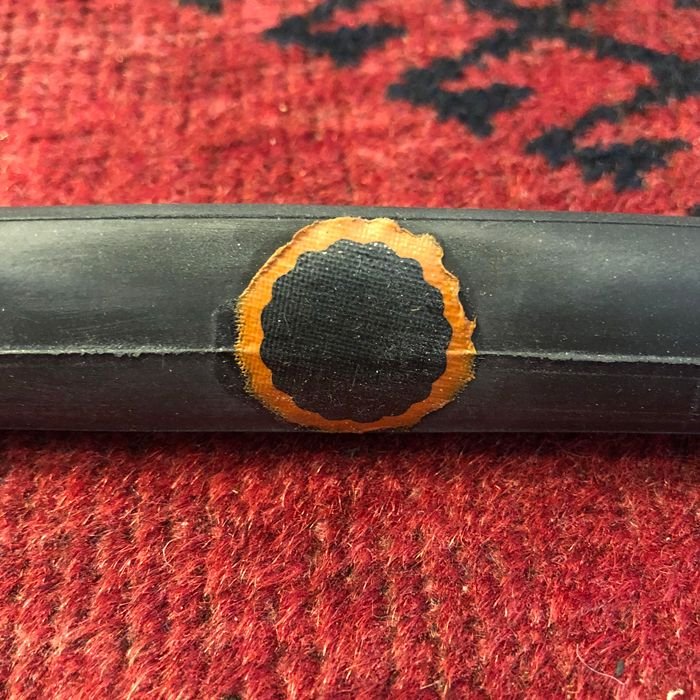
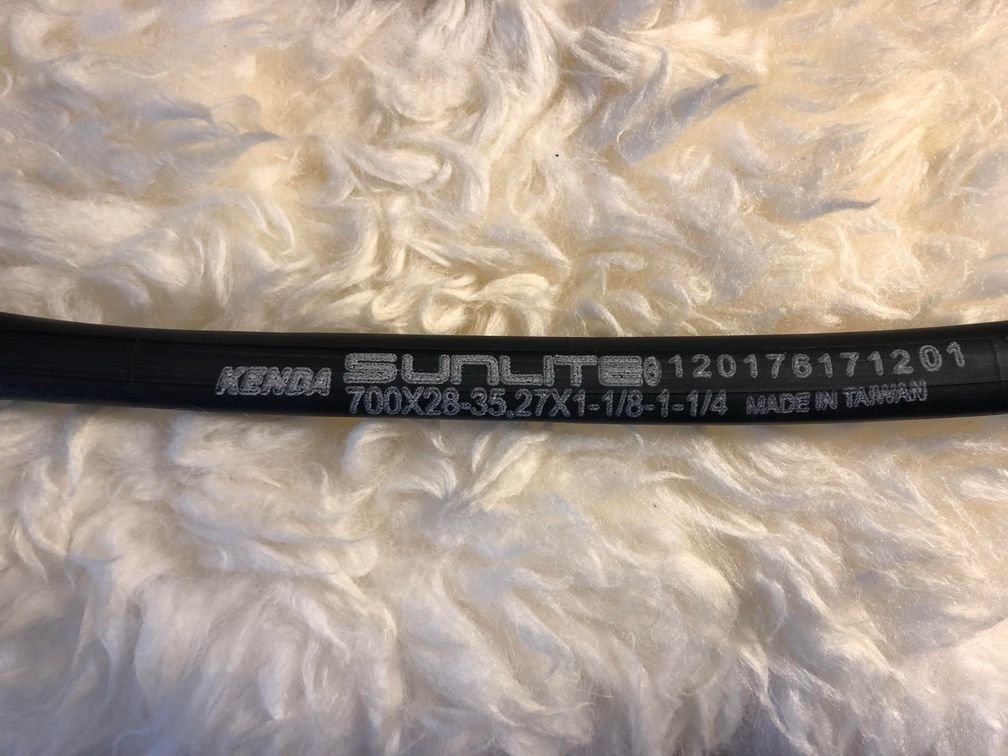
This seems plausible as well.
Last edited by specialmonkey; 08-23-18 at 07:17 AM.
08-23-18 | 07:40 AM
#19
Senior Member
Joined: Oct 2015
Posts: 6,280
Likes: 612
From: Los Angeles
Bikes: 78 Masi Criterium, 68 PX10, 2016 Mercian King of Mercia, Rivendell Clem Smith Jr
It's very important to check that you haven't trapped the tube under the tire bead. When you have the tire all the way on, pump a few pounds of air in the tube, and go around the rim wiggling the tire/tube, then let the air out. Go around again, pushing the tire inwards, while visually inspecting to make sure the tube is not sticking out past the tire bead anywhere. At that point you can pump them to final pressure.
Having learnt bike mechanics during the age when hookless rims were dominant, I still do this last step of inflation to full pressure carefully, listening for the telltale creaking sound a tire makes as it starts to blow off a rim, and ready to let the air out very quickly if needed. This step is mostly not necessary with modern rims and tires, but it doesn't hurt to be careful. If you are using vintage straightwall rims like Weinmann concaves, definitely inflate carefully until you know your rim/tire combo works.
Lastly, there has been a decline in tube quality. I've had a few tubes in the last year or two that came with a few tiny holes straight out of the box. I presume these were from not properly de-gassing or lack of vacuum during the molding. This never used to happen BITD. It's easy to see if you use a magnifying loupe or similar. Tire lever punctures look like a pinch flat - a little bruised slit. The defect holes look like microscopic pores.
Last edited by Salamandrine; 08-23-18 at 07:52 AM.
08-23-18 | 07:55 AM
#20
What??? Only 2 wheels?
Joined: Apr 2010
Posts: 13,501
Likes: 995
From: Boston-ish, MA
Bikes: 72 Peugeot UO-8, 82 Peugeot TH8, 87 Bianchi Brava, 76? Masi Grand Criterium, 74 Motobecane Champion Team, 86 & 77 Gazelle champion mondial, 81? Grandis, 82? Tommasini, 83 Peugeot PF10
Exactly. It's on the inside of the tube about where it would contact the rim. Were it centered on the inside it might suggest insufficient protection from the spoke nipples by the rim strip. Were it a puncture it would be on the outside quarter or so (unless the tube were twisted in the tire).
__________________
Real cyclists use toe clips.
With great bikes comes great responsibility.
jimmuller
Real cyclists use toe clips.
With great bikes comes great responsibility.
jimmuller
08-23-18 | 08:03 AM
#21
Thread Starter
Fillet-Brazed Member
Joined: Sep 2015
Posts: 488
Likes: 21
From: Brooklyn, New York
Bikes: ⊕
The location of the leak does tend to indicate a pinch during installation. It is best practice to install tires without tire levers. Use your hands, or if you need it use one of those tire jacks. It's extremely easy to pinch a tube if you're using a tire lever to get that last bit of bead over. Pro mechanics never use tire levers to install, ever.
It's very important to check that you haven't trapped the tube under the tire bead. When you have the tire all the way on, pump a few pounds of air in the tube, and go around the rim wiggling the tire/tube, then let the air out. Go around again, pushing the tire inwards, while visually inspecting to make sure the tube is not sticking out past the tire bead anywhere. At that point you can pump them to final pressure.
Having learnt bike mechanics during the age when hookless rims were dominant, I still do this last step of inflation to full pressure carefully, listening for the telltale creaking sound a tire makes as it starts to blow off a rim, and ready to let the air out very quickly if needed. This step is mostly not necessary with modern rims and tires, but it doesn't hurt to be careful. If you are using vintage straightwall rims like Weinmann concaves, definitely inflate carefully until you know your rim/tire combo works.
Lastly, there has been a decline in tube quality. I've had a few tubes in the last year or two that came with a few tiny holes straight out of the box. I presume these were from not properly de-gassing or lack of vacuum during the molding. This never used to happen BITD. It's easy to see if you use a magnifying loupe or similar. Tire lever punctures look like a pinch flat - a little bruised slit. The defect holes look like microscopic pores.
It's very important to check that you haven't trapped the tube under the tire bead. When you have the tire all the way on, pump a few pounds of air in the tube, and go around the rim wiggling the tire/tube, then let the air out. Go around again, pushing the tire inwards, while visually inspecting to make sure the tube is not sticking out past the tire bead anywhere. At that point you can pump them to final pressure.
Having learnt bike mechanics during the age when hookless rims were dominant, I still do this last step of inflation to full pressure carefully, listening for the telltale creaking sound a tire makes as it starts to blow off a rim, and ready to let the air out very quickly if needed. This step is mostly not necessary with modern rims and tires, but it doesn't hurt to be careful. If you are using vintage straightwall rims like Weinmann concaves, definitely inflate carefully until you know your rim/tire combo works.
Lastly, there has been a decline in tube quality. I've had a few tubes in the last year or two that came with a few tiny holes straight out of the box. I presume these were from not properly de-gassing or lack of vacuum during the molding. This never used to happen BITD. It's easy to see if you use a magnifying loupe or similar. Tire lever punctures look like a pinch flat - a little bruised slit. The defect holes look like microscopic pores.
Exactly. It's on the inside of the tube about where it would contact the rim. Were it centered on the inside it might suggest insufficient protection from the spoke nipples by the rim strip. Were it a puncture it would be on the outside quarter or so (unless the tube were twisted in the tire).
I do try not to use levers but usually I can't manage without (will look into jack). The folding 27 x 1 1/4" Paselas go really easily on my '87 Trek 520 Cirrus with TitanT rims (without using levers), but these Mavic Module E / G 40s, not so much. They're NOS rims and new tires. There is a hook.
It's a good feeling pushing a tire on a rim without tools, made easier when tire is used / stretched.
After installing a tire, I always inspect the circumference of the rim / tire to make sure the tube is not between bead and rim before inflating.
I do remember hearing creaks as I inflated to put in the new tube. I'm not sure they were telltale of the tire coming off, as it did not. It seems pretty firmly on (still inflated! 4 days later).
The rim is likely from the 80s. Module E 27 x 1 1/4" / G 40.
After inflating, sometimes I palm the tire at opposite angles, like you would stress to seat spokes, just to try to seat the bead evenly if not already, ocassionally it creaks here too.
I'm leaning towards pinch, but didn't photograph the hole at the time.
Last edited by specialmonkey; 08-23-18 at 08:16 AM.

Thread
Thread Starter
Forum
Replies
Last Post
c4p
Bicycle Mechanics
3
06-19-18 05:17 AM
notwist
Cyclocross and Gravelbiking (Recreational)
3
09-25-12 01:50 PM
