


Brake Cable Question
 11-30-18 | 05:37 AM
#1
Thread Starter
Senior Member
Joined: Aug 2018
Posts: 687
Likes: 114
From: north NJ
Bikes: Miyata 710, Univega Viva Sport, Centurion LeMans, Peugeot U09
Brake Cable Question
I am switching a Team Fuji from Aero to non-Aero brakes. I have all the components needed, and I have to decide on the proper routing. How much slack should I have in the cables above the bars? Should I max out the stem height and adjust for that? Or just go by where the bars are comfortable to me? Unfortinately I can't just go by the original cables.
Here's an example of a Team Fuji with non-aero.
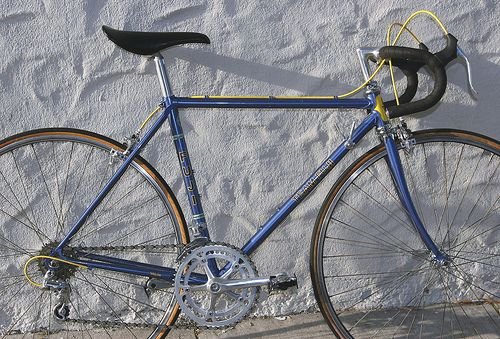
Here's an example of a Team Fuji with non-aero.
 11-30-18 | 05:45 AM
#2

Senior Member

Joined: Feb 2017
Posts: 872
Likes: 601
From: Concord, NC
Bikes: 1984 Bianchi Tipo Corsa, 1985 Cannondale SM600 (24/26)
I would set the stem where you will be comfortable. Leave enough of a "loop" so there are no sharp bends even when bars are turned side to side. Just an aesthetic thing- I try to get cables to "cross" directly over stem when looking down at it. (OCD?) 
11-30-18 | 05:50 AM
#3

What??? Only 2 wheels?


Joined: Apr 2010
Posts: 13,496
Likes: 940
From: Boston-ish, MA
Bikes: 72 Peugeot UO-8, 82 Peugeot TH8, 87 Bianchi Brava, 76? Masi Grand Criterium, 74 Motobecane Champion Team, 86 & 77 Gazelle champion mondial, 81? Grandis, 82? Tommasini, 83 Peugeot PF10
There is no fixed rule for housing length. That pic looks good as a model. The thing about bar height is unless you are using a really long stem the difference between stem up or down isn't so great as to make the housing look odd. Just get the bar dialed in roughly where you'll ride it then install the brakes to look like that pic. The only real error could be that you make it too short so that raising the bar (literally) pulls the housing tight. If you make it long you can always cut it later if you need to.
[MENTION=455882]Bianchi84[/MENTION] makes a good point about turning. That pulls the cables tighter than raising the bar generally would.
In that pic the cables appear to run in front of the bar. Some of us, perhaps almost all, would say they should run behind the bar. It's a tossup about whether the rear should run to the left of the right of the stem.
"I've cut this cable three times and it's still too short."
[MENTION=455882]Bianchi84[/MENTION] makes a good point about turning. That pulls the cables tighter than raising the bar generally would.
In that pic the cables appear to run in front of the bar. Some of us, perhaps almost all, would say they should run behind the bar. It's a tossup about whether the rear should run to the left of the right of the stem.
"I've cut this cable three times and it's still too short."
__________________
Real cyclists use toe clips.
With great bikes comes great responsibility.
jimmuller
Real cyclists use toe clips.
With great bikes comes great responsibility.
jimmuller
11-30-18 | 05:56 AM
#4

Senior Member
Joined: Nov 2010
Posts: 1,229
Likes: 287
From: Magnolia State, 100° with 110% humidity
Bikes: American, Italian, and Japanese.. in no particular order.
To me, the cables over the handlebars looks better than going under. I try to make mine as short as possible without binding. It just looks sleeker. Also if you leave extra housing between the rear brake and rear top tube guide to where it creates a slight upwards arc, it will help prevent the housing from inching forward in the top tube guides, caused by the pivoting of the handlebars.
11-30-18 | 06:30 AM
#5
Thread Starter
Senior Member
Joined: Aug 2018
Posts: 687
Likes: 114
From: north NJ
Bikes: Miyata 710, Univega Viva Sport, Centurion LeMans, Peugeot U09
In that pic the cables appear to run in front of the bar. Some of us, perhaps almost all, would say they should run behind the bar. It's a tossup about whether the rear should run to the left of the right of the stem.
"I've cut this cable three times and it's still too short."
"I've cut this cable three times and it's still too short."
11-30-18 | 07:50 AM
#6

Senior Member
Joined: Feb 2008
Posts: 5,309
Likes: 4,809
From: Peoria, IL
I don't know that there's any rule. As suggested in earlier posts, they should be only as long as they need to be.
I know that I have a tendency to make the cables longer than needed, so I try to keep an eye on my old catalogs and use them as a guide.
For instance, this shot of a Raleigh International is a typical example...
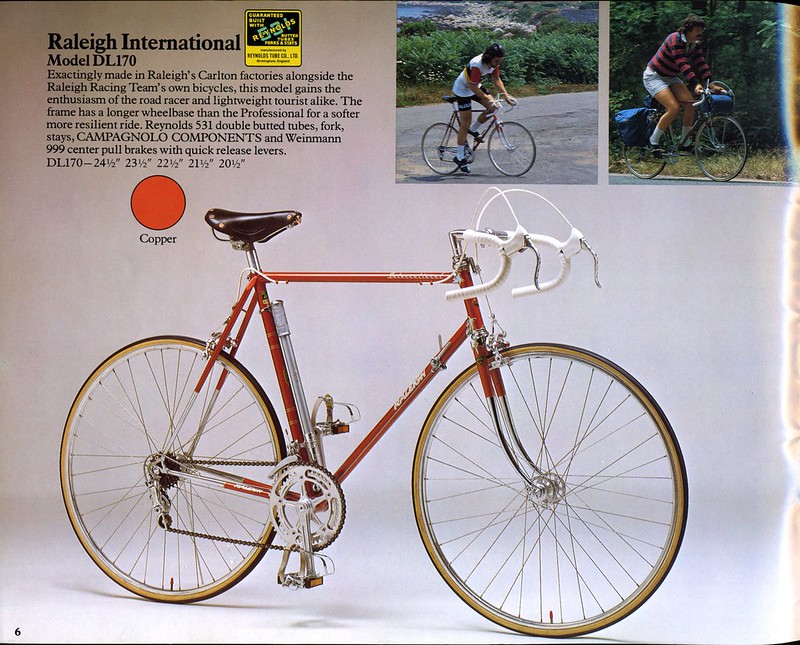
As far as whether the cables should be in front or behind the bar, I run them behind. Of course, my stems tend to be 100mm or so. With a much shorter stem, the smoothest routing might be in front of the bar.
Steve in Peoria
I know that I have a tendency to make the cables longer than needed, so I try to keep an eye on my old catalogs and use them as a guide.
For instance, this shot of a Raleigh International is a typical example...
As far as whether the cables should be in front or behind the bar, I run them behind. Of course, my stems tend to be 100mm or so. With a much shorter stem, the smoothest routing might be in front of the bar.
Steve in Peoria
11-30-18 | 08:02 AM
#7
I AM AI
Joined: Aug 2013
Posts: 4,286
Likes: 1,164
From: Tucson, AZ
Bikes: 2008 S-Works Roubaix SL, 1979 Raleigh Comp GS, 1978 Schwinn Volare
From Sheldon Brown:
The Four Commandments of Cable Routing:
- The handlebars must be able to turn as far as they can in both directions without being limited by a cable pulling taut. Instead, the turning limit must be set by the handlebar bumping into the top tube or by the brake arm or reflector bracket bumping into the down tube.
- No wrong direction bends (For example: as the rear brake cable leaves the top tube and makes the bend down toward the caliper, it should make a smooth transition from parallel to the top tube to parallel to the seat stays. If the cable bends up from the top tube before bending down toward the seat stays, it is probably too long. If the cable curves out past the caliper, then bends back at an angle more vertical than the seat stays, it is certainly too long.
- The bends that cannot be avoided should be made as wide (gradual) as possible,
- Cable housings should be as short as they can be without violating the above rules. If a housing is attached to a part that moves, test it at the extreme positions it will take when in use. Apply a brake; shift a derailer to the positions where the cable is tightest and where it bends the housing the furthest in each direction.
__________________
A race bike in any era is a highly personal choice that at its "best" balances the requirements of fit, weight, handling, durability and cost tempered by the willingness to toss it and oneself down the pavement at considerable speed. ~Bandera
A race bike in any era is a highly personal choice that at its "best" balances the requirements of fit, weight, handling, durability and cost tempered by the willingness to toss it and oneself down the pavement at considerable speed. ~Bandera
11-30-18 | 08:06 AM
#8

Senior Member
Joined: May 2008
Posts: 10,106
Likes: 2,757
From: Fredericksburg, Va
Bikes: ? Proteous, '65 Frejus TDF, '73 Bottecchia Giro d'Italia, '83 Colnago Superissimo, '84 Trek 610, '84 Trek 760, '88 Pinarello Veneto, '88 De Rosa Pro, '89 Pinarello Montello, 'Litespeed Catalyst'94 Burley Duet, 97 Specialized RockHopper, 2010 Langster
My rule is what counts and the first criteria is to have the bar at the right location. Second is to have the cables as short as possible with the maximum radius and minimum bends. As stated, the stem will dictate if the cables run in front or behind the bar. I am one of the few with the front brake controlled by the right lever. The result often is that the cable don't cross. WRT the rear cable rounting around the stem, it is determined by how much the cable is "stretched" when turning the wheel.
In addition is the issue of the rear brake cable housing from either the clamp or exit of the tube to the brake. My preference is not to have it bend up to go down. The criteria for me is to avoid the cable rubbing on the frame. If the rule for the front is followed on the back then it will rub on the frame, depending on the exit location of the clamp/tube exit.
Having been so straight forward in the above comments, I don't really care too much how other do it. To me it is all about cable/housing performance with economy of cable/housing length, in that order.
In addition is the issue of the rear brake cable housing from either the clamp or exit of the tube to the brake. My preference is not to have it bend up to go down. The criteria for me is to avoid the cable rubbing on the frame. If the rule for the front is followed on the back then it will rub on the frame, depending on the exit location of the clamp/tube exit.
Having been so straight forward in the above comments, I don't really care too much how other do it. To me it is all about cable/housing performance with economy of cable/housing length, in that order.
__________________
Bikes don't stand alone. They are two tired.
Bikes don't stand alone. They are two tired.
11-30-18 | 11:38 AM
#9
Senior Member

Joined: Aug 2012
Posts: 557
Likes: 125
From: Rochester, NY
Most of the bikes that had stem shifters were routed in front to prevent clutter. That's my understanding anyway.
11-30-18 | 12:16 PM
#10

Ride, Wrench, Swap, Race
Joined: Jan 2010
Posts: 9,813
Likes: 1,790
From: Northern California
Bikes: Cheltenham-Pedersen racer, Boulder F/S Paris-Roubaix, Varsity racer, '52 Christophe, '62 Continental, '92 Merckx, '75 Limongi, '76 Presto, '72 Gitane SC, '71 Schwinn SS, etc.
Last detail has to do with how the cables cross above the stem extension. I usually find that if they are crossed one way, that the housings touch and remain in contact.
But putting the other cable in front may leave the two housings separated by some distance, often with one of them clattering against the handlebar or stem.
My preferred way here is to have the cable housings touching, and with the front brake housing in front of the rear brake housing where they cross before going to each side of the stem.
This is for non-aero cable routing of course.
But putting the other cable in front may leave the two housings separated by some distance, often with one of them clattering against the handlebar or stem.
My preferred way here is to have the cable housings touching, and with the front brake housing in front of the rear brake housing where they cross before going to each side of the stem.
This is for non-aero cable routing of course.
11-30-18 | 12:27 PM
#11
Senior Member
Joined: Oct 2015
Posts: 6,280
Likes: 611
From: Los Angeles
Bikes: 78 Masi Criterium, 68 PX10, 2016 Mercian King of Mercia, Rivendell Clem Smith Jr
The rule(s) I was taught to follow were the same as the ones Sheldon wrote as quoted in post #7 . Basically you made them as short as possible while still being able to fully turn the bars in both directions until they touch the top tube. I'd usually give them an extra inch or so beyond this, to allow some trimming in the future as the ends got mangled. This method is/was possibly influenced by Eddy Merckx, who was famous for his extremely short cable housing. Also, unless there's very good reason to do otherwise, cables should be behind the bars. Generally speaking, you just want the smoothest most logical and shortest path from lever to brake.
The cables on my personal bikes almost never cross, because I've always hooked them up Italian style - right hand front brake.
The cables on my personal bikes almost never cross, because I've always hooked them up Italian style - right hand front brake.

 11-30-18 | 01:01 PM
#13

Senior Member

Joined: Nov 2005
Posts: 4,040
Likes: 2,120
From: NW Ohio
Bikes: 1984 Miyata 310, 1986 Schwinn Sierra, 1987 Ross Mt. Hood, 1988 Schwinn LeTour, 1988 Trek 400T, 1981 Fuji S12-1977 Univega Grand Rally, S LTD, 1973 Sears Free Spirit 531, 197? FW Evans
I am switching a Team Fuji from Aero to non-Aero brakes. I have all the components needed, and I have to decide on the proper routing. How much slack should I have in the cables above the bars? Should I max out the stem height and adjust for that? Or just go by where the bars are comfortable to me? Unfortinately I can't just go by the original cables.
Here's an example of a Team Fuji with non-aero.
Here's an example of a Team Fuji with non-aero.
Larger frame sizes tend to also have longer stem extensions, to the "behind the bar" rule makes more sense.
11-30-18 | 01:09 PM
#14
Senior Member♣️
Joined: Jan 2016
Posts: 4,075
Likes: 3,004
I always try to run cables behind the handle bars.If they cross over the stem, i use hemp and tie them together and finish with a coat of wood glue(clear) over the hemp. As far as length, I make a fist and vertically slide it under the cable for gage length. No set rule , it just seems to look correct, IMO. Joe
11-30-18 | 01:28 PM
#15
What??? Only 2 wheels?
Joined: Apr 2010
Posts: 13,496
Likes: 940
From: Boston-ish, MA
Bikes: 72 Peugeot UO-8, 82 Peugeot TH8, 87 Bianchi Brava, 76? Masi Grand Criterium, 74 Motobecane Champion Team, 86 & 77 Gazelle champion mondial, 81? Grandis, 82? Tommasini, 83 Peugeot PF10
On my bikes the handlebar always sits ahead of the front of the fork. So for sidepull brakes routing the front cable behind the bar means it drops straight down to the caliper. By choosing whether you run it across the rear cable you can make it help keep the rear cable in place too. FWIW, I always have the front brake on my left hand, and my sidepulls have the cable on the right, so the cable always has a smooth loop over the top, left to right. For centerpull brakes the hanger tends to be directly below the stem extension but still behind the bar. Looping the cable over the stem to enter the hanger from the opposite side gives it a nice smooth bend.
__________________
Real cyclists use toe clips.
With great bikes comes great responsibility.
jimmuller
Real cyclists use toe clips.
With great bikes comes great responsibility.
jimmuller
11-30-18 | 01:54 PM
#16
Senior Member
Joined: Oct 2015
Posts: 6,280
Likes: 611
From: Los Angeles
Bikes: 78 Masi Criterium, 68 PX10, 2016 Mercian King of Mercia, Rivendell Clem Smith Jr
I can assure you that the vintage correct way is behind the bars. There were always exemptions for personal preference - anyone can set up their bike however they like, but no bike would have left a professional shop floor with cables in front.
11-30-18 | 02:09 PM
#17
Thread Starter
Senior Member
Joined: Aug 2018
Posts: 687
Likes: 114
From: north NJ
Bikes: Miyata 710, Univega Viva Sport, Centurion LeMans, Peugeot U09
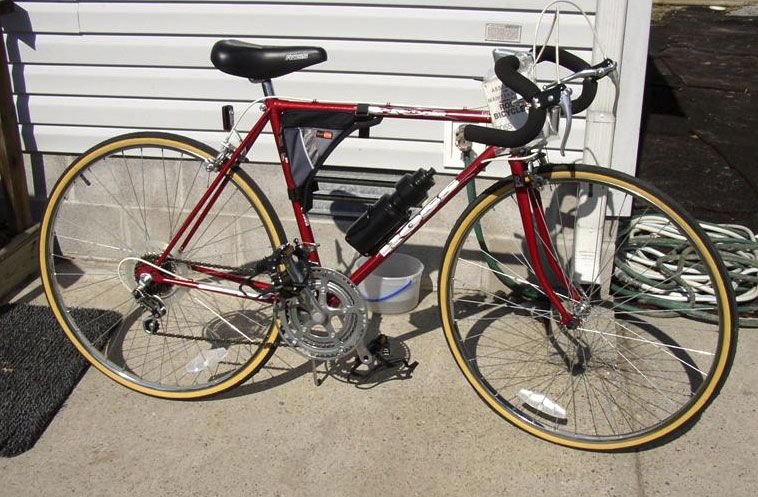
That's probably because it's been 30 years + since non aero brake levers have been standard, and people no longer know how to set them up.
I can assure you that the vintage correct way is behind the bars. There were always exemptions for personal preference - anyone can set up their bike however they like, but no bike would have left a professional shop floor with cables in front.
I can assure you that the vintage correct way is behind the bars. There were always exemptions for personal preference - anyone can set up their bike however they like, but no bike would have left a professional shop floor with cables in front.
 11-30-18 | 03:41 PM
#18
Ride, Wrench, Swap, Race
Joined: Jan 2010
Posts: 9,813
Likes: 1,790
From: Northern California
Bikes: Cheltenham-Pedersen racer, Boulder F/S Paris-Roubaix, Varsity racer, '52 Christophe, '62 Continental, '92 Merckx, '75 Limongi, '76 Presto, '72 Gitane SC, '71 Schwinn SS, etc.
Whether a bike has stem shifters, centerpull front caliper or a stem shorter than 8cm or so can affect where the optimum cable routing position will be.
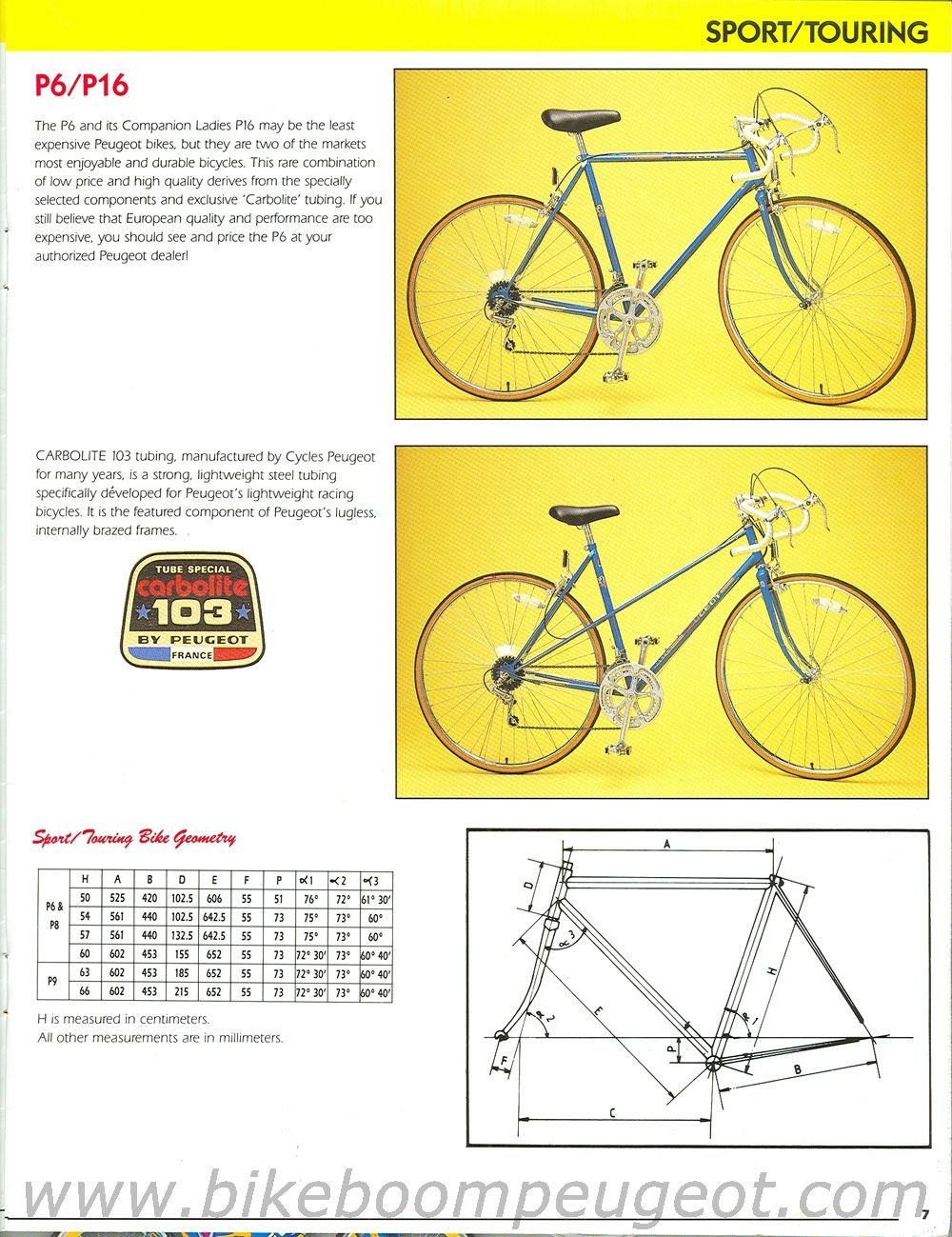
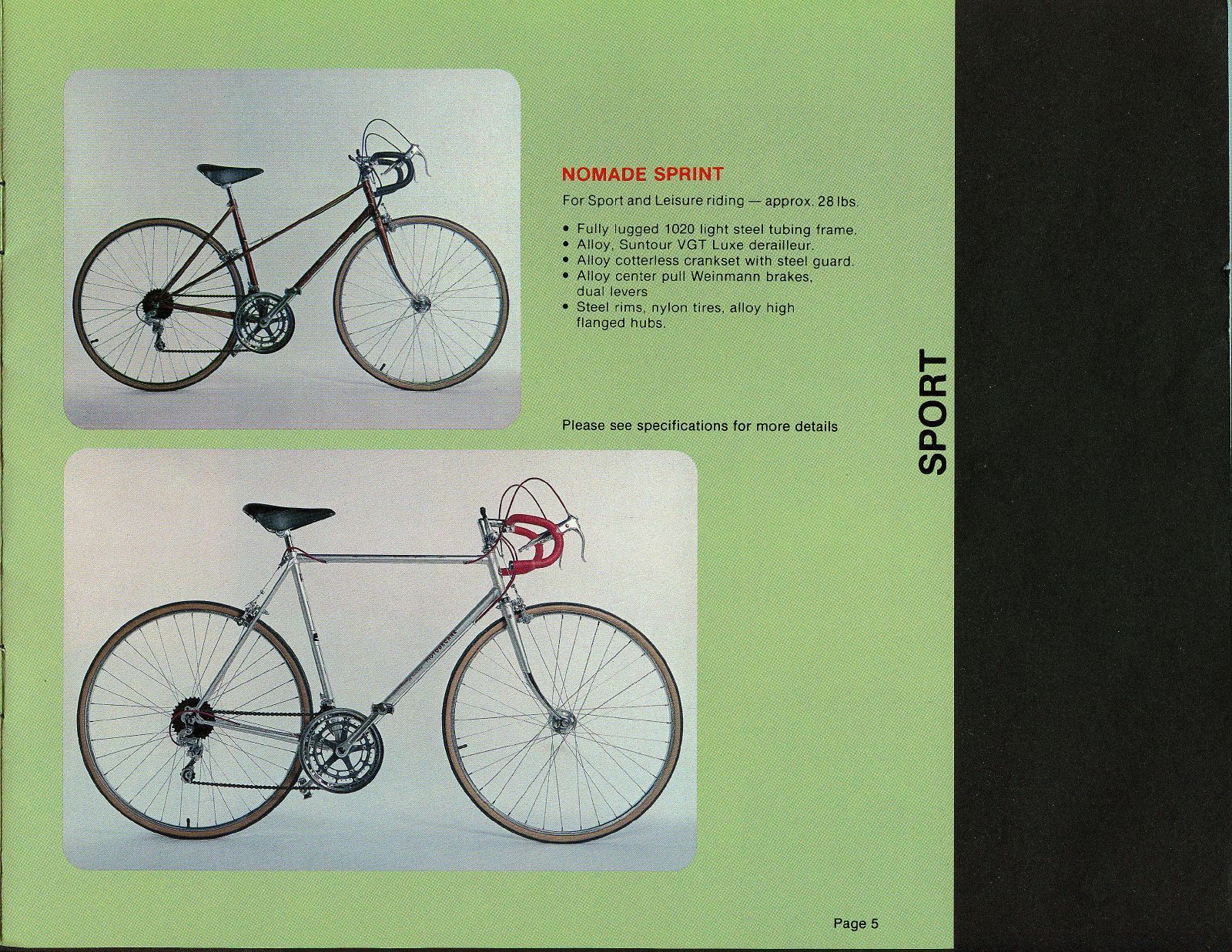
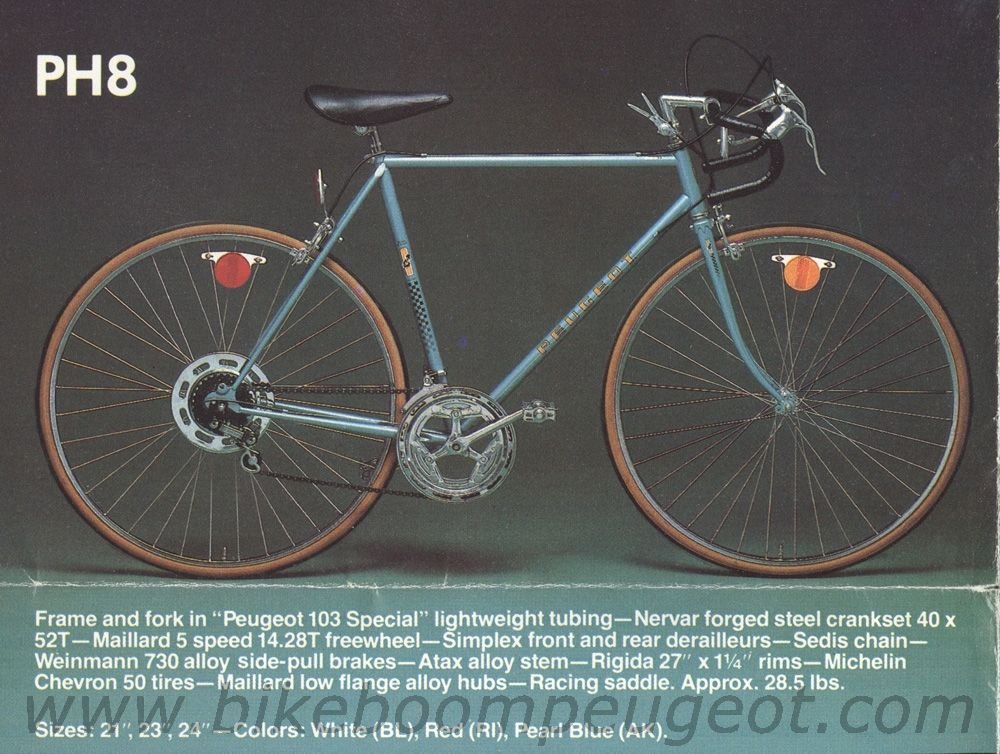
I've surprised myself a few times, when I ended up routing cables in front of the handlebar for one or more of the above reasons.
None of the bikes I ride has a stem shorter than 8cm, so I route the cables behind the bars even when stem shifters are used.
I don't think that the factories were always very particular about where the cables on boom bikes were routed, as evidenced by some of the catalog photos, and I think that it's possible that simple things like packaging/shipping concerns could have swayed the decision on how cables would be routed.
I've surprised myself a few times, when I ended up routing cables in front of the handlebar for one or more of the above reasons.
None of the bikes I ride has a stem shorter than 8cm, so I route the cables behind the bars even when stem shifters are used.
I don't think that the factories were always very particular about where the cables on boom bikes were routed, as evidenced by some of the catalog photos, and I think that it's possible that simple things like packaging/shipping concerns could have swayed the decision on how cables would be routed.
12-01-18 | 07:18 AM
#19
Thread Starter
Senior Member
Joined: Aug 2018
Posts: 687
Likes: 114
From: north NJ
Bikes: Miyata 710, Univega Viva Sport, Centurion LeMans, Peugeot U09
What I'm gathering from this is, there is no "right" way. Every bike is different, and you need to respect that. A lot of good points were made.
12-01-18 | 07:48 AM
#20

Overdoing projects
Joined: Oct 2011
Posts: 2,464
Likes: 1,369
From: Rotterdam, former republic of the Netherlands
Bikes: Batavus Randonneur GL, Gazelle Orange Excellent, Gazelle Super Licht, Gazelle Grand Tourist, Gazelle Lausanne, Gazelle Tandem, Koga-Miyata SilverAce, Koga-Miyata WorldTraveller
You can always try getting your hands on a Specialites TA brake cable guide (Velobase).

More info in a previous thread or here
More info in a previous thread or here
12-01-18 | 08:13 AM
#21


Way back, racers went as short a bend as possible. Very little arcing over the bars. I went with what would keep my hand from snagging the cable housing as I raised it to scratch my nose. I bought one bike with the super short cable approach, took a while to train myself to swing my hand clear of the cable when raising it, too much effort.
A Big arc does look tourist. But who is racing?
A Big arc does look tourist. But who is racing?
12-01-18 | 08:37 AM
#22
What??? Only 2 wheels?
Joined: Apr 2010
Posts: 13,496
Likes: 940
From: Boston-ish, MA
Bikes: 72 Peugeot UO-8, 82 Peugeot TH8, 87 Bianchi Brava, 76? Masi Grand Criterium, 74 Motobecane Champion Team, 86 & 77 Gazelle champion mondial, 81? Grandis, 82? Tommasini, 83 Peugeot PF10
12-01-18 | 09:29 AM
#23
Senior Member
Joined: Oct 2015
Posts: 6,280
Likes: 611
From: Los Angeles
Bikes: 78 Masi Criterium, 68 PX10, 2016 Mercian King of Mercia, Rivendell Clem Smith Jr
For the record, the factories didn't have much to do with cable routing. Bikes arrived at bike shops disassembled and in boxes. The LBS assembled them and made any determination about cable routing.
More often than you would think, catalog shots had poorly assembled bikes in the product shots. Presumably this was because they dragged bike boxes to a photo studio, without getting them professionally assembled.
It's true sometimes Peugeot shops would route cables under, especially older ones with under TT routing. They were an exception. May have been more sloppiness than preference. Schwinn may have had guidelines, but I never worked in a Schwinn shop so I don't know.
More often than you would think, catalog shots had poorly assembled bikes in the product shots. Presumably this was because they dragged bike boxes to a photo studio, without getting them professionally assembled.
It's true sometimes Peugeot shops would route cables under, especially older ones with under TT routing. They were an exception. May have been more sloppiness than preference. Schwinn may have had guidelines, but I never worked in a Schwinn shop so I don't know.
12-01-18 | 09:51 AM
#24
Senior Member
Joined: Dec 2015
Posts: 1,952
Likes: 1,239
From: Menomonee Falls, WI
Bikes: 1984 Schwinn Supersport, 1988 Trek 400T, 1977 Trek TX900, 1982 Bianchi Champione del Mondo, 1978 Raleigh Supercourse, 1986 Trek 400 Elance, 1991 Waterford PDG OS Paramount, 1971 Schwinn Sports Tourer, 1985 Trek 670
You can always try getting your hands on a Specialites TA brake cable guide (Velobase).
More info in a previous thread or here
More info in a previous thread or here
Tim
12-03-18 | 09:35 AM
#25
Overdoing projects
Joined: Oct 2011
Posts: 2,464
Likes: 1,369
From: Rotterdam, former republic of the Netherlands
Bikes: Batavus Randonneur GL, Gazelle Orange Excellent, Gazelle Super Licht, Gazelle Grand Tourist, Gazelle Lausanne, Gazelle Tandem, Koga-Miyata SilverAce, Koga-Miyata WorldTraveller