


Always some new lubes to test:
 01-22-19 | 05:39 PM
#1

Thread Starter
Ride, Wrench, Swap, Race

Joined: Jan 2010
Posts: 9,835
Likes: 1,816
From: Northern California
Bikes: Cheltenham-Pedersen racer, Boulder F/S Paris-Roubaix, Varsity racer, '52 Christophe, '62 Continental, '92 Merckx, '75 Limongi, '76 Presto, '72 Gitane SC, '71 Schwinn SS, etc.
Always some new lubes to test:
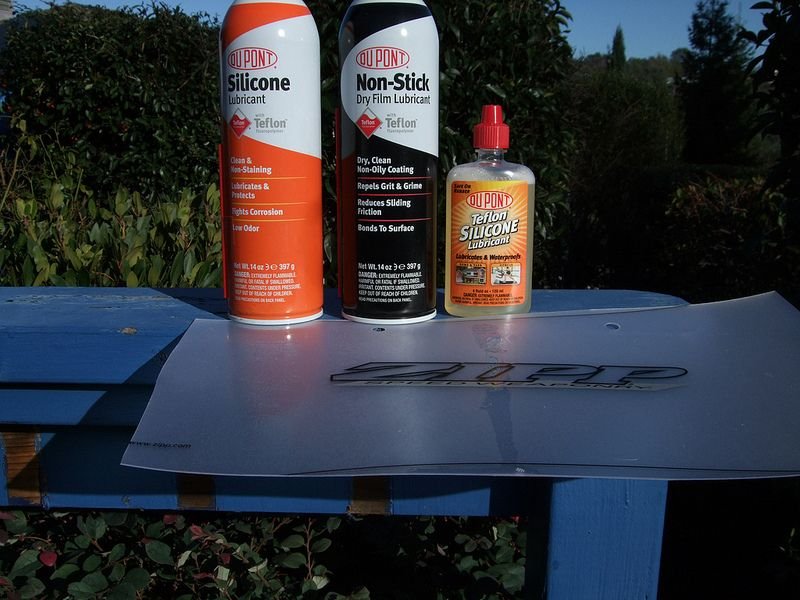
Found these on Amazon, took delivery today and did a spray-test on the plastic sheet.
The "DRY" lube was visibly dry in 30 seconds, the other two have silicone oil that will never dry.
Silicone and PTFE are what the best/priciest cable greases are made from, and never thicken inside of your housings.
Always on the lookout for a new "holy grail" lube suitable for in-situ lubing of cables with maximal results. The DRY lube is the kind that I use to refill my squeeze bottle with a seasonally-adjusted 10-20% oil added for quietness and longevity. The very high solvent content of the aerosol product assures that I can easily wipe down the chain after lubing with no excess of oil remaining to creep out of the links and cause sludge to appear.
I'll try to get these tested and report back here.
The "DRY" lube was visibly dry in 30 seconds, the other two have silicone oil that will never dry.
Silicone and PTFE are what the best/priciest cable greases are made from, and never thicken inside of your housings.
Always on the lookout for a new "holy grail" lube suitable for in-situ lubing of cables with maximal results. The DRY lube is the kind that I use to refill my squeeze bottle with a seasonally-adjusted 10-20% oil added for quietness and longevity. The very high solvent content of the aerosol product assures that I can easily wipe down the chain after lubing with no excess of oil remaining to creep out of the links and cause sludge to appear.
I'll try to get these tested and report back here.
 01-23-19 | 07:42 AM
#2

Eccentric Old Man


Joined: Jan 2014
Posts: 727
Likes: 177
From: BelleVegas, IL
Bikes: 1986 Trek 520 Cirrus, 1979 Schwinn Traveler III, Trek T100, 1995 Trek 970, Fuji America
I'm looking forward to your report. Real world info is good.
01-23-19 | 02:56 PM
#4

Senior Member
Joined: Jul 2014
Posts: 260
Likes: 14
From: Saragossa. Spain
Bikes: Peugeot Mont Blanc . Bianchi 28c 1980. Coppi Giro di Lombardia. Vitoria Vintage 1990. Orbea Luarca 1977. Trek 950.
The title had frightened...I think we will be delighted to hear your experiences.
01-23-19 | 03:30 PM
#5

Senior Member
Joined: Aug 2015
Posts: 537
Likes: 624
From: Murrieta Ca.
Bikes: Teledyne Titan, Bob Jackson Audax Club, Bob Jackson World Tour, AlAn Record Ergal, 3Rensho Katana.
Great thread, I'm looking forward to seeing all the new lubes your experimenting with.
: Mike
: Mike
01-23-19 | 04:53 PM
#6

aka Tom Reingold


Joined: Jan 2009
Posts: 44,340
Likes: 6,640
From: New York, NY, and High Falls, NY, USA
Bikes: 1962 Rudge Sports, 1971 Raleigh Super Course, 1971 Raleigh Pro Track, 1974 Raleigh International, 1975 Viscount Fixie, 1982 McLean, 1996 Lemond (Ti), 2002 Burley Zydeco tandem
Check out his other posts here. I always learn something from him.
__________________
Tom Reingold, tom@noglider.com
New York City and High Falls, NY
Blogs: The Experienced Cyclist; noglider's ride blog
“When man invented the bicycle he reached the peak of his attainments.” — Elizabeth West, US author
Please email me rather than PM'ing me. Thanks.
Tom Reingold, tom@noglider.com
New York City and High Falls, NY
Blogs: The Experienced Cyclist; noglider's ride blog
“When man invented the bicycle he reached the peak of his attainments.” — Elizabeth West, US author
Please email me rather than PM'ing me. Thanks.
01-23-19 | 05:26 PM
#7

curmudgineer
Joined: Dec 2009
Posts: 4,417
Likes: 113
From: Chicago SW burbs
Bikes: 2 many 2 fit here
Great endeavour, look forward to updates.
A minor word of caution to all about silicone (lube, adhesive, what have you)... Apparently it is murder on paint adhesion, even in trace quantities, and not easy to strip, so much so that automotive OEMs do NOT allow the substance, in any form, within their factory walls.
A minor word of caution to all about silicone (lube, adhesive, what have you)... Apparently it is murder on paint adhesion, even in trace quantities, and not easy to strip, so much so that automotive OEMs do NOT allow the substance, in any form, within their factory walls.
01-23-19 | 09:18 PM
#8
Thread Starter
Ride, Wrench, Swap, Race
Joined: Jan 2010
Posts: 9,835
Likes: 1,816
From: Northern California
Bikes: Cheltenham-Pedersen racer, Boulder F/S Paris-Roubaix, Varsity racer, '52 Christophe, '62 Continental, '92 Merckx, '75 Limongi, '76 Presto, '72 Gitane SC, '71 Schwinn SS, etc.
Great endeavour, look forward to updates.
A minor word of caution to all about silicone (lube, adhesive, what have you)... Apparently it is murder on paint adhesion, even in trace quantities, and not easy to strip, so much so that automotive OEMs do NOT allow the substance, in any form, within their factory walls.
A minor word of caution to all about silicone (lube, adhesive, what have you)... Apparently it is murder on paint adhesion, even in trace quantities, and not easy to strip, so much so that automotive OEMs do NOT allow the substance, in any form, within their factory walls.
01-23-19 | 10:03 PM
#9

Senior Member
Joined: Oct 2014
Posts: 2,539
Likes: 743
From: GWN
Found these on Amazon, took delivery today and did a spray-test on the plastic sheet.
The "DRY" lube was visibly dry in 30 seconds, the other two have silicone oil that will never dry.
Silicone and PTFE are what the best/priciest cable greases are made from, and never thicken inside of your housings.
Always on the lookout for a new "holy grail" lube suitable for in-situ lubing of cables with maximal results. The DRY lube is the kind that I use to refill my squeeze bottle with a seasonally-adjusted 10-20% oil added for quietness and longevity. The very high solvent content of the aerosol product assures that I can easily wipe down the chain after lubing with no excess of oil remaining to creep out of the links and cause sludge to appear.
I'll try to get these tested and report back here.
The "DRY" lube was visibly dry in 30 seconds, the other two have silicone oil that will never dry.
Silicone and PTFE are what the best/priciest cable greases are made from, and never thicken inside of your housings.
Always on the lookout for a new "holy grail" lube suitable for in-situ lubing of cables with maximal results. The DRY lube is the kind that I use to refill my squeeze bottle with a seasonally-adjusted 10-20% oil added for quietness and longevity. The very high solvent content of the aerosol product assures that I can easily wipe down the chain after lubing with no excess of oil remaining to creep out of the links and cause sludge to appear.
I'll try to get these tested and report back here.
The Devil we Know.
01-23-19 | 11:51 PM
#10
Thread Starter
Ride, Wrench, Swap, Race
Joined: Jan 2010
Posts: 9,835
Likes: 1,816
From: Northern California
Bikes: Cheltenham-Pedersen racer, Boulder F/S Paris-Roubaix, Varsity racer, '52 Christophe, '62 Continental, '92 Merckx, '75 Limongi, '76 Presto, '72 Gitane SC, '71 Schwinn SS, etc.
I should have mentioned that the "dry" lubes that I fortify with 10-20% motor oil (after spraying into the squeeze bottle) is what I use on chains. The solvent content is fast-drying, so the bike can be brought into the house soon after lubing, or ridden soon after lubing without any tendency for any lube to fly off, as long as the chain is wiped down thoroughly after application.
The old rule is that "you can't wipe too much lube off of your chain".
Cost per ounce is low.
As far as the "nastiness" quotient, yes these are aerosol products having a propellant. Teflon is fairly inert, but is quite nasty if burned. And silicone is inert. The terrycloth rag that I wipe the chain down with after lubing ends up in a landfill, but only after many, many post-chain lubing wipe-downs. This same soiled cloth is great for wiping down old bikes, gives the most hopeless-looking bikes some color and gloss back.
The old rule is that "you can't wipe too much lube off of your chain".
Cost per ounce is low.
As far as the "nastiness" quotient, yes these are aerosol products having a propellant. Teflon is fairly inert, but is quite nasty if burned. And silicone is inert. The terrycloth rag that I wipe the chain down with after lubing ends up in a landfill, but only after many, many post-chain lubing wipe-downs. This same soiled cloth is great for wiping down old bikes, gives the most hopeless-looking bikes some color and gloss back.
01-24-19 | 08:19 PM
#11
Senior Member
Joined: Aug 2015
Posts: 537
Likes: 624
From: Murrieta Ca.
Bikes: Teledyne Titan, Bob Jackson Audax Club, Bob Jackson World Tour, AlAn Record Ergal, 3Rensho Katana.
01-24-19 | 11:27 PM
#12

Me duelen las nalgas
Joined: Aug 2015
Posts: 13,519
Likes: 2,832
From: Texas
Bikes: Centurion Ironman, Trek 5900, Univega Via Carisma, Globe Carmel
I've had good results with Boeshield T9 liquid for making old oxidized cables tolerable in the original cable housings. Not as good as new, but tolerable until I can replace them.
I use a needle applicator. It doesn't take much. Boeshield wicks quickly down the cable. Doesn't leave any residue that can become gummy. That was a problem with Park CL-1, which is really suitable only as a chain lube. It forms a tacky film after a few days, which is fine for chains in wet weather, but not so great anywhere else. It made cables and pulley wheels worse rather than better.
I use a needle applicator. It doesn't take much. Boeshield wicks quickly down the cable. Doesn't leave any residue that can become gummy. That was a problem with Park CL-1, which is really suitable only as a chain lube. It forms a tacky film after a few days, which is fine for chains in wet weather, but not so great anywhere else. It made cables and pulley wheels worse rather than better.
01-25-19 | 02:03 PM
#13
Thread Starter
Ride, Wrench, Swap, Race
Joined: Jan 2010
Posts: 9,835
Likes: 1,816
From: Northern California
Bikes: Cheltenham-Pedersen racer, Boulder F/S Paris-Roubaix, Varsity racer, '52 Christophe, '62 Continental, '92 Merckx, '75 Limongi, '76 Presto, '72 Gitane SC, '71 Schwinn SS, etc.
I'm finding the aerosol silicone lube effective as freeing sluggish cables, but takes a day or so for the solvent to disappear leaving just the silicone/Teflon and becoming smooth.
Prior to the solvent evaporating, the cable movement has a rather "dry" feel to it.
The lube in the squeeze bottle seems not to have any solvent, just a low-viscosity silicone oil as the carrier.
Pure silicone oil is available in many viscosities btw. It never dries or thickens.
Prior to the solvent evaporating, the cable movement has a rather "dry" feel to it.
The lube in the squeeze bottle seems not to have any solvent, just a low-viscosity silicone oil as the carrier.
Pure silicone oil is available in many viscosities btw. It never dries or thickens.
01-26-19 | 11:10 AM
#14
Senior Member

Joined: Sep 2017
Posts: 2,157
Likes: 836
From: Eastern Shore, MD
Bikes: Road ready: 1993 Koga Miyata City Liner Touring Hybrid, 1989 Centurion Sport DLX, "I Blame GP" Bridgestone CB-1. Projects: Yea, I got a problem....
Just had a nightmare flashback... I was helping a friend with a kitchen install back in the day and some how we spilled silicone on the kitchen linoleum. At some point we had to push a cabinet or the counter in towards the wall and there was no way to get traction on the floor. So i ended up lying on the floor with my feet on the wall across, stretched out holding his feet so he could push. That worked great until we got to "hand me the screw gun"....
01-26-19 | 12:22 PM
#15
Senior Member
Joined: Oct 2014
Posts: 2,539
Likes: 743
From: GWN
The chemical that goes into making Teflon is called C8 and is extremly toxic. Dupont has been poisoning people in the lower Ohio River Valley for decades. 3M who initially supplied C8 stopped making it after acknowledging the Health risks. However Dupont not caring started making it themselves under another Company name. Apparently 99% of Americans have the C8 compound in their Blood stream. Maybe this clip can explain it better.
https://truthout.org/video/chemical-...-across-globe/
https://truthout.org/video/chemical-...-across-globe/
01-26-19 | 05:50 PM
#16
Thread Starter
Ride, Wrench, Swap, Race
Joined: Jan 2010
Posts: 9,835
Likes: 1,816
From: Northern California
Bikes: Cheltenham-Pedersen racer, Boulder F/S Paris-Roubaix, Varsity racer, '52 Christophe, '62 Continental, '92 Merckx, '75 Limongi, '76 Presto, '72 Gitane SC, '71 Schwinn SS, etc.
To the extent that a US corporation is fouling the environment, it is just what can be expected from a publicly-traded firm to the extent that the regulating agencies allow this.
Violations are supposed to generate fines and thus to fund enhanced monitoring and an overall cleaner envirinment.
To the extent that it isn't working is really a political problem then, perhaps leaving consumers to educate themselves and consider boycotting the too-big-to-be-regulated offenders(?). That's supposed to influence the shareholders, and thus the publicly-traded corporation's actions.
A problem with all this is that news agencies and other sources of public "information" can be biased against corporations whose shares the "news" agency's owners might be wanting to acquire at lower cost and/or to effect a board takeover. I can well imagine that some of the stunts that have been pulled by "60 Minutes" over the years may have such ulterior motives, the richest people always trying to get richer. Fake news indeed!
Could C8 be turning up in body tissues due to the frequent occurrence of overheating cookware?
I mean, do people throw away their cooked food when that happens?
Violations are supposed to generate fines and thus to fund enhanced monitoring and an overall cleaner envirinment.
To the extent that it isn't working is really a political problem then, perhaps leaving consumers to educate themselves and consider boycotting the too-big-to-be-regulated offenders(?). That's supposed to influence the shareholders, and thus the publicly-traded corporation's actions.
A problem with all this is that news agencies and other sources of public "information" can be biased against corporations whose shares the "news" agency's owners might be wanting to acquire at lower cost and/or to effect a board takeover. I can well imagine that some of the stunts that have been pulled by "60 Minutes" over the years may have such ulterior motives, the richest people always trying to get richer. Fake news indeed!
Could C8 be turning up in body tissues due to the frequent occurrence of overheating cookware?
I mean, do people throw away their cooked food when that happens?
 01-26-19 | 10:49 PM
#18
Thread Starter
Ride, Wrench, Swap, Race
Joined: Jan 2010
Posts: 9,835
Likes: 1,816
From: Northern California
Bikes: Cheltenham-Pedersen racer, Boulder F/S Paris-Roubaix, Varsity racer, '52 Christophe, '62 Continental, '92 Merckx, '75 Limongi, '76 Presto, '72 Gitane SC, '71 Schwinn SS, etc.
I was asking because I'm not sure that there is any toxicity from even inhaled Teflon so long as it isn't burned.
It was the manufacturing process where a related chemical was used that caused the uproar over Teflon, including regional environmental poisoning at the big plants where Teflon was being made.
There are other chemicals once related to Teflon manufacture that made their way into a wide range of consumer products from stain blockers to food wrappers.
In other words I am not worried about getting poisoned by Teflon since I don't live near a vintage Teflon factory and since I don't burn it.
The related PFOA and PFOS fluorocarbon pollutants (once widely used for stainblocking) have, I believe, been removed from the market.
Scary though to think of all of the chemicals in use whose dangers have not yet been realized. A ton of money can be made if the product stays on the market long enough to make the later liability payouts seem like a drop in the bucket, and/or if the company dissolves or files for bankruptcy. Not everything that's new on the market gets tested first.
I did a refurb on a 1970 Schwinn Supersport today and used the squeeze bottle lube on the lined rear brake cable housing. It's a women's step-thru model with a torturous cable path to the rear brake, but the lubed cable moves freely. A drop or two goes a long way(!), and unlike the aerosols there are no solvents to cause toxicity to penetrate skin.
It was the manufacturing process where a related chemical was used that caused the uproar over Teflon, including regional environmental poisoning at the big plants where Teflon was being made.
There are other chemicals once related to Teflon manufacture that made their way into a wide range of consumer products from stain blockers to food wrappers.
In other words I am not worried about getting poisoned by Teflon since I don't live near a vintage Teflon factory and since I don't burn it.
The related PFOA and PFOS fluorocarbon pollutants (once widely used for stainblocking) have, I believe, been removed from the market.
Scary though to think of all of the chemicals in use whose dangers have not yet been realized. A ton of money can be made if the product stays on the market long enough to make the later liability payouts seem like a drop in the bucket, and/or if the company dissolves or files for bankruptcy. Not everything that's new on the market gets tested first.
I did a refurb on a 1970 Schwinn Supersport today and used the squeeze bottle lube on the lined rear brake cable housing. It's a women's step-thru model with a torturous cable path to the rear brake, but the lubed cable moves freely. A drop or two goes a long way(!), and unlike the aerosols there are no solvents to cause toxicity to penetrate skin.


