


Freewheel wobble - Problem?
 02-22-19 | 12:55 PM
#26

Me duelen las nalgas

Joined: Aug 2015
Posts: 13,519
Likes: 2,832
From: Texas
Bikes: Centurion Ironman, Trek 5900, Univega Via Carisma, Globe Carmel
Au contraire mon frer. Very sorry about your inability to understand how freewheels work. Once the pawl system begins to break down they're toast. Chain skipping begins and just becomes progressively worse. Be good. Have fun.
 02-22-19 | 01:00 PM
#27
Me duelen las nalgas
Joined: Aug 2015
Posts: 13,519
Likes: 2,832
From: Texas
Bikes: Centurion Ironman, Trek 5900, Univega Via Carisma, Globe Carmel
Regarding skipping in the smaller cogs, sometimes this can be resolved by switching to a narrow chain. I had that problem with a cheapo Shimano MegaRange freewheel that wasn't worn out. The new chain was a mismatch. It was too wide in the plate/roller area at each link and contacted the spacers, forcing it to climb over the teeth in the smallest cogs. Switching to a chain marked "narrow" solved the problem. Gives a fraction more space between the link area and freewheel spacer in the smallest cogs. Might not be an issue at all for freewheels with a 14T smallest cog.
KMC doesn't make this clear on their website in their tech info for various 6-8 speed chains (Z33, Z50, Z51, Z72, etc.), or didn't the last time I looked. I learned that tip from an Amazon reviewer. Sure 'nuff, he was right.
KMC doesn't make this clear on their website in their tech info for various 6-8 speed chains (Z33, Z50, Z51, Z72, etc.), or didn't the last time I looked. I learned that tip from an Amazon reviewer. Sure 'nuff, he was right.
02-22-19 | 01:07 PM
#28

Senior Member

Joined: Feb 2012
Posts: 1,390
Likes: 207
From: Williamsburg, VA Sebastian, FL
Bikes: 1987 Centurion Ironman Master, 1992 Koga Miyata Exerciser, 1992 Schwinn Crosscut
02-22-19 | 01:26 PM
#29
Senior Member

Joined: Jan 2004
Posts: 6,169
Likes: 1,797
From: Madison, WI USA
 to see Bob's response.....
02-22-19 | 01:46 PM
to see Bob's response.....
02-22-19 | 01:46 PM
#30

aged to perfection

Joined: Jun 2009
Posts: 2,242
Likes: 1,659
From: PacNW
Bikes: Dinucci Allez 2.0, Richard Sachs, Alex Singer, Serotta, Masi GC, Raleigh Pro Mk.1, Hetchins, etc
Gang I think the thread may be conflating two different failure modes described as "skipping"
- freewheel pawls or annular rack teeth worn, resulting in the whole FW block "skipping"
= or =
- 1 or more cogs with worn or chipped teeth, causing the chain to "skip" on the teeth.
As I read the original poster's description of the failure - I had the distinct impression that the 2nd failure mode was being described, inasmuch as he said "it was only happening on the smallest cog".
Bob's explanation applies to # 1.
The apparent wobbling or oscillation / precession of the FW as the hub rotates is not uncommon - Regina FWs were notorious for this! But the DA MF-7400 is a very well made FW, and that oscillation or precession would not necessarily lead to chain skipping, altho it's possible - if that's the cause I would expect to see the chain skipping on the larger cogs where the radial distance, and therefore runout, is greatest. On the small cog it's either worn cog, possible derailleur adjustment, or chain problem / incompatibility as discussed.
Troubleshooting anything - from a computer network to a bike - requires a good problem statement at the beginning. Making recommendations based on incomplete information is not much better than guessing.
Mark Petry
Bainbridge Island, WA USA
- freewheel pawls or annular rack teeth worn, resulting in the whole FW block "skipping"
= or =
- 1 or more cogs with worn or chipped teeth, causing the chain to "skip" on the teeth.
As I read the original poster's description of the failure - I had the distinct impression that the 2nd failure mode was being described, inasmuch as he said "it was only happening on the smallest cog".
Bob's explanation applies to # 1.
The apparent wobbling or oscillation / precession of the FW as the hub rotates is not uncommon - Regina FWs were notorious for this! But the DA MF-7400 is a very well made FW, and that oscillation or precession would not necessarily lead to chain skipping, altho it's possible - if that's the cause I would expect to see the chain skipping on the larger cogs where the radial distance, and therefore runout, is greatest. On the small cog it's either worn cog, possible derailleur adjustment, or chain problem / incompatibility as discussed.
Troubleshooting anything - from a computer network to a bike - requires a good problem statement at the beginning. Making recommendations based on incomplete information is not much better than guessing.
Mark Petry
Bainbridge Island, WA USA
Last edited by mpetry912; 02-22-19 at 01:51 PM.
02-22-19 | 03:39 PM
#31
Thread Starter
Senior Member
Joined: Dec 2014
Posts: 5,356
Likes: 5,195
From: Central Virginia
Bikes: Numerous

Thanks for the FW offer Pat, but I think I’ll be OK. The 13-26 will be fine - the 28 is just a nice to have if the legs are completely cooked, but, hey, there’s always walking.
For the other responses: I have a chain wear gauge and the C10 chain isn’t fully stretched. I too am partial to KMC and SRAM 8 speed chains, but I wanted to test the set up with this before shortening up a new chain. This is my only set up with compact on 6 speed. Makes sense with the explanations of wobble not causing chain skip on small cog - my first thoughts on this were if axle were bent, the movement would be greater at the small cog end, but clearly that’s not the issue. At some point I’ll try the freewheel on one of my bikes with a good 8 speed chain and if still problematic, I’ll start tinkering with it.
__________________
N = '96 Colnago C40, '04 Wilier Alpe D'Huez, '10 Colnago EPS, '85 Merckx Pro, '89 Merckx Century, '86 Tommasini Professional, '04 Teschner Aero FX Pro, '05 Alan Carbon Cross, '86 De Rosa Professional, '95 Gios Compact Pro, '95 Carrera Zeus, ‘81 Masi Gran Criterium, ‘81 Merckx Pro, ‘89 Cinelli Supercorsa, ‘83 Bianchi Specialissima, ‘VO Randonneur, Ritchey Breakaway Steel, Rivendell Rambouillet, Heron Randonneur, ‘92 Ciöcc Columbus EL
N = '96 Colnago C40, '04 Wilier Alpe D'Huez, '10 Colnago EPS, '85 Merckx Pro, '89 Merckx Century, '86 Tommasini Professional, '04 Teschner Aero FX Pro, '05 Alan Carbon Cross, '86 De Rosa Professional, '95 Gios Compact Pro, '95 Carrera Zeus, ‘81 Masi Gran Criterium, ‘81 Merckx Pro, ‘89 Cinelli Supercorsa, ‘83 Bianchi Specialissima, ‘VO Randonneur, Ritchey Breakaway Steel, Rivendell Rambouillet, Heron Randonneur, ‘92 Ciöcc Columbus EL
02-22-19 | 08:29 PM
#32

Freewheel Medic

Joined: Oct 2005
Posts: 13,565
Likes: 3,308
From: An Island on the Coast of GA!
Bikes: Snazzy* Schwinns, Classy Cannondales & a Super Pro Aero Lotus (* Ed.)
I don't believe [MENTION=396076]ramzilla[/MENTION] read a word I wrote and still has the impression that pawls engage the axle and are made of a really soft substance that can "break down" and become "toast." Maybe ramzilla believes pawls are made from wheat or flour?
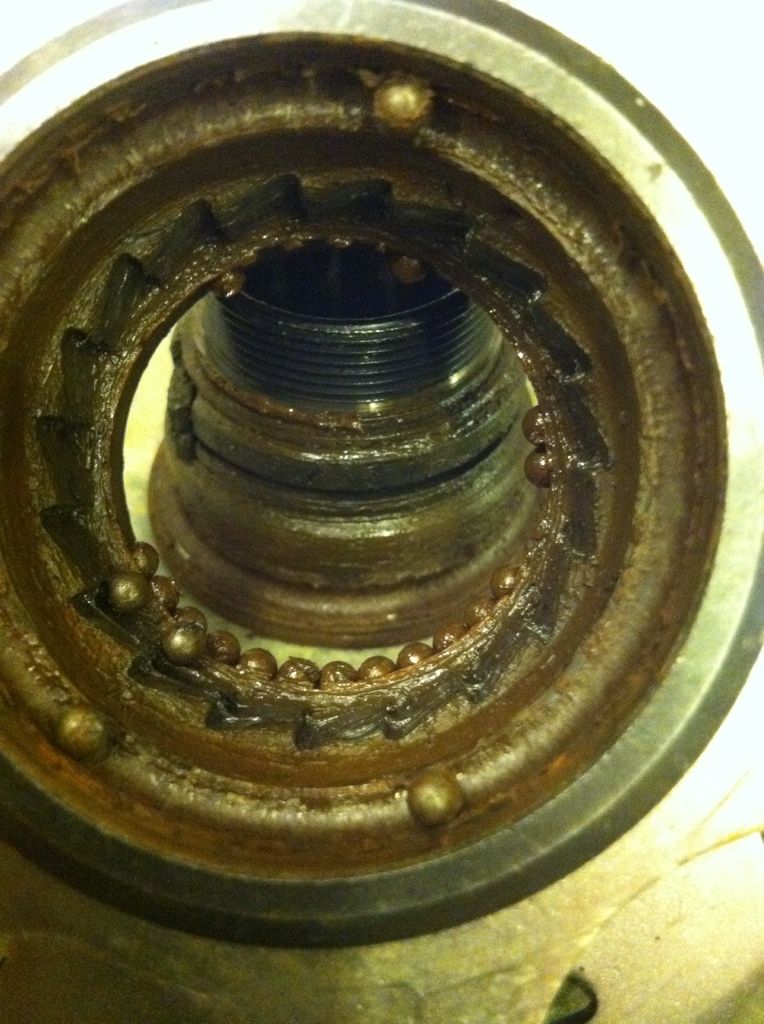
Do you think a few of my pictures might convince ramzilla that I do have the ability to "understand" how freewheels work? To keep this on topic, I'll only show pictures of a really nasty DA 7400 6 speed I was sent to service.
When I opened it up, this is what the internals looked like. Do you think flush and dribble would really clean this mess?
Admittedly, most would throw the above in the scrap metal bin, but the client wanted me to see what could be done. So I cleaned and removed as much of the dirt and corrosion as possible. Here it is ready for reassembly with fresh grease.
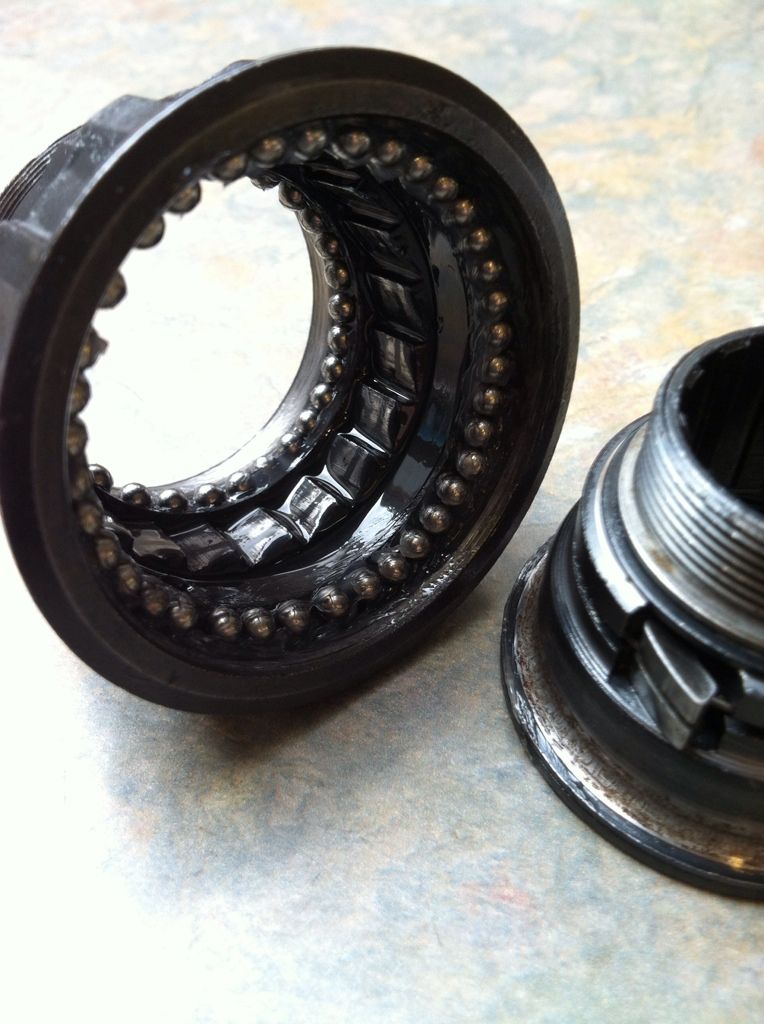
While the pawls and the ratchet teeth show some wear, they are far from being "toast" and they don't appear to be "stripped out."
So I stand by my earlier statement.
__________________
Bob
Enjoying the GA coast all year long!
Thanks for visiting my website: www.freewheelspa.com
Bob
Enjoying the GA coast all year long!
Thanks for visiting my website: www.freewheelspa.com
Last edited by pastorbobnlnh; 02-24-19 at 04:36 AM.
 02-23-19 | 07:35 AM
#33
Senior Member
Joined: Nov 2013
Posts: 2,400
Likes: 1,574
From: Near Pottstown, PA: 30 miles NW of Philadelphia
Bikes: 2 Trek Mtn, Cannondale R600 road, 6 vintage road bikes
. When I opened it up, this is what the internals looked like. Do you think flush and dribble would really clean this mess?
Admittedly, most would throw the above in the scrap metal bin, but the client wanted me to see what could be done. So I cleaned and removed as much of the dirt and corrosion as possible.
Admittedly, most would throw the above in the scrap metal bin, but the client wanted me to see what could be done. So I cleaned and removed as much of the dirt and corrosion as possible.
02-23-19 | 08:57 PM
#34

www.theheadbadge.com

Joined: Sep 2005
Posts: 29,019
Likes: 5,522
From: Southern Florida
Bikes: https://www.theheadbadge.com
Plus, [MENTION=396076]ramzilla[/MENTION]'s argument seems to be missing the OP's problem to begin with. The OP is encountering chain skip isolated to two cogs on the freewheel. This problem originates from excessive cog wear, often compounded by a new chain that isn't worn in to match the worn cogs (or, in the OP's case, compounded doubly by a new ultra narrow chain that may not want to play so nice on the older twisted Uniglide freewheel teeth.
Put simply, chain skip is irrelevant to a freewheel with malfunctioning pawls. Whether the pawls are stuck retracted or rusted to the hub body, it doesn't make a difference. Granted, you can't put enough load on a freewheel to test for chain skip when the pawls are stuck retracted, but if that were the case, we wouldn't be discussing chain skip, would we?
-Kurt
__________________


Last edited by cudak888; 02-23-19 at 09:02 PM.
02-26-19 | 12:21 PM
#37

Fillet-Brazed Member
Joined: Sep 2015
Posts: 488
Likes: 21
From: Brooklyn, New York
Bikes: ⊕
To piggy back on this, what do people recommend as replacement 5, 6, or 7 speed freewheels?
I'm not a fan of how the Shimano made-in-China ones look and feel compared to earlier Japan and Singapore made ones, or even better Suntour -- NOS can be hard to come by at a price I'd pay.
The new Shimano freewheels seem to work ok but the materials don't seem as sturdy. I wonder if they'll stand up as well as the older ones?
Also, my mechanic advised me to replace my freewheel when replacing my chain ... how would a freewheel overhaul affect this recommendation?
I'm not a fan of how the Shimano made-in-China ones look and feel compared to earlier Japan and Singapore made ones, or even better Suntour -- NOS can be hard to come by at a price I'd pay.
The new Shimano freewheels seem to work ok but the materials don't seem as sturdy. I wonder if they'll stand up as well as the older ones?
Also, my mechanic advised me to replace my freewheel when replacing my chain ... how would a freewheel overhaul affect this recommendation?
Last edited by specialmonkey; 02-26-19 at 12:27 PM.
02-26-19 | 01:24 PM
#38

Ride, Wrench, Swap, Race
Joined: Jan 2010
Posts: 9,819
Likes: 1,796
From: Northern California
Bikes: Cheltenham-Pedersen racer, Boulder F/S Paris-Roubaix, Varsity racer, '52 Christophe, '62 Continental, '92 Merckx, '75 Limongi, '76 Presto, '72 Gitane SC, '71 Schwinn SS, etc.
To piggy back on this, what do people recommend as replacement 5, 6, or 7 speed freewheels?
I'm not a fan of how the Shimano made-in-China ones look and feel compared to earlier Japan and Singapore made ones, or even better Suntour -- NOS can be hard to come by at a price I'd pay.
The new Shimano freewheels seem to work ok but the materials don't seem as sturdy. I wonder if they'll stand up as well as the older ones?
Also, my mechanic advised me to replace my freewheel when replacing my chain ... how would a freewheel overhaul affect this recommendation?
I'm not a fan of how the Shimano made-in-China ones look and feel compared to earlier Japan and Singapore made ones, or even better Suntour -- NOS can be hard to come by at a price I'd pay.
The new Shimano freewheels seem to work ok but the materials don't seem as sturdy. I wonder if they'll stand up as well as the older ones?
Also, my mechanic advised me to replace my freewheel when replacing my chain ... how would a freewheel overhaul affect this recommendation?
Cog teeth that are too worn to sustain pedaling loads when a new chain is installed can often be "dressed" with a 3/8" diameter rotary stone (i.e. Dremel).
The restoration process isn't intuitive, nor is the actual mechanism by which the chain fails to hold on worn cogs!
But it can be done. By removing the rearward-facing corners of the teeth above where the wear pocket resides!
By removing just a millimeter off the point, the chain rollers of the new chain can then fall into engagement without impacting the sharp corners under hard pedaling loads, thus allowing consistent full engagement of the chain's rollers between the cog's teeth.
Thus the true cause of the slippage (failure to engage) is remedied at the source of the problem, and the freewheel can be fixed without even removing it from the bike. Usually just one or two cogs even need the slight correcting.
This doesn't refer to cogs that have become "tombstoned" by a severely-worn chain, those are just "toast", and it doesn't always work in every other case, but it has saved many freewheels for me.
The Shimano freewheels were redesigned by what I would call the best drivetrain and mass-production specialists in the industry.
What looks cheap isn't necessarily the same as what comes up short in use.
The newer Shimano freewheels are the lightest ever (outside of the expensive alloy exotics), which carries a lot of "weight" among us traditional roadie cyclists.
Their only real shortcoming is that swapping cogs is now a thing of the past with the new design. But a new one costs less than $20.
02-26-19 | 02:08 PM
#39
Freewheel Medic
Joined: Oct 2005
Posts: 13,565
Likes: 3,308
From: An Island on the Coast of GA!
Bikes: Snazzy* Schwinns, Classy Cannondales & a Super Pro Aero Lotus (* Ed.)
IMHO, Sachs 6 and 7 speed freewheels are a great choice--- but their internals often need to be serviced because they were over greased in the first place, and the original grease often turns into a "peanut butter" like consistency.
Doing two things on an annual or more frequent basis will significantly increase the life of a freewheel. First, remove the freewheel from the hub and remove the sprockets from the freewheel body. Scrape off the encrusted crud and road grime, and scrub them with whatever you prefer, WD40, mineral spirits, Dawn dish detergent, etc. The cleaner you keep your sprockets the longer they will last.
The same is true for your chain. Remove it from the bike and clean it to look new or nearly new. Finish by lubing it off the bike, allowing the lube to penetrate the roller bearings. Finally wipe and clean as much of the lube off the external surfaces as possible. We want our chains to shed dirt, not retain it. They last significantly longer by cleaning them more often.
Just my two cents.
Doing two things on an annual or more frequent basis will significantly increase the life of a freewheel. First, remove the freewheel from the hub and remove the sprockets from the freewheel body. Scrape off the encrusted crud and road grime, and scrub them with whatever you prefer, WD40, mineral spirits, Dawn dish detergent, etc. The cleaner you keep your sprockets the longer they will last.
The same is true for your chain. Remove it from the bike and clean it to look new or nearly new. Finish by lubing it off the bike, allowing the lube to penetrate the roller bearings. Finally wipe and clean as much of the lube off the external surfaces as possible. We want our chains to shed dirt, not retain it. They last significantly longer by cleaning them more often.
Just my two cents.
__________________
Bob
Enjoying the GA coast all year long!
Thanks for visiting my website: www.freewheelspa.com
Bob
Enjoying the GA coast all year long!
Thanks for visiting my website: www.freewheelspa.com
02-26-19 | 02:24 PM
#40
Senior Member
Joined: Jan 2004
Posts: 6,169
Likes: 1,797
From: Madison, WI USA
Well, you can't overhaul the freewheel's cogs in the same sense that you can overhaul the body, but some will look at the body and cogs as separate items, not wedded to each other, so which can be swapped. But of course new freewheel cogs are not commonly found sold separately!
Cog teeth that are too worn to sustain pedaling loads when a new chain is installed can often be "dressed" with a 3/8" diameter rotary stone (i.e. Dremel).
The restoration process isn't intuitive, nor is the actual mechanism by which the chain fails to hold on worn cogs!
But it can be done. By removing the rearward-facing corners of the teeth above where the wear pocket resides!
By removing just a millimeter off the point, the chain rollers of the new chain can then fall into engagement without impacting the sharp corners under hard pedaling loads, thus allowing consistent full engagement of the chain's rollers between the cog's teeth.
Thus the true cause of the slippage (failure to engage) is remedied at the source of the problem, and the freewheel can be fixed without even removing it from the bike. Usually just one or two cogs even need the slight correcting.
This doesn't refer to cogs that have become "tombstoned" by a severely-worn chain, those are just "toast", and it doesn't always work in every other case, but it has saved many freewheels for me.
Cog teeth that are too worn to sustain pedaling loads when a new chain is installed can often be "dressed" with a 3/8" diameter rotary stone (i.e. Dremel).
The restoration process isn't intuitive, nor is the actual mechanism by which the chain fails to hold on worn cogs!
But it can be done. By removing the rearward-facing corners of the teeth above where the wear pocket resides!
By removing just a millimeter off the point, the chain rollers of the new chain can then fall into engagement without impacting the sharp corners under hard pedaling loads, thus allowing consistent full engagement of the chain's rollers between the cog's teeth.
Thus the true cause of the slippage (failure to engage) is remedied at the source of the problem, and the freewheel can be fixed without even removing it from the bike. Usually just one or two cogs even need the slight correcting.
This doesn't refer to cogs that have become "tombstoned" by a severely-worn chain, those are just "toast", and it doesn't always work in every other case, but it has saved many freewheels for me.
02-26-19 | 03:32 PM
#41
Ride, Wrench, Swap, Race
Joined: Jan 2010
Posts: 9,819
Likes: 1,796
From: Northern California
Bikes: Cheltenham-Pedersen racer, Boulder F/S Paris-Roubaix, Varsity racer, '52 Christophe, '62 Continental, '92 Merckx, '75 Limongi, '76 Presto, '72 Gitane SC, '71 Schwinn SS, etc.
I can't identify where my other posts on this subject can be found, but I did modify one sprocket for illustration purposes.
As shown, the cut is perhaps bigger than needed.
Observng the travel arc of the chain rollers as they engage the spaces between teeth, the angle of the cut would seem optimal at something slightly less than 45 degrees to the driven face of the tooth.
I've headed out of town to a ride start on more than one occasion only to realize within the first mile that the freewheel change I made the night before was causing the newer chain to skip on a particular cog. So I head straight back home, grab the Dremel with stone worn down to between 3/8 and 1/2" diameter, and cut the fifteen or so teeth on my porch in a couple of minutes. Headed back out, TT'd the 19 miles with NO skipping, and made the ride start with time still left for pre-ride coffee!
It's usually precious vintage freewheels that I am doing this to, since some ratios on these obsolete freewheels are of great value to my stock of freewheel spares.
The modified tooth on this little-worn cog is stamped ba, I did this hurriedly for illustration purpose only.
Does this look to you like what I tried to describe?

As shown, the cut is perhaps bigger than needed.
Observng the travel arc of the chain rollers as they engage the spaces between teeth, the angle of the cut would seem optimal at something slightly less than 45 degrees to the driven face of the tooth.
I've headed out of town to a ride start on more than one occasion only to realize within the first mile that the freewheel change I made the night before was causing the newer chain to skip on a particular cog. So I head straight back home, grab the Dremel with stone worn down to between 3/8 and 1/2" diameter, and cut the fifteen or so teeth on my porch in a couple of minutes. Headed back out, TT'd the 19 miles with NO skipping, and made the ride start with time still left for pre-ride coffee!
It's usually precious vintage freewheels that I am doing this to, since some ratios on these obsolete freewheels are of great value to my stock of freewheel spares.
The modified tooth on this little-worn cog is stamped ba, I did this hurriedly for illustration purpose only.
Does this look to you like what I tried to describe?
02-27-19 | 07:39 AM
#43
Fillet-Brazed Member
Joined: Sep 2015
Posts: 488
Likes: 21
From: Brooklyn, New York
Bikes: ⊕
The Shimano freewheels were redesigned by what I would call the best drivetrain and mass-production specialists in the industry.
What looks cheap isn't necessarily the same as what comes up short in use.
The newer Shimano freewheels are the lightest ever (outside of the expensive alloy exotics), which carries a lot of "weight" among us traditional roadie cyclists.
Their only real shortcoming is that swapping cogs is now a thing of the past with the new design. But a new one costs less than $20.
What looks cheap isn't necessarily the same as what comes up short in use.
The newer Shimano freewheels are the lightest ever (outside of the expensive alloy exotics), which carries a lot of "weight" among us traditional roadie cyclists.
Their only real shortcoming is that swapping cogs is now a thing of the past with the new design. But a new one costs less than $20.
That makes me feel better

Too bad they don't look as nice.
My mechanic friend said they don't last as long, but I guess they're consumables.
02-27-19 | 11:51 AM
#44
Freewheel Medic
Joined: Oct 2005
Posts: 13,565
Likes: 3,308
From: An Island on the Coast of GA!
Bikes: Snazzy* Schwinns, Classy Cannondales & a Super Pro Aero Lotus (* Ed.)
I can service modern Shimano freewheels. I have the tool which fits the lockring which holds the sprockets in place. Is it worth the time and money to do so? I guess it depends on each person's personal PM philosophy.
__________________
Bob
Enjoying the GA coast all year long!
Thanks for visiting my website: www.freewheelspa.com
Bob
Enjoying the GA coast all year long!
Thanks for visiting my website: www.freewheelspa.com
02-27-19 | 11:56 AM
#45
Junior Member

Joined: Oct 2017
Posts: 144
Likes: 23
I was also uninspired by the aesthetics of a Shimano freewheel I bought last year. I got a quality, black, 2 sided permanent marker, cleaned the surface area and colored all the white writing in. Now it's invisible and has lasted a year with no chipping or fading. A clear coat on top of the marker really isn't necessary.
Now it looks just like any other freewheel, and the 14-28 6 speed is lighter than most old 14/21 5 speeds.
Now it looks just like any other freewheel, and the 14-28 6 speed is lighter than most old 14/21 5 speeds.

