


Why are modern components black?
 01-31-20 | 10:20 PM
#26


feros ferio

Joined: Jul 2000
Posts: 22,397
Likes: 1,864
From: www.ci.encinitas.ca.us
Bikes: 1959 Capo Modell Campagnolo; 1960 Capo Sieger (2); 1962 Carlton Franco Suisse; 1970 Peugeot UO-8; 1982 Bianchi Campione d'Italia; 1988 Schwinn Project KOM-10;
"Black is the color of my true love's hair," or, as the Smothers Brothers sang it, "Black is the color of my love's true hair."
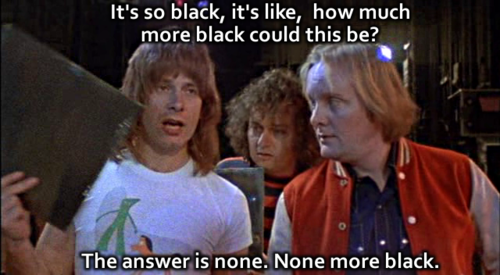
Black is the new silver.
Black is the new silver.
__________________
"Far and away the best prize that life offers is the chance to work hard at work worth doing." --Theodore Roosevelt
Capo: 1959 Modell Campagnolo, S/N 40324; 1960 Sieger (2), S/N 42624, 42597
Carlton: 1962 Franco Suisse, S/N K7911
Peugeot: 1970 UO-8, S/N 0010468
Bianchi: 1982 Campione d'Italia, S/N 1.M9914
Schwinn: 1988 Project KOM-10, S/N F804069
"Far and away the best prize that life offers is the chance to work hard at work worth doing." --Theodore Roosevelt
Capo: 1959 Modell Campagnolo, S/N 40324; 1960 Sieger (2), S/N 42624, 42597
Carlton: 1962 Franco Suisse, S/N K7911
Peugeot: 1970 UO-8, S/N 0010468
Bianchi: 1982 Campione d'Italia, S/N 1.M9914
Schwinn: 1988 Project KOM-10, S/N F804069



 01-31-20 | 11:05 PM
#29

Senior Member


Joined: Nov 2015
Posts: 4,900
Likes: 1,125
My nephew's new, utra modern, top of the line Canyon, is all full carbon fiber black. Everything on it is dull black!.....just Blaaahhhhk!
I think he might agree with me unconsciously, as I haven't seen him ride it for many months now. It's turning into an expensive garage queen. Unlike the Giant he had that was painted white and red that he rode almost every day, after he got home from work......
I think he might agree with me unconsciously, as I haven't seen him ride it for many months now. It's turning into an expensive garage queen. Unlike the Giant he had that was painted white and red that he rode almost every day, after he got home from work......
__________________
72 Line Seeker
83 Davidson Signature
84 Peugeot PSV
84 Peugeot PY10FC
84 Gitane Tour de France.
85 Vitus Plus Carbone 7
86 ALAN Record Carbonio
86 Medici Aerodynamic (Project)
88 Pinarello Montello
89 Bottecchia Professional Chorus SL
95 Trek 5500 OCLV (Project)
72 Line Seeker
83 Davidson Signature
84 Peugeot PSV
84 Peugeot PY10FC
84 Gitane Tour de France.
85 Vitus Plus Carbone 7
86 ALAN Record Carbonio
86 Medici Aerodynamic (Project)
88 Pinarello Montello
89 Bottecchia Professional Chorus SL
95 Trek 5500 OCLV (Project)
01-31-20 | 11:35 PM
#30

Sunshine
Joined: Aug 2014
Posts: 18,699
Likes: 10,236
From: Des Moines, IA
Bikes: '18 class built steel roadbike, '19 Fairlight Secan, '88 Schwinn Premis , Black Mountain Cycles Monstercross V4, '89 Novara Trionfo
Black wheelset, drivetrain, and cockpit all mated to a frame with a great paint scheme(most any AllCity in the last few years) is an absolutely awesome look.
Cant say there is anything lacking.
Cant say there is anything lacking.
02-01-20 | 12:52 AM
#31

Senior Member

Joined: Oct 2014
Posts: 14,153
Likes: 5,275
From: Portland, OR
Bikes: (2) ti TiCycles, 2007 w/ triple and 2011 fixed, 1979 Peter Mooney, ~1983 Trek 420 now fixed and ~1973 Raleigh Carlton Competition gravel grinder
02-01-20 | 12:54 AM
#32
Senior Member
Joined: Oct 2014
Posts: 14,153
Likes: 5,275
From: Portland, OR
Bikes: (2) ti TiCycles, 2007 w/ triple and 2011 fixed, 1979 Peter Mooney, ~1983 Trek 420 now fixed and ~1973 Raleigh Carlton Competition gravel grinder
02-01-20 | 01:09 AM
#33

Senior Member


Joined: Nov 2014
Posts: 27,576
Likes: 5,451
From: Eugene, Oregon, USA
Bright Shiny Chrome is so 1950's.... 
The black may have been coming for a while, but it certainly became popular with the carbon fiber bikes and carbon fiber components.
Campagnolo, of course, has carbon fiber brake levers, carbon fiber cranks, and carbon fiber derailleurs in their top of the line components. Black just goes well with those.
And, for lower quality components. Plastic instead of carbon fiber... still black, and largely mimicking the carbon (and plastic generally doesn't mimic aluminum/chrome well). Then for aluminum cranks & etc... still black like the Record/Super Record.
The black may have been coming for a while, but it certainly became popular with the carbon fiber bikes and carbon fiber components.
Campagnolo, of course, has carbon fiber brake levers, carbon fiber cranks, and carbon fiber derailleurs in their top of the line components. Black just goes well with those.
And, for lower quality components. Plastic instead of carbon fiber... still black, and largely mimicking the carbon (and plastic generally doesn't mimic aluminum/chrome well). Then for aluminum cranks & etc... still black like the Record/Super Record.
02-01-20 | 02:23 AM
#34
Full Member
Joined: Apr 2012
Posts: 400
Likes: 73
Mick remote viewing an LBS 50 years in the future:
"I see a line of bikes and they're all painted black,
No matter anyway, the frames are doomed to crack...."
Granted, a few of my C&V bikes have black components, and were spec'ed that way. But at least back then, there was some choice, some variety. All the more reason not to want modern kit on your old bike.
"I see a line of bikes and they're all painted black,
No matter anyway, the frames are doomed to crack...."
Granted, a few of my C&V bikes have black components, and were spec'ed that way. But at least back then, there was some choice, some variety. All the more reason not to want modern kit on your old bike.


 02-01-20 | 02:52 AM
#36
Senior Member

Joined: Nov 2004
Posts: 23,212
Likes: 3,122
Bicycles were goth in the early 1940s, 40 years before it became a persona statement. World War II pushed the industry into dark, dull finishes both to reduce reflectivity and to preserve nickel and chromium supplies for the war effort.
Going back even further, to the early days of cycling, most of the velocipedes and hi-wheelers had components with painted black finish. Bright plated finishes didn't become common until after the commercialization of an economical nickel plating process, which roughly coincided with the introduction of safety bicycles. However, rims, when steel, continued to be painted black or colour matched to the frame. Plated steel rims didn't start becoming popular until the industry started moving to the new chrome plating in the 1930s. Even then, painted rims were a common cost concession on many coaster brake bicycles well into the 1950s and children's bicycles continue to use primarily painted rims to this day.
Edit: While there was a small movement towards black anodization of road components in the mid-1970s, there was a more significant move to black on ATB components in the early 1990s. The rationale was that black components looked better than silver, when dirty.
Going back even further, to the early days of cycling, most of the velocipedes and hi-wheelers had components with painted black finish. Bright plated finishes didn't become common until after the commercialization of an economical nickel plating process, which roughly coincided with the introduction of safety bicycles. However, rims, when steel, continued to be painted black or colour matched to the frame. Plated steel rims didn't start becoming popular until the industry started moving to the new chrome plating in the 1930s. Even then, painted rims were a common cost concession on many coaster brake bicycles well into the 1950s and children's bicycles continue to use primarily painted rims to this day.
Edit: While there was a small movement towards black anodization of road components in the mid-1970s, there was a more significant move to black on ATB components in the early 1990s. The rationale was that black components looked better than silver, when dirty.
Last edited by T-Mar; 02-01-20 at 03:01 AM.
02-01-20 | 04:07 AM
#37
Senior Member
Joined: Nov 2004
Posts: 23,212
Likes: 3,122
My recollection is the very late 1980s move to painted components started upscale and trickled down. Shimano Santé broke the ice with its mini-group in 1987. Nestled in between 600 and Dura-Ace, pearl white with grey was chosen for the finish. It was designed for the yuppie market and aesthetics was the high priority. The colour combination was considered the most favourable match for the intended market and the Miami Vice influenced, pastel, frame colours that were popular at the time. Cost was a secondary benefit. The painted finish was trickled down to 600 Ultegra and other lower groups for the 1988 model year, in various shades of silver, grey and black.
02-01-20 | 08:54 AM
#38
Senior Member
Joined: Jan 2004
Posts: 6,169
Likes: 1,797
From: Madison, WI USA
02-01-20 | 09:35 AM
#39
Senior Member
Joined: Dec 2015
Posts: 1,951
Likes: 1,239
From: Menomonee Falls, WI
Bikes: 1984 Schwinn Supersport, 1988 Trek 400T, 1977 Trek TX900, 1982 Bianchi Champione del Mondo, 1978 Raleigh Supercourse, 1986 Trek 400 Elance, 1991 Waterford PDG OS Paramount, 1971 Schwinn Sports Tourer, 1985 Trek 670
I like black, but only on my tires, saddles, and sometimes bar tape.
Tim
Tim
02-01-20 | 10:46 AM
#40
Senior Member
Joined: Oct 2015
Posts: 6,280
Likes: 611
From: Los Angeles
Bikes: 78 Masi Criterium, 68 PX10, 2016 Mercian King of Mercia, Rivendell Clem Smith Jr
My recollection is the very late 1980s move to painted components started upscale and trickled down. Shimano Santé broke the ice with its mini-group in 1987. Nestled in between 600 and Dura-Ace, pearl white with grey was chosen for the finish. It was designed for the yuppie market and aesthetics was the high priority. The colour combination was considered the most favourable match for the intended market and the Miami Vice influenced, pastel, frame colours that were popular at the time. Cost was a secondary benefit. The painted finish was trickled down to 600 Ultegra and other lower groups for the 1988 model year, in various shades of silver, grey and black.
After a bit of puzzling, I concluded that it was likely that the point of the Santé group was to be a test case for painting instead of polishing. Shimano really needed to introduce it at the high end to avoid the cheap stigma that would have existed if they had introduced it at the low end. Note that painted finish was migrated down the line very quickly. Also, for the MTB component groups, they stuck to silver clear anodized for the higher end Deore, while introducing paint for the mid to low end.
02-01-20 | 12:12 PM
#41
Full Member
Joined: Apr 2012
Posts: 400
Likes: 73
02-01-20 | 01:58 PM
#42

Extraordinary Magnitude

Joined: Aug 2009
Posts: 14,080
Likes: 2,134
From: Waukesha WI
Bikes: 1978 Trek TX700; 1978/79 Trek 736; 1984 Specialized Stumpjumper Sport; 1984 Schwinn Voyageur SP; 1985 Trek 620; 1985 Trek 720; 1986 Trek 400 Elance; 1987 Schwinn High Sierra; 1990 Miyata 1000LT
Robert Smith disapproves of your message.
__________________
*Recipient of the 2006 Time Magazine "Person Of The Year" Award*
Commence to jigglin’ huh?!?!
"But hey, always love to hear from opinionated amateurs." -says some guy to Mr. Marshall.
Commence to jigglin’ huh?!?!
"But hey, always love to hear from opinionated amateurs." -says some guy to Mr. Marshall.
 02-01-20 | 07:45 PM
#44
Senior Member
Joined: Aug 2010
Posts: 1,941
Likes: 271
From: south kansas america
Bikes: too many
Chrome and mirrored polished surfaces started diminishing within the realm of consumer products back in the late 70's and 80's. Chrome finishes became harder to produce, because of the new environmental concerns surround it. Polished finishes were directly linked to the labor required to obtain them. So, silver and black finishes started to ebb there way into the arenas where chrome/polish had once been... automobiles, furniture, electronic consumer goods, etc. Black, always associated with formality and culture... think tuxedos, cocktail dresses, and Sunday shoes, seemed like a likely substitution choice.
I also think that our society is more market research driven now, and trends created within a market research environment tend to be self fulfilling. When Ken Consumer buys a black component bicycle, market research trends that to "Ken Consumers LIKE black component bicycles", and given that somewhat misread conclusion, the manufacturers gear up to make even more black components for bicycles. It takes someone who understands the consumer better than it understands itself, to break away from an entrenched trend. Case in point... I remember reading an article from around 2007, in Bicycling magazine, comparing 5 bicycles in the $1K cost range... each of the competitor's bikes in the comparison had dull flat finishes with white/grey/red logo schemes.
Black is a very hard color to match, sheen wise, and thus, I think the "it's scratched... and looks used" design obsolescence argument has some validity.
I also think that our society is more market research driven now, and trends created within a market research environment tend to be self fulfilling. When Ken Consumer buys a black component bicycle, market research trends that to "Ken Consumers LIKE black component bicycles", and given that somewhat misread conclusion, the manufacturers gear up to make even more black components for bicycles. It takes someone who understands the consumer better than it understands itself, to break away from an entrenched trend. Case in point... I remember reading an article from around 2007, in Bicycling magazine, comparing 5 bicycles in the $1K cost range... each of the competitor's bikes in the comparison had dull flat finishes with white/grey/red logo schemes.
Black is a very hard color to match, sheen wise, and thus, I think the "it's scratched... and looks used" design obsolescence argument has some validity.
02-01-20 | 08:32 PM
#45
Senior Member

Joined: Jan 2019
Posts: 528
Likes: 84
Well Shimano was in Japan making anodized aluminum parts and still mostly chroming their low end stuff except for the rare black skylark, and making Black DA in 1975 or so, as an alternative option to plain polished. Shimano still offers stuff in (bad) chrome on the low end, polished and anodized alumium, and painted. With the introduction of SIS across the Shimano lineup, you start to see painted accent pieces, not just in Sante. Whatever alternative theories there are, I'm thinking some people just liked black.
Steel parts are cheap to paint instead of plate, but quality steel parts are plated because paint wears down and exposes steel to rust at pivots much more easily. Paint also doesn't stick to chromed steel that well. It's not really surprising that after companies moved away from chromed steel on their high end products and aluminum was commonly adopted as a material that they started playing with adding color to parts to stand out, since it didn't need plating, anodizing can be colored, and paint adheres to aluminum well.
Steel parts are cheap to paint instead of plate, but quality steel parts are plated because paint wears down and exposes steel to rust at pivots much more easily. Paint also doesn't stick to chromed steel that well. It's not really surprising that after companies moved away from chromed steel on their high end products and aluminum was commonly adopted as a material that they started playing with adding color to parts to stand out, since it didn't need plating, anodizing can be colored, and paint adheres to aluminum well.
02-02-20 | 01:34 PM
#46

señor miembro
Joined: Dec 2018
Posts: 3,510
Likes: 8,865
From: Pac NW
Bikes: '70s - '80s Campagnolo
02-03-20 | 12:50 PM
#47
Member
Joined: Sep 2019
Posts: 26
Likes: 3
With the automotive reference, I think my love of silver components and dislike of black might go back to the automotive customization days when machined and polished aluminum accessories ("billet") were all the rage.....and really looked great. A current auto based example would, in my opinion, be black aftermarket wheels vs silver/machined. They disappear.....you cannot easily see the design. Same to me for black bike components. You cannot easily see the shapes and designs that are part of the visual appeal.
02-03-20 | 01:03 PM
#48

Newbie
Joined: Jul 2010
Posts: 35
Likes: 5
Bikes: Daylight ARC c1 XXL 20", Surly Big Dummy, Meybo HSX cruiser
Well, you hit on one of my peeves here. As others have said, it’s cheaper to paint or anodize black than to polish. And it’s a lowest common denominator thing. BORING!
I’ve made compromises in other spheres (getting previous generation hi-fi speakers to get blonde wood, previous generation flat screen TV to get white), but I mostly refuse to stoop to black components on my favorite bikes...
Black is not a designer color. It’s just lazy.
I’ve made compromises in other spheres (getting previous generation hi-fi speakers to get blonde wood, previous generation flat screen TV to get white), but I mostly refuse to stoop to black components on my favorite bikes...
Black is not a designer color. It’s just lazy.
02-03-20 | 03:23 PM
#49

Senior Member
Joined: Aug 2011
Posts: 464
Likes: 36
From: Fort Wayne, IN
Bikes: No. 22 Bicycle Great Divide, Lynskey R260, Salsa Colossal Ti, Litespeed T5, Lynskey Peloton, Bianchi Vigorelli, CAAD 10, Giant FastRoad CoMax 1, C-Dale Quick 1
Why are hifi components black? Why are so many cars black these days? I trace this whole "black is the new silver" thing back to Darth Vader. When he appeared, black suddenly became cool. I think it's been way overdone though. The biggest problem with black is that the second it gets dirty it looks terrible.