


Do you trust brazed on eyelets?
 07-16-20 | 03:04 PM
#51
Randomhead
Joined: Aug 2008
Posts: 25,930
Likes: 4,825
From: Happy Valley, Pennsylvania
I think you will be disappointed, but maybe there are engineering schools that are different than Penn State. Although I suspect you are familiar with not being able to get any work done without a charge number. All the bicycle related experiments that I have thought about doing would require enough specialized mounting that I haven't pursued it. I sometimes wish some of the machines I built were still around, lots of potential there for bike experiments. But we needed the room, so they are gone.
Although taking a hammer to some eyelets is pretty interesting, so I might go ahead and do that.
One thing I found in one of my fatigue experiments is that having loose bolts leads to early failures. I never did too much work on that, but I did find some literature about it that agreed. Unfortunately, I haven't been able to find that paper again. But if there is any constant on rack mounting, it's that people often fail to tighten rack bolts enough and they come loose. So any time you hit a bump, there is a big impact. This isn't good for the frame, bolt or the rack.
Okay, so there have been people that looked at it https://www.google.com/search?q=loos...hrome&ie=UTF-8
Although taking a hammer to some eyelets is pretty interesting, so I might go ahead and do that.
One thing I found in one of my fatigue experiments is that having loose bolts leads to early failures. I never did too much work on that, but I did find some literature about it that agreed. Unfortunately, I haven't been able to find that paper again. But if there is any constant on rack mounting, it's that people often fail to tighten rack bolts enough and they come loose. So any time you hit a bump, there is a big impact. This isn't good for the frame, bolt or the rack.
Okay, so there have been people that looked at it https://www.google.com/search?q=loos...hrome&ie=UTF-8
 07-16-20 | 05:40 PM
#52

Senior Member


Joined: Jun 2018
Posts: 1,849
Likes: 724
From: The Urban Shores Of Michigami
Bikes: ........................................ .....Holdsworth "Special"..... .......Falcon "Special".......... .........Miyata 912........... ........................................
A wood glue joint is often stronger than the wood itself. Is this also true for a brazed joint?
07-16-20 | 09:49 PM
#53

Bike Butcher of Portland

Joined: Jul 2014
Posts: 12,493
Likes: 8,061
From: Portland, OR
Bikes: It's complicated.
I think you will be disappointed, but maybe there are engineering schools that are different than Penn State. Although I suspect you are familiar with not being able to get any work done without a charge number. All the bicycle related experiments that I have thought about doing would require enough specialized mounting that I haven't pursued it. I sometimes wish some of the machines I built were still around, lots of potential there for bike experiments. But we needed the room, so they are gone.
Although taking a hammer to some eyelets is pretty interesting, so I might go ahead and do that.
One thing I found in one of my fatigue experiments is that having loose bolts leads to early failures. I never did too much work on that, but I did find some literature about it that agreed. Unfortunately, I haven't been able to find that paper again. But if there is any constant on rack mounting, it's that people often fail to tighten rack bolts enough and they come loose. So any time you hit a bump, there is a big impact. This isn't good for the frame, bolt or the rack.
Okay, so there have been people that looked at it https://www.google.com/search?q=loos...hrome&ie=UTF-8
Although taking a hammer to some eyelets is pretty interesting, so I might go ahead and do that.
One thing I found in one of my fatigue experiments is that having loose bolts leads to early failures. I never did too much work on that, but I did find some literature about it that agreed. Unfortunately, I haven't been able to find that paper again. But if there is any constant on rack mounting, it's that people often fail to tighten rack bolts enough and they come loose. So any time you hit a bump, there is a big impact. This isn't good for the frame, bolt or the rack.
Okay, so there have been people that looked at it https://www.google.com/search?q=loos...hrome&ie=UTF-8
__________________
If someone tells you that you have enough bicycles and you don't need any more, stop talking to them. You don't need that kind of negativity in your life.
If someone tells you that you have enough bicycles and you don't need any more, stop talking to them. You don't need that kind of negativity in your life.
07-16-20 | 09:59 PM
#54
Senior Member
Joined: Jun 2019
Posts: 1,063
Likes: 537
From: Portland Oregon
For my first attempt at brazing I brazed a canti stud to an old chain stay, and then I tried to remove it with a large hammer, the chain stay ended up a mangled mess and the canti stud was never failed in any way at all.
Also, brass can be built up to a fairly large fillet, or it can be be a very small fillet, how much brass is used will affect the strength. For my canti stud destructive testing the fillet was actually pretty minimal.
Also, brass can be built up to a fairly large fillet, or it can be be a very small fillet, how much brass is used will affect the strength. For my canti stud destructive testing the fillet was actually pretty minimal.
07-17-20 | 09:54 AM
#55
Senior Member
Joined: Oct 2015
Posts: 6,280
Likes: 612
From: Los Angeles
Bikes: 78 Masi Criterium, 68 PX10, 2016 Mercian King of Mercia, Rivendell Clem Smith Jr
This thread has moved in some new and interesting directions.
I have pretty limited brazing experience. It is limited to doing some simple repairs, ie replacing dropouts, in the back of one of the bike shops where I used to work. One of the other mechanics there who was also a framebuilder taught me. What I remember from this is that most failures from brazing are likely to be the result of insufficient cleaning, not enough flux, etc. The actual brass is pretty strong, especially with a good fillet. I'd be interested to see what fails first in some destructive testing too. As I already pointed out, I think part of the reason I never ran across a broken eyelet in the old days is that the racks would break before the eyelet. Perhaps the answer to this question then is, yes, brazed on eyelets are fine, just be sure and use a Pletscher rack with them. Also, probably most people that toured used bikes with forged on eyelets for the rack, and knew which eyelet to use.
I also remember my Blackburn rack as being pretty tough. Hard to imagine breaking it. I wonder if the original flavor Blackburns were heat treated? Mine was the old original style non-adjustable type. It would have been very easy to bring the cost down by not heat treating at some point. None would have been the wise, and production cost would go way down, but the racks would be ~ half as strong.
For sure. In fact I wanted to get up to the PNW this summer to visit some old friends, but given the situation, it's going to have to wait till next year. Also, As I Recall more Correctly, I think I added about a day per decade to that tour, much like how fast I was BITD  , but it was still around 3 weeks. We burned up a couple bottles of fuel.
I have pretty limited brazing experience. It is limited to doing some simple repairs, ie replacing dropouts, in the back of one of the bike shops where I used to work. One of the other mechanics there who was also a framebuilder taught me. What I remember from this is that most failures from brazing are likely to be the result of insufficient cleaning, not enough flux, etc. The actual brass is pretty strong, especially with a good fillet. I'd be interested to see what fails first in some destructive testing too. As I already pointed out, I think part of the reason I never ran across a broken eyelet in the old days is that the racks would break before the eyelet. Perhaps the answer to this question then is, yes, brazed on eyelets are fine, just be sure and use a Pletscher rack with them. Also, probably most people that toured used bikes with forged on eyelets for the rack, and knew which eyelet to use.
I also remember my Blackburn rack as being pretty tough. Hard to imagine breaking it. I wonder if the original flavor Blackburns were heat treated? Mine was the old original style non-adjustable type. It would have been very easy to bring the cost down by not heat treating at some point. None would have been the wise, and production cost would go way down, but the racks would be ~ half as strong.
, but it was still around 3 weeks. We burned up a couple bottles of fuel.
07-20-20 | 03:54 PM
#56
Senior Member
Joined: Jan 2017
Posts: 659
Likes: 211
As a frame builder I would not use a braze-on eyelet on a dropout to support a rear rack. What has unfortunately happened in the past was that when the loaded rear rack fell over and the panniers (or tent or whatever) hit something on the way down, the braze-on was not strong enough to stay on the dropout. The force broke off the eyelet. This was an eyelet properly brazed with brass (actually bronze but American builders say brass) and in addition a little miter was filed into the dropout to give additional support and contact area. Even if the rear rack is not usually loaded down so the strength would be more than enough, the possibility exists that someone might make a grocery run and - especially if it is only loaded on one side - the bike may tip over and the force of the fall with the extra weight will break off the eyelet.
What I do if the dropout already has one eyelet is put the rack on that one and the fender on the braze-on eyelet. If the dropout has no eyelets I put a water bottle boss as close as possible to the dropout to hold the rack strut and braze-on on eyelet on the dropout for fenders.
What I do if the dropout already has one eyelet is put the rack on that one and the fender on the braze-on eyelet. If the dropout has no eyelets I put a water bottle boss as close as possible to the dropout to hold the rack strut and braze-on on eyelet on the dropout for fenders.
07-20-20 | 05:11 PM
#57

Senior Member

Joined: Sep 2010
Posts: 8,327
Likes: 1,112
From: Roswell, GA
Bikes: '93 Trek 750, '92 Schwinn Crisscross, '93 Mongoose Alta
Files + patience are a very under-rated combination.
 07-20-20 | 05:37 PM
#58

Senior Member

Joined: Oct 2014
Posts: 14,192
Likes: 5,328
From: Portland, OR
Bikes: (2) ti TiCycles, 2007 w/ triple and 2011 fixed, 1979 Peter Mooney, ~1983 Trek 420 now fixed and ~1973 Raleigh Carlton Competition gravel grinder
 My '73 Competition. Brazed on bits being the DT shifter stop (I saw the lack of braze underneath and had further investigation done) and bits like the main tubes to the corresponding lugs. Little stuff like that. Dave Levy worked in braze like it was a freshly jigged frame. Also found a couple of cracked tubes - at the lugs. Said the paint held it together.
07-20-20 | 06:02 PM
My '73 Competition. Brazed on bits being the DT shifter stop (I saw the lack of braze underneath and had further investigation done) and bits like the main tubes to the corresponding lugs. Little stuff like that. Dave Levy worked in braze like it was a freshly jigged frame. Also found a couple of cracked tubes - at the lugs. Said the paint held it together.
07-20-20 | 06:02 PM
#59
Bike Butcher of Portland
Joined: Jul 2014
Posts: 12,493
Likes: 8,061
From: Portland, OR
Bikes: It's complicated.
For my first attempt at brazing I brazed a canti stud to an old chain stay, and then I tried to remove it with a large hammer, the chain stay ended up a mangled mess and the canti stud was never failed in any way at all.
Also, brass can be built up to a fairly large fillet, or it can be be a very small fillet, how much brass is used will affect the strength. For my canti stud destructive testing the fillet was actually pretty minimal.
Also, brass can be built up to a fairly large fillet, or it can be be a very small fillet, how much brass is used will affect the strength. For my canti stud destructive testing the fillet was actually pretty minimal.
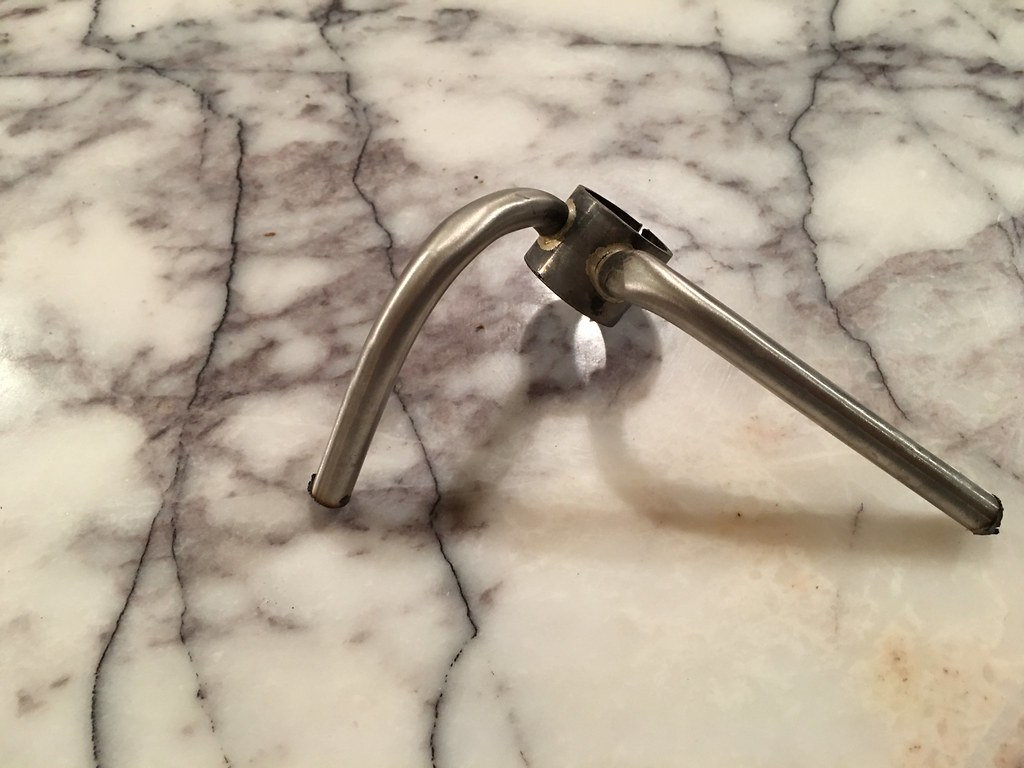
If you look closely, even though the one on the right didn't break off, there's a crack in the braze. I tightened up interface hole, did a few more, now I'm satisfied that the design, properly executed is stronger than it needs to be.
__________________
If someone tells you that you have enough bicycles and you don't need any more, stop talking to them. You don't need that kind of negativity in your life.
If someone tells you that you have enough bicycles and you don't need any more, stop talking to them. You don't need that kind of negativity in your life.
07-20-20 | 08:17 PM
#60
Senior Member
Joined: Jun 2019
Posts: 1,063
Likes: 537
From: Portland Oregon
You did end up with a crack in the brass on one of those joints but you really had to beat on it to get that to happen, its crazy how strong such a small amount of brass is!
07-21-20 | 12:40 PM
#61
Randomhead
Joined: Aug 2008
Posts: 25,930
Likes: 4,825
From: Happy Valley, Pennsylvania
Okay, I did a two part experiment on this. Let's just say I'm not going to be using any brazed on eyelets for rack mount use. Hourglass or bottle cage mounts should be fine. The eyelets I used are thick, so bending them would be pretty difficult.
I had a piece of angle iron and brazed on two eyelets. One was just cleaned up, no filing. The other, I filed a shallow groove. I held the other leg of the angle iron and beat on the eyelets on their sides. They both broke off with a few hits, not really that much difference, 4 or 5 maybe?. Then I noticed there wasn't full penetration on the grooved one, so I brazed another eyelet in the groove (should go find the two first victims). This time the eyelet bent over fairly far before it broke off.
My conclusion is you need more surface area.
Having said all this, most eyelets would never see loading like this and would work fine for years. Unless it got hit wrong.
I had a piece of angle iron and brazed on two eyelets. One was just cleaned up, no filing. The other, I filed a shallow groove. I held the other leg of the angle iron and beat on the eyelets on their sides. They both broke off with a few hits, not really that much difference, 4 or 5 maybe?. Then I noticed there wasn't full penetration on the grooved one, so I brazed another eyelet in the groove (should go find the two first victims). This time the eyelet bent over fairly far before it broke off.
My conclusion is you need more surface area.
Having said all this, most eyelets would never see loading like this and would work fine for years. Unless it got hit wrong.
07-21-20 | 01:19 PM
#62
Senior Member
Joined: Oct 2015
Posts: 6,280
Likes: 612
From: Los Angeles
Bikes: 78 Masi Criterium, 68 PX10, 2016 Mercian King of Mercia, Rivendell Clem Smith Jr
Thanks guys for taking the time to do actual destructive testing. Real world tests are more valuable than theory alone.
I suspect building up a large and non traditional level of brass fillet would enhance the strength of a brazed on eyelet, if one were to needed to carry a rack. It's pretty easy to break stuff in shear.
I suspect building up a large and non traditional level of brass fillet would enhance the strength of a brazed on eyelet, if one were to needed to carry a rack. It's pretty easy to break stuff in shear.
07-21-20 | 01:49 PM
#63
Bike Butcher of Portland
Joined: Jul 2014
Posts: 12,493
Likes: 8,061
From: Portland, OR
Bikes: It's complicated.
Okay, I did a two part experiment on this. Let's just say I'm not going to be using any brazed on eyelets for rack mount use. Hourglass or bottle cage mounts should be fine. The eyelets I used are thick, so bending them would be pretty difficult.
I had a piece of angle iron and brazed on two eyelets. One was just cleaned up, no filing. The other, I filed a shallow groove. I held the other leg of the angle iron and beat on the eyelets on their sides. They both broke off with a few hits, not really that much difference, 4 or 5 maybe?. Then I noticed there wasn't full penetration on the grooved one, so I brazed another eyelet in the groove (should go find the two first victims). This time the eyelet bent over fairly far before it broke off.
My conclusion is you need more surface area.
Having said all this, most eyelets would never see loading like this and would work fine for years. Unless it got hit wrong.
I had a piece of angle iron and brazed on two eyelets. One was just cleaned up, no filing. The other, I filed a shallow groove. I held the other leg of the angle iron and beat on the eyelets on their sides. They both broke off with a few hits, not really that much difference, 4 or 5 maybe?. Then I noticed there wasn't full penetration on the grooved one, so I brazed another eyelet in the groove (should go find the two first victims). This time the eyelet bent over fairly far before it broke off.
My conclusion is you need more surface area.
Having said all this, most eyelets would never see loading like this and would work fine for years. Unless it got hit wrong.
__________________
If someone tells you that you have enough bicycles and you don't need any more, stop talking to them. You don't need that kind of negativity in your life.
If someone tells you that you have enough bicycles and you don't need any more, stop talking to them. You don't need that kind of negativity in your life.
