


An experiment with "Looking-Glass" paint
 09-15-20 | 09:09 AM
#1
Thread Starter
Senior Member


Joined: Feb 2020
Posts: 4,039
Likes: 2,356
An experiment with "Looking-Glass" paint
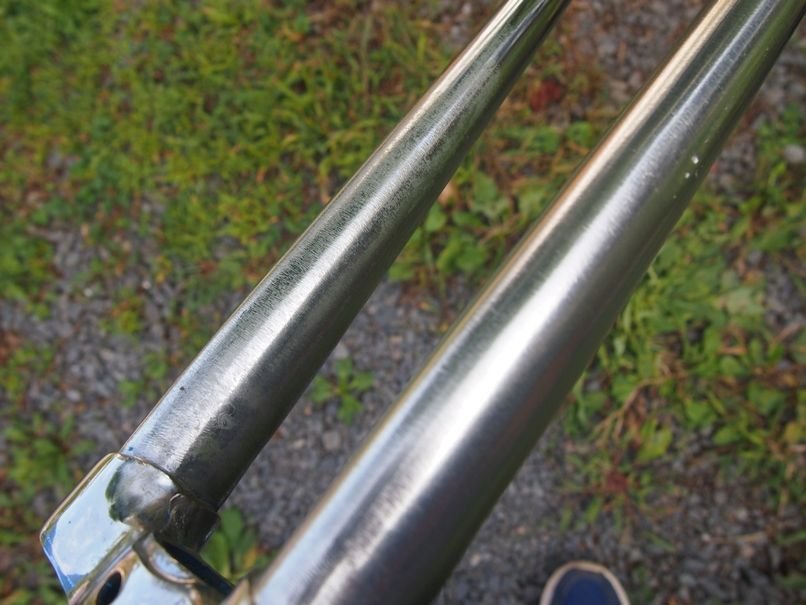
I'm working on a 1970-ish Torpado, stripping the paint. The frame is chrome, but part of it is not as polished as the rest - it had an opaque paint scheme with the bare parts polished. The fork was stripped first, and the under-paint section was not really as nice as could be wished, so I tried a special paint. This is the Testors "Looking Glass" paint, and for my purposes it works well enough.
What you're supposed to do with this stuff is spray it on the back side of something clear, 5 very light coats 1 minute apart, and then from the other side you get a mirror effect. Videos on the net make it clear it isn't a mirror, but it's not bad.
What I wanted it to do was minimize the scratchy effect that lack-of-polishing plus time had wrought on the fork upper. I left a mask line straight across the crown, which was polished and had pretty good chrome. I'm happy with this, and the next step is to try a candy-over-coat - et voila, chromovelato. Italians all speak french, don't they?
Painted left, unpainted right - forks are upside-down in the first pic (so painted is closer to camera).:
The mask line:

Another comparison:

Where the polishing ended:

What you're supposed to do with this stuff is spray it on the back side of something clear, 5 very light coats 1 minute apart, and then from the other side you get a mirror effect. Videos on the net make it clear it isn't a mirror, but it's not bad.
What I wanted it to do was minimize the scratchy effect that lack-of-polishing plus time had wrought on the fork upper. I left a mask line straight across the crown, which was polished and had pretty good chrome. I'm happy with this, and the next step is to try a candy-over-coat - et voila, chromovelato. Italians all speak french, don't they?
Painted left, unpainted right - forks are upside-down in the first pic (so painted is closer to camera).:
The mask line:
Another comparison:
Where the polishing ended:
Last edited by oneclick; 09-15-20 at 09:13 AM.
 09-15-20 | 09:16 AM
#2

Senior Member
Joined: Jun 2018
Posts: 1,848
Likes: 724
From: The Urban Shores Of Michigami
Bikes: ........................................ .....Holdsworth "Special"..... .......Falcon "Special".......... .........Miyata 912........... ........................................
Did you try polishing the unfinished chrome first?
09-15-20 | 09:29 AM
#4
Senior Member
Joined: Jun 2018
Posts: 1,848
Likes: 724
From: The Urban Shores Of Michigami
Bikes: ........................................ .....Holdsworth "Special"..... .......Falcon "Special".......... .........Miyata 912........... ........................................
09-15-20 | 09:34 AM
#5

The dropped
Joined: Oct 2018
Posts: 2,182
Likes: 1,055
From: Columbus, OH
Bikes: Pake C'Mute Touring/Commuter Build, 1989 Kona Cinder Cone, 1995 Trek 5200, 1973 Raleigh Super Course FG, 1969 Raleigh Superbe, 1986 Miyata Nine : 1960/61 Montgomery Ward Hawthorne "thrift" 3 speed, by Hercules (sold), 1966 Schwinn Deluxe Racer (sold)
Interesting, but IMO unnecessary for chromovelato. Unfortunately the enamel might react with whatever top coat you decide to use. Chrome plate is notoriously difficult to paint because the adhesion is poor to begin with; paint and primer simply flake off when scratched.
Your top coat will enhance the chrome underneath through concealing the minor imperfections in the chrome plate without a base coat. It's like a three stage paint job with the base coat stage being chroming instead.
The "ice x" colors used by Trek in the 90's seem to have been achieved (at least on the carbon frames) by a silver metallic base coat followed by a tinted top coat. It's a beautiful look similar to chromovelato and an absolute ***** to touch up.
Your top coat will enhance the chrome underneath through concealing the minor imperfections in the chrome plate without a base coat. It's like a three stage paint job with the base coat stage being chroming instead.
The "ice x" colors used by Trek in the 90's seem to have been achieved (at least on the carbon frames) by a silver metallic base coat followed by a tinted top coat. It's a beautiful look similar to chromovelato and an absolute ***** to touch up.
09-15-20 | 09:36 AM
#6
Thread Starter
Senior Member
Joined: Feb 2020
Posts: 4,039
Likes: 2,356
The chrome colour is good, the paint just fills in the base-metal scratches. Without it, I think they'd show a lot more under the colour coat.
09-15-20 | 04:01 PM
#7


I'm going to venture to say that there's no point in "polishing the chrome". When doing chrome-plate finishes, the basic quality of the finish is what is given to the substrate before plating begins. Chrome plating is traditionally 3 different plating operations: copper, then nickel, then chrome -- each of these being a harder finish than the previous (and thus harder to "polish" in a way that's going to help with what you want to do). Bikes that were intended to have certain parts be exposed chrome had to be dipped into the tank, like anything else. The manufacturer did not waste time polishing the substrate of areas that were not to be painted, and in fact doing so would result in poorer paint adhesion. So basically, a lot more of your frame may be chromed than was originally exposed chrome, but those previously painted areas are never going to look the same as the ones intended to be "chrome". The previously unexposed "chrome" areas you're trying to remediate look that way because the prep of the substrate was different; and will almost certainly remain that way.
It's much easier to go the other way, and paint over chrome, after you've scuffed it up with an abrasive blast.
It's much easier to go the other way, and paint over chrome, after you've scuffed it up with an abrasive blast.
Last edited by Charles Wahl; 09-15-20 at 04:06 PM.
