


Big Gear Flywheel
 10-08-20 | 06:48 AM
#1

Thread Starter
Senior Member

Joined: May 2020
Posts: 1,297
Likes: 544
From: Great White North
Bikes: 2013 Cannondale Caad 8, 2010 Opus Fidelio, 1985 Peugeot UO14, 1999 Peugeot Dune, Sakai Select, L'Avantage, 1999 Specialized Hard Rock, 1973 Raleigh Sport, Nishiki Probe
Big Gear Flywheel
Picked up this bike over the summer and really like it but just wondering why the big cogs on the freewheel are so big? What would be the purpose for this?
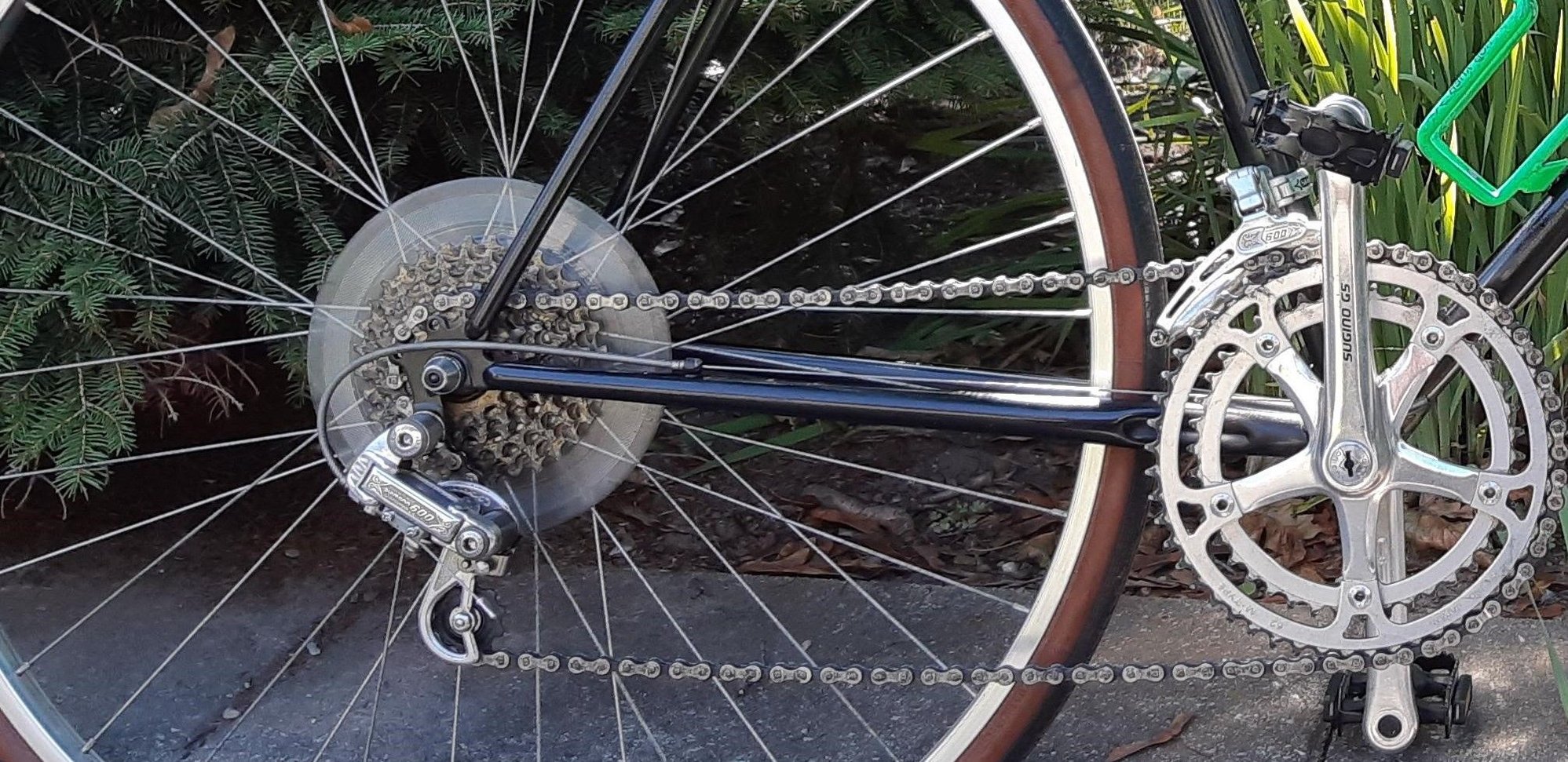
Last edited by gthomson; 10-08-20 at 07:32 AM.
 10-08-20 | 07:10 AM
#2
Full Member
Joined: Jul 2013
Posts: 298
Likes: 106
From: Tokyo
Well, it might act as a flywheel, but it's usually termed a freewheel. (Or more likely, we're looking at part of a freehub.)
The smaller chainwheel isn't so small. You need a small chainwheel or big rear sprockets or both if you (a) want to ride up steep hills or (b) are a weakling or of course (c) both.
Me, I'm (c). There are gradients of 18% (and even occasionally 25% or so) hereabouts, and sustained gradients of 10% plus. And I am enfeebled by a combination of age and a decades-long successful avoidance of any exercise whatever.
That is a mighty impressive dork disc, though.
The smaller chainwheel isn't so small. You need a small chainwheel or big rear sprockets or both if you (a) want to ride up steep hills or (b) are a weakling or of course (c) both.
Me, I'm (c). There are gradients of 18% (and even occasionally 25% or so) hereabouts, and sustained gradients of 10% plus. And I am enfeebled by a combination of age and a decades-long successful avoidance of any exercise whatever.
That is a mighty impressive dork disc, though.
10-08-20 | 07:40 AM
#3
Thread Starter
Senior Member
Joined: May 2020
Posts: 1,297
Likes: 544
From: Great White North
Bikes: 2013 Cannondale Caad 8, 2010 Opus Fidelio, 1985 Peugeot UO14, 1999 Peugeot Dune, Sakai Select, L'Avantage, 1999 Specialized Hard Rock, 1973 Raleigh Sport, Nishiki Probe
Well, it might act as a flywheel, but it's usually termed a freewheel. (Or more likely, we're looking at part of a freehub.)
The smaller chainwheel isn't so small. You need a small chainwheel or big rear sprockets or both if you (a) want to ride up steep hills or (b) are a weakling or of course (c) both.
Me, I'm (c). There are gradients of 18% (and even occasionally 25% or so) hereabouts, and sustained gradients of 10% plus. And I am enfeebled by a combination of age and a decades-long successful avoidance of any exercise whatever.
That is a mighty impressive dork disc, though.
The smaller chainwheel isn't so small. You need a small chainwheel or big rear sprockets or both if you (a) want to ride up steep hills or (b) are a weakling or of course (c) both.
Me, I'm (c). There are gradients of 18% (and even occasionally 25% or so) hereabouts, and sustained gradients of 10% plus. And I am enfeebled by a combination of age and a decades-long successful avoidance of any exercise whatever.
That is a mighty impressive dork disc, though.

 10-08-20 | 12:54 PM
#5
Thread Starter
Senior Member
Joined: May 2020
Posts: 1,297
Likes: 544
From: Great White North
Bikes: 2013 Cannondale Caad 8, 2010 Opus Fidelio, 1985 Peugeot UO14, 1999 Peugeot Dune, Sakai Select, L'Avantage, 1999 Specialized Hard Rock, 1973 Raleigh Sport, Nishiki Probe
I was looking online when I originally got the bike on the Shimano 600 series and most of the finds were about having it on older MTN bikes, so not sure if that's where it's from?
the giant pizza sized dork disc doesn't help.

 10-08-20 | 03:41 PM
#7

Senior Member

Joined: Nov 2005
Posts: 4,070
Likes: 2,161
From: NW Ohio
Bikes: 1984 Miyata 310, 1986 Schwinn Sierra, 1987 Ross Mt. Hood, 1988 Schwinn LeTour, 1988 Trek 400T, 1981 Fuji S12-1977 Univega Grand Rally, S LTD, 1973 Sears Free Spirit 531, 197? FW Evans
Chances are, the bike came with the standard 14-28 freewheel. Maybe the owner was having trouble climbing hills in his area. Swapping to a 14-32 freewheel would be an easy $10 solution.
On the other hand, some bikes did come with larger freewheels. My Fuji S12-S has a 14-30.
On the other hand, some bikes did come with larger freewheels. My Fuji S12-S has a 14-30.
10-08-20 | 04:39 PM
#8
Full Member


Joined: Dec 2012
Posts: 434
Likes: 296
From: North Seattle
Bikes: Davidson ’81
It looks totally normal to me but I have little use for old-fashioned road gearing.
It’s pretty close to the low gear of a compact double with an 11-25 cassette. Hardly outrageous by modern standards.
It’s pretty close to the low gear of a compact double with an 11-25 cassette. Hardly outrageous by modern standards.
10-10-20 | 02:05 PM
#9
Thread Starter
Senior Member
Joined: May 2020
Posts: 1,297
Likes: 544
From: Great White North
Bikes: 2013 Cannondale Caad 8, 2010 Opus Fidelio, 1985 Peugeot UO14, 1999 Peugeot Dune, Sakai Select, L'Avantage, 1999 Specialized Hard Rock, 1973 Raleigh Sport, Nishiki Probe
I'm just going to leave it for now as I don't plan on racing on it or climbing mountains, I just think it looks odd.
 10-10-20 | 03:41 PM
#11
Senior Member
Joined: Apr 2015
Posts: 4,272
Likes: 1,304
From: Seattle
If you're mostly looking at very old racing bikes, yeah.
Nearly all modern road bikes come with at least 28 teeth on the big cog, with 30 or 32 also being common. Current-generation mid-cage Shimano road derailleurs officially support up to 34T, and they can usually handle somewhat bigger if you force them to.
Getting lower gearing.
The cog in your photo is 32T, and the chainring is 42T. It's nowhere near as big as the smaller chainring.
Even if it was, there's nothing esoteric about that. What's needed varies a lot depending on the rider and the rides being ridden. On my gravel bike, the small ring is considerably smaller than the biggest cog (24-32).
Nearly all modern road bikes come with at least 28 teeth on the big cog, with 30 or 32 also being common. Current-generation mid-cage Shimano road derailleurs officially support up to 34T, and they can usually handle somewhat bigger if you force them to.
The cog in your photo is 32T, and the chainring is 42T. It's nowhere near as big as the smaller chainring.
Even if it was, there's nothing esoteric about that. What's needed varies a lot depending on the rider and the rides being ridden. On my gravel bike, the small ring is considerably smaller than the biggest cog (24-32).
