


3-arm "circular" cranks vs. 5-arm starfish design
 02-02-21 | 11:16 PM
#1
Thread Starter
Junior Member
Joined: Apr 2018
Posts: 6
Likes: 0
3-arm "circular" cranks vs. 5-arm starfish design
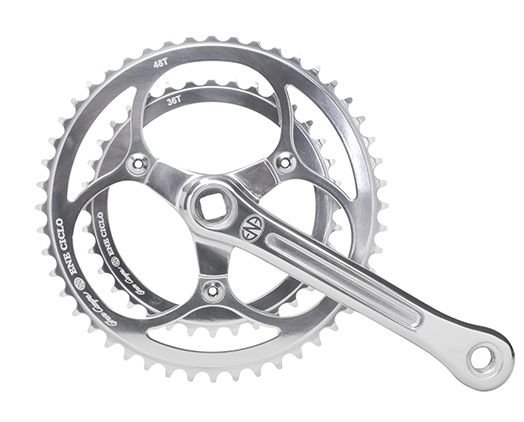
Hi all. Currently building up a pretty frame from the 80s, and I like the look of the Dia-Compe ENE Ciclo double crankset -- I can't upload a photo, but the design has 3 arms, and the arms branch as they approach the outer ring, creating three 'circles', in contrast to the 'starfish' shape of standard 80s cranks. Other details include cold-forged arms. I read that this process makes them even stronger, but this made me wonder if the rings, on the other hand, were not more flexible than rings with 5 arms of support, if the "circular" design improves stiffness relative to 'radial' arms, etc., etc..
My question is for anyone who's experienced both this 3-arm design and the more common 5-arm starfish of 80s/90s Sugino cranks etc. What were your impressions, how did they compare? Thanks in advance for your input.
My question is for anyone who's experienced both this 3-arm design and the more common 5-arm starfish of 80s/90s Sugino cranks etc. What were your impressions, how did they compare? Thanks in advance for your input.
 02-03-21 | 03:32 AM
#2
Senior Member♣️

Joined: Jan 2016
Posts: 4,075
Likes: 3,004
I have one bike that has a three arm Campy crank and the rest of my bikes all have five arm Campy or Ambrosio. At my age and strength , honestly, I can’t tell the difference in rigidity . I would go with the cranks that give you the best ratios gear wise to fit your type of riding.
02-03-21 | 03:48 AM
#3
Senior Member


Joined: Feb 2020
Posts: 4,035
Likes: 2,356
Absent finite element analysis or accurate mechanical testing, you have no way of knowing which set of arms is stiffer.
Neither does anyone else.
The various patterns you see in cranksets are all (supposedly) the result of careful compromise between the various factors of material cost, manufacturing cost, form, and function.
And I suggest that that is the order in which most manufacturers today consider them.
Neither does anyone else.
The various patterns you see in cranksets are all (supposedly) the result of careful compromise between the various factors of material cost, manufacturing cost, form, and function.
And I suggest that that is the order in which most manufacturers today consider them.
 02-03-21 | 06:02 AM
#5

Phyllo-buster

Joined: Jan 2010
Posts: 9,276
Likes: 2,698
From: Nova Scotia
Bikes: roadsters, club bikes, fixed and classic
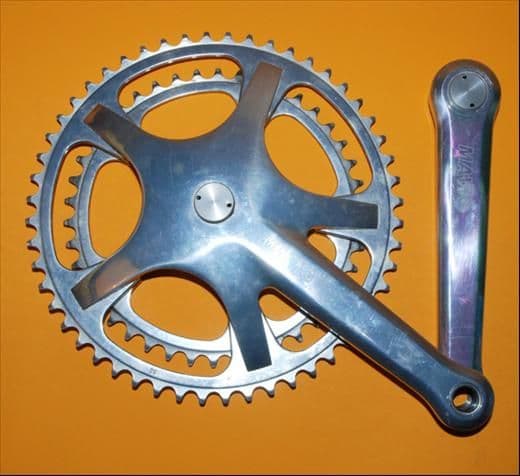
Just to be a pedant, the term Starfish is used to refer to one particular crankset made by Mavic. The rest are generally called 3 pin, or 5 pin.
Mavic courtesy Velobase.
Mavic courtesy Velobase.
02-03-21 | 06:34 AM
#6


Death fork? Naaaah!!

Joined: Nov 2005
Posts: 5,534
Likes: 959
From: The other Maine, north of RT 2
Bikes: Seriously downsizing.
I have a TA three-arm crank on a Gitane. Can't tell any difference from the TA Cylotouriste on a <otobecane.
Top
Top
__________________
You know it's going to be a good day when the stem and seatpost come right out.
(looking for a picture and not seeing it? Thank the Photobucket fiasco.PM me and I'll link it up.)
You know it's going to be a good day when the stem and seatpost come right out.
(looking for a picture and not seeing it? Thank the Photobucket fiasco.PM me and I'll link it up.)
02-03-21 | 06:34 AM
#7

Senior Member
Joined: Apr 2005
Posts: 17,196
Likes: 761
From: Ann Arbor, MI
Bikes: 1980 Masi, 1984 Mondonico, 1984 Trek 610, 1980 Woodrup Giro, 2005 Mondonico Futura Leggera ELOS, 1967 PX10E, 1971 Peugeot UO-8
I agree there's no straightforward way to prove greater stiffness, at least at the consumer's level of technology. I'm also not clear on whether stiffness matters to a rider or is perceptible. But assuming cold-forged cranksets are stronger, you can get the same strength, if not stiffness, with the same or lesser amount of material. The sales metric, as with frames, is less mass with equal durability. So if the weight of this chainset is more like that of a Rene Herse than another double capable of 46/30 which is not cold-forged (I can't think of one at the moment), there's a tangible difference. Real nice looking design, though!
02-03-21 | 06:49 AM
#8
Senior Member
Joined: May 2008
Posts: 10,106
Likes: 2,762
From: Fredericksburg, Va
Bikes: ? Proteous, '65 Frejus TDF, '73 Bottecchia Giro d'Italia, '83 Colnago Superissimo, '84 Trek 610, '84 Trek 760, '88 Pinarello Veneto, '88 De Rosa Pro, '89 Pinarello Montello, 'Litespeed Catalyst'94 Burley Duet, 97 Specialized RockHopper, 2010 Langster
My suspicion is that the 5 pin is designed to survive lateral forces from accidents. A three pin would be optimal for driving a chain.
__________________
Bikes don't stand alone. They are two tired.
Bikes don't stand alone. They are two tired.
02-03-21 | 07:13 AM
#10

Senior Member


Joined: Apr 2012
Posts: 21,823
Likes: 5,781
From: Middle Earth (aka IA)
Bikes: A bunch of old bikes and a few new ones
02-03-21 | 08:01 AM
#11

PM me your cotters
Joined: Jun 2015
Posts: 3,280
Likes: 631
From: ATL
That said, I do like the look of that crankset.
__________________
███████████████
███████████████
02-03-21 | 08:02 AM
#12
Senior Member
Joined: Sep 2017
Posts: 2,157
Likes: 835
From: Eastern Shore, MD
Bikes: Road ready: 1993 Koga Miyata City Liner Touring Hybrid, 1989 Centurion Sport DLX, "I Blame GP" Bridgestone CB-1. Projects: Yea, I got a problem....
Dia Compe has a 96 BCD. Old Shimano 600 cranks are 95 BCD. They could have at least revived an old standard and made some 30t chainrings.
02-03-21 | 08:41 AM
#13

Hoards Thumbshifters
Joined: Jul 2010
Posts: 1,211
Likes: 430
From: Signal Mountain, TN
Bikes: '23 Black Mtn MC, '87 Bruce Gordon Chinook, '08 Jamis Aurora, '86 Trek 560, '97 Mongoose Rockadile, & '91 Trek 750
It should be said too, that if you already have a Sugino crankset they are great and sturdy and polish beautifully.
02-03-21 | 09:02 AM
#14
Senior Member
Joined: Oct 2010
Posts: 8,841
Likes: 2,859
This is the best answer, assuming OP plans to ride the bike far enough to wear out a chainring. I would modify to say "availability and cost of replacement chainrings" though. If there's a $50 crankset, but the chainrings cost $75 versus a $75 crankset with rings that cost $50 or the BCD is common enough to enable me to use a wide variety of rings, I'm going with the latter every time.
That said, I do like the look of that crankset.
That said, I do like the look of that crankset.
Last edited by seypat; 02-03-21 at 09:15 AM.
 02-03-21 | 09:06 AM
#15
Senior Member
Joined: Oct 2010
Posts: 8,841
Likes: 2,859
Now, get off my lawn!

Last edited by seypat; 02-03-21 at 04:59 PM.
02-03-21 | 10:31 AM
#16

Drip, Drip.
Joined: Oct 2020
Posts: 1,575
Likes: 194
From: Southern Ontario
Bikes: Trek Verve E bike, Felt Doctrine 4 XC, Opus Horizon Apex 1
Like someone else mentioned, the most important factor here is the gearing.
there should be a sufficiently fast jump between the two ratios, no dead space in between, and a versatile granny gear useful for both climbing and flat terrain. You shouldn't feel like you have to always compensate by changing thenresr cassette ratio when changing between front chainrings.
there should be a sufficiently fast jump between the two ratios, no dead space in between, and a versatile granny gear useful for both climbing and flat terrain. You shouldn't feel like you have to always compensate by changing thenresr cassette ratio when changing between front chainrings.
02-03-21 | 10:40 AM
#17

Senior Member
Joined: Oct 2014
Posts: 14,180
Likes: 5,313
From: Portland, OR
Bikes: (2) ti TiCycles, 2007 w/ triple and 2011 fixed, 1979 Peter Mooney, ~1983 Trek 420 now fixed and ~1973 Raleigh Carlton Competition gravel grinder
It's 90% marketing, With good design, you can optimize anything from 3 to 6 stars for any standard of stiffness and strength you want. There will be minor weight and aero trade-offs but not race winning or losing. The final and ultimate solution will not happen until software people can encrypt "bling" into the FEA code.
02-03-21 | 11:07 AM
#18
Thread Starter
Junior Member
Joined: Apr 2018
Posts: 6
Likes: 0
Wow, this forum is the best thing since sliced bread! Thank you everyone for your input! I have to say that I agree with the latter posts, in that the gearing is the main deciding factor -- this is the reason for building this bike to begin with: 10%+ hills in my neck of the woods. Initially I chose this crankset because I couldn't find any cheaper options for 48/36, but have since found a few (Sugino is top contender for competition with this Dia-Compe Ene Ciclo, for me at the moment). Glad to hear that there aren't any horror stories of these differently-designed rings, or with 3-pin designs in general. That was my main fear and reason for posting.
So, beyond the gearing choices, it sounds like it's mostly an aesthetic difference. (Still grateful for any input anyone may want to share!)
So, beyond the gearing choices, it sounds like it's mostly an aesthetic difference. (Still grateful for any input anyone may want to share!)
02-03-21 | 11:14 AM
#19
Drip, Drip.
Joined: Oct 2020
Posts: 1,575
Likes: 194
From: Southern Ontario
Bikes: Trek Verve E bike, Felt Doctrine 4 XC, Opus Horizon Apex 1
I think the difference in stiffness would be marginal unless you are a 240lb bodybuilder cranking out 500+w up a hill in a regular basis.
02-03-21 | 11:50 AM
#20
Senior Member

Joined: Dec 2005
Posts: 18,822
Likes: 11,675
The Andel crank I mentioned above comes in 46/30t configuration if you want some serious climbing gears. I put one on my Rivendell Roadini.
02-03-21 | 08:30 PM
#21
Senior Member
Joined: Jul 2013
Posts: 1,449
Likes: 309
Yep. 110 and 130mm 5-pin rings will be around after the cockroaches are gone. Availability of 3-pin rings is sketchy at best, even when the cranks are in production.
