


Crank arm covers?
 08-11-21 | 11:41 AM
#1

Thread Starter
Senior Member


Joined: Jun 2018
Posts: 1,168
Likes: 516
From: NW Ohio
Bikes: 1983 Univega Super Strada, 1986 Panasonic DX5000, 1984 Fuji Team 85 Univega Gran Turismo, 1984 Lotus Unique, 1987 Centurion Expert, 1987 Centurion Ironman Master,
Crank arm covers?
I just noticed that both my 1987 Ironmen are missing the crank arm dust covers.
Are these hard to find and are they all threaded the same?
Are these hard to find and are they all threaded the same?
 08-11-21 | 11:54 AM
#2

Senior Member

Joined: Feb 2013
Posts: 15,369
Likes: 4,393
From: Alta California
-----
their thread matches that of the removal threads on the arm
the "standard" is 22.0mm
however, there is also the 23.0mm employed by SPECTA (T.A.) and the 23.35mm employed by Verot (Stronglight)
-----
their thread matches that of the removal threads on the arm
the "standard" is 22.0mm
however, there is also the 23.0mm employed by SPECTA (T.A.) and the 23.35mm employed by Verot (Stronglight)
-----
08-11-21 | 12:14 PM
#3
Senior Member

Joined: May 2008
Posts: 10,106
Likes: 2,762
From: Fredericksburg, Va
Bikes: ? Proteous, '65 Frejus TDF, '73 Bottecchia Giro d'Italia, '83 Colnago Superissimo, '84 Trek 610, '84 Trek 760, '88 Pinarello Veneto, '88 De Rosa Pro, '89 Pinarello Montello, 'Litespeed Catalyst'94 Burley Duet, 97 Specialized RockHopper, 2010 Langster
__________________
Bikes don't stand alone. They are two tired.
Bikes don't stand alone. They are two tired.
 08-11-21 | 12:59 PM
#4

Senior Member


Joined: Aug 2009
Posts: 4,313
Likes: 3,747
You can find some generic crank caps/ dust covers on Ebay. They might not look good on some cranksets though. The Shimano FC6400 crank for example comes with these chromed caps which have slightly sloping contours to match the crank contours, and generic caps would not look good in this instance.
08-11-21 | 08:33 PM
#5

Observational Theorist
Joined: Jan 2021
Posts: 74
Likes: 20
From: Baltimore
You'll have to specifically ask for them, cuz they're not something that will be on display on the sales floor.
08-11-21 | 08:41 PM
#6
Senior Member
Joined: Dec 2015
Posts: 1,958
Likes: 1,243
From: Menomonee Falls, WI
Bikes: 1984 Schwinn Supersport, 1988 Trek 400T, 1977 Trek TX900, 1982 Bianchi Champione del Mondo, 1978 Raleigh Supercourse, 1986 Trek 400 Elance, 1991 Waterford PDG OS Paramount, 1971 Schwinn Sports Tourer, 1985 Trek 670
eBay, lots of options.
Tim
Tim
08-11-21 | 09:34 PM
#7

Senior Member
Joined: Nov 2015
Posts: 4,900
Likes: 1,127
Yup!,....They were the first thing my brother and I used to toss away after getting a new bike or crankset in the 80's, along with dork discs and the CPSC required reflectors. Now I wish I didn't just dump them, as they now cost surprisingly lot of money (Even some of the chintzy plastic ones), for what they are....

 08-12-21 | 12:22 PM
#10

Full Member
Joined: Jun 2021
Posts: 278
Likes: 425
From: Barboursville, Va
Bikes: N+1
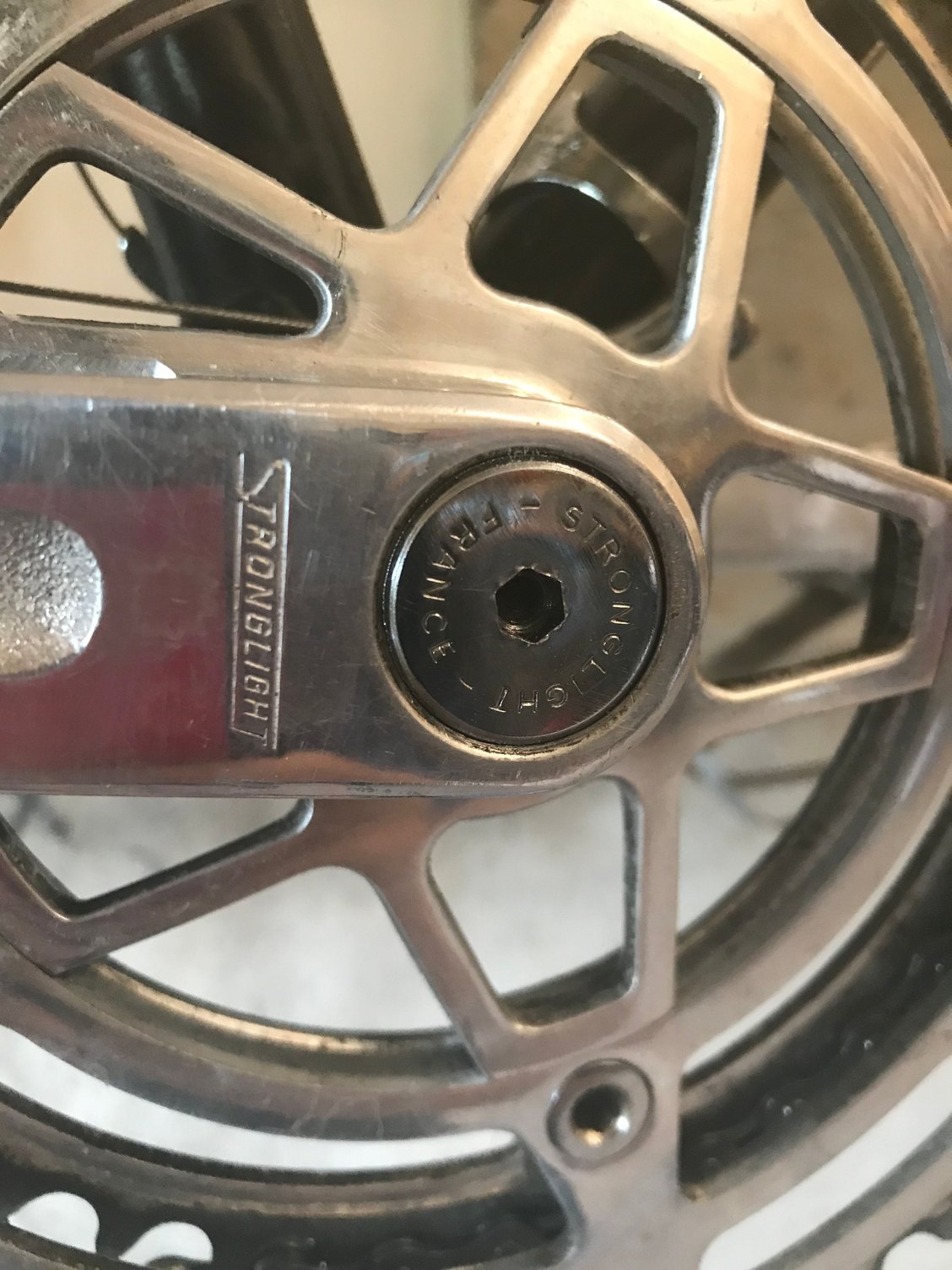
These stronglight ones are easy to get on and off, sturdy, and look great. They are staying till the cranks break

These… not so much. Had to bend a paper clip into a tool to remove and install them.

These are waiting for the next time my campy cranks come off for bottom bracket service.
08-12-21 | 01:18 PM
#11

Senior Member
Joined: Mar 2021
Posts: 1,980
Likes: 1,601
From: Beaverton, OR
Bikes: You had me at rusty and Italian!!
I’m a fan of the caps since I think it looks cleaner. I haven’t had much luck finding them and when I do they seem ridiculously priced for what they are.
08-12-21 | 04:41 PM
#12

Senior Member

Joined: Apr 2009
Posts: 3,812
Likes: 5,701
From: Seattle
The one-key release is of course intended to replace the separate extractor tool, but they also made a LH threaded tool. For people who lost their one-key release whatzit maybe? Who knows. Looks just like the iconic Campy crank extractor, except with sort of "hash marks" machined into the wrench faces to indicate the LH thread. (I don't think hash marks is the correct term, what do machinists and machine designers call those?) The LH threaded nuts on my acetylene regulator, hoses etc have the same markings, so I think it might be an interntional standard.
I have one (the extractor tool, not the one-key), but I have never used it. I was not a fan of Campagnolo during those years so I never had one of those cranks on any of my bikes.
The LH thread for a one-key release is an interesting idea with some merit, but decades of experience show us that RH threads also work fine, so LH is definitely not needed there. And there are costs and risks involved with using LH threads, so they're best avoided where not needed. Just another one of Campy's questionable design decisions from back then.
Mark B
08-12-21 | 04:52 PM
#13

Senior Member
Joined: Feb 2008
Posts: 5,321
Likes: 4,834
From: Peoria, IL


although I think the Campy Mexico crank on my Olmo deserves to keep the dustcap too....

I'd say that there was an expectation that a "work" bike, whether a bike being flogged in crit races or a bike being used for commuting, etc., wouldn't bother with the dust caps. Bikes that exist to look marvelous should keep the dustcaps.
My Hetchins has the dustcaps too.

Steve in Peoria
 08-12-21 | 06:23 PM
#14
Full Member
Joined: Jun 2021
Posts: 278
Likes: 425
From: Barboursville, Va
Bikes: N+1
Have you checked those Campy one-key release whatzits for "handedness"? I don't know what years, but they did make them in left-hand-thread, obviously to fit cranks that were also made with LH threads there.
The one-key release is of course intended to replace the separate extractor tool, but they also made a LH threaded tool. For people who lost their one-key release whatzit maybe? Who knows. Looks just like the iconic Campy crank extractor, except with sort of "hash marks" machined into the wrench faces to indicate the LH thread. (I don't think hash marks is the correct term, what do machinists and machine designers call those?) The LH threaded nuts on my acetylene regulator, hoses etc have the same markings, so I think it might be an interntional standard.
I have one (the extractor tool, not the one-key), but I have never used it. I was not a fan of Campagnolo during those years so I never had one of those cranks on any of my bikes.
The LH thread for a one-key release is an interesting idea with some merit, but decades of experience show us that RH threads also work fine, so LH is definitely not needed there. And there are costs and risks involved with using LH threads, so they're best avoided where not needed. Just another one of Campy's questionable design decisions from back then.
Mark B
The one-key release is of course intended to replace the separate extractor tool, but they also made a LH threaded tool. For people who lost their one-key release whatzit maybe? Who knows. Looks just like the iconic Campy crank extractor, except with sort of "hash marks" machined into the wrench faces to indicate the LH thread. (I don't think hash marks is the correct term, what do machinists and machine designers call those?) The LH threaded nuts on my acetylene regulator, hoses etc have the same markings, so I think it might be an interntional standard.
I have one (the extractor tool, not the one-key), but I have never used it. I was not a fan of Campagnolo during those years so I never had one of those cranks on any of my bikes.
The LH thread for a one-key release is an interesting idea with some merit, but decades of experience show us that RH threads also work fine, so LH is definitely not needed there. And there are costs and risks involved with using LH threads, so they're best avoided where not needed. Just another one of Campy's questionable design decisions from back then.
Mark B
08-13-21 | 01:28 AM
#15
Senior Member
Joined: Apr 2009
Posts: 3,812
Likes: 5,701
From: Seattle
