


Mystery Track Frame ID #2
 01-15-22 | 10:25 AM
#1

Thread Starter
Full Member


Joined: Aug 2009
Posts: 287
Likes: 70
Mystery Track Frame ID #2
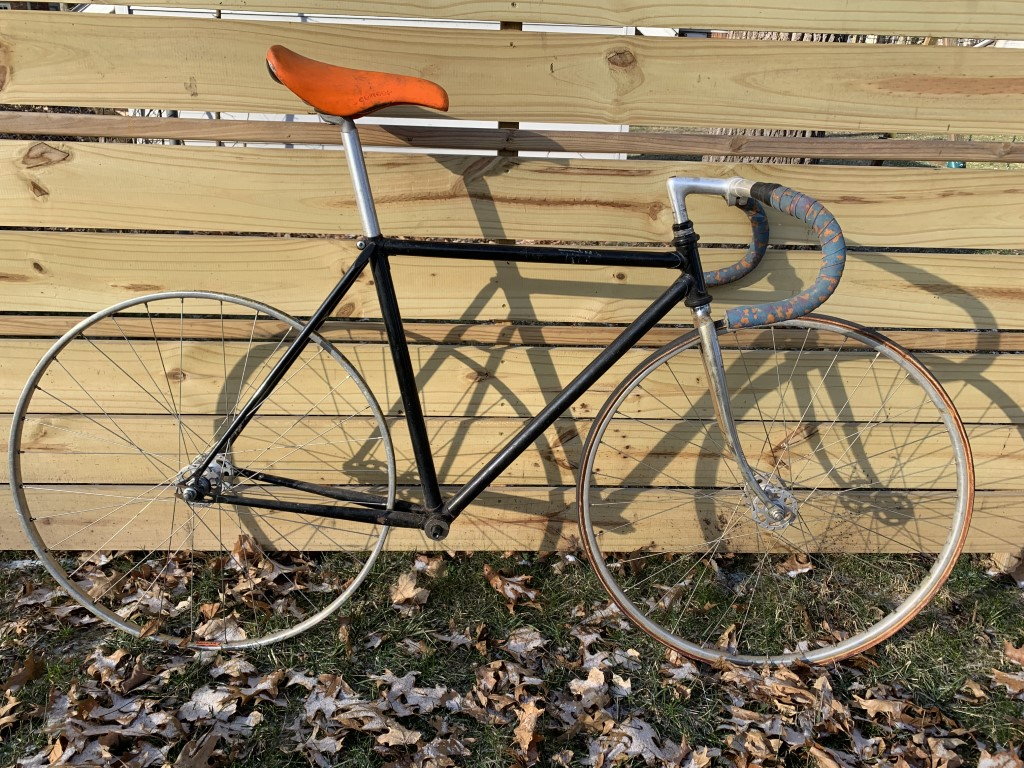
This is the other mystery frame that was in the lot of track parts. The lugs look somewhat generic but the rear drop outs have some detail and the bottom bracket is Italian threaded with bottom cutout. It is stamped 48 on the bottom bracket but no markings I can see otherwise. I assume that the fork is not original since it is english threaded and has no markings but could be wrong. Any idea who made this based on the rear dropouts?


__________________
Bikes are cool, even the dumb ones.
Bikes are cool, even the dumb ones.
 01-15-22 | 12:35 PM
#2


"I assume that the fork is not original since it is english threaded and has no markings but could be wrong. Any idea who made this based on the rear dropouts?"
Correct per that fork: it's a road fork and not original.
As for the dropouts (hint: you call these "track ends" when rear-facing slots or on a track frame) they look like could be CNC'd from plate steel (?) or possibly investment cast, but never seen this style before so they are a good clue (for somebody).
The BB shell, undrilled brake bridge and chainstay bridge are all common Italian frame bits, possibly GPM or some such brand(s).
Also what do the chainstays measure: they seem fairly long for a track frame...
Correct per that fork: it's a road fork and not original.
As for the dropouts (hint: you call these "track ends" when rear-facing slots or on a track frame) they look like could be CNC'd from plate steel (?) or possibly investment cast, but never seen this style before so they are a good clue (for somebody).
The BB shell, undrilled brake bridge and chainstay bridge are all common Italian frame bits, possibly GPM or some such brand(s).
Also what do the chainstays measure: they seem fairly long for a track frame...
01-15-22 | 12:46 PM
#3

Edumacator


Joined: Jan 2018
Posts: 9,688
Likes: 5,175
From: Goose Creek, SC
Bikes: More than the people who ride them...oy.
Recently, I learned about "road path" training bikes that have most attributes of track frames. I recently bid on one, a Rory O'Brien nifty little frame, and there was another Freddie GRubb version. Also a bit longer in the chain stays.
__________________
1987 Crest C'dale, 1987 Basso Gap, 1992 Rossin EL, 1990 Van Tuyl, 1985 Trek 670, 2003 Pinarello Surprise, 1990ish MBK Atlantique, 1987 Peugeot Isoard, 1987 Nishiki Tri-A, 1981 Faggin, 1996 C'dale M500, 1984 Mercian Pro, 1982 AD SuperLeicht, 1985 Massi ?, 1988 Daccordi Griffe , 1989 Fauxsin MTB, 1981 Ciocc Mockba, 1992 Bianchi Giro, 1977 Colnago Super, 1971 Raleigh Internat'l, 1998 Corratec U+D, 1991 Peugeot Slimestone, 1987 Bianchi Volpe, 1995 Trek 750
1987 Crest C'dale, 1987 Basso Gap, 1992 Rossin EL, 1990 Van Tuyl, 1985 Trek 670, 2003 Pinarello Surprise, 1990ish MBK Atlantique, 1987 Peugeot Isoard, 1987 Nishiki Tri-A, 1981 Faggin, 1996 C'dale M500, 1984 Mercian Pro, 1982 AD SuperLeicht, 1985 Massi ?, 1988 Daccordi Griffe , 1989 Fauxsin MTB, 1981 Ciocc Mockba, 1992 Bianchi Giro, 1977 Colnago Super, 1971 Raleigh Internat'l, 1998 Corratec U+D, 1991 Peugeot Slimestone, 1987 Bianchi Volpe, 1995 Trek 750
 01-15-22 | 02:30 PM
#6

Senior Member

Joined: Apr 2009
Posts: 3,783
Likes: 5,629
From: Seattle
The silhouette of the track dropouts looks identical to Zeus*, but they look too square-edged. The Zeus pieces are forged with rounded edges. I also have some later copies of Zeus track dropouts that were laser cut (or maybe waterjet?) out of thick sheet. My vague recollection is the copies were from Poland, but don't trust me on that. They were really cheap.
Originals Right, copies Left.


*I'm calling the originals Zeus even though I'm 98% sure Zeus didn't make them. I've seen them with other names stamped in them but the ones with Zeus stamped in seem to be the most common. The pair I have here that I'm calling originals has no name stamped in them.
I'm calling them dropouts not "track ends" because I just like saying that and I'm too old to change. The "descriptive linguist" in me (as opposed to "prescriptive") would say "since most people call them dropouts, then that's what they are". Thats how words work.
Mark B, cunning linguist
Originals Right, copies Left.
*I'm calling the originals Zeus even though I'm 98% sure Zeus didn't make them. I've seen them with other names stamped in them but the ones with Zeus stamped in seem to be the most common. The pair I have here that I'm calling originals has no name stamped in them.
I'm calling them dropouts not "track ends" because I just like saying that and I'm too old to change. The "descriptive linguist" in me (as opposed to "prescriptive") would say "since most people call them dropouts, then that's what they are". Thats how words work.
Mark B, cunning linguist
01-15-22 | 03:38 PM
#7
Edumacator
Joined: Jan 2018
Posts: 9,688
Likes: 5,175
From: Goose Creek, SC
Bikes: More than the people who ride them...oy.
The silhouette of the track dropouts looks identical to Zeus*, but they look too square-edged. The Zeus pieces are forged with rounded edges. I also have some later copies of Zeus track dropouts that were laser cut (or maybe waterjet?) out of thick sheet. My vague recollection is the copies were from Poland, but don't trust me on that. They were really cheap.
Originals Right, copies Left.
*I'm calling the originals Zeus even though I'm 98% sure Zeus didn't make them. I've seen them with other names stamped in them but the ones with Zeus stamped in seem to be the most common. The pair I have here that I'm calling originals has no name stamped in them.
I'm calling them dropouts not "track ends" because I just like saying that and I'm too old to change. The "descriptive linguist" in me (as opposed to "prescriptive") would say "since most people call them dropouts, then that's what they are". Thats how words work.
Mark B, cunning linguist
Originals Right, copies Left.
*I'm calling the originals Zeus even though I'm 98% sure Zeus didn't make them. I've seen them with other names stamped in them but the ones with Zeus stamped in seem to be the most common. The pair I have here that I'm calling originals has no name stamped in them.
I'm calling them dropouts not "track ends" because I just like saying that and I'm too old to change. The "descriptive linguist" in me (as opposed to "prescriptive") would say "since most people call them dropouts, then that's what they are". Thats how words work.
Mark B, cunning linguist
Dave
__________________
1987 Crest C'dale, 1987 Basso Gap, 1992 Rossin EL, 1990 Van Tuyl, 1985 Trek 670, 2003 Pinarello Surprise, 1990ish MBK Atlantique, 1987 Peugeot Isoard, 1987 Nishiki Tri-A, 1981 Faggin, 1996 C'dale M500, 1984 Mercian Pro, 1982 AD SuperLeicht, 1985 Massi ?, 1988 Daccordi Griffe , 1989 Fauxsin MTB, 1981 Ciocc Mockba, 1992 Bianchi Giro, 1977 Colnago Super, 1971 Raleigh Internat'l, 1998 Corratec U+D, 1991 Peugeot Slimestone, 1987 Bianchi Volpe, 1995 Trek 750
1987 Crest C'dale, 1987 Basso Gap, 1992 Rossin EL, 1990 Van Tuyl, 1985 Trek 670, 2003 Pinarello Surprise, 1990ish MBK Atlantique, 1987 Peugeot Isoard, 1987 Nishiki Tri-A, 1981 Faggin, 1996 C'dale M500, 1984 Mercian Pro, 1982 AD SuperLeicht, 1985 Massi ?, 1988 Daccordi Griffe , 1989 Fauxsin MTB, 1981 Ciocc Mockba, 1992 Bianchi Giro, 1977 Colnago Super, 1971 Raleigh Internat'l, 1998 Corratec U+D, 1991 Peugeot Slimestone, 1987 Bianchi Volpe, 1995 Trek 750
01-15-22 | 08:14 PM
#8
Senior Member
Joined: Apr 2009
Posts: 3,783
Likes: 5,629
From: Seattle
Stylin' builders, mostly for looks, will make those knife shapes on the dropouts even sharper. Typically done with a file after brazing, so you're only filing the bit of dropout that's above and below the chainstay. That applies to Campy dropouts and clones thereof; these Zeus dropouts aren't very tall where they meet the stays, so there's little to no dropout above and below the stay at the chainstay slot. So the knife shapes don't do much, on these, not really visible after filing. When I used Zeus dropouts, such as on my then-girlfriend's (now wife's) track bike in about 1982, I filed the knife shape part down until it made a tang that went inside the stay, like trad road dropouts do. I think this makes a stronger joint, though that's moot since these joints almost never fail. But I do things the way I consider "right" sometimes even when it doesn't matter, even if no one will ever see how it was made (inside), just because it pleases me. But a square-bottomed slot, with no tang that reaches in beyond the slot, is technically weaker or more prone to fatigue failure. (Again, frames don't break there, so this is nothing to lose sleep over.)
This knife-shape filing on track dropouts is a tradition that goes back I don't know how far, '50s maybe. I don't know who first started shaping track drops this way, Campy maybe. It used to be track-only until De Rosa, Richard Sachs and a couple others started filing their road dropouts into a similar shape, with a much shorter taper. I never saw that (road version) before the '70s. I don't much like it on road bikes, it seems a bit forced/inorganic, though there's nothing wrong with it structurally. It's actually a time saver in a way, easier to file than just fitting and brazing everything really crisp so there's nothing to file. My first framebuilding job as an apprentice was filing down lumps put there by someone else, so I vowed to learn how to braze without making lumps that need filing! Just a personal preference...
Best way IMHO, though time-consuming (you'll never see it on a factory-made bike), is notching the dropout and the stay so they both notch into each other. Requires milling the dropouts on a milling machine in a particular way known as a plunge-cut, sort of like drilling in a drill-press. Diameter of the cutter must match the stay diameter, and the angle is totally unforgiving, especially the angle between the chainstay and seatstay. So the dropouts must be milled to fit each individual frame. I had a setup on the mill that made it pretty fast, and my drawing gave me the exact angle, so not too too tricky. I made a few batches of "production" (not custom) track bikes at Davidson that way, with Dura-Ace dropouts (way nicer than Campy), here's an example:

Here's one in-process:

Still needs thinning, deburring etc. but you get the picture with the plunge-cut shape.
Compared to the tradional way, with knife-shaped Campy dropouts in a knife-shaped slot, mine is lighter (milligrams!) due to the dropout being sort of hollow inside, between the points. And the slotted part of the stay, which is the weak point, isn't right out at the end of the joint, it is about 15 mm away, from where those thin points on the dropout stop. Thin points act as strain-relief, reinforcing the stay well beyond the end of the slot. In theory, better fatigue endurance... if frames ever broke there.
But as I said, none of that really matters. Frames done the trad way have lasted a half-century at least, and they don't break, and the extra weight is less than an ounce. I could say my way is closer to "correct" engineering" but engineering efficiency also includes making stuff cost-efficient, which this isn't. So I just have to fall back on "because I like to do it that way". You can't see that the dropout is milled out "hollow" inside, you just have to take my word for it!
How's that for giving way more answer than anyone was asking for, eh?
Mark B
 01-15-22 | 08:24 PM
#9
Senior Member
Joined: Apr 2009
Posts: 3,783
Likes: 5,629
From: Seattle
Well, I said my way was the best (is there an emoji for patting yourself on the back?), but I should have limited that to when using traditional dropouts (track ends).
If you could choose any dropouts, you can't do much better than Nagasawa, which have investment-cast sockets that are light and strong and require no filing/cleanup whatsoever unless you're a very sloppy brazer. Load the stay with a ring of filler (e.g. brass or silver), flux, assemble and heat until you see a thin line of braze come out from inside, et voilà, a perfectly brazed joint in under a minute.
There are other similar socket-style dropouts, both road and track, but none as pretty as Nagasawa's IMHO.

Note how the seatstay sockets are separate pieces, to allow the different seatstay angles you need on different size frames.
Finished look:

Mark B
If you could choose any dropouts, you can't do much better than Nagasawa, which have investment-cast sockets that are light and strong and require no filing/cleanup whatsoever unless you're a very sloppy brazer. Load the stay with a ring of filler (e.g. brass or silver), flux, assemble and heat until you see a thin line of braze come out from inside, et voilà, a perfectly brazed joint in under a minute.
There are other similar socket-style dropouts, both road and track, but none as pretty as Nagasawa's IMHO.
Note how the seatstay sockets are separate pieces, to allow the different seatstay angles you need on different size frames.
Finished look:
Mark B
Last edited by bulgie; 01-15-22 at 08:28 PM.
01-16-22 | 07:09 AM
#10
Edumacator
Joined: Jan 2018
Posts: 9,688
Likes: 5,175
From: Goose Creek, SC
Bikes: More than the people who ride them...oy.
You see the sort of knife shape on the originals? Those require a matching knife-shaped slot in the stays, unless you just put 'em in a normal square-bottom slot and fill in the resulting gaps with brass <ugh>. Fugly, but I've seen 'em done that way. The laser-jet cut copies would go in a plain square-bottom slot without making big gaps you need to fill. So that'd be the easiest. Not the best though (more on that below for anyone interested).
Stylin' builders, mostly for looks, will make those knife shapes on the dropouts even sharper. Typically done with a file after brazing, so you're only filing the bit of dropout that's above and below the chainstay. That applies to Campy dropouts and clones thereof; these Zeus dropouts aren't very tall where they meet the stays, so there's little to no dropout above and below the stay at the chainstay slot. So the knife shapes don't do much, on these, not really visible after filing. When I used Zeus dropouts, such as on my then-girlfriend's (now wife's) track bike in about 1982, I filed the knife shape part down until it made a tang that went inside the stay, like trad road dropouts do. I think this makes a stronger joint, though that's moot since these joints almost never fail. But I do things the way I consider "right" sometimes even when it doesn't matter, even if no one will ever see how it was made (inside), just because it pleases me. But a square-bottomed slot, with no tang that reaches in beyond the slot, is technically weaker or more prone to fatigue failure. (Again, frames don't break there, so this is nothing to lose sleep over.)
This knife-shape filing on track dropouts is a tradition that goes back I don't know how far, '50s maybe. I don't know who first started shaping track drops this way, Campy maybe. It used to be track-only until De Rosa, Richard Sachs and a couple others started filing their road dropouts into a similar shape, with a much shorter taper. I never saw that (road version) before the '70s. I don't much like it on road bikes, it seems a bit forced/inorganic, though there's nothing wrong with it structurally. It's actually a time saver in a way, easier to file than just fitting and brazing everything really crisp so there's nothing to file. My first framebuilding job as an apprentice was filing down lumps put there by someone else, so I vowed to learn how to braze without making lumps that need filing! Just a personal preference...
Best way IMHO, though time-consuming (you'll never see it on a factory-made bike), is notching the dropout and the stay so they both notch into each other. Requires milling the dropouts on a milling machine in a particular way known as a plunge-cut, sort of like drilling in a drill-press. Diameter of the cutter must match the stay diameter, and the angle is totally unforgiving, especially the angle between the chainstay and seatstay. So the dropouts must be milled to fit each individual frame. I had a setup on the mill that made it pretty fast, and my drawing gave me the exact angle, so not too too tricky. I made a few batches of "production" (not custom) track bikes at Davidson that way, with Dura-Ace dropouts (way nicer than Campy), here's an example:
Here's one in-process:
Still needs thinning, deburring etc. but you get the picture with the plunge-cut shape.
Compared to the tradional way, with knife-shaped Campy dropouts in a knife-shaped slot, mine is lighter (milligrams!) due to the dropout being sort of hollow inside, between the points. And the slotted part of the stay, which is the weak point, isn't right out at the end of the joint, it is about 15 mm away, from where those thin points on the dropout stop. Thin points act as strain-relief, reinforcing the stay well beyond the end of the slot. In theory, better fatigue endurance... if frames ever broke there.
But as I said, none of that really matters. Frames done the trad way have lasted a half-century at least, and they don't break, and the extra weight is less than an ounce. I could say my way is closer to "correct" engineering" but engineering efficiency also includes making stuff cost-efficient, which this isn't. So I just have to fall back on "because I like to do it that way". You can't see that the dropout is milled out "hollow" inside, you just have to take my word for it!
How's that for giving way more answer than anyone was asking for, eh?
Mark B
Stylin' builders, mostly for looks, will make those knife shapes on the dropouts even sharper. Typically done with a file after brazing, so you're only filing the bit of dropout that's above and below the chainstay. That applies to Campy dropouts and clones thereof; these Zeus dropouts aren't very tall where they meet the stays, so there's little to no dropout above and below the stay at the chainstay slot. So the knife shapes don't do much, on these, not really visible after filing. When I used Zeus dropouts, such as on my then-girlfriend's (now wife's) track bike in about 1982, I filed the knife shape part down until it made a tang that went inside the stay, like trad road dropouts do. I think this makes a stronger joint, though that's moot since these joints almost never fail. But I do things the way I consider "right" sometimes even when it doesn't matter, even if no one will ever see how it was made (inside), just because it pleases me. But a square-bottomed slot, with no tang that reaches in beyond the slot, is technically weaker or more prone to fatigue failure. (Again, frames don't break there, so this is nothing to lose sleep over.)
This knife-shape filing on track dropouts is a tradition that goes back I don't know how far, '50s maybe. I don't know who first started shaping track drops this way, Campy maybe. It used to be track-only until De Rosa, Richard Sachs and a couple others started filing their road dropouts into a similar shape, with a much shorter taper. I never saw that (road version) before the '70s. I don't much like it on road bikes, it seems a bit forced/inorganic, though there's nothing wrong with it structurally. It's actually a time saver in a way, easier to file than just fitting and brazing everything really crisp so there's nothing to file. My first framebuilding job as an apprentice was filing down lumps put there by someone else, so I vowed to learn how to braze without making lumps that need filing! Just a personal preference...
Best way IMHO, though time-consuming (you'll never see it on a factory-made bike), is notching the dropout and the stay so they both notch into each other. Requires milling the dropouts on a milling machine in a particular way known as a plunge-cut, sort of like drilling in a drill-press. Diameter of the cutter must match the stay diameter, and the angle is totally unforgiving, especially the angle between the chainstay and seatstay. So the dropouts must be milled to fit each individual frame. I had a setup on the mill that made it pretty fast, and my drawing gave me the exact angle, so not too too tricky. I made a few batches of "production" (not custom) track bikes at Davidson that way, with Dura-Ace dropouts (way nicer than Campy), here's an example:
Here's one in-process:
Still needs thinning, deburring etc. but you get the picture with the plunge-cut shape.
Compared to the tradional way, with knife-shaped Campy dropouts in a knife-shaped slot, mine is lighter (milligrams!) due to the dropout being sort of hollow inside, between the points. And the slotted part of the stay, which is the weak point, isn't right out at the end of the joint, it is about 15 mm away, from where those thin points on the dropout stop. Thin points act as strain-relief, reinforcing the stay well beyond the end of the slot. In theory, better fatigue endurance... if frames ever broke there.
But as I said, none of that really matters. Frames done the trad way have lasted a half-century at least, and they don't break, and the extra weight is less than an ounce. I could say my way is closer to "correct" engineering" but engineering efficiency also includes making stuff cost-efficient, which this isn't. So I just have to fall back on "because I like to do it that way". You can't see that the dropout is milled out "hollow" inside, you just have to take my word for it!
How's that for giving way more answer than anyone was asking for, eh?
Mark B
And those Nagasawa drops are pieces of art. Wow. Makes me sort of want to find a track frame with them...And sell my house to do so...
__________________
1987 Crest C'dale, 1987 Basso Gap, 1992 Rossin EL, 1990 Van Tuyl, 1985 Trek 670, 2003 Pinarello Surprise, 1990ish MBK Atlantique, 1987 Peugeot Isoard, 1987 Nishiki Tri-A, 1981 Faggin, 1996 C'dale M500, 1984 Mercian Pro, 1982 AD SuperLeicht, 1985 Massi ?, 1988 Daccordi Griffe , 1989 Fauxsin MTB, 1981 Ciocc Mockba, 1992 Bianchi Giro, 1977 Colnago Super, 1971 Raleigh Internat'l, 1998 Corratec U+D, 1991 Peugeot Slimestone, 1987 Bianchi Volpe, 1995 Trek 750
1987 Crest C'dale, 1987 Basso Gap, 1992 Rossin EL, 1990 Van Tuyl, 1985 Trek 670, 2003 Pinarello Surprise, 1990ish MBK Atlantique, 1987 Peugeot Isoard, 1987 Nishiki Tri-A, 1981 Faggin, 1996 C'dale M500, 1984 Mercian Pro, 1982 AD SuperLeicht, 1985 Massi ?, 1988 Daccordi Griffe , 1989 Fauxsin MTB, 1981 Ciocc Mockba, 1992 Bianchi Giro, 1977 Colnago Super, 1971 Raleigh Internat'l, 1998 Corratec U+D, 1991 Peugeot Slimestone, 1987 Bianchi Volpe, 1995 Trek 750
01-16-22 | 07:12 AM
#11
Edumacator
Joined: Jan 2018
Posts: 9,688
Likes: 5,175
From: Goose Creek, SC
Bikes: More than the people who ride them...oy.
I love Rossin's sockets on my Performance ELOS.
Well, I said my way was the best (is there an emoji for patting yourself on the back?), but I should have limited that to when using traditional dropouts (track ends).
If you could choose any dropouts, you can't do much better than Nagasawa, which have investment-cast sockets that are light and strong and require no filing/cleanup whatsoever unless you're a very sloppy brazer. Load the stay with a ring of filler (e.g. brass or silver), flux, assemble and heat until you see a thin line of braze come out from inside, et voilà, a perfectly brazed joint in under a minute.
There are other similar socket-style dropouts, both road and track, but none as pretty as Nagasawa's IMHO.
Note how the seatstay sockets are separate pieces, to allow the different seatstay angles you need on different size frames.
Finished look:
Mark B
If you could choose any dropouts, you can't do much better than Nagasawa, which have investment-cast sockets that are light and strong and require no filing/cleanup whatsoever unless you're a very sloppy brazer. Load the stay with a ring of filler (e.g. brass or silver), flux, assemble and heat until you see a thin line of braze come out from inside, et voilà, a perfectly brazed joint in under a minute.
There are other similar socket-style dropouts, both road and track, but none as pretty as Nagasawa's IMHO.
Note how the seatstay sockets are separate pieces, to allow the different seatstay angles you need on different size frames.
Finished look:
Mark B
__________________
1987 Crest C'dale, 1987 Basso Gap, 1992 Rossin EL, 1990 Van Tuyl, 1985 Trek 670, 2003 Pinarello Surprise, 1990ish MBK Atlantique, 1987 Peugeot Isoard, 1987 Nishiki Tri-A, 1981 Faggin, 1996 C'dale M500, 1984 Mercian Pro, 1982 AD SuperLeicht, 1985 Massi ?, 1988 Daccordi Griffe , 1989 Fauxsin MTB, 1981 Ciocc Mockba, 1992 Bianchi Giro, 1977 Colnago Super, 1971 Raleigh Internat'l, 1998 Corratec U+D, 1991 Peugeot Slimestone, 1987 Bianchi Volpe, 1995 Trek 750
1987 Crest C'dale, 1987 Basso Gap, 1992 Rossin EL, 1990 Van Tuyl, 1985 Trek 670, 2003 Pinarello Surprise, 1990ish MBK Atlantique, 1987 Peugeot Isoard, 1987 Nishiki Tri-A, 1981 Faggin, 1996 C'dale M500, 1984 Mercian Pro, 1982 AD SuperLeicht, 1985 Massi ?, 1988 Daccordi Griffe , 1989 Fauxsin MTB, 1981 Ciocc Mockba, 1992 Bianchi Giro, 1977 Colnago Super, 1971 Raleigh Internat'l, 1998 Corratec U+D, 1991 Peugeot Slimestone, 1987 Bianchi Volpe, 1995 Trek 750
01-16-22 | 04:52 PM
#12
Senior Member
Joined: Apr 2009
Posts: 3,783
Likes: 5,629
From: Seattle
The blobs you mention are called domes (in English; don't know what the French word is). Domed stays were popular eveywhere, not just France, though somewhat more rare on Italian frames. (My '60s Bianchi Specialissima has them though.) At some point they became unfashionable, tho French and Brit builders hung onto them a bit longer than Italian, American and Japanese builders. It's a perfectly fine way to make a frame but I don't like how the factory-made domes prevent you from cleaning out the oxidation from the inside of the tube before brazing. I'm finicky that way, but obviously bikes made with "factory" domes have lasted many decades, so it's definitely not a big problem.
I preferred to get unfinished tubes and forge my own domes (after cleaning the insides of the tubes) freehand, with a hammer, though that's somewhat time-consuming. '70s over-the-top custom builder Art Stump showed me how to do that in 1977. The upside is no filing after brazing, just braze 'em clean and you're done. The style we associate with Italy (Masi, Colnago etc) is filed to shape after brazing, and sometimes they nicked into the dropout while filing, weakening it at a point where dropouts do break sometimes, so a little less excellent IMHO. So the "DIY domes" save a little time later, but take more time than they save. And the customers weren't appreciating them, so I stopped doing it after just a few customs in the '80s. Jim Merz also made his own domes, which he's rightfully proud of, and he has also complained about the lack of love from the tifosi. Pearls before swine I guess. (OK that's putting it a mite too strongly!)
My main complaint about the factory domes, as supplied by Reynolds for example, is they protruded into the chain/freewheel space on the inside of the right dropout. Better builders had various ways to get more clearance there, but too many French and Brit builders just left the domes as-is there, to where the chain gouged up the seatstay when shifting, and the freewheel gouged up the chainstay when removing the wheel. Some people corrected for this by adding a spacer to the axle on the right, but that increases wheel dish, so it's clearly sub-optimal. Plus, some hubs (e.g. Phil Wood) can't even take an extra washer there. The Italians were mostly excellent at proper clearance there starting way back, I don't know when but definitely by the 1950s. Stupid French bikes like my old Motobecane Le Champion, and loads of English bikes too, were still doing it wrong as late as the mid-'70s. Contributing to the feeling a lot of us had back then that Italian frames were "better".
Some American custom builders took what was right about Italian, French, English and Japanese bikes and made them evern better IMHO. Though of course America also made some of the world's crappiest bikes, so we have much to atone for.
Mark B
01-16-22 | 07:14 PM
#14
Edumacator
Joined: Jan 2018
Posts: 9,688
Likes: 5,175
From: Goose Creek, SC
Bikes: More than the people who ride them...oy.
Yeah, I love learning about the intricacies of what it takes to create a frame. And now I am in lust with those Nagasawa drops...
__________________
1987 Crest C'dale, 1987 Basso Gap, 1992 Rossin EL, 1990 Van Tuyl, 1985 Trek 670, 2003 Pinarello Surprise, 1990ish MBK Atlantique, 1987 Peugeot Isoard, 1987 Nishiki Tri-A, 1981 Faggin, 1996 C'dale M500, 1984 Mercian Pro, 1982 AD SuperLeicht, 1985 Massi ?, 1988 Daccordi Griffe , 1989 Fauxsin MTB, 1981 Ciocc Mockba, 1992 Bianchi Giro, 1977 Colnago Super, 1971 Raleigh Internat'l, 1998 Corratec U+D, 1991 Peugeot Slimestone, 1987 Bianchi Volpe, 1995 Trek 750
1987 Crest C'dale, 1987 Basso Gap, 1992 Rossin EL, 1990 Van Tuyl, 1985 Trek 670, 2003 Pinarello Surprise, 1990ish MBK Atlantique, 1987 Peugeot Isoard, 1987 Nishiki Tri-A, 1981 Faggin, 1996 C'dale M500, 1984 Mercian Pro, 1982 AD SuperLeicht, 1985 Massi ?, 1988 Daccordi Griffe , 1989 Fauxsin MTB, 1981 Ciocc Mockba, 1992 Bianchi Giro, 1977 Colnago Super, 1971 Raleigh Internat'l, 1998 Corratec U+D, 1991 Peugeot Slimestone, 1987 Bianchi Volpe, 1995 Trek 750
01-17-22 | 02:28 PM
#15
"...the seat post measures out at 26.4 on my digital calipers."
digital calipers are not always accurate when used inside a seat tube opening, even if you take several and average the results, (BTDT).
BUT what do the external OD of 3-main tubes measure?
Chance that this is metric tubing or quite heavy-walled (plain gage) but either way that would be strange for an Italian-made frame.
Looking more like this could be a one-off custom IMO.
OR...Spanish???.
digital calipers are not always accurate when used inside a seat tube opening, even if you take several and average the results, (BTDT).
BUT what do the external OD of 3-main tubes measure?
Chance that this is metric tubing or quite heavy-walled (plain gage) but either way that would be strange for an Italian-made frame.
Looking more like this could be a one-off custom IMO.
OR...Spanish???.
01-17-22 | 02:59 PM
#16
Edumacator
Joined: Jan 2018
Posts: 9,688
Likes: 5,175
From: Goose Creek, SC
Bikes: More than the people who ride them...oy.
So those domes are built into the tubing from the factory, or are separate from the tubing and added during brazing?

So the ends of the stays are slotted domes?

So that gap is where braze fill goes?
So the ends of the stays are slotted domes?
So that gap is where braze fill goes?
Almost all bike frame tubing companies sold their fork blades and stays either pre-slotted or plain. Ya pays your money and ya takes yer choice.
The blobs you mention are called domes (in English; don't know what the French word is). Domed stays were popular eveywhere, not just France, though somewhat more rare on Italian frames. (My '60s Bianchi Specialissima has them though.) At some point they became unfashionable, tho French and Brit builders hung onto them a bit longer than Italian, American and Japanese builders. It's a perfectly fine way to make a frame but I don't like how the factory-made domes prevent you from cleaning out the oxidation from the inside of the tube before brazing. I'm finicky that way, but obviously bikes made with "factory" domes have lasted many decades, so it's definitely not a big problem.
I preferred to get unfinished tubes and forge my own domes (after cleaning the insides of the tubes) freehand, with a hammer, though that's somewhat time-consuming. '70s over-the-top custom builder Art Stump showed me how to do that in 1977. The upside is no filing after brazing, just braze 'em clean and you're done. The style we associate with Italy (Masi, Colnago etc) is filed to shape after brazing, and sometimes they nicked into the dropout while filing, weakening it at a point where dropouts do break sometimes, so a little less excellent IMHO. So the "DIY domes" save a little time later, but take more time than they save. And the customers weren't appreciating them, so I stopped doing it after just a few customs in the '80s. Jim Merz also made his own domes, which he's rightfully proud of, and he has also complained about the lack of love from the tifosi. Pearls before swine I guess. (OK that's putting it a mite too strongly!)
My main complaint about the factory domes, as supplied by Reynolds for example, is they protruded into the chain/freewheel space on the inside of the right dropout. Better builders had various ways to get more clearance there, but too many French and Brit builders just left the domes as-is there, to where the chain gouged up the seatstay when shifting, and the freewheel gouged up the chainstay when removing the wheel. Some people corrected for this by adding a spacer to the axle on the right, but that increases wheel dish, so it's clearly sub-optimal. Plus, some hubs (e.g. Phil Wood) can't even take an extra washer there. The Italians were mostly excellent at proper clearance there starting way back, I don't know when but definitely by the 1950s. Stupid French bikes like my old Motobecane Le Champion, and loads of English bikes too, were still doing it wrong as late as the mid-'70s. Contributing to the feeling a lot of us had back then that Italian frames were "better".
Some American custom builders took what was right about Italian, French, English and Japanese bikes and made them evern better IMHO. Though of course America also made some of the world's crappiest bikes, so we have much to atone for.
Mark B
The blobs you mention are called domes (in English; don't know what the French word is). Domed stays were popular eveywhere, not just France, though somewhat more rare on Italian frames. (My '60s Bianchi Specialissima has them though.) At some point they became unfashionable, tho French and Brit builders hung onto them a bit longer than Italian, American and Japanese builders. It's a perfectly fine way to make a frame but I don't like how the factory-made domes prevent you from cleaning out the oxidation from the inside of the tube before brazing. I'm finicky that way, but obviously bikes made with "factory" domes have lasted many decades, so it's definitely not a big problem.
I preferred to get unfinished tubes and forge my own domes (after cleaning the insides of the tubes) freehand, with a hammer, though that's somewhat time-consuming. '70s over-the-top custom builder Art Stump showed me how to do that in 1977. The upside is no filing after brazing, just braze 'em clean and you're done. The style we associate with Italy (Masi, Colnago etc) is filed to shape after brazing, and sometimes they nicked into the dropout while filing, weakening it at a point where dropouts do break sometimes, so a little less excellent IMHO. So the "DIY domes" save a little time later, but take more time than they save. And the customers weren't appreciating them, so I stopped doing it after just a few customs in the '80s. Jim Merz also made his own domes, which he's rightfully proud of, and he has also complained about the lack of love from the tifosi. Pearls before swine I guess. (OK that's putting it a mite too strongly!)
My main complaint about the factory domes, as supplied by Reynolds for example, is they protruded into the chain/freewheel space on the inside of the right dropout. Better builders had various ways to get more clearance there, but too many French and Brit builders just left the domes as-is there, to where the chain gouged up the seatstay when shifting, and the freewheel gouged up the chainstay when removing the wheel. Some people corrected for this by adding a spacer to the axle on the right, but that increases wheel dish, so it's clearly sub-optimal. Plus, some hubs (e.g. Phil Wood) can't even take an extra washer there. The Italians were mostly excellent at proper clearance there starting way back, I don't know when but definitely by the 1950s. Stupid French bikes like my old Motobecane Le Champion, and loads of English bikes too, were still doing it wrong as late as the mid-'70s. Contributing to the feeling a lot of us had back then that Italian frames were "better".
Some American custom builders took what was right about Italian, French, English and Japanese bikes and made them evern better IMHO. Though of course America also made some of the world's crappiest bikes, so we have much to atone for.
Mark B
__________________
1987 Crest C'dale, 1987 Basso Gap, 1992 Rossin EL, 1990 Van Tuyl, 1985 Trek 670, 2003 Pinarello Surprise, 1990ish MBK Atlantique, 1987 Peugeot Isoard, 1987 Nishiki Tri-A, 1981 Faggin, 1996 C'dale M500, 1984 Mercian Pro, 1982 AD SuperLeicht, 1985 Massi ?, 1988 Daccordi Griffe , 1989 Fauxsin MTB, 1981 Ciocc Mockba, 1992 Bianchi Giro, 1977 Colnago Super, 1971 Raleigh Internat'l, 1998 Corratec U+D, 1991 Peugeot Slimestone, 1987 Bianchi Volpe, 1995 Trek 750
1987 Crest C'dale, 1987 Basso Gap, 1992 Rossin EL, 1990 Van Tuyl, 1985 Trek 670, 2003 Pinarello Surprise, 1990ish MBK Atlantique, 1987 Peugeot Isoard, 1987 Nishiki Tri-A, 1981 Faggin, 1996 C'dale M500, 1984 Mercian Pro, 1982 AD SuperLeicht, 1985 Massi ?, 1988 Daccordi Griffe , 1989 Fauxsin MTB, 1981 Ciocc Mockba, 1992 Bianchi Giro, 1977 Colnago Super, 1971 Raleigh Internat'l, 1998 Corratec U+D, 1991 Peugeot Slimestone, 1987 Bianchi Volpe, 1995 Trek 750
