


Is triple butted better than double butted?
 07-20-22 | 03:32 PM
#1
Thread Starter
Full Member

Joined: Oct 2020
Posts: 425
Likes: 333
From: Portland
Is triple butted better than double butted?
I know that at times the lower modes receive an upgrade the following year as parts or materials change. I was looking at a 1988 SJ and a 1989 RH. I noticed the RH is triple butted while the SJ is double.
does triple butting make a frame with the same geometry as a double butted one innately better?
does triple butting make a frame with the same geometry as a double butted one innately better?
 07-20-22 | 03:41 PM
#2
Senior Member

Joined: Oct 2005
Posts: 1,914
Likes: 449
From: Upper Left, USA
I know that at times the lower modes receive an upgrade the following year as parts or materials change. I was looking at a 1988 SJ and a 1989 RH. I noticed the RH is triple butted while the SJ is double.
does triple butting make a frame with the same geometry as a double butted one innately better?
does triple butting make a frame with the same geometry as a double butted one innately better?
RH = Rockhopper?

 07-20-22 | 03:55 PM
#3

Senior Member

Joined: Oct 2012
Posts: 2,722
Likes: 1,698
From: Berkeley CA
Bikes: 1981 Ron Cooper, 1974 Cinelli Speciale Corsa, 1975 Alex Singer, 2000 Gary Fisher Sugar 1, 1986 Miyata 710, 1982 Raleigh "International", 1985 Trek 720
All else being equal, the bike made with triple- vs double-butted tubing will be lighter, and perhaps more compliant. Therein lies the rub though. All else is seldom equal. More importantly, could you tell the difference in a blind test? I very much doubt it. Next you'll be asking about Splined Triple-Butted Tubing.
 07-20-22 | 03:55 PM
#4

Crawlin' up, flyin' down

Joined: Jan 2006
Posts: 6,765
Likes: 4,421
From: Democratic Peoples' Republic of Berkeley
Bikes: 1967 Paramount; 1982-ish Ron Cooper; 1978 Eisentraut "A"; two mid-1960s Cinelli Speciale Corsas; and others in various stages of non-rideability.
I doubt it. I'll defer to the people who actually, you know, build frames for the final word.
But speaking from the unique position of never having brazed two pieces of metal together in my life, I am convinced that, once you get past a certain level of quality of steel, the builder's skill and the thickness of the tubes are more important than the name on the sticker or the number of butts. I'm a big boy, and the best riding bike I have was made in the mid-1960s with Columbus SP (thicker walls). To someone who is my height but lighter than I am might think it feels lifeless. By the same token, a thinner-walled tubed frame that feels great to them might feel a bit flexy to me. And this is not even getting into the differences in tube diameters . . . .
But speaking from the unique position of never having brazed two pieces of metal together in my life, I am convinced that, once you get past a certain level of quality of steel, the builder's skill and the thickness of the tubes are more important than the name on the sticker or the number of butts. I'm a big boy, and the best riding bike I have was made in the mid-1960s with Columbus SP (thicker walls). To someone who is my height but lighter than I am might think it feels lifeless. By the same token, a thinner-walled tubed frame that feels great to them might feel a bit flexy to me. And this is not even getting into the differences in tube diameters . . . .
__________________
"I'm in shape -- round is a shape." Andy Rooney
"I'm in shape -- round is a shape." Andy Rooney
 07-20-22 | 04:15 PM
#6

Bike Butcher of Portland
Joined: Jul 2014
Posts: 12,487
Likes: 8,057
From: Portland, OR
Bikes: It's complicated.
Is triple butted "better?" Are 12 cogs on your freewheel better than 11?
Maybe yes, but not significantly, IMO
__________________
If someone tells you that you have enough bicycles and you don't need any more, stop talking to them. You don't need that kind of negativity in your life.
If someone tells you that you have enough bicycles and you don't need any more, stop talking to them. You don't need that kind of negativity in your life.
07-20-22 | 04:37 PM
#7
Full Member
Joined: Mar 2022
Posts: 261
Likes: 85
Is stepped butting better, or would it be better to have it conical?
Are internal splines (Miyata) better, or external fluting (Gilco)?
Do the tube ends need to be thicker (butted) for brazing into lugs and filet brazing only, or can tig-welded, air-hardened steels (631, 853) make butting less relevant?
Because tubing failure often begins at a stress riser, could honing and polishing the inside of the tubes reduce the required thickness?
Are internal splines (Miyata) better, or external fluting (Gilco)?
Do the tube ends need to be thicker (butted) for brazing into lugs and filet brazing only, or can tig-welded, air-hardened steels (631, 853) make butting less relevant?
Because tubing failure often begins at a stress riser, could honing and polishing the inside of the tubes reduce the required thickness?








 07-20-22 | 05:09 PM
#9
 07-20-22 | 05:12 PM
#10
I doubt it. I'll defer to the people who actually, you know, build frames for the final word.
But speaking from the unique position of never having brazed two pieces of metal together in my life, I am convinced that, once you get past a certain level of quality of steel, the builder's skill and the thickness of the tubes are more important than the name on the sticker or the number of butts. I'm a big boy, and the best riding bike I have was made in the mid-1960s with Columbus SP (thicker walls). To someone who is my height but lighter than I am might think it feels lifeless. By the same token, a thinner-walled tubed frame that feels great to them might feel a bit flexy to me. And this is not even getting into the differences in tube diameters . . . .
But speaking from the unique position of never having brazed two pieces of metal together in my life, I am convinced that, once you get past a certain level of quality of steel, the builder's skill and the thickness of the tubes are more important than the name on the sticker or the number of butts. I'm a big boy, and the best riding bike I have was made in the mid-1960s with Columbus SP (thicker walls). To someone who is my height but lighter than I am might think it feels lifeless. By the same token, a thinner-walled tubed frame that feels great to them might feel a bit flexy to me. And this is not even getting into the differences in tube diameters . . . .
07-20-22 | 05:25 PM
#11
Bike Butcher of Portland
Joined: Jul 2014
Posts: 12,487
Likes: 8,057
From: Portland, OR
Bikes: It's complicated.
Chains are cheaper that way.
__________________
If someone tells you that you have enough bicycles and you don't need any more, stop talking to them. You don't need that kind of negativity in your life.
If someone tells you that you have enough bicycles and you don't need any more, stop talking to them. You don't need that kind of negativity in your life.


 07-20-22 | 06:00 PM
#12
Senior Member

Joined: Aug 2010
Posts: 1,941
Likes: 272
From: south kansas america
Bikes: too many
I'm attempting to ride every variation of tubing diameter, thickness, buttness, brazing material, lug type, and color (I've heard orange is the fastest, but that's just talk talk talk.. with no documented conclusive data to back it up). I feel confident, after exhausting all variables in the equation, tabulating it, and crunching the data... I will still not have the answer. If you have doubled butts... that's the best, and tripling your butts, even better. I think mostly though, C&V is about riding, learning, drinking, and lying; and the greatest of these is lying (trust me).

 07-20-22 | 06:03 PM
#13

Senior Member
Joined: Jul 2006
Posts: 11,499
Likes: 4,919
From: San Jose (Willow Glen) Ca
Bikes: Kirk Custom JK Special, 86 De Rosa Pro, '84 Team Miyata,(dura ace old school) 80?? SR Semi-Pro 600 Arabesque
fwiw
I have a double butted 84 team miyata, best ride ever so far....with the right wheelset and tires mavic gel 330 and tubies
I also have an 85 team miyata with triple butted (but not splined triple butted) and with a similar wheelset (mavic reflex with vittoria corsa control tubies) and it rides almost as well, but not quite.
so just tubing is not going to make that big of a difference, once you are at at least middle level decent stuff
I have a double butted 84 team miyata, best ride ever so far....with the right wheelset and tires mavic gel 330 and tubies
I also have an 85 team miyata with triple butted (but not splined triple butted) and with a similar wheelset (mavic reflex with vittoria corsa control tubies) and it rides almost as well, but not quite.
so just tubing is not going to make that big of a difference, once you are at at least middle level decent stuff
__________________
Life is too short not to ride the best bike you have, as much as you can.
Life is too short not to ride the best bike you have, as much as you can.

 07-20-22 | 06:04 PM
#14
Senior Member
Joined: Jul 2006
Posts: 11,499
Likes: 4,919
From: San Jose (Willow Glen) Ca
Bikes: Kirk Custom JK Special, 86 De Rosa Pro, '84 Team Miyata,(dura ace old school) 80?? SR Semi-Pro 600 Arabesque
I'm attempting to ride every variation of tubing diameter, thickness, buttness, brazing material, lug type, and color (I've heard orange is the fastest, but that's just talk talk talk.. with no documented conclusive data to back it up). I feel confident, after exhausting all variables in the equation, tabulating it, and crunching the data... I will still not have the answer. If you have doubled butts... that's the best, and tripling your butts, even better. I think mostly though, C&V is about riding, learning, drinking, and lying; and the greatest of these is lying (trust me).
__________________
Life is too short not to ride the best bike you have, as much as you can.
Life is too short not to ride the best bike you have, as much as you can.
07-20-22 | 06:39 PM
#15
Senior Member
Joined: Nov 2004
Posts: 23,212
Likes: 3,123
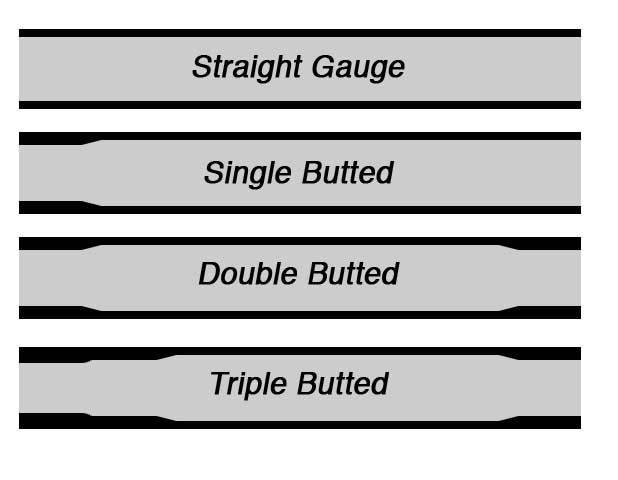
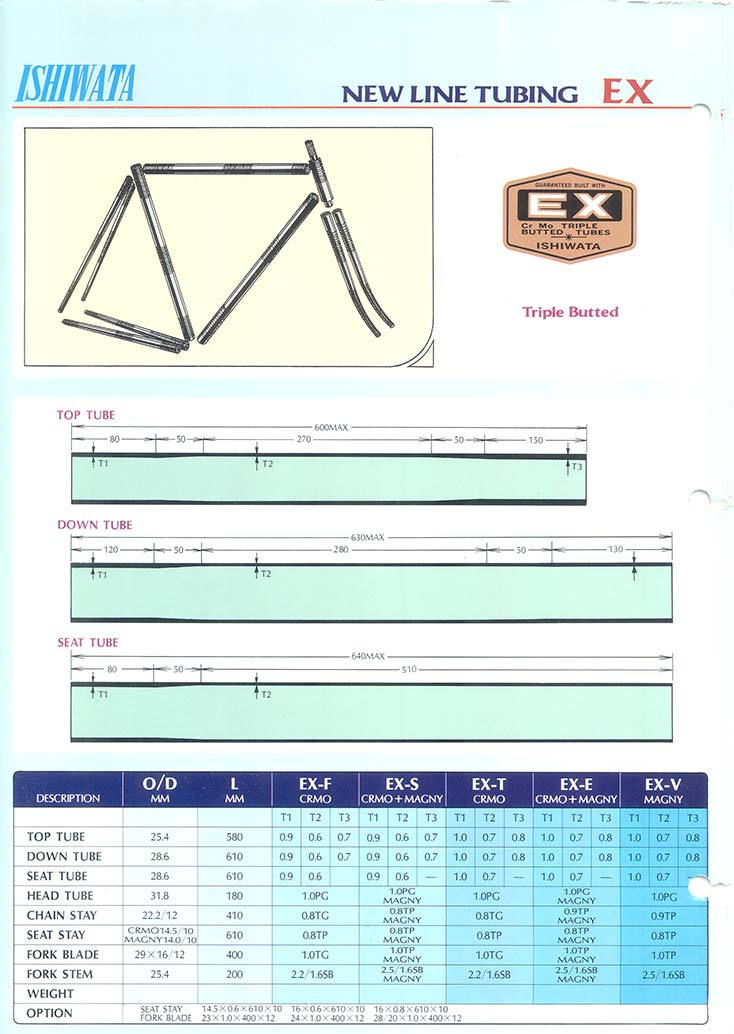
Maybe, like "clincher", the defintion of "triple butted" has changed with time. However, the above illustration does not represent the triple butted tubes employed by companies
such as Ishiwata, Fuji and Miyata, in the 1980s. Those triple butted tubes had only a single butt at each end, like a double butted tube, but unlike a double butted tube, the butts were a different thickness.
This was a slightly more sophisticated approach than double butting, allowing the designer more flexibility in achieving the desired frame characteristics. Traditonally, the thicker of the two ends was employed at the bottom bracket end of the down tube and seat tube, and the head tube end of the top tube. Depending on the actual gauges of the tubes selected, it could result in a stiffer frame and slightly heavier frame or a more compliant and slightly lighter frame. So, whether or not is better than double butted will depend on the gauges selected by the designer, your frame characteristics preference and how sensitive you are to the differences. Most cyclists can't feel the difference.
Attached is a page from an Ishiwata catalog showing their EX series of triple butted tubesets. Note how the construction is essentially a double butted tube but with each butt having a different thickness.
such as Ishiwata, Fuji and Miyata, in the 1980s. Those triple butted tubes had only a single butt at each end, like a double butted tube, but unlike a double butted tube, the butts were a different thickness.
This was a slightly more sophisticated approach than double butting, allowing the designer more flexibility in achieving the desired frame characteristics. Traditonally, the thicker of the two ends was employed at the bottom bracket end of the down tube and seat tube, and the head tube end of the top tube. Depending on the actual gauges of the tubes selected, it could result in a stiffer frame and slightly heavier frame or a more compliant and slightly lighter frame. So, whether or not is better than double butted will depend on the gauges selected by the designer, your frame characteristics preference and how sensitive you are to the differences. Most cyclists can't feel the difference.
Attached is a page from an Ishiwata catalog showing their EX series of triple butted tubesets. Note how the construction is essentially a double butted tube but with each butt having a different thickness.
 07-20-22 | 07:14 PM
#16
Crawlin' up, flyin' down
Joined: Jan 2006
Posts: 6,765
Likes: 4,421
From: Democratic Peoples' Republic of Berkeley
Bikes: 1967 Paramount; 1982-ish Ron Cooper; 1978 Eisentraut "A"; two mid-1960s Cinelli Speciale Corsas; and others in various stages of non-rideability.
Amen. This applies as well to frames, components, tires, marriages . . . .
__________________
"I'm in shape -- round is a shape." Andy Rooney
"I'm in shape -- round is a shape." Andy Rooney
Last edited by bikingshearer; 07-21-22 at 11:15 AM.


 07-21-22 | 09:32 AM
#18
Bike Butcher of Portland
Joined: Jul 2014
Posts: 12,487
Likes: 8,057
From: Portland, OR
Bikes: It's complicated.
Maybe, like "clincher", the defintion of "triple butted" has changed with time. However, the above illustration does not represent the triple butted tubes employed by companies
such as Ishiwata, Fuji and Miyata, in the 1980s. Those triple butted tubes had only a single butt at each end, like a double butted tube, but unlike a double butted tube, the butts were a different thickness.
such as Ishiwata, Fuji and Miyata, in the 1980s. Those triple butted tubes had only a single butt at each end, like a double butted tube, but unlike a double butted tube, the butts were a different thickness.
On the other hand...
From Kaisei:

Kaisei 019E CR-MO Quadruple Butted Tubing
Chromium Molybdenum (CRMO)
Top Tube: Outer Diam- 25.4mm / Length- 580mm / Wall Thickness- 0.8mm> 0.5mm> 0.4mm> 0.7mm
Down Tube: Outer Diam- 28.6mm / Length- 630mm / Wall Thickness- 0.8mm> 0.5mm> 0.4mm> 0.8mm
Seat Tube: Outer Diam- 28.6mm / Length- 610mm / Wall Thickness- 0.8mm> 0.5mm> 0.4mm> 0.7mm
Head Tube: Outer Diam- 31.8mm / Length- 180mm / Wall Thickness- 1.0mm-
Chain Stays: Outer Diam 1-22.2 mm / Outer Diam 2- 12mm / Length- 410mm / Wall Thickness- 0.8mm-
Seat Stays: Outer Diam 1- mm / Outer Diam 2- mm / Length- mm / Wall Thickness- mm-
Fork Blades: Outer Diam 1- 28/20mm / Outer Diam 2- 12mm / Length- 400mm / Wall Thickness- 0.95mm-
Fork Steerer: Outer Diam- 25.4mm / Length- 200mm / Wall Thickness- 2.2mm> 1.6mm
The three main tubes on this set are clearly stepped down more than once.
__________________
If someone tells you that you have enough bicycles and you don't need any more, stop talking to them. You don't need that kind of negativity in your life.
If someone tells you that you have enough bicycles and you don't need any more, stop talking to them. You don't need that kind of negativity in your life.
07-21-22 | 09:38 AM
#19
Banned.
Joined: Jan 2022
Posts: 1,070
Likes: 585
I confess, I've probably bragged about triple butted, just because it was on the decal.
I'm pretty sure I also answered, when asked if it was better, something like "well, they say it is."
Also, there is a slight hesitation when someone brings "butted" into the conversation.
To remind myself to think right.
I'm pretty sure I also answered, when asked if it was better, something like "well, they say it is."
Also, there is a slight hesitation when someone brings "butted" into the conversation.
To remind myself to think right.

 07-21-22 | 10:27 AM
#22
Bike Butcher of Portland
Joined: Jul 2014
Posts: 12,487
Likes: 8,057
From: Portland, OR
Bikes: It's complicated.
That's it, I'm on the search for undecuple-butted tubing...cause I wanna go to 11
__________________
If someone tells you that you have enough bicycles and you don't need any more, stop talking to them. You don't need that kind of negativity in your life.
If someone tells you that you have enough bicycles and you don't need any more, stop talking to them. You don't need that kind of negativity in your life.
07-21-22 | 12:34 PM
#23
Senior Member
Joined: Nov 2004
Posts: 23,212
Likes: 3,123
Of course you're right, I didn't take the time to look at the picture I posted!
On the other hand...
From Kaisei:
Kaisei 019E CR-MO Quadruple Butted Tubing
Chromium Molybdenum (CRMO)
Top Tube: Outer Diam- 25.4mm / Length- 580mm / Wall Thickness- 0.8mm> 0.5mm> 0.4mm> 0.7mm
Down Tube: Outer Diam- 28.6mm / Length- 630mm / Wall Thickness- 0.8mm> 0.5mm> 0.4mm> 0.8mm
Seat Tube: Outer Diam- 28.6mm / Length- 610mm / Wall Thickness- 0.8mm> 0.5mm> 0.4mm> 0.7mm
Head Tube: Outer Diam- 31.8mm / Length- 180mm / Wall Thickness- 1.0mm-
Chain Stays: Outer Diam 1-22.2 mm / Outer Diam 2- 12mm / Length- 410mm / Wall Thickness- 0.8mm-
Seat Stays: Outer Diam 1- mm / Outer Diam 2- mm / Length- mm / Wall Thickness- mm-
Fork Blades: Outer Diam 1- 28/20mm / Outer Diam 2- 12mm / Length- 400mm / Wall Thickness- 0.95mm-
Fork Steerer: Outer Diam- 25.4mm / Length- 200mm / Wall Thickness- 2.2mm> 1.6mm
The three main tubes on this set are clearly stepped down more than once.
On the other hand...
From Kaisei:
Kaisei 019E CR-MO Quadruple Butted Tubing
Chromium Molybdenum (CRMO)
Top Tube: Outer Diam- 25.4mm / Length- 580mm / Wall Thickness- 0.8mm> 0.5mm> 0.4mm> 0.7mm
Down Tube: Outer Diam- 28.6mm / Length- 630mm / Wall Thickness- 0.8mm> 0.5mm> 0.4mm> 0.8mm
Seat Tube: Outer Diam- 28.6mm / Length- 610mm / Wall Thickness- 0.8mm> 0.5mm> 0.4mm> 0.7mm
Head Tube: Outer Diam- 31.8mm / Length- 180mm / Wall Thickness- 1.0mm-
Chain Stays: Outer Diam 1-22.2 mm / Outer Diam 2- 12mm / Length- 410mm / Wall Thickness- 0.8mm-
Seat Stays: Outer Diam 1- mm / Outer Diam 2- mm / Length- mm / Wall Thickness- mm-
Fork Blades: Outer Diam 1- 28/20mm / Outer Diam 2- 12mm / Length- 400mm / Wall Thickness- 0.95mm-
Fork Steerer: Outer Diam- 25.4mm / Length- 200mm / Wall Thickness- 2.2mm> 1.6mm
The three main tubes on this set are clearly stepped down more than once.
However, the fourth butt is not a butt in the traditonal sense. Basically, it's a triple butted tube with a mid-section that has long gradual taper(s) to the thinnest section of the tube. So, in that sense there is no additional step down, it's more of a ramp. See attached illustration from a Kaisei catalog. Note that this is the same illustration previously used by Ishiwata. In these illustrations, T1 is the thickest section, followed by T4, then T2 and T3, in order of decreasing thickness.

 07-21-22 | 02:35 PM
#25

Old fart

Joined: Nov 2004
Posts: 26,404
Likes: 5,338
From: Appleton WI
Bikes: Several, mostly not name brands.
IIRC, "triple butting" only applied to the head tube end of the down tube, to put a little more "meat" on the tube where the shift lever bosses would be brazed.
Tange "Infinity" tubing used a long, gradual taper instead of the fairly abrupt tapers on traditional butted tubes.
And then there's this:
https://www.dailymotion.com/video/x6qglec
Tange "Infinity" tubing used a long, gradual taper instead of the fairly abrupt tapers on traditional butted tubes.
And then there's this:
https://www.dailymotion.com/video/x6qglec