


Frames and Framebuilding (1988) Frame Flex
 07-23-23 | 02:31 PM
#1

Thread Starter
Senior Member


Joined: Aug 2010
Posts: 2,419
Likes: 5,534
From: Central Florida, USA
Bikes: Litespeed (9); Slingshot (7); Specialized (3); Kestrel (2); Trek (2); Cervelo (1); FELT (1); Quintana Roo (1)
Frames and Framebuilding (1988) Frame Flex

__________________
WTB: Slingshot bicycle promotional documents (catalog, pamphlets, etc).
WTB: American Cycling May, Jul, Aug, Oct, 1966.
WTB: Bicycle Guide issues 1984 (any); Dec 1985; Apr 1994; May, Jun 1996; May 1997.
WTB: bicyclist May, Dec 1997: Jun-Dec 1998.
WTB: Bike World issue Jun 1974.
WTB: Litespeed head badge (circa 2000)
WTB: Slingshot bicycle promotional documents (catalog, pamphlets, etc).
WTB: American Cycling May, Jul, Aug, Oct, 1966.
WTB: Bicycle Guide issues 1984 (any); Dec 1985; Apr 1994; May, Jun 1996; May 1997.
WTB: bicyclist May, Dec 1997: Jun-Dec 1998.
WTB: Bike World issue Jun 1974.
WTB: Litespeed head badge (circa 2000)


 07-23-23 | 04:10 PM
#2

The Wheezing Geezer
Joined: Oct 2021
Posts: 1,852
Likes: 1,951
From: Española, NM
Bikes: 1976 Fredo Speciale, Rivendell Clem Smith Jr., Libertas mixte, Raleigh Super Record mixte
Perhaps pneumatic compression works the same way with flexible tires - most of the energy is returned to the road...
__________________
Beneath the valley of the underbikers.
Beneath the valley of the underbikers.
07-23-23 | 04:25 PM
#3
Senior Member
Joined: Apr 2015
Posts: 4,272
Likes: 1,304
From: Seattle
Yes. Movement of air within a pneumatic tire costs very little energy. As long as the tire isn't overinflated (i.e. it's able to serve as suspension), the primary contributor to rolling resistance is the energy that gets lost from flex in the tread, casing, inner tube, etc. This can be improved by using materials or layups that produce less internal damping (i.e. less energy is converted to heat when you flex them), and by just flat-out using less material. This is the primary reason that racing tires typically have very lightweight construction, far moreso than direct benefits of weight savings.
07-23-23 | 04:50 PM
#4

Senior Member


Joined: Apr 2009
Posts: 3,707
Likes: 5,488
From: Seattle
Whether rolling or sitting still, the air isn't compressing and uncompressing, it's nearly constant. Totally constant on a smooth surface, only increasing a tiny bit for a brief instant when hitting bumps. That increase is not what holds you up; the tire casing would hold you up just the same even if the pressure didn't go up one bit.
The materials that make a tire have some hysteresis (energy loss from flexing), but especially the rubber — less so in the casing fibers. I'm gonna go out on a limb and predict that energy loss from heating the air in your tire will be below the threshold of "measurable", definitely way below the threshold of "where I start to give a damn".
Energy isn't "returned" to the road, since we don't get energy from the road. (Apologies if that was joshing, I couldn't tell.) I guess theoretically, a bike tire heats the pavement up a little as it passes, but that has got to be the tiniest fraction of where our energy goes. I'm pretty sure all scientists who've studied this agree, almost all the energy that goes into rolling resistance goes into the rubber, via hysteresis.
Bike frames and other metal parts have much lower hysteresis than rubber, which is why flex in frames, cranks, handlebars etc. doesn't waste energy (or not enough to bother mentioning), while tires flexing does.
I disagree with your .sig also! So did Francesco Moser, who set the hour record using probably the heaviest wheels ever used in a bike race. I doubt the heavy wheels helped him much, but they sure didn't seem to hurt.
Man, am I ever argumentative! Sorry about that, science gets my blood up.
07-23-23 | 05:41 PM
#5
Senior Member
Joined: Apr 2009
Posts: 4,638
Likes: 1,251
I'm going to leave sprinting and possibly time-trialing out of consideration in my comments, because I do neither. The best frames I have ridden have a "memory" or "response" that co-operates with the (to use electronic terms) rate and quality of gain and decay of the muscle action. A stiff frame is fine.., I have a couple (Moser, Barnard).., so I understand why Klein cites the adaptive capabilities of the muscles. Whenever I get into some rough road patches, I am glad when I am riding one of my relatively-stiff frames. For day-to-day fast and long riding, though, I like a frame that co-operates (there's that word again) and integrates with the muscle action by compressing and expanding by its controlled flex, giving-weigh to the force and then returning it back in a (again, controlled) whip-like action. This means my Manufrance or Technium, which are exquisite, in this regard. I don't think my muscles like going up against an immovable object, but again, a stiff frame is your best friend when the going gets rough. These are my observations, experiences and ideas regarding the desirability of frame flex, and they are worth exactly two bits.
07-23-23 | 06:15 PM
#6
The Wheezing Geezer
Joined: Oct 2021
Posts: 1,852
Likes: 1,951
From: Española, NM
Bikes: 1976 Fredo Speciale, Rivendell Clem Smith Jr., Libertas mixte, Raleigh Super Record mixte
Air pressure holds you up off the ground only indirectly, by tensioning the tire casing, The casing is what holds you up.
Whether rolling or sitting still, the air isn't compressing and uncompressing, it's nearly constant. Totally constant on a smooth surface, only increasing a tiny bit for a brief instant when hitting bumps. That increase is not what holds you up; the tire casing would hold you up just the same even if the pressure didn't go up one bit.
The materials that make a tire have some hysteresis (energy loss from flexing), but especially the rubber — less so in the casing fibers. I'm gonna go out on a limb and predict that energy loss from heating the air in your tire will be below the threshold of "measurable", definitely way below the threshold of "where I start to give a damn".
Energy isn't "returned" to the road, since we don't get energy from the road. (Apologies if that was joshing, I couldn't tell.) I guess theoretically, a bike tire heats the pavement up a little as it passes, but that has got to be the tiniest fraction of where our energy goes. I'm pretty sure all scientists who've studied this agree, almost all the energy that goes into rolling resistance goes into the rubber, via hysteresis.
Bike frames and other metal parts have much lower hysteresis than rubber, which is why flex in frames, cranks, handlebars etc. doesn't waste energy (or not enough to bother mentioning), while tires flexing does.
I disagree with your .sig also! So did Francesco Moser, who set the hour record using probably the heaviest wheels ever used in a bike race. I doubt the heavy wheels helped him much, but they sure didn't seem to hurt.
Man, am I ever argumentative! Sorry about that, science gets my blood up.
Whether rolling or sitting still, the air isn't compressing and uncompressing, it's nearly constant. Totally constant on a smooth surface, only increasing a tiny bit for a brief instant when hitting bumps. That increase is not what holds you up; the tire casing would hold you up just the same even if the pressure didn't go up one bit.
The materials that make a tire have some hysteresis (energy loss from flexing), but especially the rubber — less so in the casing fibers. I'm gonna go out on a limb and predict that energy loss from heating the air in your tire will be below the threshold of "measurable", definitely way below the threshold of "where I start to give a damn".
Energy isn't "returned" to the road, since we don't get energy from the road. (Apologies if that was joshing, I couldn't tell.) I guess theoretically, a bike tire heats the pavement up a little as it passes, but that has got to be the tiniest fraction of where our energy goes. I'm pretty sure all scientists who've studied this agree, almost all the energy that goes into rolling resistance goes into the rubber, via hysteresis.
Bike frames and other metal parts have much lower hysteresis than rubber, which is why flex in frames, cranks, handlebars etc. doesn't waste energy (or not enough to bother mentioning), while tires flexing does.
I disagree with your .sig also! So did Francesco Moser, who set the hour record using probably the heaviest wheels ever used in a bike race. I doubt the heavy wheels helped him much, but they sure didn't seem to hurt.
Man, am I ever argumentative! Sorry about that, science gets my blood up.
My reference to energy 'returned to the road' was an allusion to the hypothesis that high tire pressures are only advantageous on smooth roads, and would be from a bump, flexing the tire rather than jiggling all bits above, as the analogy goes.
__________________
Beneath the valley of the underbikers.
Beneath the valley of the underbikers.
07-23-23 | 07:22 PM
#7
Senior Member
Joined: Apr 2015
Posts: 4,272
Likes: 1,304
From: Seattle
"When you're trying to go faster, an ounce off the wheels is worth two off the frame."
...presents it as a holistic description of how mass affects performance, which is not the case. Even if we're only looking at the high-level kinematics, there's also gravity, which on many rides consumes a much larger total energy contribution than inertia.
More broadly, mass also affects how a bike dynamically feels, and this can depend heavily on the specific distribution. For example, mass at the saddle has a larger effect on how easily a bike throws side-to-side than mass at the bottom bracket. Or if we're looking at the steering effects of gyroscopic precession, mass on the front rim has an essentially infinitely-larger effect than mass on the bottle cage.
That being said, the impacts that these things have on "performance" are extremely difficult to quantify, and it's not necessarily the case that greater mass is always detrimental with respect to them.
Or, put another way...
If you know the correct coefficient for the simplifying assumption that the rotating weight is all at the radius, do tell.
...Unless caveats are added to make the matter more specific, it's a loaded question. You can't reduce the effect of placing additional mass on the rim versus the frame to a single generally-applicable number.
07-23-23 | 07:33 PM
#8
Senior Member
Joined: Apr 2009
Posts: 3,707
Likes: 5,488
From: Seattle
I believe my signature is a concise statement of the physics, and not an exaggeration. At least, nobody answered my points last time around - they were too busy congratulating themselves in the 'how to learn' thread, iirc. If you know the correct coefficient for the simplifying assumption that the rotating weight is all at the radius, do tell..
Would you agree that weight at the rims or tires only matters 2x as much as weight on the frame and elsewhere when accelerating? If you agree with that, then we're on the same page. If you disagree, then I think you have diverged from the thinking of every scientist I've ever heard on the subject.
When climbing at a steady rate, rotating weight does matter, but only the same amount as frame etc. Both matter equally, an ounce = an ounce.
When riding at a steady rate on the flat (as with the hour record on the track), neither rotating weight nor frame etc weight matter except for the tiny influence they have on rolling resistance. But the whole range of wheel weights from lightest to heaviest is not enough to affect the RR to a degree worth worrying about, even for racers. Thus Moser's extra-heavy wheels when he broke the hour record.
So, an ounce on the rims or tires truly is worth two on the rest of the bike, with respect to acceleration (only).
Since we humans are capable of only weak acceleration, especially at racing speeds (like the sprint at the end of a road race), this effect gets swamped by more powerful factors like aero drag. And the time we spend accelerating, as a fraction of time spent on the bike, is minuscule. So overall, slower accel due to rim weight is lost in the noise, unimportant for most riding.
About the only common scenario where it matters enough for me to care about is "spirited" stop-and-go city riding, where you're repeatedly sprinting away from stop signs and traffic lights.
Light wheels do feel snappy, and I like that feeling, and that's enough reason for a lot of us to prefer light wheels. But they won't shave much time if any from your time on a century, brevet or time trial. Or, I should say, not more than saving that same weight elsewhere on the bike, which matters if it's hilly.
I haven't taken part in this dicussion here (BF) before but I get the feeling it's been hashed and rehashed, so maybe I should shut up now. Not trying to have the last word, please go ahead and tell me where I went wrong.
Mark B

 07-23-23 | 07:48 PM
#9


bulgie mentioned Moser's heavy wheels as used to capture the Hour Record. The runner-up in the category of "heaviest wheels ever used for an hour record attempt" would likely be this guy, when he broke the "Human-Powered [Merckx rules] Hour Record."
Ondrej Sosenka (Moscow, 19.7.2005, 49.700 km)
07-23-23 | 08:11 PM
#10
Senior Member
Joined: Apr 2009
Posts: 3,707
Likes: 5,488
From: Seattle
bulgie mentioned Moser's heavy wheels as used to capture the Hour Record. The runner-up in the category of "heaviest wheels ever used for an hour record attempt" would likely be this guy, when he broke the "Human-Powered [Merckx rules] Hour Record."
Ondrej Sosenka (Moscow, 19.7.2005, 49.700 km)

"a 3.2 kg wheel" — as in weight of ONE wheel?

Yep, that's hefty. And you can't be a slowpoke to beat Chris Boardman.
07-23-23 | 09:02 PM
#11

Slowfoot
Joined: Dec 2009
Posts: 146
Likes: 351
From: Reston, VA
Bikes: 1975 Raleigh International | 1979 Scapin | 1980 Trek 715 | 1984 SR Maxima | 1993 Bridgestone RB1 | 1996 Trek 5200 OCLV | 1998 753 Waterford X-12
"He then had a group of local racers ride each bike and fill out questionnaires concerning their impressions of frame stiffness and ride qualities. He found that the test group could not correctly identify which bike was different, even though 17 of the 18 riders claimed they could."
Cringing at this - thinking back on my sound mixer days claiming we could hear this or that nuance in this or that sound system. CD vs mp3 double blind anyone? Gradually losing my hearing has been the great equalizer of my hubris. But I can still hear "passing on left" pretty well when I'm on the W&OD trail - and I hear it a lot.
Cringing at this - thinking back on my sound mixer days claiming we could hear this or that nuance in this or that sound system. CD vs mp3 double blind anyone? Gradually losing my hearing has been the great equalizer of my hubris. But I can still hear "passing on left" pretty well when I'm on the W&OD trail - and I hear it a lot.
 07-23-23 | 10:37 PM
#12
The Wheezing Geezer
Joined: Oct 2021
Posts: 1,852
Likes: 1,951
From: Española, NM
Bikes: 1976 Fredo Speciale, Rivendell Clem Smith Jr., Libertas mixte, Raleigh Super Record mixte
It might be that we agree more than disagree and it's just some word choice that separates us.
Would you agree that weight at the rims or tires only matters 2x as much as weight on the frame and elsewhere when accelerating? If you agree with that, then we're on the same page.
...
So, an ounce on the rims or tires truly is worth two on the rest of the bike, with respect to acceleration (only).
...
I haven't taken part in this dicussion here (BF) before but I get the feeling it's been hashed and rehashed, so maybe I should shut up now. Not trying to have the last word, please go ahead and tell me where I went wrong.
Mark B
Would you agree that weight at the rims or tires only matters 2x as much as weight on the frame and elsewhere when accelerating? If you agree with that, then we're on the same page.
...
So, an ounce on the rims or tires truly is worth two on the rest of the bike, with respect to acceleration (only).
...
I haven't taken part in this dicussion here (BF) before but I get the feeling it's been hashed and rehashed, so maybe I should shut up now. Not trying to have the last word, please go ahead and tell me where I went wrong.
Mark B
For mass at the rim, it's a concise statement of the impact on inertia. However, the statement...
"When you're trying to go faster, an ounce off the wheels is worth two off the frame."
...presents it as a holistic description of how mass affects performance, which is not the case.
"When you're trying to go faster, an ounce off the wheels is worth two off the frame."
...presents it as a holistic description of how mass affects performance, which is not the case.
Perhaps "When you're trying to go faster..." is the click-bait version.
__________________
Beneath the valley of the underbikers.
Beneath the valley of the underbikers.
07-23-23 | 10:55 PM
#13

Senior Member

Joined: Oct 2014
Posts: 14,153
Likes: 5,275
From: Portland, OR
Bikes: (2) ti TiCycles, 2007 w/ triple and 2011 fixed, 1979 Peter Mooney, ~1983 Trek 420 now fixed and ~1973 Raleigh Carlton Competition gravel grinder
I was a long, skinny climber with small lung capacity and virtually no fast twitch muscles. I raced the lightest wheels I could afford and that were New England roads worthy. The place where that matter so much to me was all the little and not so little accelerations the field did over the course of a race. All the gaps I had to close. Very light wheels meant I arrived where I needed to be sooner and spent both less "grunt" and less time at power to get on that wheel. Simply real over the course of hours. (My wheels - Criterium Seta tires (259 g), Ergal (290 g) and for one years, a Medaille d'Or (260g) front rim. 36 spoke 3X with 15-17 ga spokes. Rode my fastest and hardest race on matt tread Criterium Setas at 220 g. (Fastest and hardest race and ride I've ever done. By a lot. Don't regret the light wheels at all. Even though I dented both rims on the railroad tracks a mile before the finish.)
Now, the guys with legs to snap their bikes onto that wheel instantly, my wheels would have made little difference. I'd have to get reincarnated to have those legs. Now, 45 years later I am back onto almost those wheels (one bike - GEL330s and Veloflex Protours) and I get reminded every ride why I loved those wheels so much.
Now, the guys with legs to snap their bikes onto that wheel instantly, my wheels would have made little difference. I'd have to get reincarnated to have those legs. Now, 45 years later I am back onto almost those wheels (one bike - GEL330s and Veloflex Protours) and I get reminded every ride why I loved those wheels so much.
07-24-23 | 12:00 AM
#14
The Wheezing Geezer
Joined: Oct 2021
Posts: 1,852
Likes: 1,951
From: Española, NM
Bikes: 1976 Fredo Speciale, Rivendell Clem Smith Jr., Libertas mixte, Raleigh Super Record mixte
With regard to the article, the conventional wisdom in the mid '70s was that stiffer is better, alright. Track-bike clearances on road bikes became kind of a fad. When I built Fredo in 1976, I didn't want to go that far, but wanted a stiff frame, especially since it would have the disadvantage of a large size, 26", or 66cm. I went with 75°/75° angles and a fairly short wheelbase of 39.5", which still has no toe overlap, and can run 28mm tires in the rear.
One other thing Colin Laing had me do was use a straight-gauge, not doubled-butted, tube for the down tube, Columbus iirc, with the rest of the frame being Reynolds 531.
One other thing Colin Laing had me do was use a straight-gauge, not doubled-butted, tube for the down tube, Columbus iirc, with the rest of the frame being Reynolds 531.
__________________
Beneath the valley of the underbikers.
Beneath the valley of the underbikers.
 07-25-23 | 01:05 PM
#16

Senior Member
Joined: Feb 2008
Posts: 5,305
Likes: 4,801
From: Peoria, IL
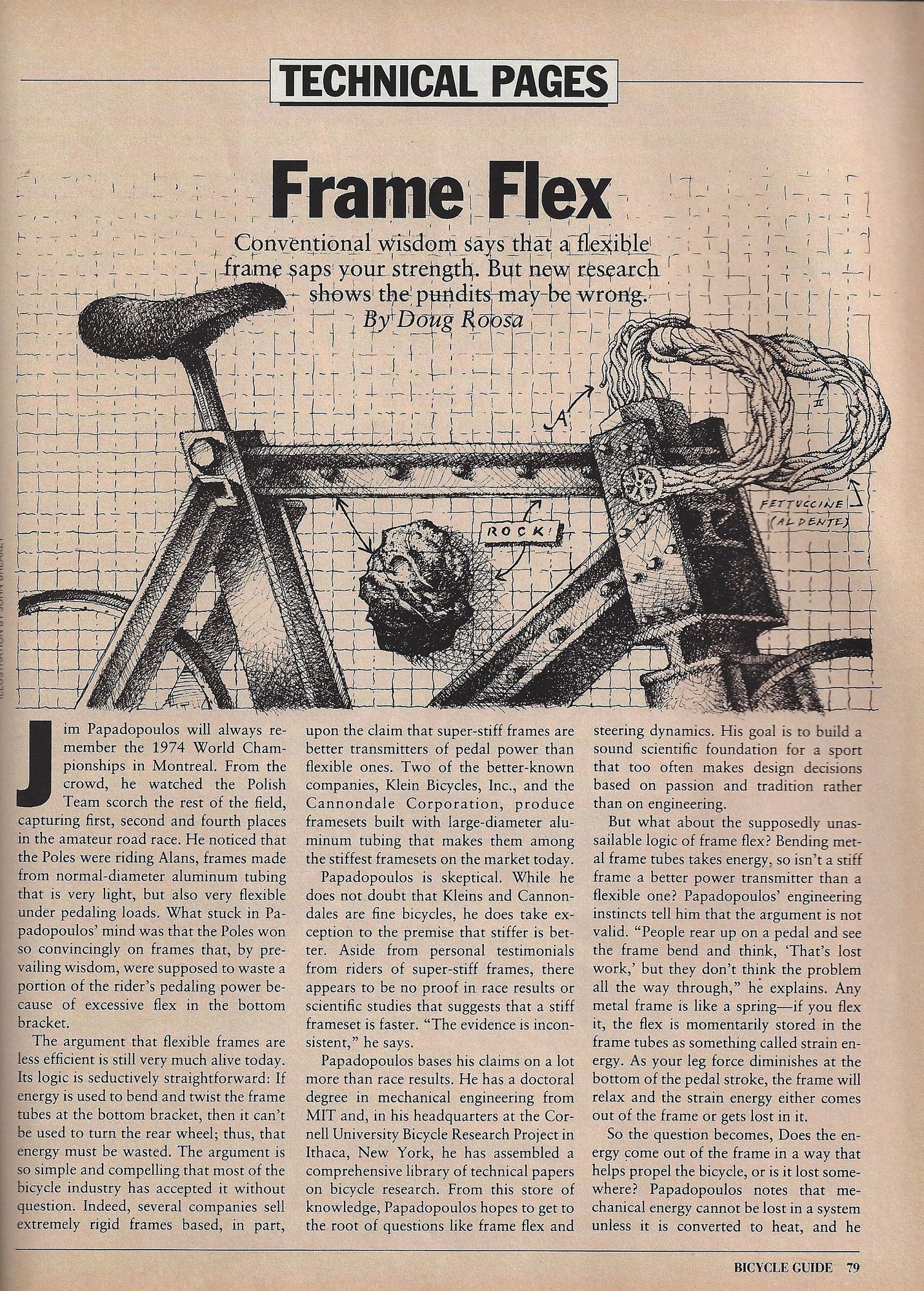
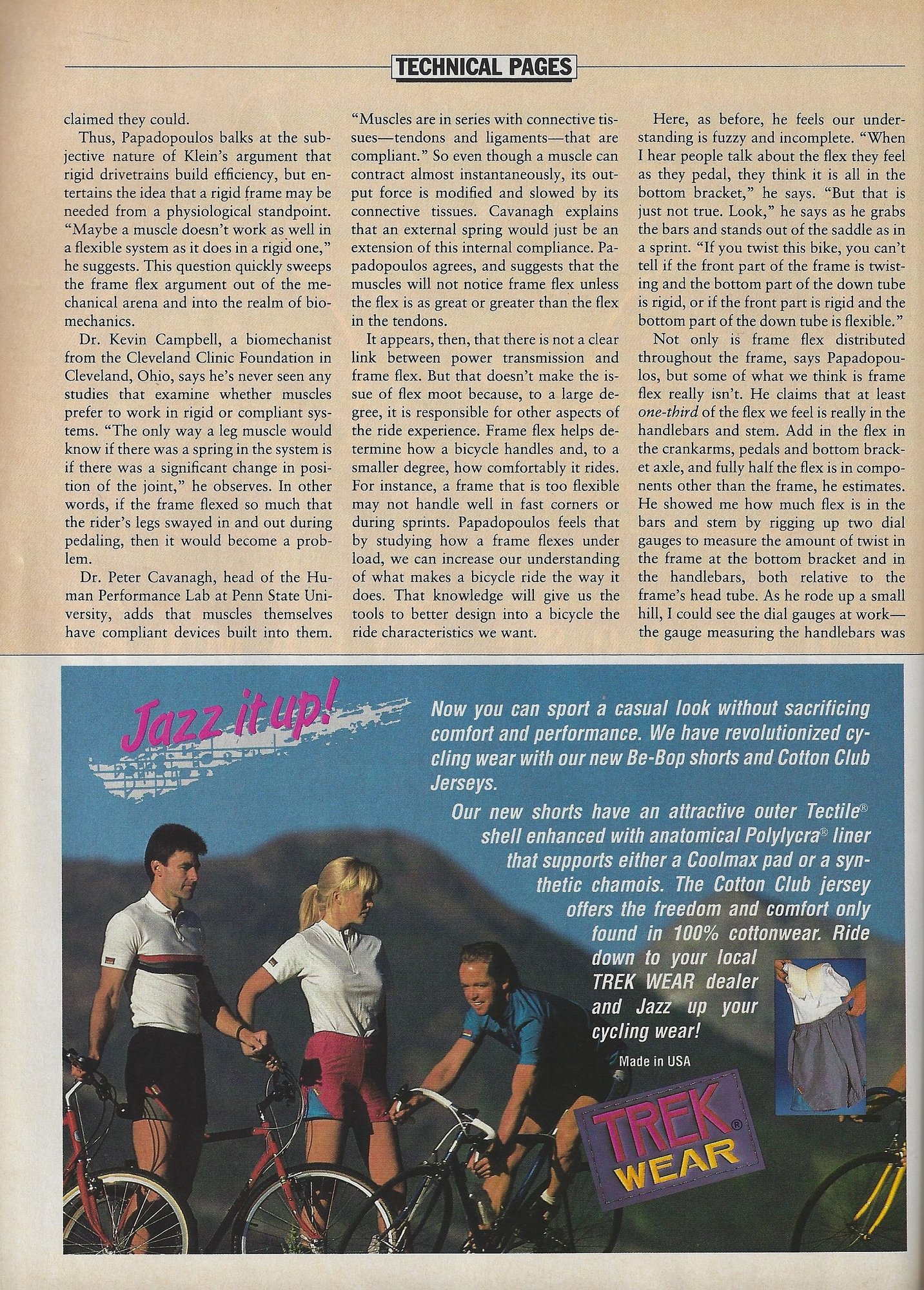
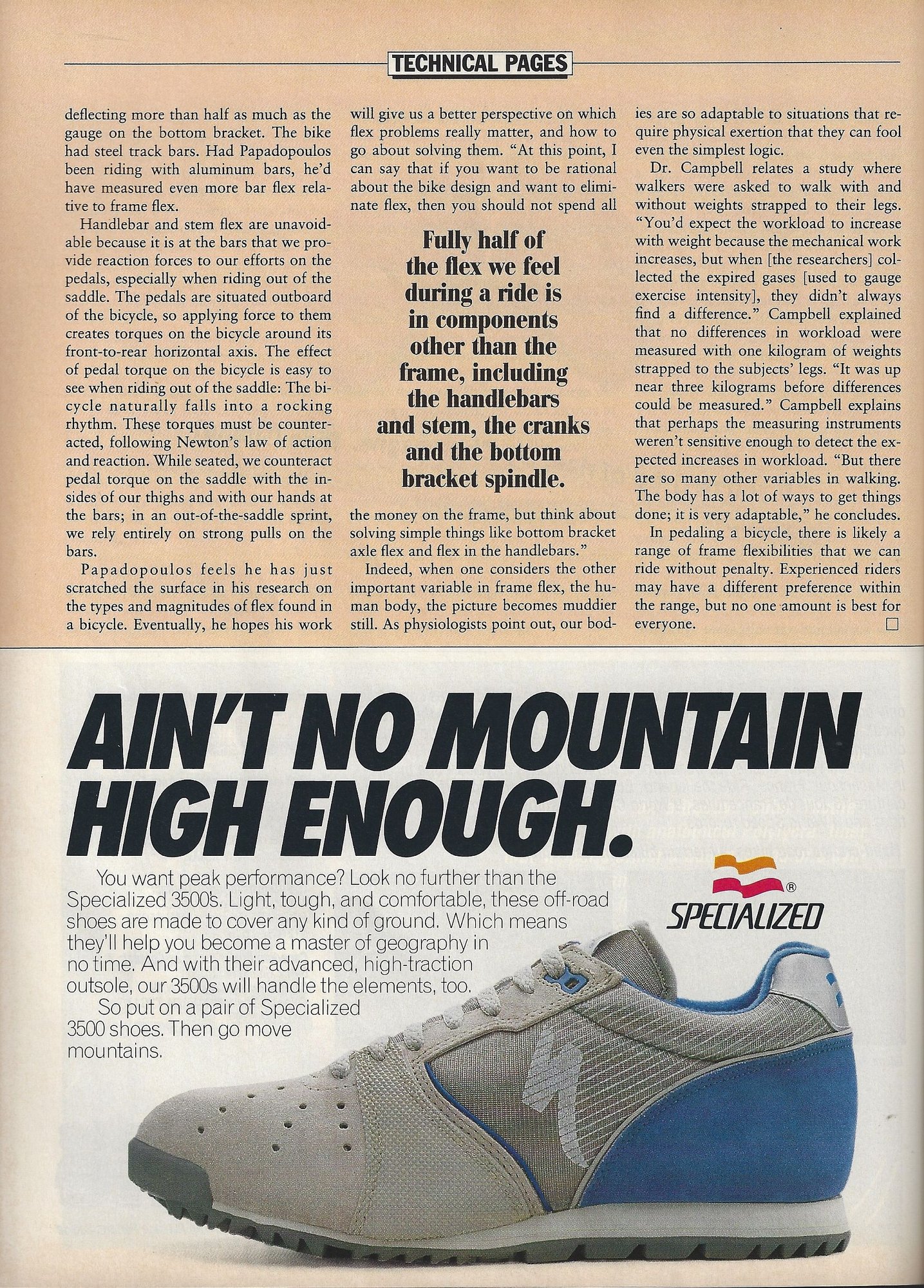
Great article! I guess the "planing" theory began well before Jan Heine??
I did like that Mr. Popadopolous ran an experiment in stiffness:
Too bad that there isn't more info on this.
How much stiffer was the one stiff frame? Even if the riders couldn't identify the stiff one, did they get better or worse results on it?
I imagine that to really explore this topic would require plenty of funding and time, unfortunately.
I did enjoy this observation regarding sources of flex....
The bike industry did go after bottom bracket axle flex by introducing various designs with larger diameter axles. I assume that larger diameter steerer tubes and modern bar and stem designs have reduced flex too. I wonder if there has been any effort to link the stiffness with better race results?
Steve in Peoria
I did like that Mr. Popadopolous ran an experiment in stiffness:
... he had a local framebuilder, Glen Swan, construct three steel bicycles that were identical save for the differences in the frame tubing; the variations in tubing gave one bike more stiffness. ... Papadopoulos found that the test group could not correctly identify which bike was different...
How much stiffer was the one stiff frame? Even if the riders couldn't identify the stiff one, did they get better or worse results on it?
I imagine that to really explore this topic would require plenty of funding and time, unfortunately.
I did enjoy this observation regarding sources of flex....
At this point, I can say that if you want to be rational about the bike design and want to eliminate flex, then you should not spend all the money on the frame, but think about solving things like bottom bracket axle flex and flex in the handlebars.
Steve in Peoria
07-26-23 | 02:52 PM
#17
Live not by lies.
Joined: Nov 2020
Posts: 1,343
Likes: 837
Bikes: BigBox bikes.
"He then had a group of local racers ride each bike and fill out questionnaires concerning their impressions of frame stiffness and ride qualities. He found that the test group could not correctly identify which bike was different, even though 17 of the 18 riders claimed they could."
Cringing at this - thinking back on my sound mixer days claiming we could hear this or that nuance in this or that sound system. CD vs mp3 double blind anyone? Gradually losing my hearing has been the great equalizer of my hubris. But I can still hear "passing on left" pretty well when I'm on the W&OD trail - and I hear it a lot.
Cringing at this - thinking back on my sound mixer days claiming we could hear this or that nuance in this or that sound system. CD vs mp3 double blind anyone? Gradually losing my hearing has been the great equalizer of my hubris. But I can still hear "passing on left" pretty well when I'm on the W&OD trail - and I hear it a lot.
