


Bike Compound/Polish Chart
 10-03-23 | 04:37 PM
#1
Thread Starter
Amateur Member

Joined: Mar 2021
Posts: 5,251
Likes: 8,717
From: SoCal
Bikes: Cuevas & Cimmaron are my full time riders, small MB-3 and large Competition GS are my sometimers
Bike Compound/Polish Chart
I had been reading through various threads about refinishing frames and kept seeing different advice. I was having a hard time understanding which products were "more aggressive" than others. I found this chart (which is a bit out dated) but does provide some good comparison info. If anyone has a better or more current way to reference this info please share.
Helped me understand Meguiars products easier than their website:

Obviously not bike specific, taken from - https://www.autopia.org/forums/paint...son-chart.html
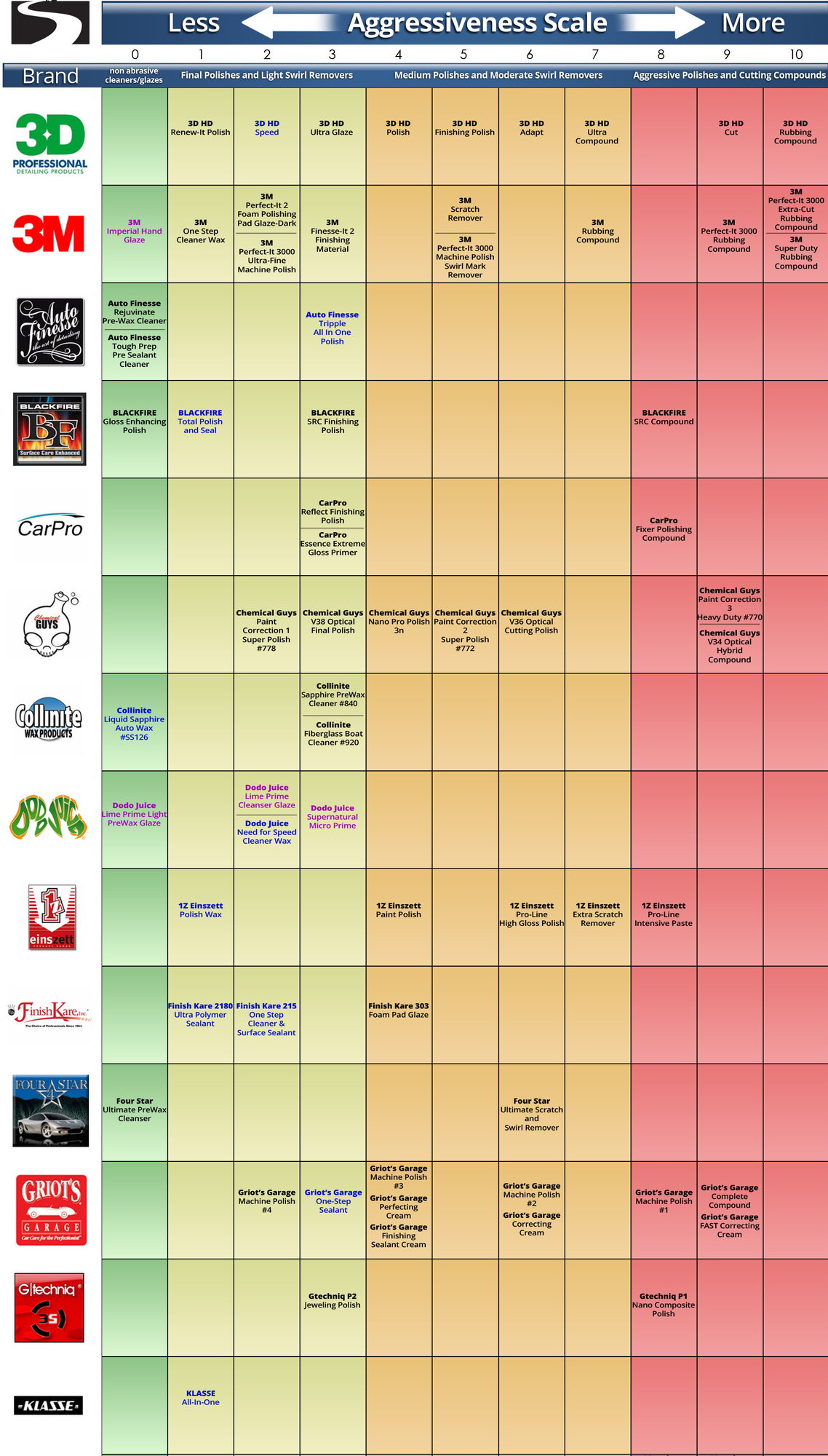
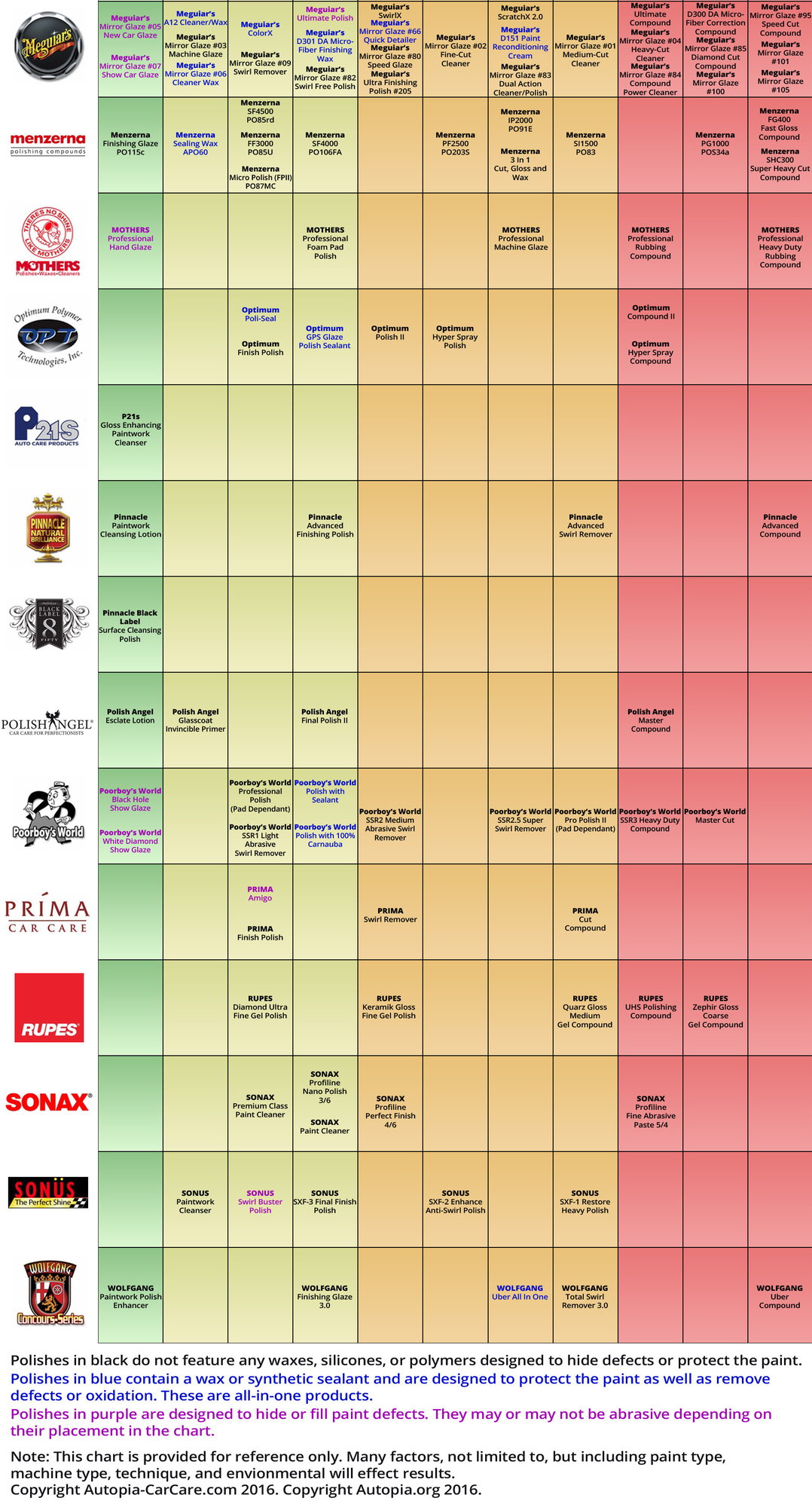
Helped me understand Meguiars products easier than their website:
Obviously not bike specific, taken from - https://www.autopia.org/forums/paint...son-chart.html
Last edited by SoCaled; 10-03-23 at 04:46 PM. Reason: Re-formatted to make more readable



 10-03-23 | 05:42 PM
#2
Senior Member


Joined: Jul 2010
Posts: 1,788
Likes: 722
Long story short, paint has certain thickness. If the paint is in bad shape there are products that will pretty much strip the top layer of paint allowing fresh paint to shine through. There is just so many times you can get away with those.
You would want the product that is the least aggressive for the existing condition and result you want.
You would want the product that is the least aggressive for the existing condition and result you want.
10-03-23 | 09:04 PM
#3

Senior Member

Joined: May 2012
Posts: 5,056
Likes: 4,923
From: Point Reyes Station, California
Bikes: Indeed!
Thanks for the chart! I too have been baffled by the array of available products and their relative aggressiveness.
Brent
Brent
__________________
"I have a tendency to meander sometimes." B.G.
"I have a tendency to meander sometimes." B.G.
10-03-23 | 11:25 PM
#4

Test, don’t guess. I have a number of bikes and some cannot tolerate a product that works wonders on a different bike.
many of the Meguiars compounds have a bit of safety built in, the abrasive erodes fast. Reducing scratching.
one idea I got by watching an auto detailer, mask off a pin stripe and polish each side of the stripe separately, saves wear on the pin stripe itself.
Time is on no consequence.
many of the Meguiars compounds have a bit of safety built in, the abrasive erodes fast. Reducing scratching.
one idea I got by watching an auto detailer, mask off a pin stripe and polish each side of the stripe separately, saves wear on the pin stripe itself.
Time is on no consequence.
10-04-23 | 12:16 AM
#5

Senior Member


Joined: Oct 2015
Posts: 16,174
Likes: 9,549
From: PDX
Bikes: Merz x 5 + Specialized Merz Allez x 2, Strawberry/Newlands/DiNucci/Ti x3, Gordon, Fuso/Moulton x2, Bornstein, Paisley,1958-74 Paramounts x3, 3rensho, 74 Moto TC, 73-78 Raleigh Pro's x5, Marinoni x2, 1960 Cinelli SC, 1980 Bianchi SC, PX-10 X 2
This is a dark art, patience and caution are key, very measured elbow grease is often the main ingredient.
Many techniques can be employed, adding water, soap, using the polish as the soap, cloths and rags, etc, etc.
Knowing when to get aggressive, when to use a solvent to get something nasty off and knowing how to do it without ruining the paint so you can polish the trouble spot.
The learning is endless and if you're careful you can figure out a lot of very serious problems.
Many techniques can be employed, adding water, soap, using the polish as the soap, cloths and rags, etc, etc.
Knowing when to get aggressive, when to use a solvent to get something nasty off and knowing how to do it without ruining the paint so you can polish the trouble spot.
The learning is endless and if you're careful you can figure out a lot of very serious problems.
10-04-23 | 01:18 AM
#6
Senior Member
Joined: Jul 2013
Posts: 2,611
Likes: 919
From: So Cal, for now
Bikes: 1974 Bob Jackson - Nuovo Record, Brooks Pro, Clips & Straps
That is a GREAT chart. Thanks for that.
In polishing lacquer finishes, I often use paraffin oil as a medium to carry the grit. It lubricates the work piece, creates a slurry of grit & lacquer but is slow to evaporate.
In polishing lacquer finishes, I often use paraffin oil as a medium to carry the grit. It lubricates the work piece, creates a slurry of grit & lacquer but is slow to evaporate.
10-04-23 | 03:42 AM
#7

Freewheel Medic


Joined: Oct 2005
Posts: 13,569
Likes: 3,314
From: An Island on the Coast of GA!
Bikes: Snazzy* Schwinns, Classy Cannondales & a Super Pro Aero Lotus (* Ed.)
Perfect Halloween metaphor at the beginning of October as the daylight hours noticeably decline.
__________________
Bob
Enjoying the GA coast all year long!
Thanks for visiting my website: www.freewheelspa.com
Bob
Enjoying the GA coast all year long!
Thanks for visiting my website: www.freewheelspa.com
10-04-23 | 11:46 AM
#9
If I read that chart correctly no brand included make (or made 7 years back) a non-cleaner (containing no abrasives) paste wax.
Plenty of "polishes, cleansers and glazes" and lotions of another name (thank you, Marketing Dept.!) in the "green column" but only one Collinite Liquid Sapphire Auto Wax has "wax" in the name. and clearly it's also called "liquid". I doubt any actual sapphires were used (or harmed) in the formulation of this product.
But noting some Mother's products are in the chart but AFAIK they still sell this Claimed-to-be non-abrasive, non-cleaner paste wax (containing genuine Carnauba wax, or so claimed) and has been on the market for many years (I have 2 cans that are OLD) called:
MOTHERS 05550 California Gold Pure Brazilian Carnauba Wax Paste (Ultimate Wax System, Step 3)
But read labels carefully cause there's another Mothers California Gold paste wax with nearly the same name that clearly says "Cleaner wax" on the can, but not "Step 3"
Plenty of "polishes, cleansers and glazes" and lotions of another name (thank you, Marketing Dept.!) in the "green column" but only one Collinite Liquid Sapphire Auto Wax has "wax" in the name. and clearly it's also called "liquid". I doubt any actual sapphires were used (or harmed) in the formulation of this product.
But noting some Mother's products are in the chart but AFAIK they still sell this Claimed-to-be non-abrasive, non-cleaner paste wax (containing genuine Carnauba wax, or so claimed) and has been on the market for many years (I have 2 cans that are OLD) called:
MOTHERS 05550 California Gold Pure Brazilian Carnauba Wax Paste (Ultimate Wax System, Step 3)
But read labels carefully cause there's another Mothers California Gold paste wax with nearly the same name that clearly says "Cleaner wax" on the can, but not "Step 3"
10-04-23 | 03:27 PM
#10
Thread Starter
Amateur Member
Joined: Mar 2021
Posts: 5,251
Likes: 8,717
From: SoCal
Bikes: Cuevas & Cimmaron are my full time riders, small MB-3 and large Competition GS are my sometimers
Agreed and understandable considering the various paints and application techniques used on bike over the years by all the different companies/makers. What shouldn't be a "Dark Art" IMO is what is in the compounds/cleaners? There seems to be precious little info on what "grit" is in the product, which is the important spec. Harder to determine what various chemical compositions will do to various paints/decals, but the "grit" should be straight forward
I had to do some acrylic/Plexiglas polishing for the first time a while back. Someone who previously had done the polishing, gave me the polishing system, which included 3 bottles, Novus 3, 2 & 1 to be used in that order. The kit also included wet sand paper at increasingly high grits up to 20,000 I believe. I struggled with the system following the instructions I was given and had lousy results, felt like I was re-introducing scratches as I was going, even though the sandpaper grit was getting finer and finer. After doing some research it turned out that the grit in the bottle of Novus was way more course than the sandpaper we were using Novus #2 is close to 1200 grit and #3-800 grit. If I had the correct specs on the Novus it would have saved lots of time.
For some reason the companies that make these products don't seem willing to share this info (try to find the grit info I provided for Novus, it will likely take a while, and will likely be second hand). I went on the Meguiars website and couldn't find the info, I called and could not get a person who knew. As I pointed out in my original post, the chart I posted is out of date (7 years, as others have noted), but was the only one I could find and it doesn't even supply actual specs. There are numerous posts in threads on BF and other places that suggest using products that contain abrasives when the poster is not aware there are any in the product, let alone what grit they are.
I am all for "testing" (took a while to learn) but I would love to know what the product I am testing is.
If anyone has an updated chart or "grit" info on any of these products please share.
I had to do some acrylic/Plexiglas polishing for the first time a while back. Someone who previously had done the polishing, gave me the polishing system, which included 3 bottles, Novus 3, 2 & 1 to be used in that order. The kit also included wet sand paper at increasingly high grits up to 20,000 I believe. I struggled with the system following the instructions I was given and had lousy results, felt like I was re-introducing scratches as I was going, even though the sandpaper grit was getting finer and finer. After doing some research it turned out that the grit in the bottle of Novus was way more course than the sandpaper we were using Novus #2 is close to 1200 grit and #3-800 grit. If I had the correct specs on the Novus it would have saved lots of time.
For some reason the companies that make these products don't seem willing to share this info (try to find the grit info I provided for Novus, it will likely take a while, and will likely be second hand). I went on the Meguiars website and couldn't find the info, I called and could not get a person who knew. As I pointed out in my original post, the chart I posted is out of date (7 years, as others have noted), but was the only one I could find and it doesn't even supply actual specs. There are numerous posts in threads on BF and other places that suggest using products that contain abrasives when the poster is not aware there are any in the product, let alone what grit they are.
I am all for "testing" (took a while to learn) but I would love to know what the product I am testing is.
If anyone has an updated chart or "grit" info on any of these products please share.
10-04-23 | 03:59 PM
#11
Senior Member
Joined: Oct 2015
Posts: 16,174
Likes: 9,549
From: PDX
Bikes: Merz x 5 + Specialized Merz Allez x 2, Strawberry/Newlands/DiNucci/Ti x3, Gordon, Fuso/Moulton x2, Bornstein, Paisley,1958-74 Paramounts x3, 3rensho, 74 Moto TC, 73-78 Raleigh Pro's x5, Marinoni x2, 1960 Cinelli SC, 1980 Bianchi SC, PX-10 X 2
Agreed and understandable considering the various paints and application techniques used on bike over the years by all the different companies/makers. What shouldn't be a "Dark Art" IMO is what is in the compounds/cleaners? There seems to be precious little info on what "grit" is in the product, which is the important spec. Harder to determine what various chemical compositions will do to various paints/decals, but the "grit" should be straight forward
I had to do some acrylic/Plexiglas polishing for the first time a while back. Someone who previously had done the polishing, gave me the polishing system, which included 3 bottles, Novus 3, 2 & 1 to be used in that order. The kit also included wet sand paper at increasingly high grits up to 20,000 I believe. I struggled with the system following the instructions I was given and had lousy results, felt like I was re-introducing scratches as I was going, even though the sandpaper grit was getting finer and finer. After doing some research it turned out that the grit in the bottle of Novus was way more course than the sandpaper we were using Novus #2 is close to 1200 grit and #3-800 grit. If I had the correct specs on the Novus it would have saved lots of time.
For some reason the companies that make these products don't seem willing to share this info (try to find the grit info I provided for Novus, it will likely take a while, and will likely be second hand). I went on the Meguiars website and couldn't find the info, I called and could not get a person who knew. As I pointed out in my original post, the chart I posted is out of date (7 years, as others have noted), but was the only one I could find and it doesn't even supply actual specs. There are numerous posts in threads on BF and other places that suggest using products that contain abrasives when the poster is not aware there are any in the product, let alone what grit they are.
I am all for "testing" (took a while to learn) but I would love to know what the product I am testing is.
If anyone has an updated chart or "grit" info on any of these products please share.
I had to do some acrylic/Plexiglas polishing for the first time a while back. Someone who previously had done the polishing, gave me the polishing system, which included 3 bottles, Novus 3, 2 & 1 to be used in that order. The kit also included wet sand paper at increasingly high grits up to 20,000 I believe. I struggled with the system following the instructions I was given and had lousy results, felt like I was re-introducing scratches as I was going, even though the sandpaper grit was getting finer and finer. After doing some research it turned out that the grit in the bottle of Novus was way more course than the sandpaper we were using Novus #2 is close to 1200 grit and #3-800 grit. If I had the correct specs on the Novus it would have saved lots of time.
For some reason the companies that make these products don't seem willing to share this info (try to find the grit info I provided for Novus, it will likely take a while, and will likely be second hand). I went on the Meguiars website and couldn't find the info, I called and could not get a person who knew. As I pointed out in my original post, the chart I posted is out of date (7 years, as others have noted), but was the only one I could find and it doesn't even supply actual specs. There are numerous posts in threads on BF and other places that suggest using products that contain abrasives when the poster is not aware there are any in the product, let alone what grit they are.
I am all for "testing" (took a while to learn) but I would love to know what the product I am testing is.
If anyone has an updated chart or "grit" info on any of these products please share.
A lot of it was propagated on prior knowledge and understanding the tightrope nature of it all.
Also the elixirs have a prime shelf life IMO, especially for the true magic they can sometimes achieve.
Dark art is an understatement IMO.
 10-04-23 | 05:06 PM
#12
Senior Member
Joined: Oct 2015
Posts: 16,174
Likes: 9,549
From: PDX
Bikes: Merz x 5 + Specialized Merz Allez x 2, Strawberry/Newlands/DiNucci/Ti x3, Gordon, Fuso/Moulton x2, Bornstein, Paisley,1958-74 Paramounts x3, 3rensho, 74 Moto TC, 73-78 Raleigh Pro's x5, Marinoni x2, 1960 Cinelli SC, 1980 Bianchi SC, PX-10 X 2
[MENTION=536587]SoCaled[/MENTION]
Also, the true grit is likely skewed by the emulsion, suspension, etc and not actually, directly correlated to the standard grit we like to go by.
I have a good friend who is a world class painter, we have talked about this before and I will pick his brain again.
Also, the true grit is likely skewed by the emulsion, suspension, etc and not actually, directly correlated to the standard grit we like to go by.
I have a good friend who is a world class painter, we have talked about this before and I will pick his brain again.
