Souplesse / Planing, which type of frames
 12-11-23 | 10:41 AM
#51
Senior Member

Joined: Jul 2011
Posts: 823
Likes: 340
I'm a framebuilder that prefers the ride of a .7/.4/.7 thin wall tubing bike frame with a 1" top tube. Full stop. I made my 1st very light frame out of Ishiwata 015 tubing in the late 70's. It was a weight weenie exercise. 015 tubing is even lighter with .6/.3/.6 tubing wall thickness. The whole bike weighed under 16 pounds. What surprised me about the ride of that bike was that it was not whippy or loose/goosy or seemed to flex too much when I rode it. It just rode nicely. I loaned it on one of our training rides to a Cat 2 that rode with us. He was bigger and stronger than me and went on an all out sprint up a fairly steep hill and came back and said the bike flexed too much for him. But I wasn't bigger or stronger - just a decent rider and it certainly worked very well for me.
Let's remember that Jan originally went on a hunt to figure out why he liked the ride of his French bikes (Herse or Singer or both I forget) better than his Bob Jackson. Eventually (as I recall) he came to the conclusion the difference he felt was how thin walled the tubing of the French bikes were compared to the English. And then he has tried to explain why they rode differently and I think this is where all the trouble lies. It is possible people mix up their attitudes with his definition of planing, the way he writes, how they relate to his business. In fact few people have ever ridden a 7/4/7 frame with a 1" top tube. Production companies don't make them because they are harder to manufacturer and the liability is too great. Anything that they make and it breaks can be big trouble. That is why production steel frames were always overbuilt. The exception would be the Raleigh SBDU 753 frames. Of course 753 was made with heavier walls than 7/4/7 so it is possible some of those couldn't be used as an example.
My own frames i've built for myself have 7/4/7 walls with a 1" top tube. I vastly prefer their ride over those with heavier or bigger diameter walls. Even those i've built myself. There is no debate at all in my mind as to what works best for me. And those that have never ridden a light walled bike with a 1" top tube aren't going to persuade me otherwise.
Let's remember that Jan originally went on a hunt to figure out why he liked the ride of his French bikes (Herse or Singer or both I forget) better than his Bob Jackson. Eventually (as I recall) he came to the conclusion the difference he felt was how thin walled the tubing of the French bikes were compared to the English. And then he has tried to explain why they rode differently and I think this is where all the trouble lies. It is possible people mix up their attitudes with his definition of planing, the way he writes, how they relate to his business. In fact few people have ever ridden a 7/4/7 frame with a 1" top tube. Production companies don't make them because they are harder to manufacturer and the liability is too great. Anything that they make and it breaks can be big trouble. That is why production steel frames were always overbuilt. The exception would be the Raleigh SBDU 753 frames. Of course 753 was made with heavier walls than 7/4/7 so it is possible some of those couldn't be used as an example.
My own frames i've built for myself have 7/4/7 walls with a 1" top tube. I vastly prefer their ride over those with heavier or bigger diameter walls. Even those i've built myself. There is no debate at all in my mind as to what works best for me. And those that have never ridden a light walled bike with a 1" top tube aren't going to persuade me otherwise.
Do you recall what thickness tubes Waterford used; I know it is 1” top tube.
 12-11-23 | 12:26 PM
#52
Senior Member

Joined: Nov 2019
Posts: 529
Likes: 359
From: SF Bay Area
Bikes: Raleigh Super Course, Raleigh International, Raleigh Gran Sport
Wouldn't there also be wind-up/release in the crank arm, BB spindle, rear hub and stem? This quickly gets to be a pretty complex "spring system"
12-11-23 | 01:09 PM
#53

Senior Member

Joined: Feb 2008
Posts: 5,321
Likes: 4,834
From: Peoria, IL
.... In fact few people have ever ridden a 7/4/7 frame with a 1" top tube. Production companies don't make them because they are harder to manufacturer and the liability is too great. Anything that they make and it breaks can be big trouble. That is why production steel frames were always overbuilt. The exception would be the Raleigh SBDU 753 frames. Of course 753 was made with heavier walls than 7/4/7 so it is possible some of those couldn't be used as an example.
....
....

My Hetchins is built with 531C tubing, which might(?) be a bit thinner than standard gauge, and I do find that I prefer the ride to my similar Raleigh International built with "normal" 531. Naturally, I have no way of being sure of the tube gauges, but it does seem that thinner fits my body and style better.
Steve in Peoria
12-11-23 | 01:19 PM
#54
Senior Member
Joined: Feb 2008
Posts: 5,321
Likes: 4,834
From: Peoria, IL
.....
It seems to me that springs returning energy idea, at least in my subjective assessment, works only to a limited extent, considering the example of mountain bikes with full suspension. If I ride them on streets or well packed bike paths, they simply suck the energy to never return. But they do keep me from getting sore on rough paths. 🤪
....
It seems to me that springs returning energy idea, at least in my subjective assessment, works only to a limited extent, considering the example of mountain bikes with full suspension. If I ride them on streets or well packed bike paths, they simply suck the energy to never return. But they do keep me from getting sore on rough paths. 🤪
....
An example of an undamped suspension is the Brooks Champion Flyer. I used to ride one, and the springs really soaked up the bumps! Pretty nice, and sorta felt like a severely underinflated tire. In fact, I couldn't feel a rear tire losing air, and I wouldn't know that I was getting a flat until I heard the rim banging on the road.
The downside was that if I hit a big lump in the road, the springs would compress and nearly launch me off the bike when they extended!
Well, the other downside is that the springs and the second framework add a pound (or more?) to the weight of a B.17, so it's more efficient to just lift my butt off the saddle for the few bumps that would justify the springs.
Steve in Peoria
12-11-23 | 02:47 PM
#55

Senior Member
Joined: May 2013
Posts: 2,036
Likes: 550
From: Pacific Northwest
Bikes: ‘87 Marinoni SLX Sports Tourer, ‘79 Miyata 912 by Gugificazione
I’m a retired aerospace (rockets and satellites) test engineer as well as being an avid but far from strong (at my best I was a “spinner” not a “masher”, now I’m just old and weak) bike rider. I have far fewer multiple bike ownership experiences than many of you in C&V Land, but I’ve had the pleasure of putting decent miles on several of [MENTION=401497]RiddleOfSteel[/MENTION]’s lovely creations when he still lived in Seattle.
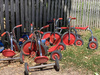
When I was still working and bike commuting 36 miles regularly, I owned the three bikes, all 62-64 cm, in the attached photo: 2003 Rivendell Rambouillet - the green one - built from in Japan with OS probably Kaisei (?) tubing and likely rather thick walls, 1987 Marinoni Sports Tourer made with Columbus SLX (maybe a thicker walled down tube given the tall frame?), and the 1979 Miyata 912 made with Tange Champion tubes. I’ve had the 912 from new, updated extensively over the decades, the Marinoni was then new (I’ve now been loving it for ten years) after realizing that I just wasn’t “falling in love” with the Riv despite 10 years of ownership expecting that it would be my Last Bike Forever. BTW, the bikes in the photo were carefully aligned parallel, so frame angle differences are as they appear.
Note that they were set up essentially identical except saddle/seatpost differences to achieve similar fits; similar gearing and bars/stems, identical cranksets. Wheels and tires were different, but all high quality 700C clinchers. For commuting, they had very similar rear SS Tubus racks carrying a single pannier.
I’d rotate through them on that longish commute and realized that whenever I rode the Riv, I wished I was on either of the other two. Being a true test engineer I swapped wheels and tires between the bikes to reduce the variables. That desire never changed and the Riv has moved on to another home. Notably the Marinoni always still feels like it wants me to push a little harder, ride farther. The Miyata doesn’t speak to me quite so clearly, but the message is still there (and it’s since been delightfully transformed into a dedicated fender bike and front-load light tourer by [MENTION=381793]gugie[/MENTION]).
Yes, I definitely feel that bike “planing” is real and largely a frame characteristic more likely felt with standard diameter double-butted steel, and not just in the realm of very strong riders.

When I was still working and bike commuting 36 miles regularly, I owned the three bikes, all 62-64 cm, in the attached photo: 2003 Rivendell Rambouillet - the green one - built from in Japan with OS probably Kaisei (?) tubing and likely rather thick walls, 1987 Marinoni Sports Tourer made with Columbus SLX (maybe a thicker walled down tube given the tall frame?), and the 1979 Miyata 912 made with Tange Champion tubes. I’ve had the 912 from new, updated extensively over the decades, the Marinoni was then new (I’ve now been loving it for ten years) after realizing that I just wasn’t “falling in love” with the Riv despite 10 years of ownership expecting that it would be my Last Bike Forever. BTW, the bikes in the photo were carefully aligned parallel, so frame angle differences are as they appear.
Note that they were set up essentially identical except saddle/seatpost differences to achieve similar fits; similar gearing and bars/stems, identical cranksets. Wheels and tires were different, but all high quality 700C clinchers. For commuting, they had very similar rear SS Tubus racks carrying a single pannier.
I’d rotate through them on that longish commute and realized that whenever I rode the Riv, I wished I was on either of the other two. Being a true test engineer I swapped wheels and tires between the bikes to reduce the variables. That desire never changed and the Riv has moved on to another home. Notably the Marinoni always still feels like it wants me to push a little harder, ride farther. The Miyata doesn’t speak to me quite so clearly, but the message is still there (and it’s since been delightfully transformed into a dedicated fender bike and front-load light tourer by [MENTION=381793]gugie[/MENTION]).
Yes, I definitely feel that bike “planing” is real and largely a frame characteristic more likely felt with standard diameter double-butted steel, and not just in the realm of very strong riders.
Last edited by Dfrost; 12-11-23 at 03:14 PM.


 12-11-23 | 03:21 PM
#56
Senior Member
Joined: Apr 2013
Posts: 943
Likes: 106
From: Oz
Bikes: Curve Grovel v2 ti
I'm 6' tall and weigh 155 pounds, so I'm somewhat accustomed to owning bikes that are significantly overbuilt for my weight. I've got a SBDU 753 frame (61cm) and I find the ride to be better than my very similar Olmo Competition, which I'm guessing is built of Columbus SP tubing. I used to be able to get the chain to rub on the Raleigh SBDU in a hard sprint, but age has gotten rid of that issue by taking away some strength.
My Hetchins is built with 531C tubing, which might(?) be a bit thinner than standard gauge, and I do find that I prefer the ride to my similar Raleigh International built with "normal" 531. Naturally, I have no way of being sure of the tube gauges, but it does seem that thinner fits my body and style better.
Steve in Peoria
My Hetchins is built with 531C tubing, which might(?) be a bit thinner than standard gauge, and I do find that I prefer the ride to my similar Raleigh International built with "normal" 531. Naturally, I have no way of being sure of the tube gauges, but it does seem that thinner fits my body and style better.
Steve in Peoria
Hoping for a nice ride feel as a 130lb rider.
Reading up on the T and R tube specs, I think the walls were a smidge thinner in some tubes.
12-11-23 | 04:44 PM
#57

 12-11-23 | 05:36 PM
#58
Senior Member
Joined: Feb 2008
Posts: 5,321
Likes: 4,834
From: Peoria, IL
I checked mine, and it's about 22 1/2 inches, or 57cm.
As long as it fits, then that's what counts.
Steve in Peoria
12-11-23 | 05:55 PM
#59

Strong Walker
Joined: May 2007
Posts: 1,407
Likes: 616
From: Black Forest, Germany
Bikes: too many
Any, mount some quality tubulars, like veloflex
 12-12-23 | 01:37 AM
#60

Master Parts Rearranger
Joined: Mar 2015
Posts: 4,851
Likes: 2,834
From: Portlandia's Kuiper Belt, OR
Bikes: 1987 Woodrup Competition - 2025 Trek Checkpoint SL 6 Gen 3 - 1987 Lotus Legend - 2024 Trek Emonda ALR Rim Brake - 1980 Trek 510 - 1988 Cannondale SR500 - 1985 Trek 670 - 1982 Trek 730
My most recent "found it!" story involves my (second) 1980 Trek 510 with fully double-butted Ishiwata 022 tubing. Like the previous '79/'80 510 I'd had, in saddle was fine, if not quite efficient, but out of saddle it was pretty meh. I had good wheels and tires on the old 510, and I had set up the new 510 for selling duty after trying some Pasela 32s and simply serviceable Alexrim DA16s. Even worse with Michelin Dynamic Classic 25s and the same rims. So here I went, Hail Mary pass with 11-speed Shimano RS81 C24 wheels, GP5000 32mm tires, latex tubes coupled with my Dura-Ace Di2 groupset. Success is not guaranteed, but the 510 finally found her wheels. Sure, all my 531-equipped Treks had their arms crossed, saying "welcome to the club" because, in my experience, one can have pretty middling wheel and tire combinations on 531-tubed Treks (600- and 700-level here), and the bike will feel pretty good right out of the gate.
If we have proportional frames, stems, crank lengths, and bar widths, then it makes sense that for taller/larger riders, larger tires (proportional to size/weight) would also make sense. 32-35mm for my 6'5" self (35mm ideally) is great, which would be like 25mm or 28mm for someone riding a 55cm or 59cm frame. Heck, even brake levers can affect the feel. Dura-Ace 7402 levers are sublime, and made a definite difference in how I thought a bike felt. Add to that brake lever height/elevation relative to the saddle, and it's another thing.
At my height, 200--ish lb weight, 70-ish RPM cruise speed, I find the 47cm chain stay 531 Treks with 35-38mm (actual) tires to be my best pairing. '82 Trek 720 with MA2 wheels, DB spokes, 7400 hubs, and Compass 35mm tires; or '85 620 with any number of decent wheels (hand-built 6500 hub/14ga spokes/TB14 rims and Donnelly 40mm gravel tires presently)--either with 175mm crank--allow me to make a lot of speed over ground in considerable comfort while still offering beautiful out-of-saddle response.
Frames that don't like a ton of torque delivered to them get shorter cranks and/or narrower handlebars. For me, since I can choose, I like to discover and engage in the waltz, the dance, between myself and the frame. I want it to be a partnership, not simply me using crank arm and handlebar leverages to exert inputs for obtained results. Too impersonal, "rash" or robotic feeling, while eliciting the generally-desired response, doesn't feel quite right. Naturally, on the flipside, a lack of leverage or influence is frustrating and causes one/me to reef on the bike to get a desired result. Light, sinuous, synced response is the ideal that I pursue. The aforementioned 720 and 620 are there, the 510 is there as well I think (looking forward to riding it again to confirm the loveliness), and my '84 620 is plenty good but in the fine tuning stages.
 12-15-23 | 03:53 PM
#61
Full Member

Joined: Dec 2003
Posts: 247
Likes: 7
From: San Francisco East Bay
Bikes: 2016 Tom Kellogg steel Spectrum all-road, '89 Eisentraut Rainbow Traut, '81 Marinoni Special, 2018 Ritchey Road Logic, 2006 Ritchey Breakaway Cross, 2009 custom Joe Wells alu Tsunami CX, '71 Favorit (Czech Rep) Special, 2012 Co-Motion Tandem
This always comes across like trying to sell a bottled moment of zen. A SWAG study of different frames rigged with sensors and dohickies ridden by a wide variety of different riders of different weight and amperages might be used to draw a present a graphic representation of a proposed "sweet spot". I'd guess "Big Bike" has this technology, and it's proprietary.

Last edited by ZenNMotion; 12-15-23 at 03:58 PM.
11-19-24 | 05:00 PM
#62

Senior Member
Joined: Mar 2024
Posts: 1,950
Likes: 784
From: San Diego
Bikes: Columbine, Lynskey GR300, Paramount Track Bike, Colnago Super (4), Santana Tandems (1995 & 2007), Gary Fisher Piranha (retired), Bianchi Track Bike, a couple of Honda mountain bikes
I've been wondering about this claim lately. Results of recent studies have shown that elite/pro bike racers apply force in a shorter section of the pedaling circle than amateurs and non-racers.
Could be that pedaling at higher watts works best with a shorter, harder effort followed by a longer unloaded recovery period/dead moment. The rest of us may enjoy pedaling smoothly throughout as much of the pedaling circle as possible, and that is probably pretty efficient at modest power output levels, but pros are faster.
Could be that pedaling at higher watts works best with a shorter, harder effort followed by a longer unloaded recovery period/dead moment. The rest of us may enjoy pedaling smoothly throughout as much of the pedaling circle as possible, and that is probably pretty efficient at modest power output levels, but pros are faster.
11-19-24 | 05:19 PM
#63


RChung posted graphs in a thread on this or a related topic last year. Don't remember the sources.
I should have saved the links. I hope he'll pop in here (assuming that participating in the other current "planing" thread hasn't caused forum burnout) and at least post the links again.
I should have saved the links. I hope he'll pop in here (assuming that participating in the other current "planing" thread hasn't caused forum burnout) and at least post the links again.
11-19-24 | 08:09 PM
#64
Senior Member
Joined: Mar 2024
Posts: 1,950
Likes: 784
From: San Diego
Bikes: Columbine, Lynskey GR300, Paramount Track Bike, Colnago Super (4), Santana Tandems (1995 & 2007), Gary Fisher Piranha (retired), Bianchi Track Bike, a couple of Honda mountain bikes
[QUOTE=RChung;233464610[/QUOTE]
RChung Do you have links to studies showing Pro racers pedal in short hard strokes?
RChung Do you have links to studies showing Pro racers pedal in short hard strokes?
11-20-24 | 10:59 AM
#65

just another gosling

Joined: Feb 2007
Posts: 20,583
Likes: 2,690
From: Everett, WA
Bikes: CoMo Speedster 2003, Trek 5200, CAAD 9, Fred 2004
The pros are different animals. They are not like you and I. I don't think ordinary mortals can adopt pro technique and expect to get better results from it. Hammering the downstroke is definitely more efficient, but how long can we do that without tiring the fewer muscles involved? Being a wimp, I get better endurance by spreading the stress out over as many muscles as possible, while still hammering that downstroke when I need to. Notably, I think TTers of all abilities mostly hammer the downstroke, but that's only for an hour, which is nothing for an endurance rider. The smaller the percentage of max muscle force we exert, the longer we last, i.e. the fewer type 2 fibers we recruit.
__________________
Results matter
Results matter