


Parker Process
 10-29-24 | 08:13 PM
#1

Thread Starter
Senior Member

Joined: Sep 2010
Posts: 1,408
Likes: 280
From: Rupert's Land
Bikes: 1981 Raleigh GP, 1985 Norco Bush Pilot, . . .
Parker Process
I first saw mention of the Parker Process about 15 years ago on the decal of bicycle frames manufactured by Miki Seisakusho of Sakai, Japan. This decal appeared on frames from the early 1980s.
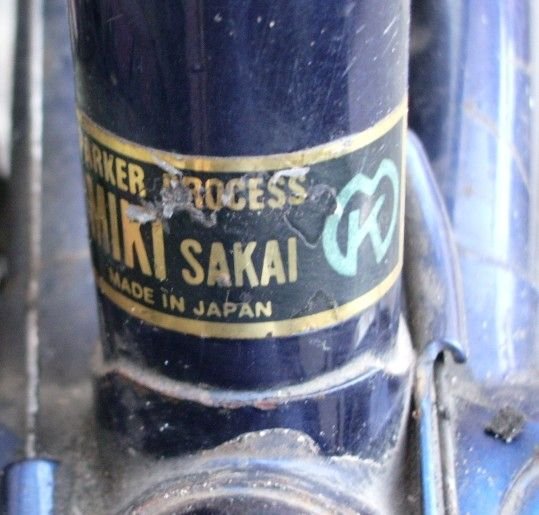
Back then I searched the internet and did not find any thing about the Parker Process.
Recently I was sorting through some old images that I copied from the internet and rediscovered this brochure from Rollfast circa 1936.
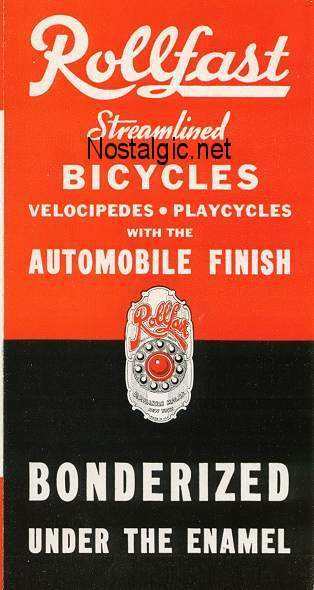
Rollfast Bonderize 1
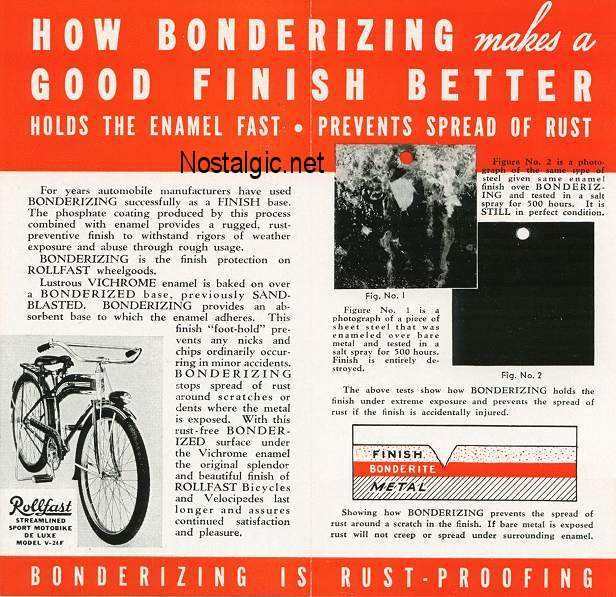
Rollfast Bonderize 2-3

Rollfast Bonderize 4
Thanks to Nostalgic.net for preserving images of these types of documents.
The process comes from Parker Rust Proof Company of Detroit, Michigan. The target market for the process were car and truck manufacturers, but other steel products use the process.
The Parker Process is a type of bonderizing. Bonderizing holds paint to steel. The Parker Process also inhibits rust. The Parker Process also allows for different types of paint to be used.
Some people repaint vintage bicycle and start by stripping off the original paint.
If the frame was bonderized, what happens to the bonderizing if you strip the original paint from the frame?
Back then I searched the internet and did not find any thing about the Parker Process.
Recently I was sorting through some old images that I copied from the internet and rediscovered this brochure from Rollfast circa 1936.
Rollfast Bonderize 1
Rollfast Bonderize 2-3
Rollfast Bonderize 4
Thanks to Nostalgic.net for preserving images of these types of documents.
The process comes from Parker Rust Proof Company of Detroit, Michigan. The target market for the process were car and truck manufacturers, but other steel products use the process.
The Parker Process is a type of bonderizing. Bonderizing holds paint to steel. The Parker Process also inhibits rust. The Parker Process also allows for different types of paint to be used.
Some people repaint vintage bicycle and start by stripping off the original paint.
If the frame was bonderized, what happens to the bonderizing if you strip the original paint from the frame?
 10-30-24 | 03:32 AM
#2

SE Wis

Joined: Apr 2005
Posts: 11,546
Likes: 4,324
From: Milwaukee, WI
Bikes: '68 Raleigh Sprite, '02 Raleigh C500, '84 Raleigh Gran Prix, '91 Trek 400, 2013 Novara Randonee, 1990 Trek 970
Parkerizing is big in the firearms area
https://www.parkerhq.com/about-us
https://advancedtf.com/parkerizing/
https://www.parkerhq.com/about-us
https://advancedtf.com/parkerizing/
10-30-24 | 05:09 AM
#3
...

Joined: Oct 2021
Posts: 2,528
Likes: 3,471
From: Whitestone and Rensselaerville, New York
Bikes: '23 Canyon Endurace, '87 Bottecchia Equipe Professional
10-30-24 | 09:14 AM
#4


There's a fairly comprehensive Wikipedia article on this topic:
https://en.wikipedia.org/wiki/Phosph...ersion_coating
https://en.wikipedia.org/wiki/Phosph...ersion_coating

 10-30-24 | 11:48 AM
#6
SE Wis
Joined: Apr 2005
Posts: 11,546
Likes: 4,324
From: Milwaukee, WI
Bikes: '68 Raleigh Sprite, '02 Raleigh C500, '84 Raleigh Gran Prix, '91 Trek 400, 2013 Novara Randonee, 1990 Trek 970
Not really. Those were produced by Parker Bros. (not the game company)
Parkerizing is often used on firearms rather than blueing. While it protects corrosion in its own right, it's more about acting as a "sponge" for oil to protect against corrosion.
Parkerizing is often used on firearms rather than blueing. While it protects corrosion in its own right, it's more about acting as a "sponge" for oil to protect against corrosion.
10-30-24 | 07:20 PM
#7
Thread Starter
Senior Member
Joined: Sep 2010
Posts: 1,408
Likes: 280
From: Rupert's Land
Bikes: 1981 Raleigh GP, 1985 Norco Bush Pilot, . . .
Justia - Parker Rust Proof
PARKER RUST PROOF COMPANY PROTECTED BY BONDERIZING CORROSION PROTECTION BONDERITE CHEMICALS - Trademark Details
Statements
Certification Mark Statement
THE MARK CERTIFIES THAT THE GOODS HAVE BEEN TREATED WITH MATERIALS SOLD BY PARKER RUST PROOF COMPANY UNDER ITS TRADEMARK "BONDERITE" TO PROVIDE A HIGH QUALITY CORROSION RESISTANT PAINT HOLDING COATING.
Certification Mark Statement
THE MARK CERTIFIES THAT THE GOODS HAVE BEEN TREATED WITH MATERIALS SOLD BY PARKER RUST PROOF COMPANY UNDER ITS TRADEMARK "BONDERITE" TO PROVIDE A HIGH QUALITY CORROSION RESISTANT PAINT HOLDING COATING.
Parkerized has a coating.
See page 66 of "Sweet's catalog file : sections 1-7."
Sweet's Catalog file: Section 1-7
Last edited by Hummer; 10-30-24 at 07:47 PM. Reason: More information
10-30-24 | 07:55 PM
#8

Senior Member


Joined: Apr 2011
Posts: 12,629
Likes: 4,783
According to the Parker Rust Proof trademark application there is a coating.
Justia - Parker Rust Proof
PARKER RUST PROOF COMPANY PROTECTED BY BONDERIZING CORROSION PROTECTION BONDERITE CHEMICALS - Trademark Details
Justia - Parker Rust Proof
PARKER RUST PROOF COMPANY PROTECTED BY BONDERIZING CORROSION PROTECTION BONDERITE CHEMICALS - Trademark Details
It isn't a coating like paint is, and won't react to paint stripper. There are chemicals that will strip phosphate, just like there are chemicals that will strip off anodizing. Or chrome.
The porous surface of phosphate isn't just good for absorbing oil, it hangs onto paint really well and is used that way for military weapons.
It is too bad that steel bikes don't get this kind of treatment normally, but chromoly is somewhat rust resistant. The reason cars no longer rust so badly is that they now galvanize the bodies before painting (zinc plating).
10-31-24 | 02:43 AM
#9
Highly Enriched Driftium

Joined: Apr 2017
Posts: 6,676
Likes: 2,160
Phosphate coatings are best thought of like hard anodizing - it uses the base metal and introduced chemicals to deposit a layer that both a coating and a conversion.
It isn't a coating like paint is, and won't react to paint stripper. There are chemicals that will strip phosphate, just like there are chemicals that will strip off anodizing. Or chrome.
The porous surface of phosphate isn't just good for absorbing oil, it hangs onto paint really well and is used that way for military weapons.
It is too bad that steel bikes don't get this kind of treatment normally, but chromoly is somewhat rust resistant. The reason cars no longer rust so badly is that they now galvanize the bodies before painting (zinc plating).
It isn't a coating like paint is, and won't react to paint stripper. There are chemicals that will strip phosphate, just like there are chemicals that will strip off anodizing. Or chrome.
The porous surface of phosphate isn't just good for absorbing oil, it hangs onto paint really well and is used that way for military weapons.
It is too bad that steel bikes don't get this kind of treatment normally, but chromoly is somewhat rust resistant. The reason cars no longer rust so badly is that they now galvanize the bodies before painting (zinc plating).
I treat steel with Ospho before prime and paint, it's a mild phosporic acid treatment, not nearly as deep an etch as the acid pickle above, but can't hurt. It's also nice to give that aged gray patina to a carbon steel kitchen knife, making it look like it's been slicing acidic foods like beef and tomatoes and lemons for decades. Old Sabatier carbon knives typically have that look. Did this to a new Old Timer carbon steel knife:
 10-31-24 | 06:44 AM
#10

I don't know.
Joined: May 2003
Posts: 2,370
Likes: 1,233
From: South Meriden, CT
Bikes: '90 B'stone RB-1, '92 B'stone RB-2, '89 SuperGo Access Comp, '03 Access 69er, '23 Trek 520, '14 Ritchey Road Logic, '09 Kestrel Evoke, '08 Windsor Tourist, '17 Surly Wednesday, '89 Centurion Accordo, '15 CruX, '17 Ridley X-Night, '89 Marinoni
10-31-24 | 01:50 PM
#11
SE Wis
Joined: Apr 2005
Posts: 11,546
Likes: 4,324
From: Milwaukee, WI
Bikes: '68 Raleigh Sprite, '02 Raleigh C500, '84 Raleigh Gran Prix, '91 Trek 400, 2013 Novara Randonee, 1990 Trek 970
 10-31-24 | 07:38 PM
#12
Senior Member
Joined: Apr 2011
Posts: 12,629
Likes: 4,783
I just remember growing up in Wisconsin and seeing the bottom half of doors falling off, and floors open to the road.
10-31-24 | 09:59 PM
#13
Highly Enriched Driftium
Joined: Apr 2017
Posts: 6,676
Likes: 2,160
I remember decades ago (about that time or before) asking my dad if chrome-moly steel was stainless, and he said, "Oh no, chrome-moly rusts like a b!tch." I now know that it has chrome content below 1.1%, that's well below stainless which typically has about 13% chrome. There are "semi-stainless" alloys with about 8 or 9% chrome, where rust resistance is not the goal, but the chrome is there to increase hardenability (can harden without a fast quench, such as just air cooling) and other properties, and that chrome content gives limited rust resistance, like enough for a kitchen knife that is hand-washed, but not a salt water dive knife.
There's an exceptionally good blog by a metallurgist, who wanted a better knife steel and theorized that most knife steels have too much chrome, so he did precise calculations to have just barely enough chrome to "saturate" the iron, and thus no excess to easily link up with carbon to form chromium carbides, which are hard but not real hard. As a result, the carbon would hook up with vanadium to form vanadium carbides which are very hard, in fact too hard for typical aluminum oxide sharpening stones, that required harder ones. All the other properties were great too, including toughness, the guy did the hat trick on his first attempt, helped greatly by a modern computer program "ThermoCalc", which predicted behaviors before actually making an alloy. I've learned tons from the website/blog, things I couldn't grasp easily in metallurgy classes. Site is https://knifesteelnerds.com/ . The steel he designed is MagnaCut, there's an article about it, and it's now showing up in the commercial market.
Last edited by Duragrouch; 10-31-24 at 10:03 PM.
 10-31-24 | 10:45 PM
#14
Senior Member
Joined: Apr 2011
Posts: 12,629
Likes: 4,783
My first car was like that, huge holes. Just so happens that dad replaced our hot water heater right then, I took the sheet metal off the outside and used it for floorboards. He also trashed a steel swing set no longer used by my younger brother, and the skinnier tubes on that made perfect ribs under the sheet metal to support it. New carpet on top, new (much better) seats from a Euro sedan, and the inside looked and felt great.
I remember decades ago (about that time or before) asking my dad if chrome-moly steel was stainless, and he said, "Oh no, chrome-moly rusts like a b!tch." I now know that it has chrome content below 1.1%, that's well below stainless which typically has about 13% chrome. There are "semi-stainless" alloys with about 8 or 9% chrome, where rust resistance is not the goal, but the chrome is there to increase hardenability (can harden without a fast quench, such as just air cooling) and other properties, and that chrome content gives limited rust resistance, like enough for a kitchen knife that is hand-washed, but not a salt water dive knife.
There's an exceptionally good blog by a metallurgist, who wanted a better knife steel and theorized that most knife steels have too much chrome, so he did precise calculations to have just barely enough chrome to "saturate" the iron, and thus no excess to easily link up with carbon to form chromium carbides, which are hard but not real hard. As a result, the carbon would hook up with vanadium to form vanadium carbides which are very hard, in fact too hard for typical aluminum oxide sharpening stones, that required harder ones. All the other properties were great too, including toughness, the guy did the hat trick on his first attempt, helped greatly by a modern computer program "ThermoCalc", which predicted behaviors before actually making an alloy. I've learned tons from the website/blog, things I couldn't grasp easily in metallurgy classes. Site is https://knifesteelnerds.com/ . The steel he designed is MagnaCut, there's an article about it, and it's now showing up in the commercial market.
I remember decades ago (about that time or before) asking my dad if chrome-moly steel was stainless, and he said, "Oh no, chrome-moly rusts like a b!tch." I now know that it has chrome content below 1.1%, that's well below stainless which typically has about 13% chrome. There are "semi-stainless" alloys with about 8 or 9% chrome, where rust resistance is not the goal, but the chrome is there to increase hardenability (can harden without a fast quench, such as just air cooling) and other properties, and that chrome content gives limited rust resistance, like enough for a kitchen knife that is hand-washed, but not a salt water dive knife.
There's an exceptionally good blog by a metallurgist, who wanted a better knife steel and theorized that most knife steels have too much chrome, so he did precise calculations to have just barely enough chrome to "saturate" the iron, and thus no excess to easily link up with carbon to form chromium carbides, which are hard but not real hard. As a result, the carbon would hook up with vanadium to form vanadium carbides which are very hard, in fact too hard for typical aluminum oxide sharpening stones, that required harder ones. All the other properties were great too, including toughness, the guy did the hat trick on his first attempt, helped greatly by a modern computer program "ThermoCalc", which predicted behaviors before actually making an alloy. I've learned tons from the website/blog, things I couldn't grasp easily in metallurgy classes. Site is https://knifesteelnerds.com/ . The steel he designed is MagnaCut, there's an article about it, and it's now showing up in the commercial market.
10-31-24 | 11:39 PM
#15
Highly Enriched Driftium
Joined: Apr 2017
Posts: 6,676
Likes: 2,160
My folder frame and fork is 4130, probably not terribly thick, so the few small spots of rust it had when I got it, I Osphoed and touched up with reasonably matching fingernail polish.
11-01-24 | 07:07 AM
#16
SE Wis
Joined: Apr 2005
Posts: 11,546
Likes: 4,324
From: Milwaukee, WI
Bikes: '68 Raleigh Sprite, '02 Raleigh C500, '84 Raleigh Gran Prix, '91 Trek 400, 2013 Novara Randonee, 1990 Trek 970
Huh, good to know. I knew there were architectural exterior steels that rusted to a certain point and then stopped, at least according to dad; Commercial buildings like that were very much in vogue in the '70s, zero exterior maintenance.
My folder frame and fork is 4130, probably not terribly thick, so the few small spots of rust it had when I got it, I Osphoed and touched up with reasonably matching fingernail polish.
My folder frame and fork is 4130, probably not terribly thick, so the few small spots of rust it had when I got it, I Osphoed and touched up with reasonably matching fingernail polish.
Consumer grade stainless like 304 or 316 have a minimum chrome content of 18%, hence they are known as 18-8 SS. 400 series has less chrome and corrosion resistance. Choosing between martensitic stainless steels and austenitic types really matters on the application being used in and the characteristics required.
Working in underground infrastructure construction all our fasteners were 304, 316, Corten, or A242 steels
11-01-24 | 11:42 AM
#17
Biker
Joined: Jul 2008
Posts: 369
Likes: 263
From: New Mexico
Bikes: Boone McReynolds, Centurion Pro Tour
Interesting how this thread wandered to what rusts, and did not focus on what bikes actually had the sticker indicating the Parker protection. The sticker on a bike was what started this thread. Did they survive better?
11-01-24 | 08:24 PM
#18
Highly Enriched Driftium
Joined: Apr 2017
Posts: 6,676
Likes: 2,160
11-01-24 | 10:00 PM
#19
Senior Member
Joined: Apr 2011
Posts: 12,629
Likes: 4,783
To answer that question, you'd need to have a bunch of bikes that didn't survive to compare.
11-01-24 | 10:26 PM
#20
Highly Enriched Driftium
Joined: Apr 2017
Posts: 6,676
Likes: 2,160
Last edited by Duragrouch; 11-01-24 at 10:31 PM.
11-01-24 | 10:58 PM
#21
Senior Member
Joined: Apr 2011
Posts: 12,629
Likes: 4,783
I would generally agree. But, in my case, I had to get deep into this exact question for car parts, and convince the customer that it was as good as galvannealed steel. The customer test specs were severe, not only salt spray, but cyclic salt spray involving wetting and drying. And the phosphated/parkerized with baked enamel paint performed immensely better than plain painted (same everything including paint, just no phosphating), including paint adhesion under rock chipping ("gravelometer"). On bikes, the difference may not be nearly as much if the bikes are not subjected to as severe use as those car parts; Our customer, located in the rust belt with salted roads, made a big push to make their cars not rustbuckets like they had been. I don't think most bikes are in the salt much, unless winter commuting where roads are salted, or living by the sea (I rode for several days along the ocean on sunny days, geez, I couldn't believe how much dry salt the bike and my clothes picked up, just from the onshore winds over the beach).
Parkerizing bikes is a nice idea. But chromoly frames don't generally rust out, despite having completely untreated insides that are constantly getting wet from condensation and rain.
Tempest in a tea cup.
11-01-24 | 11:10 PM
#22
Highly Enriched Driftium
Joined: Apr 2017
Posts: 6,676
Likes: 2,160
(above) Yeah I'll buy that. There are lots of things on bikes that are unnecessary overkill, my first good bike, a Cannondale road racer, was very much along those lines.
EDIT: I would say though, if phosphating reduces paint chipping (better paint adhesion), that is noticeable. A bike frame I stripped and painted in my teens, pretty, but paint would chip very easy. Sandblasting before prime and paint would help, but is such a pain doing it out in the driveway and sweeping up the sand ten or twenty times, if you don't have a blasting cabinet.
EDIT: I would say though, if phosphating reduces paint chipping (better paint adhesion), that is noticeable. A bike frame I stripped and painted in my teens, pretty, but paint would chip very easy. Sandblasting before prime and paint would help, but is such a pain doing it out in the driveway and sweeping up the sand ten or twenty times, if you don't have a blasting cabinet.
Last edited by Duragrouch; 11-01-24 at 11:26 PM.
 11-02-24 | 10:35 AM
#25

Parkerized firearms also have the added benefit of being non-reflective (finish is dull matte dark gray/black) which you might prefer if say a Commando or Navy Seal (just sayin')
My Dad's Ka-Bar knife from WW2 has a Parkerized blade, still looks pretty good (dull gray) after all this time, but I don't get sent into midnight raids much these days!

My Dad's Ka-Bar knife from WW2 has a Parkerized blade, still looks pretty good (dull gray) after all this time, but I don't get sent into midnight raids much these days!